




| Research Article | ||
Open Vet. J.. 2026; 16(7): 4609-4617
Open Veterinary Journal, (2026), Vol. 16(7): 4609-4617 Research Article Bovine endometrial cytology samples and lochia smears obtained during the first 10 days postpartumRuth Denise Eilenberg1, Judith Krohn2*, Lukas Trzebiatowski2 and Axel Wehrend21LandVET Veterinary GbR, Much, Germany 2Faculty of Veterinary Medicine, Veterinary Clinic for Reproductive Medicine and Neonatology, Justus-Liebig University, Giessen, Germany *Corresponding Author: Judith Krohn. Faculty of Veterinary Medicine, Veterinary Clinic for Reproductive Medicine and Neonatology, Justus-Liebig University, Giessen, Germany. Email: Judith.krohn [at] vetmed.uni-giessen.de Submitted: 29/08/2025 Revised: 22/03/2026 Accepted: 02/04/2026 Published: 17/07/2026 © 2025 Open Veterinary Journal
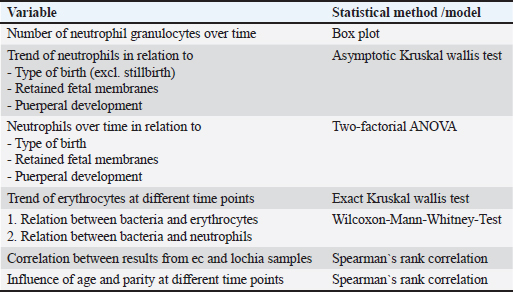
ABSTRACTBackground: Postpartum involution of the reproductive organs strongly impacts the fertility of cows. The key features include bacterial contamination of the uterus, followed by uterine clearance, as well as macroscopic and microscopic involution. Close monitoring is essential during the puerperium, as physiological inflammation may progress to a persistent infection. Aim: This study used exfoliative cytology to assess endometrial and lochia cell composition in 44 puerperal cows following various obstetrical interventions to determine their value as indicators of pathological processes during the early puerperium. Methods: Uterine involution was monitored by transrectal and vaginal examinations every 2 days. Animals were grouped according to obstetrical management (cesarean section, fetotomy, and manual traction), fetal membrane retention, and puerperal development (sound or disturbed). Endometrial cytology samples were obtained using a CytoBrush®. Lochia secretions were collected manually using a sterile glove. The retrieval of lochia secretion was limited depending on the postpartum reformation of the cervix. The slides were stained using an eosin-thiazine staining kit (Hemacolor®). Results: A total of 96 endometrial samples and 37 lochia smears were analyzed using light microscopy. Evaluation of the cellular composition included endometrial cells, neutrophil granulocytes, and erythrocytes. The incidence and quantity of each cell type were recorded. After cesarean section, the concentration of neutrophil granulocytes was consistently high for 6 days (p=0.046). Overall, none of the other parameters had a significant influence on the numbers of neutrophil granulocytes during the first 6 days after parturition (obstetrical management (p=0.82), retention of fetal membranes (p=0.75), and disturbed puerperium (p=0.065). Conclusion: According to our results, endometrial exfoliative cytology and lochia samples are not suitable for monitoring the early puerperium in cows. Keywords: Cow, Cytology, Granulocyte, Puerperium, Uterus. IntroductionPhysiological involution of the genital tract during the puerperium in cows positively impacts reproductive performance and milk yield. Both factors contribute to the economic viability of dairy farming. In dairy cows, the macroscopic involution of the uterus is completed 4 weeks after calving (Simões and Stilwell, 2021). Microscopic involution, which includes the regeneration of all tissue layers, takes 6 to 8 weeks (Wu et al., 2021; Kumaresan et al., 2022a,b). Bacterial contamination of the uterus is a physiological phenomenon of the early puerperium (Sheldon et al., 2020; Kumaresan et al., 2022a,b; Kumaresan and Srivastava, 2022). The extent of contamination depends on the pathogenicity and diversity of bacteria, uterine defense mechanisms, the general condition of the uterus, and other predisposing factors (Pascottini et al., 2020; Dadarwal and Palmer, 2021; Kumaresan et al., 2022a,b). The uterine epithelium often has superficial lacerations and is covered with debris and secretions. Therefore, it presents an optimal milieu for bacterial colonization and growth (Dadarwal and Palmer, 2021). Bacterial contamination leads to a local immune response within the uterus alongside an inflammatory reaction (Singh et al., 2008; Dadarwal and Palmer, 2021). Neutrophil granulocytes are an important part of local immunity in the bovine uterus (Singh et al., 2008; Chapwanya et al., 2009; Santos et al., 2009). During the early puerperium, neutrophil granulocytes are recruited into the uterine lumen, where they become activated in order to eliminate foreign microorganisms. They constitute the largest population of immune cells in the uterus (Singh et al., 2008). Various techniques can be used to sample inflammatory and endometrial cells. CytoBrush® is considered the most reliable method for retrieving inflammatory cells from the uterus (Kasimanickam et al., 2005). In two previous studies, endometrial cytology (ec) samples were collected during the early puerperium in the bovine (up to 10 days p.p.) to analyze inflammatory reactions (Santos et al., 2009; Gilbert and Santos, 2016). This study aimed to simultaneously analyze ec and lochia samples during the first 10 days after parturition to determine their value as pathological puerperal development indicators. Material and MethodsAnimalsAll cows included in this study were patients of the Veterinary Clinic for Reproductive Medicine and Neonatology. The inclusion criteria were parturition during admission and the possibility of performing at least two postpartum examinations (p.p.). Anamnestic data included age, breed, number of calvings, date, and progress of previous parturitions (if applicable). The cows were assigned to one of the following categories: spontaneous birth (no assistance necessary) with live calf, stillbirth (dead fetus delivered spontaneously), cesarean section (abdominal surgery for fetus delivery), fetotomy (intrauterine dissection of a dead fetus, followed by vaginal extraction), and manual traction (assisted vaginal delivery of a live calf). The delivery of the fetal membranes was recorded, and retention of fetal membranes was diagnosed if they were not expelled up to 12 hours after delivery. Animals were grouped according to whether they experienced a sound or disturbed puerperium. A disturbed puerperium was diagnosed if symptoms of puerperal metritis were present (aberrance of lochia secretion regarding odor, quantity, color, and consistency, or a thin-walled and enlarged uterus in the transrectal examination). In patients who experienced a sound puerperium, uterine palpation and lochia secretion were physiologic. The first 10 days postpartum were chosen as this is the time frame in which most complications with genital involution typically arise. We did not define different treatment groups. Sampling and preparation of slidesSampling was performed at 1- to 2-day intervals during routine puerperal examinations. During the examination, the movements of the cows were restricted using a headlock and a harness to prevent kicking. Assessment of the uterine involution was performed by transrectal palpation and ultrasound. The vulva was thoroughly cleaned with a mild disinfectant (Spitacid®, Ecolab, Ethanol, Monheim a. R., Germany), and a clean, inside-out examination glove coated in lubricant was used for the vaginal examination. The following parameters were assessed: fetal membrane retention and birth-associated lacerations in the uterus, cervix, or vestibule. Uterine cytology was performed using a CytologyBrush® (Minitube, Tiefenbach/Germany). The CytoBrush® tip was kept sterile and lubricant-free to ensure high-quality samples. The CytoBrush® tip was covered by the gloved hand during the passage of the caudal genital tract. If the cervix had already reformed and passage of the sampling system was difficult, the gloved hand was inserted transrectally, fixating the uterus and allowing cervix passage, thereby ensuring that samples were drawn only from the dorsal uterine wall without cervical or vaginal contamination. The retrieval of lochia secretion was limited depending on the postpartum reformation of the cervix. A suitable sample could only be taken if passage of the cervix by a gloved hand was possible. Lochia secretion samples could only be drawn up to 24 hours after parturition unless cervical reformation was delayed. Secretions adherent to the examination glove were transferred into a sterile sampling tube. The CytoBrush® tip was used to cover a glass slide with the sample material. A cotton swab was used to transfer the lochia secretions to a slide. The slides were air-dried and fixed using a lighter. Thereafter, the slides were stained in the laboratory with a Hemacolor-set® (Merck, Darmstadt, Germany), containing azure b and eosin dye. Analysis of the slidesThe slides were analyzed using a light microscope at 400-fold magnification. Regions with crowds of cells were considered unsuitable for evaluation. The presence of single or grouped (three or more cells in close contact) endometrial cells and bacteria in regions with appropriate cell distribution was assessed. Meandered counting was performed up to a maximum of 200 endometrial cells (100%), and the number of neutrophils counted alongside was quoted as a percentage. Erythrocytes were counted in 10 fields of view. The samples were assigned to one of three groups according to the average: large (>20/field of view), medium (10–20/field of view), or small (<10/field of view) number of erythrocytes (=semi-quantitative parameter). Overall, the lochia samples contained few endometrial cells. Thus, only neutrophils were counted in 10 randomly chosen fields of view. The upper limit was set at 5,000 neutrophil granulocytes. The other parameters were assessed as previously described for the ec samples. Statistical analysisThe sampling times were combined into 2-day intervals for statistical analysis. We used the program packages BMDP/Dynamic, Release 8.1 (BMDP Statistical Software Inc, 1992), and StatXact. The following groups were included in the statistical analysis regarding the obstetric procedure: cesarean section, fetotomy, and manual traction. Owing to the small number of cows experiencing spontaneous births or stillbirths, these data were only analyzed descriptively. Statistical description involved the median, first and third quartiles, and minimum and maximum of the sample data. Graphs were generated using box-and-whisker plots. The asymptotic Kruskal-Wallis test was used to calculate the association between the trend of neutrophils and birth type, puerperal development, and retained fetal membranes. A two-factorial ANOVA was used to test the significance between neutrophils and the parameters “puerperium,” “type of birth,” and “retained fetal membranes.” Spearman`s Rank Correlation Coefficient was calculated to investigate the possible relationship between the ec results and lochia samples. An overview of the statistical methods is presented in Table 1. Statistical significance was set at α=0.05. Table 1. Variables and applied statistical methods.
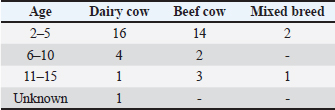
Ethical approvalThe ethics committee of the regional council of Giessen, Germany approved all experimental procedures (V 54-19c20 15h02Gl18/14kTV13/2017). ResultsThe data of 44 animals were evaluated in this study. The ages and breeds of the cows are summarized in Table 2. Table 2. Age (years) and breed (number) of the cows examined.
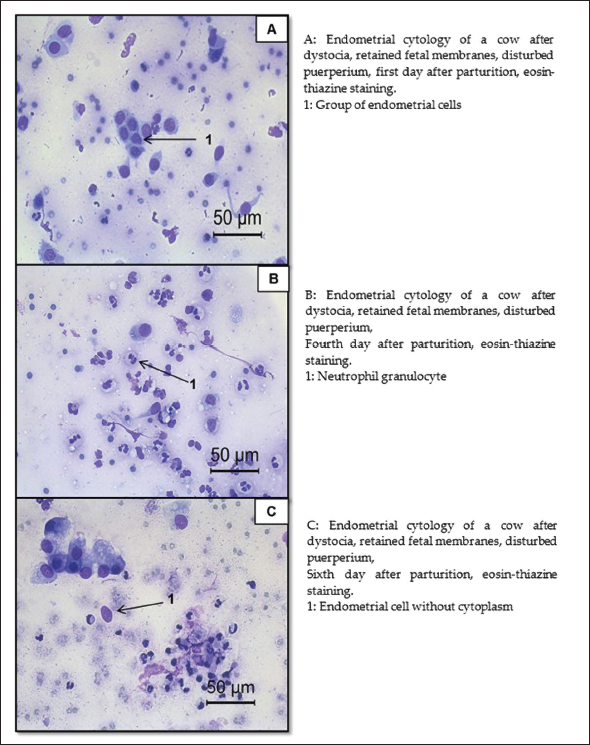
Most cows included in the study underwent cesarean delivery (n=18), followed by fetotomy (n=11) and manual traction (n=10). Eutocia occurred in four cows; one had a stillbirth. Puerperal development was disturbed in 23 (52%) and sound in 21 (48%) cows. Retention of fetal membranes occurred in half of the patients included in this study (n=22). A total of 96 ec samples were obtained. The endometrial cells of 95 (98.95%) samples were analyzed. One of the samples was excluded because of poor quality. Figure 1 shows an example of the slides from one animal at different time points.
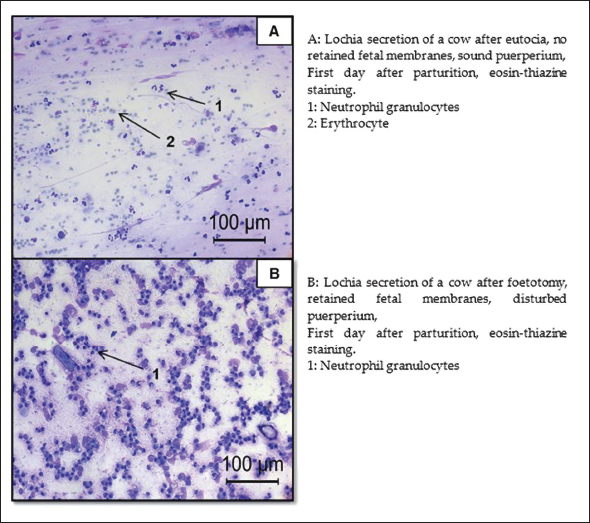
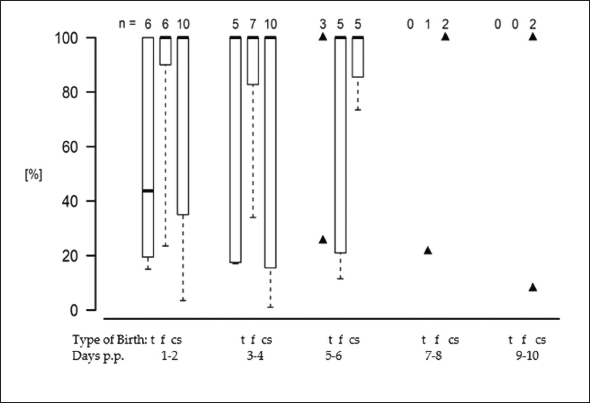
Fig. 1. Ec of a cow after dystocia with retention of fetal membranes and a disturbed puerperium, two (A), four (B) and six (C) days after parturition, length of bar=50 µm. Endometrial cytologySingle and grouped endometrial cells were detected in 76 (80%) cytological samples. Single endometrial cells were found in 18 samples (18.9%). One sample (1.1%) contained no endometrial cells. The presence of neutrophil granulocytes was analyzed in 92 slides. The overall amount and trends over time were analyzed in relation to the other factors explained below. Four slides were of minor quality for neutrophils; thus, reliable analysis was not possible. Bacteria were detected in 75 (78.1%) ec samples, whereas 21 (21.9%) were free from bacteria. A large number of erythrocytes was detected in 64 slides (66.7%), a medium number in seven (7.3%), and a small number of erythrocytes in 25 slides (26%). Lochia smearsA total of 37 lochia smear slides were analyzed (Fig. 2). Endometrial cells were predominantly found as single cells in these samples. Neutrophil granulocytes were identified in 32 (86.5%) slides, and bacteria were identified in 35 (94.6%). A large number of erythrocytes were present in 20 slides (54.1%), a medium number in 6 slides (16.2%), and a small number of erythrocytes were detected in 11 slides (29.7%). After cesarean section, a high concentration of neutrophil granulocytes (restricted by the 100% limit) was present in the ec samples during the first 6 days postpartum. This trend was statistically significant (p=0.046) (Fig. 3, Table 3).
Fig. 2. Lochia of a cow: A=eutocia, no retention of fetal membranes, sound puerperium, 1 day after parturition, B=fetotomy, retention of fetal membranes, disturbed puerperium, 1 day after parturition, length of bar=100 µm.
Fig. 3. Neutrophil granulocytes in ec samples of cows after manual traction (t), fetotomy (f), and cesarean section (cs), n=number of samples, displayed as a box and whisker plot. Table 3. Neutrophil granulocytes in bovine ec samples after cesarean section—data provided as median, first and third quartile.
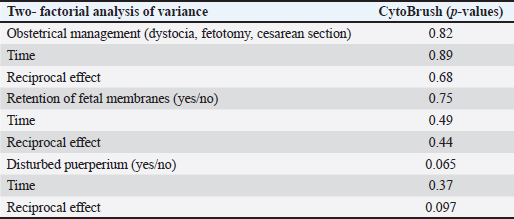
No significant decrease in neutrophil granulocyte levels was observed following fetotomy or manual traction. Overall, neither the type of birth nor retention of fetal membranes, puerperal development, or time had a significant impact on the number of neutrophil granulocytes in ec samples during the first 6 days postpartum. No reciprocal effect was found between “time” and the other factors. Table 4 presents the p-values. Table 4. P-values of the two-factorial analysis of variance.
A significant correlation was found between the distribution of erythrocytes and the presence of bacteria in the ec samples that were obtained up to 10 days after parturition (p=0.025). In contrast, this was not observed in the lochia smears (p=0.82). Furthermore, the number of neutrophils was significantly correlated with the presence of bacteria (p=0.037). Spearman`s Rank Correlation revealed no relationship between the number of neutrophils in cytology samples and the number of lochia smears (rs=0.25, p=0.17), whereas a strongly positive correlation was found for the distribution of erythrocytes in these samples (rs=0.58, p=0.0002). The age of the animals and the number of calvings did not significantly influence the number of neutrophils in the ec samples at any investigated time point. DiscussionSubfertility is a major problem in intensive dairy farming and a common cause of economic losses in the dairy industry (Jakupov et al., 2024). Uterine disorders often result from issues that arise during the early postpartum period. These pose a particular challenge to the animal during reproductive tract involution, with the onset of lactation and metabolic adaptation. The early detection and adequate treatment of at-risk animals are of high importance (Szenci et al., 2018). Ec is a useful approach for detecting intrauterine inflammation (Helfrich et al., 2020; Kumar et al., 2020; Parikh et al., 2022). Moreover, ec is an established method for assessing bovine uterine involution (Arango-Sabogal et al., 2019; Kusaka et al., 2020). However, these studies mainly focused on the progression during the late puerperium. To date, only Santos et al. (2009)and Gilbert and Santos (2016)have reported sampling during the early puerperium. To add to these findings, we aimed to investigate the cellular composition of ec and lochia smears during the first 10 days of the puerperium. A comparison of smears from both samples was used to derive recommendations for clinical application. A further objective was to evaluate the use of this technique in early-stage pathological process diagnosis. Various studies have used CytoBrush® or a comparable double-guarded sampling system to obtain bovine ec samples (Helfrich et al., 2020; Kumar et al., 2020). The number of harvested endometrial cells is higher compared with methods such as cotton swab and uterine flushing (Kasimanickam et al., 2005). The smear quality in this study was predominantly good, with only a few smears being excluded from the analysis due to poor quality. In line with previous studies (Walter et al., 2012), eosin-thiazine staining was used in this study. The Hemacolor® staining kit is easy to use under field conditions and ensures clear differentiation among endometrial cells, neutrophils, erythrocytes, and bacteria (Krohn et al., 2019). Many protocols have been published for interpreting cytological cell counts (Chapwanya et al., 2009; Santos et al., 2009; Helfrich et al., 2020; Kumar et al., 2020). Ghanem et al. (2013) counted 200 endometrial cells and estimated the respective neutrophil percentages. However, differentiating and classifying erythrocytes in endometrial smears is a novel approach. Identifying bacteria under the light microscope was of further interest, as bacterial contamination of the uterus after parturition is considered physiological and is eliminated spontaneously during the early puerperium in most cases. Various studies have dealt with bacterial classification (Ghanem et al., 2013; Udhayavel et al., 2013; Chen et al., 2020; Gonzalez Moreno et al., 2020; Pascottini et al., 2020). The authors did not further explore this aspect in this investigation. The ec samples obtained after cesarean delivery showed a constant, high number of neutrophils during the first 6 days after parturition. This finding clearly shows the detrimental impact of abdominal surgery on the cow`s ability to clear inflammation from the genital tract. Further attention should be given to supporting patients after obstetrical surgery. Although high numbers of neutrophils were also present in the lochia smears, no significant trend was found in samples from the same animals. This can have different reasons: Lochia samples were collected without distinct contact between the uterine wall and the sampling device. Neutrophil granulocytes migrate from the endometrium into the uterine cavity to combat bacterial contamination (Zerbe et al., 2000). This may explain the differences found between the two samples. Furthermore, larger amounts of debris in lochia samples can confound cellular composition. However, the neutrophil count did not decrease in cows after fetotomy or manual traction. We would have expected similar results in cesarean delivery and fetotomy, as both procedures are invasive and associated with a severe systemic impact. Furthermore, both procedures are usually performed after prolonged second-stage labor and an attempt to manually extract the fetus, which often leads to uterine contamination. Santos et al. (2009) used low-volume lavage to retrieve ec samples from Angus cows between 2 and 87 days after parturition. A constant decrease in the number of neutrophils was observed during the puerperium. However, the study covered an extended period after parturition; thus, their results regarding the early puerperium are not sufficiently precise. Moreover, no differentiation was observed between obstetrical management and puerperal development. Gilbert and Santos (2016) also performed a low-volume lavage to retrieve ec samples from 56 dairy cows on the day of parturition and 7, 21, 35, and 49 days after calving. The authors showed no difference in the number of neutrophils over the first 21 days after calving and a reduction in the number of neutrophils thereafter. Only cows giving birth spontaneously were included in this study; therefore, the effect of obstetrical management was not recorded, and sampling was performed with greater time intervals. Considering these results, a longer postpartum interval for investigation could have led to more distinct results. This is considered a weakness of our study. In addition to obstetrical management, factors accounting for delayed uterine involution included in this investigation were: the retention of fetal membranes and disturbed puerperium. Overall, neither one of these factors nor the factor “time” had a statistically significant influence on the number of neutrophil granulocytes during the first 6 days postpartum. Bovines typically display a longer puerperium than equines, in which uterine clearance and involution are already completed 10–14 days after parturition (Noakes et al., 2018). The interpretation of these results is limited by the fact that the samples were taken during a short period after parturition, whereas the complete puerperal involution lasts markedly longer. According to other studies (Wu et al., 2021), physiological inflammation decreases approximately 14 days after parturition, a period that was not completely covered by this study. In addition, most of the animals included in this study experienced dystocia, which can adversely affect puerperal performance and lead to prolonged infection. A better comparison would be possible if a large control group of cows that had experienced spontaneous calving were included. In this study, neither age nor parity had a relevant effect on the number of neutrophil granulocytes. This is surprising, as these parameters are often associated with irreversible, pregnancy-associated changes in the reproductive tract and a negative effect on the uterine immune response (Werner et al., 2012). The number of animals aged >5 years was very small; therefore, these results are considered fragile. Including a larger number of older animals or a homogeneous age group would increase reliability. Furthermore, the differing numbers of samples per cow limit the validity of our data. A statistically significant correlation was found between the number of neutrophil granulocytes and bacteria in the endometrial samples. This result was expected because neutrophils are an important part of the local immune response in the uterus (Zerbe et al., 2000; Kasimanickam et al., 2005; Singh et al., 2008).The reason why the lochia smears did not reflect this result remains unclear. Furthermore, a statistically significant correlation was found between the erythrocyte and bacteria distribution in the ec samples. Delayed healing of birth-associated reproductive tract lacerations, along with a severe bacterial infection, is likely. Again, this correlation was not confirmed in the smears from the lochia. Erythrocyte analysis clearly is a novel aspect of our investigation. As this study was the first in this context, the results could not be compared with those of the existing literature. Although erythrocytes are not part of the immune system, their ability to heal endometrial defects and clear the uterus of birth-associated content can be used as a sign of puerperal competence. This study yielded controversial results regarding the intra-animal correlation between the cellular components of endometrial samples and those of lochia smears. The correlation between neutrophil granulocyte quantity in cytology and lochia smears was not significant. In contrast, a highly positive correlation was found regarding erythrocytes. It is well-known that different sampling methods lead to results that differ in quality and composition (Kumar et al., 2020). However, the specific differences among cell types are peculiar. The integration of supplementary markers, such as neutrophil functional assays or cytokine expression profiling (Patra et al., 2013), may enhance diagnostic precision. A comparison of both sampling methods yielded more detailed results using ec. In practice, this diagnostic tool can be considered superior to lochia samples. Our results should be strengthened by further investigations. A greater number of control animals after spontaneous calving and a longer investigation period are recommended. In contrast to the results of equine studies (Krohn et al., 2019), ec alone did not proof to be a suitable tool for the clinical monitoring of cows in the early puerperium. In conclusion, the authors identified distinct courses of cellular composition and its connections in puerperal cows. Furthermore, erythrocyte content analysis can be considered a diagnostic marker associated with puerperal competence. Unfortunately, our results are not robust enough to derive recommendations for practical application in the bovine. AcknowledgmentsWe thank Prof. Dr. Klaus Failing for statistical analysis assistance. Conflict of interestThe authors have no conflicts of interest to declare. FundingThis study received no external funding. Authors’ contributionsRuth Denise Eilenberg: Investigation, data curation, manuscript writing – review, and editing. Judith Krohn: Writing – Original Draft, Review and Editing. Lukas Trzebiatowski: Writing – Review and Editing. Axel Wehrend: Conceptualization, formal analysis, Writing – Review and Editing, Supervision, Project administration. Data availabilityAll data are available in the manuscript. ReferencesArango-Sabogal, J.C., Dubuc, J., Krug, C., Denis-Robichaud, J. and Dufour, S. 2019. Accuracy of leukocyte esterase test, endometrial cytology and vaginal discharge score for diagnosing postpartum reproductive tract health status in dairy cows at the moment of sampling, using a latent class model fit within a Bayesian framework. Prev. Vet. Med. 162, 1–10; doi:10.1016/j.prevetmed.2018.11.003 BMDP Statistical Software Inc 1992. BMDP statistical software manual. To accompany BMDP release 7. Completely rev. ed. Berkeley, CA: University of California Press (Part 1). Chapwanya, A., Meade, K.G., Doherty, M.L., Callanan, J.J., Mee, J.F. and O’Farrelly, C. 2009. Histopathological and molecular evaluation of Holstein-Friesian cows postpartum: toward an improved understanding of uterine innate immunity. Theriogenology 71(9), 1396–1407; doi:10.1016/j.theriogenology.2009.01.006 Chen, H., Fu, K., Pang, B., Wang, J., Li, H., Jiang, Z., Feng, Y., Tian, W. and Cao, R. 2020. Determination of uterine bacterial community in postpartum dairy cows with metritis based on 16S rDNA sequencing. Vet. Anim. Sci. 10, 100102; doi:10.1016/j.vas.2020.100102 Dadarwal, D. and Palmer, C. 2021. Postpartum uterine infection. In Bovine reproduction. Ed., Hopper, R.M. Hoboken, NJ: Wiley, pp: 639–54. Noakes, D.E., Parkinson, T.J. and England, G.C.W. 2018. Arthurs veterinary reproduction and obstetrics. E-book. London UK: Elsevier Health Sciences. Ghanem, M.E., Higuchi, H., Tezuka, E., Ito, H., Devkota, B., Izaike, Y. and Osawa, T. 2013. Mycoplasma infection in the uterus of early postpartum dairy cows and its relation to dystocia and endometritis. Theriogenology 79(1), 180–185; doi:10.1016/j.theriogenology.2012.09.027 Gilbert, R.O. and Santos, N.R. 2016. Dynamics of postpartum endometrial cytology and bacteriology and their relationship to fertility in dairy cows. Theriogenology 85(8), 1367–1374; doi:10.1016/j.theriogenology.2015.10.045 Gonzalez Moreno, C., Torres Luque, A., Oliszewski, R., Rosa, R.J. and Otero, M.C. 2020. Characterization of native Escherichia coli populations from bovine vagina of healthy heifers and cows with postpartum uterine disease. PLos One 15(6), 228294; doi:10.1371/journal.pone.0228294 Helfrich, A.L., Reichenbach, H.D., Meyerholz, M.M., Schoon, H.A., Arnold, G.J., Fröhlich, T., Weber, F. and Zerbe, H. 2020. Novel sampling procedure to characterize bovine subclinical endometritis by uterine secretions and tissue. Theriogenology 141, 186–196; doi:10.1016/j.theriogenology.2019.09.016 Jakupov, I., Wehrend, A., Abultdinova, A., Mamytbekova, G., Zharkimbaeva, Z. and Zabrodin, A. 2024. Development of a rapid test to determine endometritis of cows after calving. Vet. World. 17(9), 2028–2035; doi:10.14202/vetworld.2024.2028-2035 Kasimanickam, R., Duffield, T.F., Foster, R.A., Gartley, C.J., Leslie, K.E., Walton, J.S. and Johnson, W.H. 2005. A comparison of the cytobrush and uterine lavage techniques to evaluate endometrial cytology in clinically normal postpartum dairy cows. Can. Vet. J. 46(3), 255–259. Krohn, J., Eilenberg, R.D., Gajewski, Z., Failing, K. and Wehrend, A. 2019. Lochial and endometrial cytological changes during the first 10 days post-partum with special reference to the nature of foaling and puerperium in equine. Theriogenology 139, 43–48; doi:10.1016/j.theriogenology.2019.07.023 Kumar, R., Kumar, A. and Singh, G. 2020. A Novel technique to diagnose cytological endometritis in bovines. Int. J. Agric Sci. 12, 10279–10281. Kumaresan, A. and Srivastava, A.K. 2022. Current concepts in bovine reproduction. Singapore: Springer Nature Singapore. Kumaresan, A., Praveen, K.S., Manimaran, A. and Srivastava, A.K. 2022. Uterine infection in bovines: an update. In Current concepts in bovine reproduction. Eds., Kumaresan A. and Srivastava, A.K. Singapore: Springer Nature Singapore, pp: 169–95. Kusaka H., Hasegawa R., Nishimoto N., Kawahata M., Bandai K., Miura H., Kikuchi M. and Sakaguchi M. 2020. Cytobrush cytology patterns of early postpartum dairy cows. Vet. J. 262, 105516; doi:10.1016/j.tvjl.2020.105516 Parikh, S.S., Kavani, F.S., Parmar, K.H., Patbandha, T.K., Singh, V.K., Ahlawat, A.R. and Kumar, R. 2022. Diagnostic and therapeutic management of subclinical endometritis in dairy bovine: a review. Anim. Reprod. Update. 2(2), 1–11; doi:10.48165/aru.2022.2.2.1 Pascottini, O.B., Van Schyndel, S.J., Spricigo, J.F.W., Rousseau, J., Weese, J.S. and Leblanc, S.J. 2020. Dynamics of uterine microbiota in postpartum dairy cows with clinical or subclinical endometritis. Sci. Rep. 10(1), 12353; doi:10.1038/s41598-020-69317-z Patra, M.K., Kumar, H. and Nandi, S. 2013. Neutrophil functions and cytokines expression profile in buffaloes with impending postpartum reproductive disorders. Asian-Australas. J. Anim. Sci. 26(10), 1406–1415; doi:10.5713/ajas.2012.12703 Santos, N.R., Lamb, G.C., Brown, D.R. and Gilbert, R.O. 2009. Postpartum endometrial cytology in beef cows. Theriogenology 71(5), 739–745; doi:10.1016/j.theriogenology.2008.09.043 Sheldon, I.M., Molinari, P.C.C., Ormsby, T.J.R. and Bromfield, J.J. 2020. Preventing postpartum uterine disease in dairy cattle depends on avoiding, tolerating and resisting pathogenic bacteria. Theriogenology 150, 158–165; doi:10.1016/j.theriogenology.2020.01.017 Simões, J. and Stilwell, G. 2021. Calving management and newborn calf care. Cham, Switzerland: Springer International Publishing. Singh, J., Murray, R.D., Mshelia, G. and Woldehiwet, Z. 2008. The immune status of the bovine uterus during the peripartum period. Vet. J. 175(3), 301–309; doi:10.1016/j.tvjl.2007.02.003 Szenci, O., Szelényi Z., Lénàrt L., Bujàk D., Kovàcs L., Kézér L. F., Han B. and Horvàth A. 2018. Importance of monitoring the peripartal period to increase reproductive performance in dairy cattle. Veterinarska Stanica 49, 297-307. Udhayavel, S., Malmarugan, S., Palanisamy, K. and Rajeswar, J. 2013. Antibiogram pattern of bacteria causing endometritis in cows. Vet. World 6(1), 100–102; doi:10.5455/vetworld.2013.100-102 Walter, J., Neuberg, K.P., Failing, K. and Wehrend, A. 2012. Cytological diagnosis of endometritis in the mare: investigations of sampling techniques and relation to bacteriological results. Anim. Reprod. Sci. 132(3-4), 178–186; doi:10.1016/j.anireprosci.2012.05.012 Werner, A., Suthar, V., Plöntzke, J. and Heuwieser, W. 2012. Relationship between bacteriological findings in the second and fourth weeks postpartum and uterine infection in dairy cows considering bacteriological results. J. Dairy Sci. 95(12), 7105–7114; doi:10.3168/jds.2012-5627 Wu, X., Kitahara, G., Suenaga, T., Naramoto, K., Sekiguchi, S., Goto, Y. and Osawa, T. 2021. Association of intrauterine presence of Lactobacillus spp. with inflammation and pathogenic bacteria in the uterus in postpartum dairy cows. J. Reprod. Dev. 67(6), 340–344; doi:10.1262/jrd.2021-023 Zerbe, H., Schneider, N., Leibold, W., Wensing, T., Kruip, T.A. and Schuberth, H.J. 2000. Altered functional and immunophenotypical properties of neutrophilic granulocytes in postpartum cows associated with fatty liver. Theriogenology 54(5), 771–786; doi: 10.1016/S0093-691X(00)00389-7 | ||

| How to Cite this Article |
| Pubmed Style Eilenberg RD, Krohn J, Trzebiatowski L, Wehrend A. Bovine endometrial cytology samples and lochia smears obtained during the first 10 days postpartum. doi:10.5455/OVJ.2026.v16.i7.43 Web Style Eilenberg RD, Krohn J, Trzebiatowski L, Wehrend A. Bovine endometrial cytology samples and lochia smears obtained during the first 10 days postpartum. https://www.openveterinaryjournal.com/?mno=280559 [Access: July 15, 2026]. doi:10.5455/OVJ.2026.v16.i7.43 AMA (American Medical Association) Style Eilenberg RD, Krohn J, Trzebiatowski L, Wehrend A. Bovine endometrial cytology samples and lochia smears obtained during the first 10 days postpartum. doi:10.5455/OVJ.2026.v16.i7.43 Vancouver/ICMJE Style Eilenberg RD, Krohn J, Trzebiatowski L, Wehrend A. Bovine endometrial cytology samples and lochia smears obtained during the first 10 days postpartum. doi:10.5455/OVJ.2026.v16.i7.43 Harvard Style Eilenberg, R. D., Krohn, . J., Trzebiatowski, . L. & Wehrend, . A. (2026) Bovine endometrial cytology samples and lochia smears obtained during the first 10 days postpartum. doi:10.5455/OVJ.2026.v16.i7.43 Turabian Style Eilenberg, Ruth Denise, Judith Krohn, Lukas Trzebiatowski, and Axel Wehrend. 2026. Bovine endometrial cytology samples and lochia smears obtained during the first 10 days postpartum. doi:10.5455/OVJ.2026.v16.i7.43 Chicago Style Eilenberg, Ruth Denise, Judith Krohn, Lukas Trzebiatowski, and Axel Wehrend. "Bovine endometrial cytology samples and lochia smears obtained during the first 10 days postpartum." doi:10.5455/OVJ.2026.v16.i7.43 MLA (The Modern Language Association) Style Eilenberg, Ruth Denise, Judith Krohn, Lukas Trzebiatowski, and Axel Wehrend. "Bovine endometrial cytology samples and lochia smears obtained during the first 10 days postpartum." doi:10.5455/OVJ.2026.v16.i7.43 APA (American Psychological Association) Style Eilenberg, R. D., Krohn, . J., Trzebiatowski, . L. & Wehrend, . A. (2026) Bovine endometrial cytology samples and lochia smears obtained during the first 10 days postpartum. doi:10.5455/OVJ.2026.v16.i7.43 |


