




| Research Article | ||
Open Vet. J.. 2026; 16(7): 4618-4641
Open Veterinary Journal, (2026), Vol. 16(7): 4618-4641 Research Article Genomic dissection of multidrug resistance and virulence profiles in Salmonella enterica serovar tumodi isolated from food-chain sources in ChinaDongxiao Zhang, Huajie Sun, Junxiang Lin, Yan Ren and Shaojian Xu*Longhua District Center for Disease Control and Prevention, Shenzhen, China (Longhua District Health Inspection Institute, Shenzhen, China) *Corresponding Author: Shaojian Xu. Longhua District Center for Disease Control and Prevention, Shenzhen, China (Longhua District Health Inspection Institute, Shenzhen, China). Email: lhcdc_wjk [at] 126.com Submitted: 03/09/2025 Revised: 25/04/2026 Accepted: 08/05/2026 Published: 17/07/2026 © 2025 Open Veterinary Journal
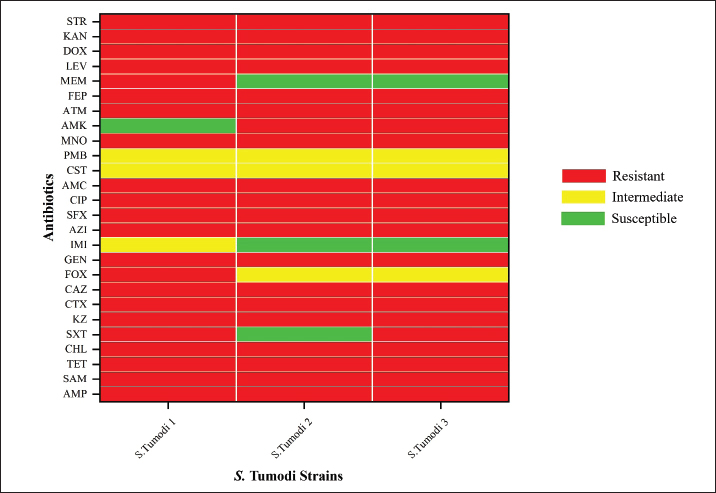
AbstractBackground: Salmonella enterica serovar Tumodi (S. Tumodi) is an emerging multidrug resistance (MDR) pathogen with significant zoonotic potential. Despite its low global prevalence, it can colonize diverse hosts, including poultry, swine, racehorses, and humans. Aim: This study aimed to describe the MDR and virulence profiles of S. Tumodi isolated from food-chain sources using whole-genome sequencing (WGS). Methods: From 2019 to 2020, 3 S. Tumodi strains were isolated from retail chicken meat (n=2) and a food handler (n=1) in Longhua District, Shenzhen, China. Antimicrobial susceptibility testing was performed using the broth microdilution method, and antimicrobial resistance genes (ARGs) and virulence profiles were analyzed via WGS. Results: All 3 S. Tumodi strains exhibited extensive MDR, demonstrating resistance to 20 to 22 of the 26 antibiotics tested. The genome assemblies were of high quality, with an average genome size of 4.92 Mb, a coverage depth of 263×, N50 of 15,687 bp, and a contig number of 105. Genomic analysis revealed a conserved resistome harboring blaCTX-M-55, sul1, and aminoglycoside-modifying enzyme genes, alongside strain-specific genes. Notably, one strain harbored the carbapenemase gene, blaNDM-5. Virulome profiling identified a highly conserved set of virulence determinants, including the intact Salmonella pathogenicity islands SPI-1 and SPI-2, adhesion systems, and flagellar motility genes. Plasmid analysis confirmed the absence of detectable plasmids in all 3 strains, suggesting that the resistance and virulence genes were likely chromosomally integrated. Conclusion: S. Tumodi is a high-risk MDR serovar with adaptive virulence mechanisms that enable cross-species transmission. This highlights the urgent need for integrated One Health surveillance to curb zoonotic dissemination. Keywords: Antimicrobial resistance genes, Foodborne pathogen, Genomic surveillance, One Health, Virulence genes. IntroductionSalmonella is a significant foodborne pathogen with over 2,600 serotypes (Xu et al., 2023). The clinical management of infections, primarily caused by serovars such as Enteritidis and Typhimurium, is severely challenged by the rise of multidrug resistance (MDR) (Kumar et al., 2025). MDR, defined as resistance to 3 or more antimicrobial classes, limits treatment options and increases the risks of therapeutic failure and mortality. The overuse of antibiotics in human medicine and agriculture is a key driver of this crisis. Effectively understanding and combating the spread of MDR requires a One Health approach. This paradigm, which recognizes the interconnection of human, animal, and environmental health, is essential for implementing the coordinated surveillance and interventions required to mitigate this pressing global health threat (One Health High-Level Expert Panel et al., 2022). Among various resistance mechanisms, resistance to β-lactam antibiotics is of particular concern due to its involvement with crucial drugs. Extended-spectrum β-lactamases and carbapenemases can hydrolyze last-resort antibiotics, such as cephalosporins and carbapenems, respectively (Aljohni et al., 2025).. Genes encoding these enzymes (e.g., blaCTX-M and blaNDM) are often located on mobile genetic elements such as plasmids and transposons, enabling horizontal transfer between different bacteria and facilitating the rapid spread of resistance in the environment, among animals, and humans (Rana et al., 2024). The pathogenic success of Salmonella relies not only on antimicrobial resistance but also on a complex arsenal of virulence factors. These factors, which are encoded on chromosomal pathogenicity islands (SPIs), prophages, and fimbrial gene clusters, mediate bacterial adhesion, invasion, intracellular survival, and systemic dissemination in the host (Marcus et al., 2000; Ramatla et al., 2024). The type III secretion systems and their effector proteins encoded by Salmonella SPI-1 and SPI-2 are central apparatuses regulating intestinal epithelial cell invasion and macrophage survival. Key virulence genes (e.g., hilA in SPI-1 and ssrB in SPI-2) are highly conserved and uniformly present in prevalent serovars, indicating their indispensable role in pathogenicity (Ramatla et al., 2024). Compared with high-impact serovars, such as Enteritidis or Typhimurium, S. Tumodi is rarely reported in surveillance data. However, it has been documented in diverse hosts, including poultry (Nadin-Davis et al., 2019; Ibrahim et al., 2024), swine (Liu et al., 2025), dairy cows (Kuang et al., 2015), racehorses (Ruxpon et al., 2022), and humans (Youssef et al., 2021), highlighting its potential for cross-species transmission. The serovar is also frequently associated with MDR phenotypes, such as ampicillin, streptomycin, tetracycline, and nalidixic acid (Ruxpon et al., 2022). In addition, a previous study found that S. Tumodi harbors plasmid-mediated resistance genes and key virulence islands (Youssef et al., 2021). Nevertheless, no comprehensive genomic analysis of S. Tumodi from both animal and human sources has been conducted, and a comprehensive analysis of its resistome and virulome is lacking. In Salmonella surveillance, whole-genome sequencing (WGS) is widely used to predict and identify serovars, virulence factors, and ARGs (Xu et al., 2023; Jin et al., 2024). This study aimed to characterize the resistome and virulome of 3 S. Tumodi isolates from different hosts in China using WGS. Materials and MethodsS. Tumodi isolatesThree S. Tumodi strains were isolated from food safety risk surveillance sites and the National Pathogen Identification Network (NPIN) monitoring sites from 2019 to 2020 in Longhua District, Shenzhen, Guangdong, China. Two strains were isolated from raw chicken meat (referred to as S. Tumodi 1 and S. Tumodi 2 for brevity), and one strain was isolated from an anal swab sample of a community food handler (referred to as S. tumodi 3 for brevity). SerotypingPresumptive Salmonella isolates were obtained from chicken meat and human anal swab samples after enrichment in selective broths and culture on Hektoen Enteric Agar. Species identification was confirmed using the VITEK2 COMPACT system (Biomerieux, France). The serovar for each isolate was determined through slide agglutination using a Salmonella diagnostic antisera kit (Statens Serum Institut, Denmark) to determine the somatic (O) and flagellar (H) antigens. Antimicrobial susceptibility testingAntimicrobial susceptibility testing was performed using a broth microdilution panel (Fosun Diagnostics Co., Ltd, China) according to the manufacturer’s instructions. This panel is designed for Enterobacteriaceae and provides minimum inhibitory concentration (MIC) values. The 26 antibiotics tested and their corresponding concentration ranges (μg/ml) are as follows: Ampicillin (AMP) (2–64), Ampicillin/Sulbactam (SAM) (2/1–64/32), Tetracycline (TET) (1–32), Chloramphenicol (CHL) (2–64), Trimethoprim-sulfamethoxazole (SXT) (0.25/4.75–8/152), Cefazolin (KZ) (0.5–16), Cefotaxime (CTX) (0.25–8), Ceftazidime (CAZ) (0.5–16), Cefoxitin (FOX) (2–64), Gentamicin (GEN) (1–32), Imipenem (IMI) (0.25–8), Azithromycin (AZI) (2–64), Sulfisoxazole (SFX) (32–512), Ciprofloxacin (CIP) (0.03–32), Amoxicillin/Clavulanate (AMC) (2/1–64/32), Colistin (CST) (0.5–16), Polymyxin B (PMB) (0.5–16), Minocycline (MNO) (1–32), Amikacin (AMK) (4–128), Aztreonam (ATM) (1–32), Cefepime (FEP) (0.5–16), Meropenem (MEM) (0.06–4), Levofloxacin (LEV) (0.125–8), Doxycycline (DOX) (0.5–16), Kanamycin (KAN) (8–64), and Streptomycin (STR) (4–32). The manufacturer predefined the concentration ranges in accordance with the Clinical and Laboratory Standards Institute guidelines (M100) to encompass clinical breakpoints. The MIC results were interpreted as susceptible (S), intermediate (I), or resistant (R) based on the CLSI M100-S27 criteria. WGS analysis of genes involved in antimicrobial resistance and virulenceAfter incubation, genomic DNA was extracted from the isolates using the QIAamp DNA Mini Kit (Qiagen, Germany). Paired-end libraries with insert sizes of 300 to 500 bp were constructed and sequenced on the Beijing Genomics Institute (BGI, Shenzhen, China) using the Illumina HiSeq 4000 platform. First, paired-end raw reads were assessed for quality using FastQC (v0.11.9). Trimmomatic (v0.36) was used to trim adapters and low-quality bases to obtain clean reads. Clean reads were assembled using ABySS (v2.0.2) with multiple k-mer parameters to optimize the assembly. The resulting contigs were ordered and scaffolded. Draft genome quality was assessed, including the calculation of the N50 (a key metric for assessing assembly continuity based on contig length) statistic and contig number. Prokka (v1.14.6) was used to predict and annotate protein-coding genes on the assembled genomes, which provided the total gene count for each isolate. The presence of plasmid sequences was investigated by screening the assembled contigs using PlasmidFinder (v2.0.1) with a minimum identity and coverage threshold of 90% and 60%, respectively. The resistome of each isolate was characterized using ResFinder (v4.1). A gene was considered present if it met the thresholds of ≥95% identity and ≥60% coverage. Acquired ARGs were categorized according to their drug class and resistance mechanism. The virulome was determined by screening the genomes against the VFDB core dataset with the thresholds of ≥90% identity and ≥50% coverage. The detected virulence factors were categorized according to their predicted function. Ethical approvalEthical approval was waived as the study used anonymized, surveillance-collected samples under the guidelines of the National Public Health Monitoring. ResultsSerotype and antimicrobial susceptibility testingAll 3 strains were identified as Salmonella and assigned to the serotype 1,4,12:i:z6, confirming that they were S. tumodi. The antimicrobial susceptibility results for the 3 S. tumodi strains revealed MDR patterns and resistance to 22, 20, and 21 antibiotics, respectively (Fig. 1 illustrates the comprehensive antibiotic resistance profile across the 3 strains). All strains were resistant to AMP, SAM, TET, CHL, KZ, CTX, CAZ, GEN, AZI, SFX, CIP, AMC, MNO, ATM, FEP, LEV, DOX, KAN, and STR. For carbapenems, S. Tumodi 1 showed intermediate susceptibility to IMI and resistance to MEM, whereas S. Tumodi 2 and S. Tumodi 3 were susceptible to both. Intermediate susceptibility was common for CST and PMB, but SXT, FOX, and AMK susceptibility differed.
Fig. 1. Antimicrobial susceptibility profiles of 3 S. Tumodi strains (S. Tumodi 1, 2, and 3). The color code represents the phenotype: red, resistant; yellow, intermediate; and green, susceptible. Antibiotic abbreviations: AMP, Ampicillin; SAM, Ampicillin/Sulbactam; TET, Tetracycline; CHL, Chloramphenicol; SXT, Trimethoprim-sulfamethoxazole; KZ, Cefazolin; CTX, Cefotaxime; CAZ, Ceftazidime; FOX, Cefoxitin; GEN, Gentamicin; IMI, Imipenem; AZI, Azithromycin; SFX, Sulfisoxazole; CIP, Ciprofloxacin; AMC, Amoxicillin/Clavulanate; CST, Colistin; PMB, Polymyxin B; MNO, Minocycline; AMK, Amikacin; ATM, Aztreonam; FEP, Cefepime; MEM, Meropenem; LEV, Levofloxacin; DOX, Doxycycline; KAN, Kanamycin; STR, Streptomycin. Genomic information of the 3 S. tumodi strainsWGS was successfully performed for all 3 S. Tumodi strains, yielding high-quality draft genomes. The assembled genomes ranged in size from approximately 4.89 to 4.98 Mb (average: 4.92 Mb), with an average sequencing coverage depth of 263× (range: 261–265×) (Table 1 summarizes the genomic information for each strain). The assessment of assembly continuity revealed that the strains were assembled into 93, 96, and 125 contigs (average: 105) for S. Tumodi 1, 3, and 2, respectively. The corresponding N50 values were 20,782, 19,291, and 6,987 bp, yielding an average of 15,687 bp. Gene prediction identified 4,805 to 4,881 genes per genome. Notably, in silico analysis uncovered a substantial repertoire of antimicrobial resistance and virulence determinants, with 29 to 30 ARGs and 235 to 236 virulence genes detected across the strain set. No complete plasmid sequence was identified in the genomes of the 3 S. Tumodi strains. Table 1. Genomic information of the 3 S. tumodi strains.
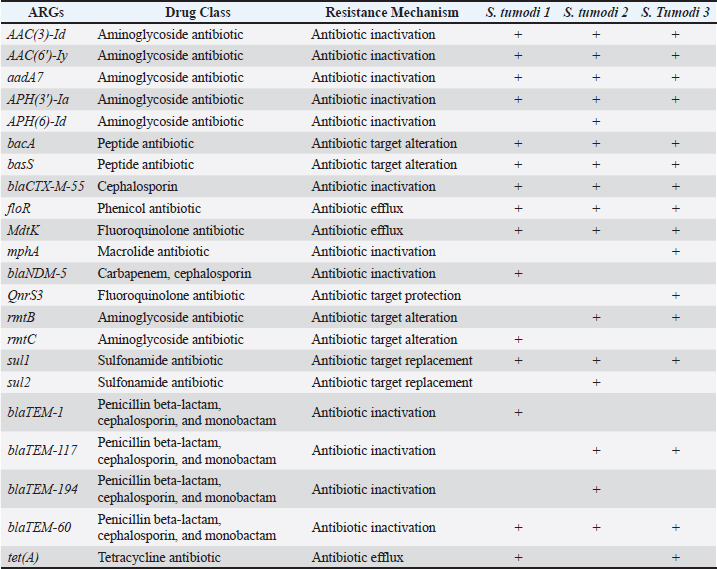
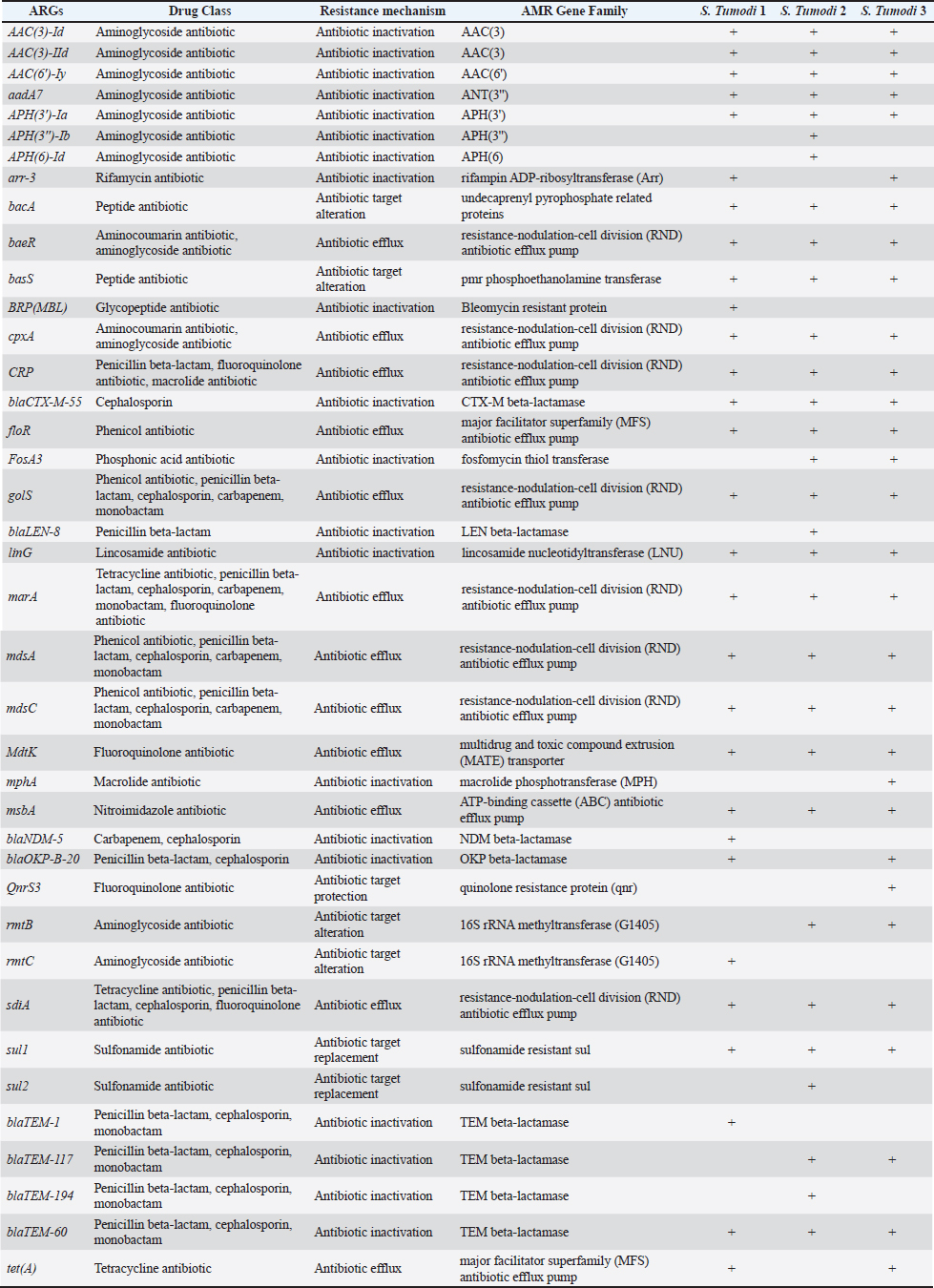
ARGs profile by WGSWGS revealed a conserved ARGs profile, with 22 out of 39 genes uniformly present across all isolates (Table S1 provides the complete list, and Table 2 summarizes the representative ARGs, which detail the drug class and resistance mechanism for each gene). These included aminoglycoside-modifying enzymes (AAC(3)-Id, AAC(3)-IId, AAC(6')-Iy, aadA7, and APH(3')-Ia), efflux pumps (CRP, floR, golS, MdtK, and sdiA), and target-altering/protecting genes (bacA, basS, and QnrS3). In addition, all strains harbored the beta-lactamase gene blaCTX-M-55, the extended-spectrum beta-lactamase gene blaTEM-60, and the sulfonamide resistance dihydropteroate synthase gene sul1. Table 2. Representative ARGs of the 3 S. tumodi strains identified by WGS.
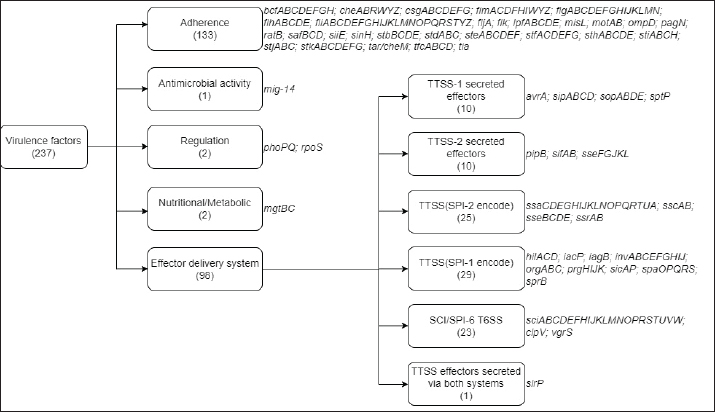
Distinct strain-specific resistance markers were also identified. Notably, S. Tumodi 1 uniquely possessed the carbapenemase gene blaNDM-5, S. Tumodi 3 possessed the macrolide phosphotransferase gene mphA and quinolone resistance protein gene QnrS3, while S. Tumodi 2 carried another sulfonamide resistance dihydropteroate synthase gene sul2. The extended-spectrum beta-lactamase genes blaTEM-1, blaTEM-117, and blaTEM-194, and the 16S rRNA methyltransferase genes rmtB and rmtC exhibited strain-specific distributions. The antibiotic efflux pump gene tet(A) was detected in both S. Tumodi 1 and S. Tumodi 3 strains, but not in S. tumodi 2. Virulence characterizationThe comparative analysis against the VFDB revealed an extensive and highly conserved repertoire of virulence determinants across all three S. Tumodi strains (Fig. 2 illustrates the conserved virulence gene profiles and Table S2 lists the complete virulence genes identified in the three S. Tumodi strains). Notably, the complete apparatus and key regulators for major secretion systems were universally present, including the entirety of the Salmonella SPI-1 (e.g., invA, invC, hilA, hilD, prgH, prgI, sicA, spaO, and spaP) and SPI-2 (e.g., ssaC, ssaD, ssaN, ssaV, ssrA, ssrB, sscA, and sscB), which encoded the type three secretion system (T3SS), crucial for invasion and intracellular survival, respectively. The type six secretion system (T6SS) apparatus encoded by the SCI/SPI-6 locus (e.g., clpV, sciA to sciW, and vgrS) was also fully intact in all strains. Furthermore, essential T3SS effectors translocated by these systems (e.g., avrA, sipA, sipB, sipC, sopB, sopD, sopE2, sptP, sifA, sseF, sseG, and sseJ) and critical regulatory systems, such as PhoPQ (phoP and phoQ) and RpoS, were consistently identified.
Fig. 2. Classification and genomic repertoire of predicted virulence factors in the 3 S. Tumodi strains. The diagram summarizes the 237 virulence-associated genes identified across all 3 genomes, categorized by their predicted function. The tree structure illustrates the hierarchical classification: the major categories are further divided into subcategories. The number within each box indicates the number of genes belonging to that specific category. Genes are listed on the right for specific subcategories. The isolates possessed a remarkably diverse array of adherence factors. This included the entire bovine colonization factor (Bcf) fimbrial system (bcfA-H), the curli fimbria operon (csgA-G), type-1 fimbriae (fimA-Z), long polar fimbriae (LPF, lpfA-E), as well as multiple other characterized fimbrial systems like Saf, Stb, Std, Ste, Stf, Sti, Stj, Stk, Tcf, and MisL. In addition to these surface adhesins, the entire machinery for peritrichous flagella synthesis, assembly, rotation, and chemotaxis (e.g., cheA-W, tar, flgA-Z, flhA-E, fliA-Z, fljA, flk, and motA/B) was present in all three genomes, enabling motility and host cell interactions. Nutritional/metabolic virulence factors, such as mgtB/mgtC (magnesium transport) and mig-14, were also conserved. The sporadic presence (stjA and tia) and absence (ssaJ) of the S. Tumodi 2 strain were the primary exceptions to absolute conservation. DiscussionThis study presents the first comprehensive genomic characterization of MDR and virulence profiles in S. tumodi strains from retail chicken meat and human carriers in China. Our findings revealed alarming MDR patterns, with all 3 isolates exhibiting resistance to 20–22 antibiotics. This aligns with global trends of escalating antimicrobial resistance in nontyphoidal Salmonella, particularly in food animal reservoirs (Wang et al., 2025). The resistome of all 3 S. tumodi strains encompasses all major categories of antimicrobial resistance mechanisms, as detailed in Table 2. These include antibiotic inactivation, antibiotic efflux, target protection, alteration, and replacement. The coexistence of multiple mechanisms across different drug classes not only defines the MDR phenotype but also creates a formidable barrier to treatment, as it necessitates the use of drugs that can overcome simultaneous inactivation, efflux, and target bypass strategies. The presence of the extended-spectrum β-lactamase gene blaCTX-M-55 and the sulfonamide resistance gene sul1 across all 3 S. Tumodi strains is a notable finding. blaCTX-M-55 encodes a CTX-M-type enzyme that hydrolyzes third-generation cephalosporins, a critical class of antibiotics for the treatment of severe Salmonella infections (Yu et al., 2024). The sul1 gene encodes an alternative, drug-insensitive dihydropteroate synthase, a key enzyme in the folate biosynthesis pathway, which confers resistance to sulfonamides (Venkatesan et al., 2023). Their cooccurrence in all strains, likely on a conserved genetic element, suggests that these genes may be cotransferred and have stabilized within this S. Tumodi lineage. This pattern underscores a successful combination of resistance mechanisms against two distinct, widely used antibiotic classes, complicating empirical therapy and highlighting their role in shaping the MDR profile of this emerging serovar. The detection of blaNDM-5 in S. Tumodi 1 is a significant public health concern. The blaNDM gene encodes New Delhi metallo-β-lactamase, a carbapenemase that hydrolyzes nearly all β-lactam antibiotics, including the last-resort carbapenems, leaving few effective therapeutic options (Xin et al., 2025). The blaNDM gene is typically located on highly conjugative plasmids, such as the IncX3 type, which are efficient vectors for horizontal gene transfer across bacterial species (Acman et al., 2022). This mobility explains its global spread from its initial discovery in Enterobacteriaceae to diverse pathogens. The presence of blaNDM-5 in Salmonella indicates a dangerous convergence of broad-spectrum resistance and a high-risk transmission route. The present finding parallels reports of blaNDM-5 in S. Corvallis from human patients and animal source foods in China, underscoring a creeping dissemination that demands vigilant One Health surveillance to prevent its establishment in major foodborne pathogens (Ma et al., 2020). Bioinformatic analysis did not identify any complete plasmid sequences in the assembled genomes of the 3 S. Tumodi strains. The blaNDM-5 gene and other ARGs were located on chromosomal contigs, often flanked by insertion sequences (e.g., IS26), suggesting integration into the chromosome via past mobile genetic element activity. This chromosomal integration may enhance the stability of the MDR phenotype in the absence of direct antibiotic selection (Li et al., 2026). Although this potentially reduces the immediate risk of horizontal plasmid-mediated spread, the presence of these genes within a mobilizable genetic context underscores a latent risk for future transfer events. This finding distinguishes our isolates from reports of blaNDM-5 on epidemic IncX3 plasmids in other serovars, such as S. Corvallis (Fernández et al., 2018), and highlights the diverse genetic pathways for carbapenem resistance acquisition in Salmonella. Virulence profiling revealed a conserved arsenal of pathogenicity determinants across isolates. The intact SPI-1 and SPI-2 T3SS clusters (essential for epithelial invasion (invA, sipB) and intracellular survival (sifA, sseF)) mirror findings in high-impact serovars such as S. Typhimurium (Lawrence et al., 2021; Jiang et al., 2021). Notably, the universal presence of bcf (fimbrial adhesion) and mgtBC (magnesium transport) genes suggests adaptations for persistence in avian hosts and metal-limited host environments. Unlike typhoidal serovars, which uniquely possess the typhoid toxin gene cluster (cdtB, pltA, and pltB), these genes are crucial for causing systemic typhoid fever. This absence definitively confirms the classification of S. Tumodi as a nontyphoidal Salmonella, aligning its expected disease manifestation with gastroenteritis rather than enteric fever (Johnson et al., 2018). In conclusion, the detection of high-risk resistance genes, including the carbapenemase gene blaNDM-5 and the extended-spectrum β-lactamase gene blaCTX-M-55, in S. Tumodi from retail chicken meat signals a potential transmission risk of pan-drug-resistant bacteria to humans via the food chain. Future studies should focus on: (i) employing long-read sequencing to definitively resolve the chromosomal or plasmid-borne context of these critical resistance determinants and assess their mobility potential, and (ii) expanding One Health genomic surveillance to track the dissemination and evolution of this serovar within poultry supply chains and clinical settings. These efforts are crucial for preempting the threat of untreatable Salmonella infections. AcknowledgmentsNone. Conflict of interestThe authors have no conflicts of interest to declare. FundingThis study was supported by the Shenzhen San-Ming Project (SZSM201809085) and the District-level Scientific Research Project of Medical and Health Institutions in Longhua District (2020055, 2021097, and 2021132). Author’s contributionsDZ: Methodology, validation, formal analysis, data curation, and manuscript drafting. HS: Data curation, investigation, and review. JL: Investigation, manuscript drafting, and review. YR: Formal analysis, manuscript drafting, and review. SX: Conceptualization, project administration, and supervision. Data availabilityThe data that support the findings of this study are not openly available due to sensitivity reasons and are available from the corresponding author upon reasonable request. ReferencesAcman, M., Wang, R., van Dorp, L., Shaw, L.P., Wang, Q., Luhmann, N., Yin, Y., Sun, S., Chen, H., Wang, H. and Balloux, F. 2022. Role of mobile genetic elements in the global dissemination of the carbapenem resistance gene blaNDM. Nat Commun. 13(1), 1131; doi: 10.1038/s41467-022-28819-2 Aljohni, M.S., Harun-Ur-Rashid, M. and Selim, S. 2025. Emerging threats: antimicrobial resistance in extended-spectrum beta-lactamase and carbapenem-resistant Escherichia coli. Microb. Pathog. 200, 107275; doi: 10.1016/j.micpath.2024.107275 Fernández, J., Guerra, B. and Rodicio, M. 2018. Resistance to carbapenems in non-Typhoidal Salmonella enterica serovars from humans, animals and food. Vet. Sci. 5(2), 40; doi:10.3390/vetsci5020040 Ibrahim, M.M., Jusoh, M.B., Rose, F.Z.C., Azami, M.M. and Roslee, R. 2024. Salmonella serovars trend in poultry Malaysia from 2011 to 2020. Vet. Res. Commun. 48(3), 1791–1802; doi:10.1007/s11259-024-10303-5 Jiang, L., Wang, P., Song, X., Zhang, H., Ma, S., Wang, J., Li, W., Lv, R., Liu, X., Ma, S., Yan, J., Zhou, H., Huang, D., Cheng, Z., Yang, C., Feng, L. and Wang, L. 2021. Salmonella Typhimurium reprograms macrophage metabolism via T3SS effector SopE2 to promote intracellular replication and virulence. Nat. Commun. 12(1), 879; doi:10.1038/s41467-021-21186-4 Jin, Y., Li, Y., Huang, S., Hong, C., Feng, X., Cai, H., Xia, Y., Li, S., Zhang, L., Lou, Y. and Guan, W. 2024. Whole-genome sequencing analysis of antimicrobial resistance, virulence factors, and genetic diversity of Salmonella from Wenzhou, China. Microorganisms 12(11), 2166; doi:10.3390/microorganisms12112166 Johnson, R., Mylona, E. and Frankel, G. 2018. Typhoidal Salmonella: distinctive virulence factors and pathogenesis. Cell. Microbiol. 20(9), e12939; doi:10.1111/cmi.12939 Kuang, X., Hao, H., Dai, M., Wang, Y., Ahmad, I., Liu, Z. and Zonghui, Y. 2015. Serotypes and antimicrobial susceptibility of Salmonella spp. isolated from farm animals in China. Front. Microbiol. 6, 602; doi:10.3389/fmicb.2015.00602 Kumar, R., Adeyemi, N.O., Chattaraj, S., Alloun, W., Thamarsha, A.K.A.N.W.M.R.K., Anđelković, S., Mitra, D. and Gautam, P. 2025. Antimicrobial resistance in Salmonella: one Health perspective on global food safety challenges. Sci. One. Health. 4, 100117; doi:10.1016/j.soh.2025.100117 Lawrence, A.L.E., Abuaita, B.H., Berger, R.P., Hill, D.R., Huang, S., Yadagiri, V.K., Bons, B., Fields, C., Wobus, C.E., Spence, J.R., Young, V.B. and O’Riordan, M.X. 2021. Salmonella enterica serovar Typhimurium SPI-1 and SPI-2 shape the global transcriptional landscape in a human intestinal organoid model system. mBio 12(3), e00399-21; doi:10.1128/mBio.00399-21 Li, X., Han, X., Tang, X., Fan, Z., Ding, L., Geng, R., Chen, Q., Huang, J., Yao, J., Zhou, L., Du, X., Liu, J., Xie, Y., Sun, S., Yu, H., Ma, R., He, J., Fu, Y., Zhou, H. and Yu, Y. 2026. Clinical characteristics and molecular epidemiology of KPC-NDM co-producing carbapenem-resistant Klebsiella pneumoniae in China: a multicentre retrospective case-control study. EBioMedicine 126, 106222; doi:10.1016/j.ebiom.2026.106222 Liu, Y., Wang, L., Wang, J., Lu, M., Liu, N., Zhao, J., Hu, F., Han, K., Liu, J., Wang, J. and Qu, Z. 2025. Epidemic trend of Salmonella from swines and broilers in China from 2014 to 2023 and genetic evolution analysis of ESBLs-producing strains. Front. Microbiol. 16, 1510751; doi:10.3389/fmicb.2025.1510751 Ma, Y., Xu, X., Gao, Y., Zhan, Z., Xu, C., Qu, X., Chen, Z., Bai, J., Liao, M. and Zhang, J. 2020. Antimicrobial resistance and molecular characterization of Salmonella enterica serovar Corvallis isolated from human patients and animal source foods in China. Int. J. Food. Microbiol. 335, 108859; doi:10.1016/j.ijfoodmicro.2020.108859 Marcus, S.L., Brumell, J.H., Pfeifer, C.G. and Finlay, B.B. 2000. Salmonella pathogenicity islands: big virulence in small packages. Microbes Infect. 2(2), 145–156; doi: 10.1016/s1286-4579(00)00273-2 Nadin-Davis, S., Pope, L., Ogunremi, D., Brooks, B. and Devenish, J. 2019. A real-time PCR regimen for testing environmental samples for Salmonella enterica subsp. enterica serovars of concern to the poultry industry, with special focus on Salmonella Enteritidis. Can. J. Microbiol. 65(2), 162–173; doi:10.1139/cjm-2018-0417 One Health High-Level Expert Panel., OHHLEP., Adisasmito, W.B., Almuhairi, S., Behravesh, C.B., Bilivogui, P., Bukachi, S.A., Casas, N., Cediel, B.N., Charron, D.F., Chaudhary, A., Ciacci Z, J.R., Cunningham, A.A., Dar, O., Debnath, N., Dungu, B., Farag, E., Gao, G.F., Hayman, D.T.S., Khaitsa, M., Koopmans, M.P.G., Machalaba, C., Mackenzie, J.S., Markotter, W., Mettenleiter, T.C., Morand, S., Smolenskiy, V. and Zhou, L. 2022. One Health: a new definition for a sustainable and healthy future. PLos Pathog. 18(6), e1010537; doi:10.1371/journal.ppat.1010537 Ramatla, T., Khasapane, N.G., Mlangeni, L.N., Mokgokong, P., Ramaili, T., Ndou, R., Nkhebenyane, J.S., Lekota, K. and Thekisoe, O. 2024. Detection of Salmonella pathogenicity islands and antimicrobial-resistant genes in Salmonella enterica serovars Enteritidis and Typhimurium isolated from broiler chickens. Antibiotics 13(5), 458; doi:10.3390/antibiotics13050458 Rana, C., Vikas, V., Awasthi, S., Gautam, D., Vats, A., Rajput, S., Behera, M., Ludri, A., Berwal, A., Singh, D. and De, S. 2024. Antimicrobial resistance genes and associated mobile genetic elements in Escherichia coli from human, animal and environment. Chemosphere 369, 143808; doi:10.1016/j.chemosphere.2024.143808 Ruxpon, D., Suchat, W., Patchara, P., Suphannika, P. and Sunpetch, A. 2022. Epidemiology and antimicrobial resistance of Salmonella isolated from racehorses and horsemen in Northeastern Thailand. Vet. Integr. Sci. 20(2), 497–506; doi:10.12982/vis.2022.037 Venkatesan, M., Fruci, M., Verellen, L.A., Skarina, T., Mesa, N., Flick, R., Pham, C., Mahadevan, R., Stogios, P.J. and Savchenko, A. 2023. Molecular mechanism of plasmid-borne resistance to sulfonamide antibiotics. Nat. Commun. 14(1), 4031; doi:10.1038/s41467-023-39778-7 Wang, Y., Xu, X., Jia, S., Qu, M., Pei, Y., Qiu, S., Zhang, J., Liu, Y., Ma, S., Lyu, N., Hu, Y., Li, J., Zhang, E., Wan, B., Zhu, B. and Gao, G.F. 2025. A global atlas and drivers of antimicrobial resistance in Salmonella during 1900-2023. Nature Commun. 16(1), 4611; doi:10.1038/s41467-025-59758-3 Xin, X., Yin, Y., Kong, J., Wang, M., Wang, Z. and Li, R. 2025. Genomic insights into carbapenem-resistant organisms producing New Delhi metallo-β-lactamase in live poultry markets. Microorganisms 13(6), 1195; doi:10.3390/microorganisms13061195 Xu, B., Hou, Z., Liu, L., Yan, R., Zhang, J., Wei, J., Du, M., Xuan, Y., Fan, L. and Li, Z. 2023. The resistance and virulence characteristics of Salmonella Enteritidis strain isolated from patients with food poisoning based on the whole-genome sequencing and quantitative proteomic analysis. Infect. Drug. Resist. 16, 6567–6586; doi:10.2147/IDR.S411125 Youssef, R.A., Abbas, A.M., El-Shehawi, A.M., Mabrouk, M.I. and Aboshanab, K.M. 2021. Serotyping and antimicrobial resistance profile of enteric nontyphoidal Salmonella recovered from febrile neutropenic patients and poultry in Egypt. Antibiotics (Basel). 10(5), 493; doi:10.3390/antibiotics10050493 Yu, K., Huang, Z., Xiao, Y., Gao, H., Bai, X. and Wang, D. 2024. Global spread characteristics of CTX-M-type extended-spectrum β-lactamases: a genomic epidemiology analysis. Drug. Resistant. 73, 101036; doi:10.1016/j.drup.2023.101036 Table S1. ARGs profile of the three S.Tumodi strains identified by WGS.
Table S2. Virulence profiles of the three S. Tumodi strains identified by WGS.
| ||


| How to Cite this Article |
| Pubmed Style Zhang D, Sun H, Lin J, Ren Y, Xu S. Genomic dissection of multidrug resistance and virulence profiles in Salmonella enterica serovar tumodi isolated from food-chain sources in China. doi:10.5455/OVJ.2026.v16.i7.44 Web Style Zhang D, Sun H, Lin J, Ren Y, Xu S. Genomic dissection of multidrug resistance and virulence profiles in Salmonella enterica serovar tumodi isolated from food-chain sources in China. https://www.openveterinaryjournal.com/?mno=281579 [Access: July 15, 2026]. doi:10.5455/OVJ.2026.v16.i7.44 AMA (American Medical Association) Style Zhang D, Sun H, Lin J, Ren Y, Xu S. Genomic dissection of multidrug resistance and virulence profiles in Salmonella enterica serovar tumodi isolated from food-chain sources in China. doi:10.5455/OVJ.2026.v16.i7.44 Vancouver/ICMJE Style Zhang D, Sun H, Lin J, Ren Y, Xu S. Genomic dissection of multidrug resistance and virulence profiles in Salmonella enterica serovar tumodi isolated from food-chain sources in China. doi:10.5455/OVJ.2026.v16.i7.44 Harvard Style Zhang, D., Sun, . H., Lin, . J., Ren, . Y. & Xu, . S. (2026) Genomic dissection of multidrug resistance and virulence profiles in Salmonella enterica serovar tumodi isolated from food-chain sources in China. doi:10.5455/OVJ.2026.v16.i7.44 Turabian Style Zhang, Dongxiao, Huajie Sun, Junxiang Lin, Yan Ren, and Shaojian Xu. 2026. Genomic dissection of multidrug resistance and virulence profiles in Salmonella enterica serovar tumodi isolated from food-chain sources in China. doi:10.5455/OVJ.2026.v16.i7.44 Chicago Style Zhang, Dongxiao, Huajie Sun, Junxiang Lin, Yan Ren, and Shaojian Xu. "Genomic dissection of multidrug resistance and virulence profiles in Salmonella enterica serovar tumodi isolated from food-chain sources in China." doi:10.5455/OVJ.2026.v16.i7.44 MLA (The Modern Language Association) Style Zhang, Dongxiao, Huajie Sun, Junxiang Lin, Yan Ren, and Shaojian Xu. "Genomic dissection of multidrug resistance and virulence profiles in Salmonella enterica serovar tumodi isolated from food-chain sources in China." doi:10.5455/OVJ.2026.v16.i7.44 APA (American Psychological Association) Style Zhang, D., Sun, . H., Lin, . J., Ren, . Y. & Xu, . S. (2026) Genomic dissection of multidrug resistance and virulence profiles in Salmonella enterica serovar tumodi isolated from food-chain sources in China. doi:10.5455/OVJ.2026.v16.i7.44 |


