Open Veterinary Journal, (2026), Vol. 16(7): 4661-4669
Research article
10.5455/OVJ.2026.v16.i7.46
Molecular diagnosis of Sarcocystis aucheniae by semi-nested polymerase chain reaction in blood from alpacas (Vicugna pacos) in Peru
Deisy Rojas-Valdez1, Marco Rivera-Jacinto2, Medali Cueva-Rodríguez1*, Antony Tayca-Saldaña1,
Norma Bujaico-Mauricio3, Oscar Efrain Cardenas Minaya4, Wuesley Alvarez-García5
and Marco Cabrera-González1
1Laboratorio de Biotecnología en Sanidad Animal, Programa Nacional de Bovinos, Estación Experimental Baños del Inca, Dirección de Desarrollo Tecnológico Agrario, Instituto Nacional de Innovación Agraria (INIA), Baños del Inca, Perú
2Laboratorio de Microbiología, Departamento de Ciencias Biológicas, Universidad Nacional de Cajamarca, Baños del Inca, Perú
3Facultad de Ciencias de Ingeniería, Universidad Nacional de Huancavelica, Huancavelica, Perú
4Laboratorio de Biotecnología Reproductiva La Rinconada - Salcedo s/n, Instituto Nacional de Innovación Agraria, Puno, Perú
5Dirección de Desarrollo Tecnológico Agrario, Instituto Nacional de Innovación Agraria (INIA), Estación Experimental de Baños del Inca, Baños del Inca, Perú
*Corresponding Author: Medali Cueva-Rodríguez. Laboratorio de Biotecnología en Sanidad Animal, Programa Nacional de Bovinos, Estación Experimental Baños del Inca, Dirección de Desarrollo Tecnológico Agrario, Instituto Nacional de Innovación Agraria (INIA), Baños del Inca, Perú. Email: mcuevar [at] unc.edu.pe
Submitted: 10/11/2025 Revised: 25/05/2026 Accepted: 08/06/2026 Published: 20/07/2026
© 2025 Open Veterinary Journal
This is an Open Access article distributed under the terms of the Creative Commons Attribution-Non Commercial-No Derivatives License (http://creativecommons.org/licenses/by-nc-nd/4.0/), which permits non-commercial re-use, distribution, and reproduction in any medium, provided the original work is properly cited, and is not altered, transformed, or built upon in any way.
ABSTRACT
Background: Sarcocystis aucheniae is the causative agent of sarcocystosis in South American camelids, such as alpacas. The disease is generally asymptomatic in its acute phase and is characterized by the presence of macroscopic cysts in skeletal muscles, which limits the commercialization of alpaca meat.
Aim: This study aimed to establish the analytical sensitivity and specificity of the semi-nested polymerase chain reaction (PCR) molecular technique for the diagnosis of S. aucheniae in the blood of alpacas from the province of Huancavelica, Peru.
Methods: The analytical sensitivity of semi-nested PCR was determined using very low concentrations of genomic DNA extracted from S. aucheniae macrocysts. The semi-nested PCR assay was compared with the results of the molecular test on blood and the necropsy method. For this purpose, genomic DNA was isolated from blood samples from Huancavelica (n=8) and Cajamarca (n=7) alpacas. Furthermore, a previous necropsy was conducted on the muscle tissue of these animals. Furthermore, 42 additional blood samples were collected from alpacas in Huancavelica to detect the 18S rRNA gene of S. aucheniae by semi-nested PCR. Macrocyst DNA was used as a positive control, whereas blood from a negative alpaca for the parasite was used as a negative control.
Results: The analytical sensitivity of semi-nested PCR had a detection limit of one picogram of DNA, and the specificity of the technique was 80%. Thirty-two percent (n=16) of Huancavelica alpacas tested positive for the parasite by semi-nested PCR.
Conclusions: Semi-nested PCR had both a satisfactory detection limit and a high degree of specificity for the diagnosis of S. aucheniae in alpaca blood.
Keywords: Alpaca, Blood, Diagnosis, Semi-nested PCR, S. aucheniae.
Introduction
Alpaca farming represents an economic and social activity of significant importance to Peru’s high Andean population. The local fauna has adapted to the conditions of the region, thus becoming an essential source of livelihood for local families. These families obtain an economic income from selling meat, fiber, and skins (Martin et al., 2016). Moreover, this practice constitutes an integral component of Peru’s cultural heritage, underscoring the imperative for its conservation (Aguirre, 2004; Mendoza et al., 2020). However, alpacas are susceptible to a multitude of diseases that result in clinical and subclinical ailments, thereby constraining fiber and meat yield and quality (Windsor et al., 1992; Ballweber, 2009). In the field of parasitic diseases, sarcocystosis is regarded as an emerging pathogen in South American camelids (Velásquez et al., 2019). Sarcocystosis has been demonstrated to result in considerable economic losses for producers, primarily due to its high prevalence, morbidity, and meat confiscation in cases of macrocyst presence. The protozoan Sarcocystis aucheniae causes this parasitic disease in South American camelids, including alpacas and llamas (Saeed et al., 2018). Several cases of this parasitic disease have been reported due to the presence of macrocysts in the animal’s body at necropsy in countries such as Peru, Bolivia, Argentina, Chile, and Colombia, with Peru being the most affected, as it is home to 95% of the alpaca population in South America (Romero et al., 2017; Saeed et al., 2018). Concurrently, the prevalence of sarcocystosis in alpacas diagnosed by necropsy has been documented to exceed 70% in the elevated Andean regions of southern Peru (Medrano et al., 2006; Gomez and Mallqui, 2018). Infection by the parasite under consideration occurs when camelids consume water and pastures contaminated with mature sporocysts or cysts of Sarcocystis spp. These are released into the intestine, pass through the intestinal wall, and enter the bloodstream, where schizogony, or the asexual phase, occurs. The size of cysts in tissues can vary, ranging from microscopic to visible macrocysts, depending on the species. When definitive hosts consume tissues such as meat or carcasses containing cysts, they develop into infectious forms within the intestines, which are subsequently excreted in feces into the environment. Infection of intermediate hosts is initiated through the ingestion of these sporocysts, thereby completing the parasite’s life cycle (Wieser et al., 2024). Modern techniques are available for the diagnosis of Sarcocystis spp. such as the analysis of ribosomal RNA gene expression, including 28S rRNA, 18S rRNA, as well as internal spacer region 1, and cytochrome c oxidase subunit I (cox1) (Bentancourt Rossoli et al., 2024). This phenomenon exhibits variation according to the taxonomic group, given that these parasites co-evolved with their respective hosts (Prakas et al., 2023). Currently, the diagnosis of sarcocystosis infection in South American camelids is primarily based on necropsy, which evaluates the presence of macrocysts in the animal’s body (Baranauskaitė et al., 2023). Immunological methods are subject to limitations due to the production of specific antibodies, a consequence of species-specific cross-reactivity (Moré et al., 2010; Decker et al., 2018). Conversely, contemporary methodologies entail the analysis of nucleic acids (DNA) extracted from biological samples (blood) obtained from subjects, which is regarded as the optimal approach. The first molecular detection of sarcocystosis using genomic DNA (gDNA) isolated from llama blood in vivo was performed in Argentina (Martin et al., 2016). The same technique has also been successfully applied in the diagnosis of sarcocystosis in rodents in Japan (Shimozuru et al., 2017), Nigeria (Kamani et al., 2018), and Turkey (Usluca et al., 2019). However, the low concentration of Sarcocystis spp. DNA in the bloodstream limits the use of conventional PCR. Conversely, the semi-nested PCR technique has been shown to offer enhanced sensitivity through the generation of sufficient concentrations of amplicons for visualization (Prakas et al., 2024). This approach is particularly advantageous because sarcocystosis does not manifest specific symptoms during the acute phase, and it is improbable that macrocysts will be detected in muscle tissues during this stage (Saeed et al., 2018), as the parasite would only be present in the blood. Therefore, the present study sought to optimize a semi-nested PCR technique to establish the analytical sensitivity and specificity of the technique for detecting very low parasite concentrations in alpaca blood.
Materials and Methods
Blood sample collection
Blood samples for molecular analysis were collected in 3 ml tubes containing EDTA 2K anticoagulant (Zhejiang Gongdong Medical Technology Co. Ltd., China) in a sterile and aseptic manner. Fifty blood samples were collected from adult alpacas via jugular vein puncture before slaughter at the municipal slaughterhouse in Huancavelica province (S 12°47’24”; W 75°02’14”). Subsequently, a visual inspection of the skeletal musculature of the neck and thorax was performed, where eight alpacas were found to be negative for the presence of Sarcocystis spp. macrocysts. Furthermore, seven blood samples were collected from macrocyst-free alpacas at the Granja Porcón research center, located in Cajamarca province (S 7°02’09”; W 78°37’56”). These samples, along with those obtained from Huancavelica’s eight macrocyst-free alpacas, were analyzed using semi-nested PCR and compared with the necropsy method to determine specificity.
Blood samples were obtained from the negative control for sarcocystosis from 2 to 7-day-old offspring in a herd of alpacas at the Porcón farm. The two alpaca calves were designated as negative samples because of their exclusive reliance on their mother’s milk, a factor that rendered them unacquainted with grass or water contaminated with sarcocystis oocysts (Raggi et al., 1995; Huarachi, 2002). Blood samples from two young animals and 57 adult alpacas were identified and stored in a cooler (model 8885M01, BASA-Peru) with cooling gel at 4°C. The samples were then transferred to the animal health biotechnology laboratory at the Baños del Inca–Cajamarca agricultural experimental station, where they were stored in a refrigerator at 4°C (Samsung, RT35K5930S8/PE, Samsung, Mexico) until use.
Collection of sarcocystis macrocysts
Portion of the cervical skeletal muscle (5 × 8 cm) infested with Sarcocystis spp. macrocysts was collected from two alpacas slaughtered at the Huancavelica abattoir. The extraction was performed using a combination of surgical scissors and toothless anatomical dissection forceps (stainless steel, Neodent-Peru). Three macrocysts were obtained from each animal (n=6). The samples were placed in a cooler (model 8885M01, BASA-Peru) and transferred to the animal health biotechnology laboratory at the Baños del Inca Agricultural Experimental Station in Cajamarca. The storage temperature of the samples was −20°C (Samsung RT35K5930S8/PE, Samsung, Mexico) until processing.
Extraction of genomic DNA from the blood of alpacas
gDNA was extracted from 300 µl of blood from each sample using the Wizard® purification kit extraction protocol (Promega, USA). The quality and concentration of the samples were evaluated using the PCR MAX Lambda 64272 instrument (Bibby Scientific Ltd, UK), and the sample were subsequently stored at −20°C until further use.
Genomic DNA extraction from Sarcocystis spp. macrocysts
The macrocysts were prewashed with sterile buffered saline solution (PBS) at pH 7.4.
The samples were then subjected to a crushing process in a porcelain mortar with liquid nitrogen at a temperature of −196°C. The extraction of gDNA from the crushed material was conducted using the Wizard® purification kit (Promega, USA) in accordance with the manufacturer’s instructions. Following the extraction process, the concentration and quality of the samples were analyzed at 260/280 nm using a spectrophotometer (PCR MAX Lambda 64272, Bibby Scientific Ltd, UK). The samples were then stored at −20°C until further use.
Optimization and analytical sensitivity of semi-nested PCR
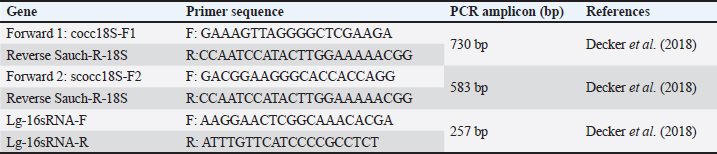
Semi-nested PCR was optimized using gDNA from S. aucheniae macrocysts. To this end, the technique previously implemented for the diagnosis of S. aucheniae in llamas (Lama glama) by Decker et al. (2018) was applied, with slight modifications as follows: The reaction mixture contained 1 µl (5 mM) of each primer for the S. aucheniae gene, 6.5 µl of molecular water, and 12.5 µl of G2 green master mix (Promega, Madison, USA). As a template, 2 µl of gDNA sample was used at concentrations of 10, 20, 30, 50, and 100 ng/µl, with a final volume of 25 µl. The semi-nested PCR reaction was performed in two cycles. The initial amplification (Alpha Thermal Cycler–PCRmax AC196) used the forward 1 cocc18S-F1 and reverse Sauch-R-18S primers to yield a 730-base pair amplicon of the 18S rRNA gene. The second round of amplification was based on the largest sequence obtained in the first round, using the forward 2: scocc18S-F2 and reverse Sauch-R-18S primers to obtain a 583-bp amplicon of the same gene. The primers Lg-16sRNA-F and Lg-16sRNA-R were used to amplify a 257 base pair sequence corresponding to the mitochondrial 16S gene of alpaca. The primers used in this study have been previously described by Decker et al. (2018) (Table 1).
Table 1. Primers for amplifying the 18S rRNA gene of S. aucheniae and the 16S mitochondrial gene of alpaca.
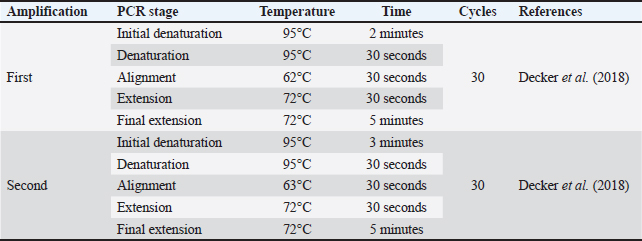
The thermal profiles for the first and second amplifications are presented in Table 2.
Table 2. Semi-nested PCR cycling conditions.
DNA extracted from S. aucheniae macrocysts was utilized at very low concentrations (1 ng, 0.1 ng, 0.01 ng, 1 pg, and 0.01 pg) to ascertain the analytical sensitivity of the molecular technique. This study aimed to ascertain the lowest detectable concentration of the target substance using polymerase chain reaction (PCR) targeting the 18S rRNA gene under optimized conditions. The same optimized semi-nested PCR technique was applied for the diagnosis of the parasite in blood, with an adjustment in the second round of amplification. In this experiment, 1 µl (5 mM) of primers for the amplification of the alpaca 16S mitochondrial gene was added, resulting in a final volume of 27 µl.
Electrophoresis
The PCR products were separated by horizontal electrophoresis (100 V/50 minutes) on a 1.5% agarose gel in 1% TBE buffer (40 mM Tris-borate/1 mM EDTA¾SIGMA, USA, pH 8), to which SYBR safe (Invitrogen, USA) was added. A 1 kb molecular weight marker (Promega, USA) was also used. The PCR products were visualized using a UV transilluminator (Visi-Blue™ Transilluminator, Jena Analytic).
Purification and sequencing of PCR products
For sequencing analysis, PCR amplicons obtained from genomic DNA (gDNA) extracted from blood samples (n=2, code D, and 27 C) and macrocysts (n=1, code 31 C) were randomly selected and purified before sequencing.
Data processing and analysis
The results obtained from the molecular test were entered into an Excel database (Microsoft Office LTSC Professional Plus 2021) and sorted accordingly. The percentage of positives and negatives for S. aucheniae was then calculated using GraphPad Prism 9.3.1 (GraphPad Software, Inc., San Diego, CA). The sequences were edited in Chromas v. 2.6.6 for bioinformatic analysis and then compared with the 18S rRNA sequences of S. aucheniae deposited in the GenBank database of the National Center for Biotechnology Information (NCBI, USA, http://www.ncbi.nlm.nih.gov/) using Standard Nucleotide BLAST (BLASTN).
Ethical approval
Blood samples and macrocysts were obtained from alpacas slaughtered at the Huancavelica Municipal Slaughterhouse. The negative control blood samples were obtained by certified veterinarians from the Faculty of Veterinary Sciences of the National University of Cajamarca, Peru (Veterinary Clinic, Ministry of Agriculture) in accordance with specific protocols and ensuring animal welfare, as provided for in Law No. 30407, the Animal Protection and Welfare Law.
Results
Molecular testing using the semi-nested PCR technique, utilizing gDNA isolated from alpaca blood (20 ng/μl) and macrocysts (50 ng/μl), revealed the presence of Sarcocystis spp., for which a 580-bp amplicon of the 18S rRNA gene of S. aucheniae was obtained. Furthermore, the presence of four 250-base pair bands was observed, representing the 16S rRNA gene of alpaca, which was used as a quality control for the PCR process (Fig. 1).
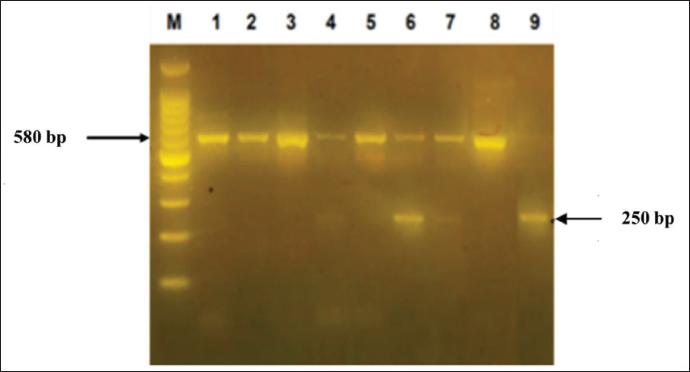
Fig. 1. Detection of S. aucheniae by the semi-nested PCR molecular technique. M: 100 bp marker. Lane 1: Positive control (macrocyst). Lane 9: Negative control. Lanes 2–8: Positive results for S. aucheniae. The 580 bp band corresponds to the 18S rRNA gene of the parasite and the 250 bp band to the 16S mitochondrial gene of alpaca. Lanes 4, 6, and 7 show both bands (580 bp and 250 bp), while lanes 2, 3, 5, and 8 show only the 580 bp band. Lanes 2, 3, 5 and 8 are positive results for S. aucheniae in alpaca blood, without using primers for the 16S rRNA gene.
With regard to the analytical sensitivity of the semi-nested PCR technique, only four of the five concentrations of gDNA used from alpaca blood samples (1 ng, 0.1 ng, 0.001 ng, 1 pg, and 0.1 pg) were detectable. The minimum detectable concentration of parasite DNA corresponding to the 18S rRNA gene was determined to be 1 pg (Fig. 2).
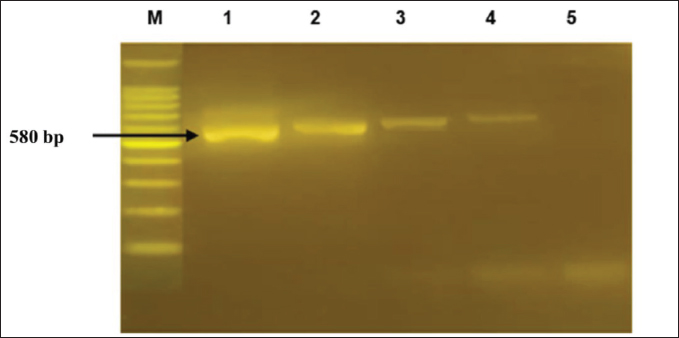
Fig. 2. Analytical sensitivity of semi-nested 1.5% agarose gel PCR of parasite gDNA at different concentrations. M: 100 bp marker. Lane 1: 1 ng; Lane 2: 0.1 ng; Lane 3: 0.001 ng; Lane 4: 1 pg; Lane 5: 0.1 pg of the 18S rRNA gene of S. aucheniae.
The semi-nested PCR technique was found to be repeatable, with the presence of the parasite being observed in alpaca blood samples using gDNA for 3 consecutive days at a working concentration of 20 ng/μl, with two replicates per sample. No discrepancies were observed in the amplification pattern following the initial reaction on days 2 and 3, thereby validating the reliability and reproducibility of the amplification outcomes (Fig. 3).
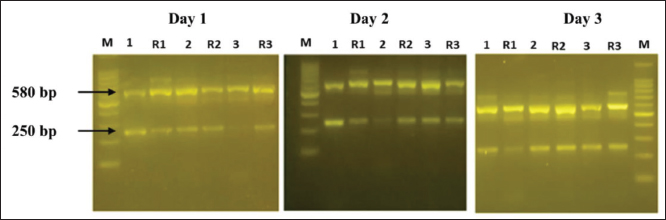
Fig. 3. Repeatability of the semi-nested PCR molecular test in the detection of S. aucheniae, 1.5% agarose gel; M: 100 bp marker; days 1, 2 and 3: Lanes 1, 3, 5: Sample; Lanes 2, 4, 6: Sample repeat; 18S rRNA gene (580 bp); 16S rRNA gene (250 bp).
The specificity of the semi-nested PCR technique was evaluated using blood samples from 15 alpacas, 8 from the province of Huancavelica and 7 from the Porcón–Cajamarca farm. All samples were found to be negative for S. aucheniae macrocysts, as determined by necropsy. The application of the semi-nested PCR technique to the samples from Huancavelica, with a specificity of 80%, yielded positive results in three cases.
The semi-nested PCR technique was used to amplify the gDNA of 50 alpaca blood samples, encompassing the 42 alpacas that did not undergo necropsy and the 8 alpacas that did. Of the samples examined, 16 (32%) were positive, and 34 (68%) were negative for S. aucheniae.
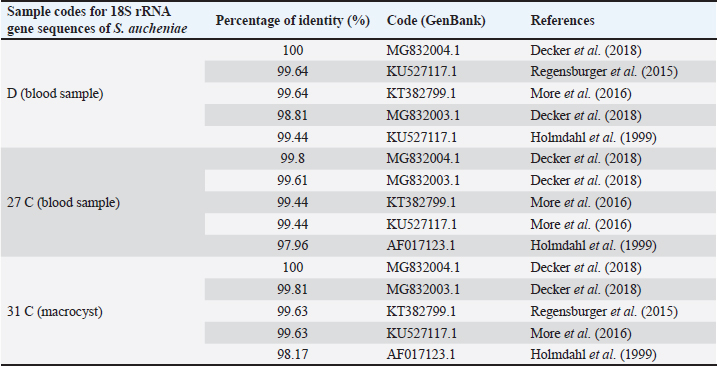
The sequences of the parasites obtained from the amplification of the 18S rRNA gene of S. aucheniae from blood samples (n=2) and macrocysts (n=1) were analyzed using BLASTn with the sequences contained in the US National Center for Biotechnology Information database. Multiple matches were obtained for each sample; however, Table 3 includes the reference sequences showing the highest percentage of identity. A similarity percentage ranging from 98.17% to 100% was identified in 15 GenBank sequences (Table 3).
Table 3. Percentage identity of the 18S rRNA gene sequences of S. aucheniae isolated from blood samples (n=2) and macrocysts (n=1) from alpacas, compared with reference sequences in the GenBank database.
Discussion
At present, there are no standardized technical criteria or diagnostic tests for detecting S. aucheniae in live alpacas. As stated by Saeed et al. (2018) the most widely accepted method for determining sarcocystosis is necropsy to identify macrocysts in the striated muscle of alpacas and llamas. This study is significance as it represents the first report of molecular diagnosis of sarcocystosis in Peruvian alpacas. The 18S rRNA gene of S. aucheniae was detected through the amplification of a gene fragment of approximately 580 base pairs using semi-nested PCR in alpaca blood samples (Fig. 1). Consistent findings were reported by Decker et al. (2018) who identified S. aucheniae in blood samples from llamas in Argentina and Bolivia using the same molecular technique. In this particular instance, a fragment of approximately 550 base pairs was reported, thereby demonstrating the efficacy of the nested PCR molecular technique in the diagnosis of S. aucheniae in live South American camelids. These results are consistent with those of Martin et al. (2016) who designed the first semi-nested PCR for the detection of this gene in S. aucheniae in llama blood, obtaining a 450-bp amplicon.
About analytical sensitivity, the technique implemented has been able to amplify the 18S rRNA gene at very low concentrations of parasitic DNA, with a detection limit of 1 pg (Fig. 2). These results are analogous to those reported by Decker et al. (2018) who demonstrated that semi-nested PCR has a detection limit of up to one parasite per milliliter of blood, suggesting that the technique has acceptable accuracy. Notably, analytical performance at low concentration limits is often of great interest in molecular testing for infectious diseases because it defines the assay’s diagnostic capability (Burd, 2010). Concurrent studies have determined the analytical sensitivity of nested PCR in the diagnosis of Sarcocystis tenella and Sarcocystis arieticanis, which infect sheep, where the 18S rRNA gene was also detected at concentration of up to 10 pg of DNA from each parasite (Heckeroth and Tenter, 1999).
The technique demonstrated high specificity (80%), with the majority of the alpacas analyzed not harboring macrocysts in their skeletal muscles, thus yielding negative results for the presence of S. aucheniae using semi-nested PCR. Concurrent findings have been documented by Moré et al. (2013) who attained a specificity of 95.5% for the multiplex PCR technique in the diagnosis of various Sarcocystis spp. infecting cattle. Similarly, a separate study documented a high specificity of 75% for the semi-nested PCR technique in the detection of S. aucheniae in llamas from Argentina (Decker et al., 2018). The findings demonstrate that semi-nested PCR is capable of accurately detecting parasites in animals that do not harbor the parasite. Conversely, in this study, three Huancavelica alpacas exhibited positive results in blood by semi-nested PCR but negative results in necropsy. This phenomenon may be attributed to several factors, including, but not limited to, inadequate sanitary conditions, the presence of definitive hosts (canines), or other variables that elevate the risk of infection (Alva et al., 1981; Saeed et al., 2018). Consequently, the positivity of the test could be attributed to the acute phase of infection in the animals. Moreover, according to certain studies, necropsy is not an appropriate method for confirming the acute phase of S. aucheniae infection. This assertion is corroborated by the findings of Decker et al. (2018) who observed the parasite’s presence in the blood of llamas that had initially tested negative by necropsy. In this regard, semi-nested PCR would be a useful technique for determining the presence of the parasite in the blood during the early stages of infection.
Regarding the blood samples from alpacas in Cajamarca (n=7), the results of both PCR and necropsy tests were negative, which can be attributed to the implementation of effective health management practices. Despite the absence of recent data, a report was published approximately 28 years ago documenting the presence of S. aucheniae macrocysts in alpaca meat (Cabrera, 1996), indicating the potential existence of the parasite in Cajamarca. Similarly, a recent study confirmed the presence of Sarcocystis spp. oocysts in the feces of canines inhabiting the same alpaca-rearing areas (Ydrogo, 2017). Consequently, confirming the presence of this parasite in the definitive host using a molecular method would be highly relevant. As illustrated in Fig. 1, 16 (32%) of the Huancavelica animals were positive for S. aucheniae using semi-nested PCR. This phenomenon could be attributed to breeding conditions that are conducive to transmission, such as transhumance and exposure to dogs, which have been identified as risk factors in Argentina (Romero et al., 2017). Inappropriate practices, such as the provision of infected raw meat to canines, have been demonstrated to facilitate the parasite cycle by contaminating pastures and water with oocysts or sporocysts present in their feces (Guerrero, 1987).
In contrast, 34 alpacas (68%) exhibited a negative result for S. aucheniae, which could be indicative of a breeding method that does not permit parasitic infection due to stringent sanitary conditions. Although all the study samples originated from Huancavelica, they do not all stem from the same breeding area. Another possibility is that there are genetic components in some alpacas that determine greater resistance to parasite invasion. This hypothesis is supported by the findings of previous studies that have identified significant genomic regions in the sheep genome that are associated with resistance to parasites (Al Kalaldeh et al., 2019). It is also conceivable that the parasite is not circulating in the animal’s blood but may be present in the animal’s skeletal muscle in the form of macrocysts.
Sequence analysis confirmed that the 18S rRNA gene amplified from gDNA from blood samples corresponded to S. aucheniae. The sequences exhibited identity percentages >97.96% with the 18S rRNA sequences deposited in GenBank, which were derived from blood samples of llamas originating in Argentina and Bolivia. Furthermore, a high percentage of identity was observed between the sequence of the gene isolated from macrocysts in this study and the sequences of the same gene from macrocysts (98.17%) from llamas, alpacas, and guanacos. These results indicate that the genetic variation observed in the 18S rRNA sequence is not related to the host species or the geographical origin of the isolates (Decker et al., 2018). However, further studies are required to confirm this hypothesis.
The PCR exhibited repeatable results, indicating that the replicates of the test application in each sample over a period of 3 days remained constant (Fig. 3). This finding shows that the technique is robust; that is, its performance remains unaffected by minor alterations in testing procedures that may occur over time within a single laboratory (Waugh and Clark, 2021).
Conclusion
This study demonstrates significant and substantial progress in the diagnosis of S. aucheniae in alpacas in Peru. The analytical sensitivity of the semi-nested PCR technique was as low as 1 pg of parasite gDNA for the 18S rRNA gene, indicating that the technique has an optimal detection limit. Conversely, the semi-nested PCR technique exhibited a high degree of specificity (80%).
The application of this technique revealed that 16 of the alpacas analyzed (32%) were found to be infected with the parasite, indicating that they would be in the acute phase of infection, that is, when it is circulating in the blood. Implementing this technique in early control programs for alpaca offspring could facilitate the zoning of areas free of S. aucheniae. Furthermore, it can facilitate the evaluation of pharmaceuticals intended for the management of both the intermediate and final hosts. This approach is designed to circumvent the occurrence of false positives and negatives in the treatment.
Acknowledgments
We would like to express our gratitude to INIA, Baños del Inca Experimental Station, Cajamarca, for granting us access to the Animal Health Biotechnology Laboratory, and to the National University of Cajamarca for facilitating access to the Microbiology Laboratory. The authors would also like to thank René Molleapaza Poma, Segundo Salamanca, and Delia Foroca Mamani for their invaluable contributions to the sample collection process.
Conflict of interest
The authors declare no conflicts of interest.
Funding
Not applicable.
Authors’ contributions
Conceptualization: MCG and MRJ. Methodology: DRV and ATS. Internal research: NBM and OECM. Resources: MCG and WAG. Formal analysis: MCG, DRV. Visualization: MCR and MCG.
Data availability
Data supporting the results and conclusions of this research are available from the corresponding authors, DRV and MCG, upon reasonable request.
References
Aguirre, W. 2004. Project to support the sustainability of South American camelid breeding in the Cusco region. London: Instituto Interamericano de Cooperación a La Agricultura (IICA), pp. 1–57.
Al Kalaldeh, M., Gibson, J., Lee, S.H., Gondro, C. and Van Der Werf, J.H.J. 2019. Detection of genomic regions underlying resistance to gastrointestinal parasites in Australian sheep. Genet. Sel. Evol. 51(1), 2–18.
Alva, J., Bazalar, H., Guerrero, C. and Nuñez, A. 1981. Observations on the life cycle of Sarcocystis aucheniae in alpacas (Lama pacos). In 5th Peruvian Congress on Microbiology and Parasitology, Peruvian Association of Microbiology and Parasitology, pp. 1–5.
Ballweber, L.R. 2009. Ecto and endoparasites of New World camelids. Vet. Clin. North. Am. Food. Anim. Pract. 25(2), 295–310.
Baranauskaitė, A., Strazdaitė-Žielienė, Z., Servienė, E., Butkauskas, D. and Prakas, P. 2023. Molecular identification of protozoan Sarcocystis in different types of water bodies in Lithuania. Life 13(1), 51.
Bentancourt Rossoli, J.V., Moré, G., Soto-Cabrera, A., Moore, D.P., Morrell, E.L., Pedrana, J., Scioli, M.V., Campero, L.M., Basso, W., Hecker, Y.P. and Scioscia, N.P. 2024. Identification of Sarcocystis spp. in synanthropic (Muridae) and wild (Cricetidae) rodents from Argentina. Parasitol. Res. 123, 31.
Burd, E.M. 2010. Validation of laboratory-developed molecular assays for infectious diseases. Clin. Microbiol. Rev. 23(3), 550–576.
Cabrera, M. 1996. Protein characterisation of Sarcocystis in alpacas from the Cajamarca area. In Book of abstracts: 1st World Congress on Camelids. Comité Organizador del I Congreso Mundial sobre Camélidos. Cajamarca, Peru: Universidad Nacional de Cajamarca, p: 55.
Decker, C., Romero, S., Ferrari, A., Schnittger, L. and Florin-Christensen, M. 2018. Detection of Sarcocystis aucheniae in llama blood using a duplex semi-nested PCR assay and its association with cyst infestation. Heliyon 4(11), 928.
Gomez, E.G. and Mallqui, S.D. 2018. Mapa parasitológico del lugar de procedencia de alpacas y llamas infestadas con Lamanema chavezi y Sarcocystis aucheniae beneficiadas en el Matadero Municipal de Huancavelica, B.Sc. thesis, Universidad Nacional de Huancavelica, Huancavelica, Peru.
Guerrero, C. 1987. Parasitic diseases of alpacas. Alpacas, infectious and parasitic diseases. Outreach. Lima: Peru, pp. 41–42.
Heckeroth, A.R. and Tenter, A.M. 1999. Development and validation of species-specific nested PCRs for diagnosis of acute sarcocystiosis in sheep. Int. J. Parasitol. 29(8), 1331–1349.
Holmdahl, O.J.M., Morrison, D.A., Ellis, J.T. and Huong, L.T.T. 1999. Evolution of ruminant Sarcocystis (Sporozoa) parasites based on small subunit rDNA sequences. Mol. Phylogenetics. Evol. 11(1), 27–37.
Huarachi, D. 2002. Manual on South American camelid breeding. Kullu Huma Edition. Bolivia: La Paz, p. 27
Kamani, J., Harrus, S., Nachum-Biala, Y., Gutiérrez, R., Mumcuoglu, K.Y. and Baneth, G. 2018. Prevalence of Hepatozoon and Sarcocystis spp. in rodents and their ectoparasites in Nigeria. Acta Trop. 187, 124–128.
Martin, M., Decker Franco, C., Romero, S., Carletti, T., Schnittger, L. and Florin-Christensen, M. 2016. Molecular detection of Sarcocystis aucheniae in the blood of llamas from Argentina. Rev. Argent. Microbiol. 48(3), 200–205.
Medrano, G., Hung, A. and Rubio, N. 2006. Early molecular detection of Sarcocystis in live animals and its phylogenetic study based on SSU rRNA gene analysis in alpacas in Peru. Mosaico. Cient. 3(2), 5–9.
Mendoza, M.N., Raudsepp, T., More, M.J., Gutiérrez, G.A. and Ponce De León, F.A. 2020. Cytogenetic mapping of 35 new markers in the Alpaca (Vicugna pacos). Genes. (Basel). 11(5), 522.
Moré, G., Bacigalupe, D., Basso, W., Rambeaud, M., Venturini, M.C. and Venturini, L. 2010. Serologic profiles for Sarcocystis sp. and Neospora caninum and productive performance in naturally infected beef calves. Parasitol. Res. 106, 689–693.
Moré, G., Regensburger, C., Gos, M.L., Pardini, L., Verma, S.K., Ctibor, J., Serrano-Martínez, M.E., Dubey, J.P. and Venturini, M.C. 2016. Sarcocystis masoni, n. sp. (Apicomplexa: sarcocystidae), and redescription of Sarcocystis aucheniae from llama (Lama glama), guanaco (Lama guanicoe) and alpaca (Vicugna pacos). Parasitol 143(5), 617–626.
Moré, G., Schares, S., Maksimov, A., Conraths, F.J., Venturini, M.C. and Schares, G. 2013. Development of a multiplex real time PCR to differentiate Sarcocystis spp. affecting cattle. Vet. Parasitol. 197(1-2), 85–94.
Prakas, P., Gudiškis, N., Kitrytė, N., Bagdonaitė, D. and Baltrūnaitė, L. 2024. Detection of three species of Sarcocystis (Apicomplexa) in blood samples from red voles and yellow-necked mice in Lithuania. Life 14(3), 365.
Prakas, P., Stirkė, V., Šneideris, D., Rakauskaitė, P., Butkauskas, D. and Balčiauskas, L. 2023. Protozoan parasites of Sarcocystis spp. in rodents from commercial orchards. Animals 13(13), 2087.
Raggi, L.A., Macniven, V. and Ferrando, G. 1995. Ganancia de peso nacimiento-posdestete en crías de alpaca bajo diferente manejo alimentario materno. In IX National Congress of Veterinary Medicine, Chillán, Chile. Universidad Austral de Chile, pp 10–15.
Regensburger, C., Gos, M., Ctibor, J. and Moré, G. 2015. Morphological and molecular characteristics of Sarcocystis aucheniae isolated from meat of guanaco (Lama guanicoe). J. Food Qual. Hazards. Control 2(4), 118–121.
Romero, S., Carletti, T., Decker Franco, C., Moré, G., Schnittger, L. and Florin-Christensen, M. 2017. Seropositivity to Sarcocystis infection of llamas correlates with breeding practices. Vet. Parasitol. Reg. Stud. Rep. 10, 65–70.
Saeed, M.A., Rashid, M.H., Vaughan, J. and Jabbar, A. 2018. Sarcocystosis in South American camelids: the state of play revisited. Parasitol. Vectors. 11(1), 146.
Shimozuru, M.M., Mohamed, K.R.., Taylor Nakao., M. and Tsubota, S. 2017. First molecular detection and characterisation of Hepatozoon and Sarcocystis spp. in field mice and voles from Japan. Parasitol. Res. 116(8), 2321–2325.
Usluca, S., Celebi, B., Karasartova, D., Gureser, A.S., Matur, F., Oktem, M.A., Sozen, M., Karatas, A., Babur, C., Mumcuoglu, K.Y. and Taylan Ozkan, A. 2019. Molecular survey of Babesia microti (Aconoidasida: piroplasmida) in wild rodents in Turkey. J. Med. Entomol. 56(6), 1605–1609.
Velásquez, L., Soncco, J. and Valderrama, A. 2019. Sarcocystis aucheniae in South American camelids and risk factors in the province of Lucanas. Vet. Technol. Health. 7(1), 8–13.
Waugh, C. and Clark, G. 2021. Factors affecting test reproducibility among laboratories. Rev. Sci. Tech. 40, 131–143.
Wieser, S.N., Giuliano, S.M., Reategui Ordoñez, J., Barriga Marcapura, X., Olivera, L.V.M., Chavez Fumagalli, M.A.C., Schnittger, L. and Florin-Christensen, M. 2024. Sarcocystis spp. of new and old world camelids: ancient origin, present challenges. Pathogens 13(3), 196.
Windsor, R.H.S., Teran, M. and Windsor, R.S. 1992. Effects of parasitic infestation on the productivity of alpacas (Lama pacos). Trop. Anim. Health. Prod. 24(1), 57–62.
Ydrogo, M. 2017. Frequency of Sarcocystis spp. in dogs (Canis lupus familiaris) raised on three alpaca farms in Cajamarca, 2017. Undergraduate thesis, National University of Cajamarca, Cajamarca.