



| Research Article | ||
Open Vet. J.. 2026; 16(7): 4263-4273 Open Veterinary Journal, (2026), Vol. 16(7): 4263-4273 Research Article Efficacy of Clinacanthus nutans Lindau extract against vermicidal, ovicidal, and larvicidal potency of Haemonchus contortus in Capra hircus in vitroI Gusti Komang Oka Wirawan1*, Julita D. Mertha Yasa1, Yanse Yane Rumlaklak1, Devi Y. J. A. Moenek1 and Aholiab Aoetpah21Animal Health Study Program, State Agricultural Polytechnic of Kupang, Kupang, Indonesia 2Animal Feed Techonolgy Study Program, State Agricultural Polytechnic of Kupang, Kupang, Indonesia *Corresponding Author: I. Gusti Komang Oka Wirawan. Animal Health Study Program, State Agricultural Polytechnic of Kupang, Kupang, Indonesia. Email: oka_sayun [at] yahoo.com Submitted: 20/11/2025 Revised: 25/05/2026 Accepted: 08/06/2026 Published: 02/07/2026 © 2025 Open Veterinary Journal
AbstractBackground: Secondary metabolites from the aqueous extract of Clinacanthus nutans Lindau leaves (E.A.C.L.), particularly saponins and tannins, are known to have various bioactive properties. However, to the author's knowledge, no study has published the anthelmintic efficacy of E.A.C.L. against Haemonchus contortus in goats or other ruminants. Therefore, exploratory research on E.A.C.L. is needed as a botanical alternative for controlling haemonchosis in goats. Aim: To determine the efficacy of E.A.C.L. as an anthelmintic with vermicidal, ovicidal, and larvicidal properties against H. contortus in vitro. Methods: This study was conducted from May 2025 to August 2025, starting from the preparation of Clinacanth anthelmintic us nutans Lindau leaf samples and the collection of female H. contortus specimens, qualitative and quantitative analysis of secondary metabolites, and anthelmintic efficacy treatment of E.A.C.L. Results: Qualitative phytochemical screening of E.A.C.L. showed the presence of saponins and tannins with grades of (+++) each. Quantitative analysis showed a tannin content of 4.48% w/w. For vermicidal efficacy, a concentration of 9-mg/ml E.A.C.L. reached 100% after 7 hours of exposure, which was significantly different from the other treatments (p < 0.05). The concentration of 17-mg/ml E.A.C.L. gave the highest ovicidal efficacy (86.34%), comparable to the positive control (p > 0.05), while the negative control was significantly lower (p < 0.05). The highest larvicidal efficacy was 89.95% at a concentration of 21-mg/ml E.A.C.L., comparable to the positive control (p > 0.05). This was followed by concentrations of 17-mg/ml and 25-mg/ml E.A.C.L., with larvicidal efficacies of 62.86% and 45.83%, respectively, whereas the negative control had an efficacy of 0.34%. Conclusion: E.A.C.L. treatment, with its active secondary metabolite content, particularly saponins and tannins, demonstrated significant vermicidal, ovicidal, and larvicidal activity against H. contortus in vitro. The most effective concentrations were 9 mg/ml (vermicidal), 17 mg/ml (ovicidal), and 21 mg/ml (larvicidal). Further in vivo studies are needed to determine the optimal therapeutic dose for controlling haemonchosis in goats and other ruminants. Keywords: Clinacanthus nutans Lindau, Etnofarmakologi haemonchosis, Secondary metabolites. IntroductionClinacanthus nutans Lindau from the family Acanthaceae is known to the community as “rumput ular” or “belalai gajah,” while in Java it is known as “dandang gendis.” The utilization of C. nutans Lindau by the community in East Nusa Tenggara Province (NTT) is for wound healing, dysuria, gingivitis, and other conditions. Therefore, the residents cultivate it as a household-scale herbal plant. Along with technological advances, the secondary metabolites of C. nutans Lindau have been developed by experts for the control of various diseases in humans and livestock. Several studies have been conducted, including: the leaf extract of C. nutans Lindau has strong activity against Streptococcus nutans and Staphylococcus aureus (Pechroj et al., 2024); C. nutans Lindau extract has been used in traditional medicine due to its anti-inflammatory and antiviral properties (Jantakee et al., 2024); stem and leaf extracts of C. nutans Lindau as an anthelmintic agent against earthworms (Manju and Tharakan, 2020). To the author’s knowledge, none of these studies have used E.A.C.L. for the control of haemonchosis in Capra hircus or other ruminants. Haemonchus contortus is a blood-sucking parasite that causes very significant economic losses in sheep farming in tropical and subtropical regions (Regassa et al., 2024). The pathogenicity of haemonchosis is due to its blood-sucking activity, which harms health and reduces productivity (Arsenopoulos et al., 2021). One of the external factors causing haemonchosis to be endemic in East NTT is the traditional practice of farmers, passed down through generations, of grazing goats extensively. This practice causes animals infected with H. contortus to become a source of transmission to healthy animals through feed contaminated with infective larvae. According to the life cycle of H. contortus as described by Qamar and Alkheraije (2023) and Guzhva et al. (2024) worm eggs are excreted with feces, develop into infective larvae (L3), then contaminate feed sources (grass), and animals become infected through this feed. This situation is strongly felt by goat farmers in NTT Province, as well as farmers from other provinces in Indonesia and possibly around the world, because they have to spend extra costs on treatment and care. Efforts to control haemonchosis in goats have been carried out by veterinary medical professionals through epidemiological approaches and the application of conventional anthelmintics. However, in practice, there are obstacles in obtaining conventional anthelmintics that are vermicidal, ovicidal, and larvicidal, especially in animal health centers far from urban areas. This obstacle is likely also experienced by provinces classified as underdeveloped, frontier, and outermost (3T). The disadvantages of administering conventional anthelmintics, according to Alkadir et al. (2023) include the development of resistance if given continuously over a long period or if the applied dose does not match body weight. If increased resistance occurs due to the use of conventional anthelmintics, it is recommended by Nikelo et al. (2022) to use medicinal plants as one of the main options for controlling endoparasites in livestock. Given the impact of losses due to haemonchosis and the problems faced by goat farmers, especially in NTT Province, comprehensive research is urgently needed on the potential of secondary metabolites from C. nutans Lindau leaves as an environmentally friendly anthelmintic candidate. The objective of this study was to determine the efficacy of the aqueous extract of C. nutans Lindau leaves (E.A.C.L.) as an anthelmintic with vermicidal, ovicidal, and larvicidal properties against H. contortus in Capra hircus in vitro. The benefits of this study include: serving as a reference for further in vivo studies in goats and other ruminants, providing baseline data for the development of anthelmintic research using the spraying method in situ, and the research data can be used for the advancement of Science and Technology (IPTEK). Materials and MethodsResearch procedure and samplingStudy period and locationThis study was conducted from May 1, 2025, to August 10, 2025. All samples were processed at the Microbiology Laboratory of the Veterinary Health Study Program, Kupang State Agricultural Polytechnic, except for the preparation of C. nutans Lindau leaf extract and the qualitative test of secondary metabolites (saponin and tannin compounds), which were carried out at the Technical Implementation Unit (UPT) of the Integrated Laboratory, Nusa Cendana University (UNDANA), East NTT, Indonesia (Report of analysis, No.: 054/LHU/LAB.UNDANA/X/2025). Plant collection and extractionClinacanthus nutans Lindau leaves were obtained from a herbal cultivation garden belonging to a resident in Noelbaki Village, Central Kupang District, Kupang Regency, East NTT. Identification of this plant specimen was carried out at the Biology Laboratory, Biology Study Program, Faculty of Science and Engineering, Nusa Cendana University, with Identification Certificate Number: 298/UN15.18.6/TU/2026. Approximately 300 g of C. nutans Lindau leaves were cleaned and dried in a drying room. After drying, they were ground, and the powdered sample was sieved using a flour sieve and stored in a vacuum bottle. This method was modified based on Susanti et al. (2023). A 100-g sample of the leaf powder was extracted using 500 ml of water for injection. The resulting leaf extract was evaporated using a rotary evaporator. This procedure was modified based on the study by Yunita et al. (2023) yielding a stock solution (E.A.C.L.) with a concentration of 200 mg/ml. This solution was ready for use according to the research procedures. Plant phytochemicalTest for tanninsThe qualitative test for tannin compounds from C. nutans Lindau extract was as follows: 90 µl of 1% w/v iron (III) chloride (FeCl₃) solution was added to 10 mg of the extract, which was then dissolved in 1 ml of methanol. The indicator for the presence of tannins was qualitatively compared with gallic acid as a standard; this procedure was modified (Muhamad et al., 2022). Test for saponinsThe qualitative test for saponin compounds from an extract of C. nutans Lindau was carried out by mixing dimethyl sulfoxide (DMSO) with 5 ml of distilled water, then adding this mixture to 10 mg of the extract, which had been dissolved in 1 ml of ethanol. These mixed materials were shaken until evenly mixed (homogeneous), and the indicator for the presence of saponins was compared with sodium dodecyl sulfate as a standard; this procedure was modified (Muhamad et al., 2022). Quantitative test of tannin compoundsQuantitative determination of tannin content in C. nutans Lindau extract was measured using tannic acid as a standard and Folin–phenol reagent. Tannic acid standards from this extract were prepared at various concentrations (50, 100, 150, 200, and 250 μg/ml). The C. nutans Lindau extract was diluted by adding 7.5 ml of distilled water, then mixed with Folin–phenol reagent (0.5 ml) and 1 ml of sodium carbonate (35%). The final volume of the reaction mixture was made up to 10 ml with distilled water, shaken vigorously, and incubated at room temperature for approximately 30 minutes. The absorbance of the sample was obtained by spectrophotometry at 725 nm. The total tannin content in the plant extract was expressed as Tannic Acid Equivalent (TAE) per gram of extract (in mg TAE/g extract). This procedure was modified and refers to Pavani and Shasthree (2022). In vitro studyFemale H. contortus worms were obtained from the abomasum of goats at a traditional slaughterhouse owned by a resident on Timor Raya Road, Kupang City, East NTT (conducted from May 21, 2025; to July 31, 2025). Sampling of female H. contortus worms was performed by making a longitudinal incision along the abomasum. Then the contents of the abomasum were carefully poured out, and female H. contortus worms were collected and placed in a pot containing 0.62% physiological NaCl solution, referring to the study by Widiarso et al. (2021) which had been modified to suit the research needs. Subsequently, they were brought to the Microbiology Laboratory of the Veterinary Health Study Program, Kupang State Agricultural Polytechnic, NTT Province. The H. contortus worms were then washed using saline and were ready for use according to the procedures. The required supporting materials included: 0.62% physiological NaCl and saline, water for injection, FeCl₃, DMSO, Lugol’s solution for staining worm eggs and larvae to facilitate observation, albendazole at a concentration of 0.55 mg/ml (positive control), and water for injection (negative control). The determination of albendazole treatment concentrations was modified based on the study by Mumed et al. (2022). The equipment used included: an electric balance with 0.001-g accuracy, a blender and grinder, a sieve, a vacuum bottle, conical flasks, Whatman No. 1 filter paper, a rotary evaporator, a mortar, a stirring rod, Petri dishes, a stopwatch, a mortar, a stereo microscope (Hirox KH-8700, H08754®, Current Meter Valeport, Kowloon, Hong Kong) for observing worms before and after treatment, as well as for observing worm eggs and larvae. A counting chamber (E-Counting Chamber By: βravo, 1,080 × 1,350) for counting worm eggs (McMaster method) and counting worm larvae, test tubes, a test tube rack, aluminum foil, and an incubator. Research proceduresVermicSh2idal efficacy of E.A.C.L.The study was divided into five treatment groups: three E.A.C.L. treatment groups at concentrations of 5, 7, and 9 mg/ml; one negative control group (water for injection); and one positive control group of Albendazole 0.55 mg/ml. Determination of the concentration refers to the study conducted by Oka Wirawan et al. (2022). Each Petri dish contained six worms per treatment, and each concentration treatment was diluted using 1.5 ml of water for injection, which was then added to each Petri dish. The determination of concentration was modified and referred to the study by Susanti et al. (2023). The efficacy of the extract was determined based on worm mortality in the exposure groups at 1, 3, 5, and 7 hours, with 4 replications per treatment. The method for determining dead or alive worms was modified, referring to the study by Mumed et al. (2022). The variables observed and analyzed were the percentage of dead and alive worms in each treatment group. The most effective vermicidal concentration of E.A.C.L. was used as a reference for the ovicidal study. Efficacy of E.A.C.L. on ovicidal and larvicidal activityOvicidaSh3l efficacy of E.A.C.L.The ovicidal efficacy procedure was modified and referred to Alemu et al. (2014). The study was divided into 5 treatment groups: three E.A.C.L. treatment groups at concentrations of 9, 13, and 17 mg/ml; a negative control (water for injection); and a positive control (Albendazole 0.55 mg/ml), with 5 replications per treatment. Each concentration treatment was diluted using 1.5 ml of water for injection. The variables measured and analyzed were the percentage (%) of hatched and unhatched worm eggs in the immersion groups. The percentage formula for ovicidal efficacy referred to Alemu et al. (2014). 
The E.A.C.L. concentration treatment that is most effective as an ovicidal agent was used as a reference for the larvicidal study. Larvicidal efficacy of E.A.C.L.The larvicidal efficacy procedure was modified and referred to Alemu et al. (2014). The preparation of the vermiculite medium referred to the procedure performed by Wirawan and Semang (2024). The study was divided into 5 treatment groups: three E.A.C.L. treatment groups at concentrations of 17, 21, and 25 mg/ml; a negative control (water for injection); and a positive control (Albendazole 0.55 mg/ml), with 5 replications per treatment. All treatments used vermiculite as the medium. The variables measured and analyzed were the percentage of larvicidal efficacy: (number of L1 before treatment minus number of L1 after treatment) divided by number of L1 before treatment, multiplied by one hundred. The formula for larvicidal percentage referred to Alemu et al. (2014). Analysis of results1. Vermicidal efficacy percentage of E.A.C.L. The percentage of live and dead worms in each immersion group was analyzed using ANOVA with a completely randomized design (CRD), while data on live and dead worms at different immersion times were analyzed using regression. Assumption tests were performed using the Shapiro–Wilk and Levene tests. 2. Ovicidal and larvicidal efficacy percentages of E.A.C.L. The ovicidal data were analyzed using ANOVA with a CRD; if significantly different, it was followed by Duncan's test. The larvicidal percentage was analyzed using ANOVA with a CRD; if significantly different, it was followed by Duncan's test. Data were entered into the Microsoft Excel spreadsheet, transferred to SPSS software (version 17), and analyzed using descriptive statistics, including means and standard deviations. Ethical approvalEthical approval for this in vitro study was not required, as parasite material was sourced from a commercial slaughterhouse. ResultsQualitative determination of plant phytochemicalsBased on the qualitative phytochemical analysis, the leaf extract of C. nutans Lindau was indicated to contain saponin and tannin compounds, each with a grade of +++ (very strong). The quantitative analysis results for tannin compounds showed a condensed tannin content of 4.48% w/w, as presented in Table 1. Table 1. Qualitative and quantitative phytochemical analysis.
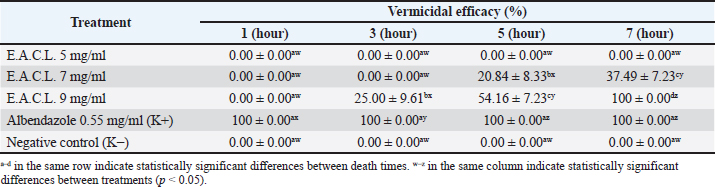
Adult mortality assayThe vermicidal efficacy percentages, as shown in Table 2, indicate that all concentration treatments of E.A.C.L. and the positive control had significant efficacy against the vermicidal percentage of H. contortus, with significant differences (p < 0.05) among concentrations and treatment times, except for the 5-mg/ml E.A.C.L. concentration treatment, which was comparable to the negative control (p > 0.05)–meaning this treatment caused no mortality even after 7 hours of exposure. The positive control, as the gold standard, provided the fastest vermicidal effectiveness, with 100% mortality within 1 hour of exposure, and its vermicidal efficacy was significantly different (p < 0.05) from all E.A.C.L. concentration treatments. However, when the concentration was increased to 7-mg/ml E.A.C.L., the pharmacodynamic effect began to work, with a mortality percentage of 20.84% within 5 hours of exposure, whereas the 9-mg/ml E.A.C.L. concentration, with a shorter exposure time of 3 hours, had a higher mortality impact of 25%. The optimal mortality percentage of the 9-mg/ml E.A.C.L. concentration was achieved within 7 hours of exposure, with a total mortality of 100%, while the 7-mg/ml E.A.C.L. concentration, with the same exposure time, had a mortality percentage of 37.49%. Table 2. Percentage of vermicidal efficacy of E.A.C.L. concentrations.
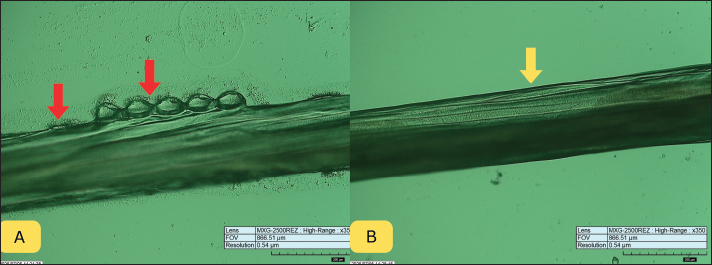
The vermicidal efficacy of the 7- and 9-mg/ml E.A.C.L. concentrations is thought to have caused lesions and tumor-like bumps on the cuticle of H. contortus worms. This condition differed from the negative control, which had a smooth cuticle surface, as shown in Figure 1.
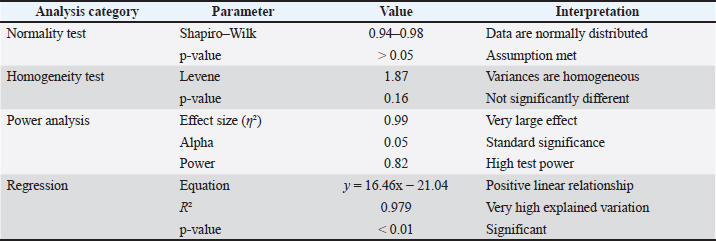
Fig. 1. (A) Vermicidal efficacy: lesions and bumps on the cuticle (red arrows). (B) Smooth cuticle surface (yellow arrows), negative control. Since the number of female H. contortus worm samples per treatment (n=6 worms per Petri dish) was relatively low, regression analysis was performed after classical assumption tests. The validity of these statistical results was supported by the assumption test results. The Shapiro–Wilk test (Table 3) showed that the data were normally distributed (p > 0.05), while the Levene test showed that variances among groups were homogeneous (p > 0.05). The fulfillment of both assumptions indicates that the use of parametric tests, such as ANOVA and regression, was appropriate, so the results obtained can be considered reliable. Furthermore, the power analysis showed a value of 0.82, which is above the commonly used minimum threshold (0.80). This indicates that the study had sufficient power to detect significant differences among treatments. This high-power value is consistent with a large effect size (η²=0.99), indicating that the treatment had a strong effect on worm mortality. Table 3. Normality test, homogeneity test, power analysis, and regression.
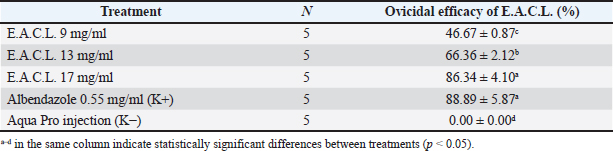
The regression analysis results (Table 3) showed a strong positive relationship between exposure time and mortality, as indicated by the regression equation (y=16.46x−21.04) and a high coefficient of determination (R²=0.979). This shows that most of the variation in mortality can be explained by exposure time. The significant p-value (p < 0.01) further confirms that exposure time is an important factor affecting treatment effectiveness. These results indicate that the longer the exposure time, the greater the linear increase in vermicidal efficacy. Although the results of this study show strong findings, there are several limitations that need to be considered. The relatively low sample size may limit the generalizability of the study results. However, the consistency of the observed patterns and the strong statistical indicators (high R² value, significant p-value, and adequate power) indicate that the results of this study remain reliable. Further studies with larger sample sizes are recommended to strengthen and validate these findings. Overall, the results of this study indicate that exposure time plays an important role in determining vermicidal efficacy, with longer exposure times resulting in higher mortality rates. Egg hatch inhibition assayThe ovicidal efficacy of the treatments increased with increasing treatment concentration, as shown in Table 4. Based on statistical analysis, all E.A.C.L. treatments showed significant ovicidal efficacy (p < 0.05) among the concentrations. The treatment at a concentration of 17-mg/ml E.A.C.L. gave the highest ovicidal efficacy among all E.A.C.L. treatments, namely 86.34%, comparable to the positive control (p > 0.05), while the negative control was significantly lower (p < 0.05) among all treatments and provided no ovicidal efficacy. Table 4. Percentage of ovicidal efficacy of E.A.C.L. concentrations.
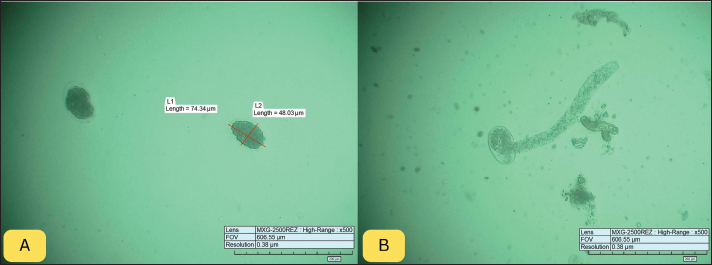
The ovicidal efficacy of E.A.C.L. at all treatment concentrations was indicated by the failure of H. contortus worm eggs to hatch, whereas in the negative control, the embryos developed into larvae, as shown in Fig. 2. Furthermore, at all E.A.C.L. concentration treatments, morphological changes in the worm eggs were observed, namely, abnormal embryos.
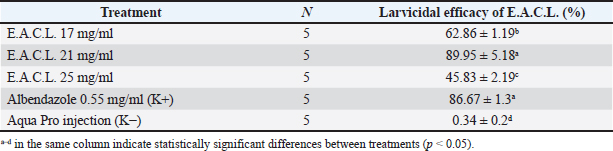
Fig. 2. (A) Ovicidal efficacy of E.A.C.L. (abnormal embryo); (B) Negative control (embryo developing into larva). Larvae inhibition assayThe increase in larvicidal efficacy correlated with increasing E.A.C.L. treatment concentrations, except for the 25-mg/ml E.A.C.L. concentration, which was significantly different (p < 0.05) from the 17- and 21-mg/ml E.A.C.L. concentrations; its larvicidal efficacy was lower but still higher than that of the negative control. The concentration of 21-mg/ml E.A.C.L. gave the highest larvicidal efficacy of 89.95%, comparable to the positive control (p > 0.05), followed by the 17-mg/ml E.A.C.L. concentration at 62.86%, and the 25-mg/ml E.A.C.L. concentration at 45.83%, while the negative control had a larvicidal efficacy of 0.34%, as shown in Table 5. Table 5. Percentage of larvicidal efficacy of E.A.C.L. concentrations.
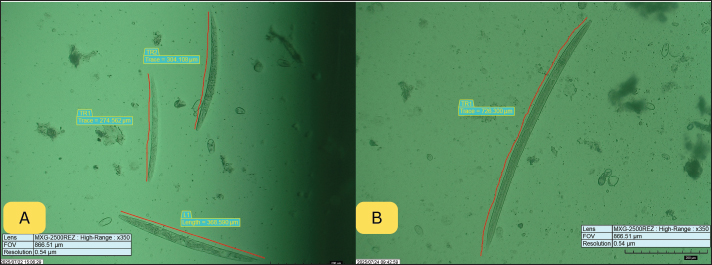
The larvicidal efficacy of E.A.C.L. at all treatment concentrations was indicated by larval lengths of <580 µm, whereas infective larval lengths range from 580 to 800 µm (Fig. 3). Another indicator was that all post-treatment larvae from the E.A.C.L. concentrations were identified as non-filamentous.
Fig. 3. (A) Larvicidal efficacy (Larval length < 580 µm); (B) Negative control (Larval length > 700 µm). DiscussionQualitative determination of plant phytochemicalsBased on qualitative phytochemical analysis of secondary metabolites from C. nutans Lindau leaves extracted using water for injection, saponins and tannins were found. A study conducted by Sabindo et al. (2024)found that when C. nutans Lindau leaves were extracted using water, the secondary metabolites included alkaloids, triterpenoids, diterpenes, and tannins, whereas extraction with methanol yielded saponin compounds. Susanti et al. (2023)stated that C. nutans Lindau leaves extracted using 70% ethanol and water contained phenolic compounds, flavonoids, tannins, and saponins. According to a study by Baihaqi et al. (2023)the addition of Carica pubescens seed extract up to 5% in sheep feed showed anthelmintic activity against H. contortus. This anthelmintic activity is attributed to the extract containing tannins, flavonoids, alkaloids, saponins, and steroids. Vermicidal activityAll E.A.C.L. concentration treatments provided a vermicidal efficacy percentage against H. contortus that was linear with increasing extract concentration and exposure time, except for the 5-mg/ml E.A.C.L. concentration, which showed no vermicidal efficacy. This is thought to be because the extract concentration was too low, resulting in weak affinity between the saponin and tannin compounds and the target receptors, so that the ligands failed to activate the target receptors, leading to no vermicidal efficacy. Fissiha and Kinde (2021) stated that a low anthelmintic dose that does not match the number of receptors causes changes at the receptor sites, thereby weakening the binding, which results in resistance development in the worms. The highest vermicidal efficacy against H. contortus from E.A.C.L. treatments was achieved at a concentration of 9 mg/ml with an exposure time of 7 hours. Increasing the concentration causes the composition of saponins and tannins to increase synergistically, so that the pharmacodynamic effect is thought to work more effectively, producing vermicidal efficacy. Muda et al. (2021) reported that administration of Indigofera tinctoria L. extract with increasing concentration from 200 to 220 mg/ml over the same exposure time (8 hours) increased the average mortality rate of H. contortus from 76.66% to 93.33%. Furthermore, a study by Djambo et al. (2025) found that the highest concentration (3 mg/ml) of hydroethanolic extract of Senegalia senegal caused the most significant death of female H. contortus compared to lower concentrations. The saponin and tannin compounds in E.A.C.L. are thought ethnopharmacologically to have potential as anthelmintics because they possess vermicidal activity similar to the positive control, although their mechanism of action differs. Hassan and Ghazy (2022)stated that the mechanism of action of albendazole is the inhibition of microtubule subunit polymerization, causing microtubule disruption. Jacob et al. (2022)reported that disruption of microtubules interferes with the sequence of cell division at metaphase, leading to the death of individual cells and thus the death of the parasite. The 7- and 9-mg/ml E.A.C.L. treatments are thought to cause paralysis, death, morphological changes in the cuticle (lesions and wrinkling), and tumor-like bumps on the cuticle. The results of a study by Widiarso et al. (2021) reported that H. contortus treated with bamboo leaf extract (tannin compounds) showed thicker protrusions, lesions, and damage to the cuticle surface. Furthermore, Pramu et al. (2025) reported that H. contortus treated with 25- and 75-mg/ml A.E.I. caused ultrastructural changes in the cuticle, with a rough, wrinkled, and irregular surface. Belemlilga et al. (2024) reported that the extract of Balanites aegyptiaca L. fruit, which contains saponins and flavonoids, may have a mechanism of action that disrupts the cuticle integrity of the parasite or binds to proteins in the worm's body that serve as its nutrition. Regarding the direct mechanism of action of tannin compounds, according to Widiarso et al. (2021)condensed tannins have the ability to bind to proteins on the wall or cuticle of nematodes, causing loss of flexibility and leading to death. Ovicidal activityThe ovicidal efficacy of all E.A.C.L. concentration treatments significantly showed a linear increase in ovicidal percentage with increasing concentration. The highest ovicidal efficacy was at a concentration of 17-mg/ml E.A.C.L.; this phenomenon is thought to be because the concentration of saponins and tannins likely has a greater chance of binding to specific receptors on the worm eggshell layer, thus achieving optimum efficacy. Fidèle et al. (2024) reported that graded increases in the concentration of aqueous extract of Combretum micranthum leaves containing condensed tannins were synergistic with an increased ovicidal percentage of H. contortus. A similar statement was reported by Abubakar et al. (2024): increasing concentrations of Leucaena leucocephala extract with condensed tannin compounds at 0.3, 0.6, 1.2, 2.5, and 5 mg/ml successively increased the ovicidal percentage of H. contortus to 50.6%, 54.0%, 58.3%, 64.0%, and 70.3%, respectively. Maestrini et al. (2020) reported that saponin compounds in Medicago polymorpha cv. Santiago extract at a concentration of 2.5 mg/ml showed 93% ovicidal activity. When the concentration was reduced to 0.25 mg/ml, the ovicidal percentage decreased to 43%. Furthermore, Pramu et al. (2025)reported that increasing concentrations of Ipomoea batatas leaf extract provided synergistic inhibitory effectiveness on the development of H. contortus eggs; concentrations of 25 (2.5%), 50 (5%), and 100 (10%) mg/ml gave inhibitory activities of 38%, 51%, and 81%, respectively. The ovicidal efficacy of E.A.C.L. concentration treatments at all concentrations was indicated by morphological changes in H. contortus worm eggs, including: the eggshell remained intact, but the embryo was abnormal, and the presumptive larva did not develop (Fig. 2). The results of a study by Pramu et al. (2025) showed that secondary metabolites from I. batatas leaf extract containing flavonoids, alkaloids, tannins, saponins, and steroids inhibited H. contortus eggs, with indicators including: blastomeres failing to develop, presumptive larvae not moving inside the eggshell (dead), and damaged eggshells. Larvicidal activityAll E.A.C.L. concentration treatments significantly affected the larvicidal percentage. The larvicidal efficacy of the 17-and 21-mg/ml E.A.C.L. concentrations was higher than that of the 25-mg/ml E.A.C.L. concentration. This phenomenon is possibly related to the solubility and bioavailability of the extract. At higher concentrations, the active compounds tend to undergo aggregation. As a result, solubility and bioavailability decrease, so the larvicidal efficacy becomes suboptimal. According to Zhuo et al. (2024) low solubility is a major cause of suboptimal bioavailability, resulting in drug concentrations at the target organ being below the therapeutic threshold, thereby reducing efficacy. Furthermore, Nyamba et al. (2024) stated that high solubility in water and body physiological fluids is a very important requirement for the pharmacological efficacy of a pharmaceutical active ingredient. Furthermore, the lower concentrations (17-and 21-mg/ml of E.A.C.L.) likely have higher solubility in the solvent medium compared to the higher concentration (25 mg/ml of E.A.C.L.), thereby increasing bioavailability along with efficacy. This is consistent with the opinion of Arkhipov et al. (2020) that increased solubility through mechanochemical technology leads to optimal anthelmintic efficacy at lower doses. The larvicidal efficacy of all E.A.C.L. concentration treatments was indicated by the total length of infective larvae (L3) failing to reach a minimum of 580 µm. Sauermann et al. (2021) reported that the length of infective larvae (L3) ranges from 580 to 800 µm, a result obtained from culture. In addition to that indicator, almost all H. contortus larvae were observed to be non-filamentous (Fig. 3). This is thought to be due to the pharmacodynamic effect of saponins and tannins acting synergistically on receptors located in the cuticle or other parts of the larva. Greiffer et al. (2022) reported that the cuticle is identified as the primary site for binding with tannins. This binding causes changes in cuticle structure, disruption of molting, and decreased flexibility. According to the results of a study by Widiarso et al. (2021) tannin compounds affect or inhibit the growth of nematode larvae. Khan et al. (2024) reported that Vitex negundo leaves extracted using methanol with high concentrations of saponins and flavonoids caused lesions on the cuticle. The researchers acknowledge that this study has limitations in terms of the number of female H. contortus worm samples (6 worms/treatment), resulting in low replication. The solution implemented by the researchers was to perform regression analysis preceded by classical assumption tests. The number of replications was inconsistent between the vermicidal treatment (*n*=4) and the ovicidal and larvicidal treatments (*n*=5) due to limited availability of H. contortus worm samples, considering that goat slaughtering was performed only upon request from street vendors (on average, slaughtering occurred three times per week, with 1–2 animals per slaughter). Quantitative testing of saponins and GC-MS/HPLC profiling were not conducted because they were not included in the 2025 Fiscal Year Research Contract (Number: 0339/PL24/LT/2025). The researchers did not perform a quantitative test of saponin compounds because the structure of their components is too complex (steroids/triterpenoids) with different polarities, making it difficult to conduct quantitative testing of saponins individually. ConclusionBased on the results and discussion, it can be concluded that treatment with E.A.C.L., containing secondary metabolites (saponins and tannins), was proven to have significant vermicidal, ovicidal, and larvicidal activity against H. contortus in vitro. The most effective concentrations for vermicidal, ovicidal, and larvicidal efficacy were 9, 17, and 21 mg/ml of E.A.C.L., respectively. Further in vivo studies are needed for the control of haemonchosis in goats or other ruminants. AcknowledgmentsThe authors would like to thank Mr. Muhamad Said, the owner of the goat slaughterhouse in Kupang City, East Nusa Tenggara Province (NTT), for facilitating the provision of abomasums, which are the predilection organ of H. contortus. FundingThe funding source for this research came from the Basic Research Scheme (Regular Fundamental Research) of the Ministry of Higher Education, Science, and Technology of the Republic of Indonesia, based on Decree Number 0419/C3/DT.05.00/2025 and Agreement/Contract Number 0339/PL24/LT/2025. Authors’ contributionsIGKOW, JDMY, YYR, DYJAM, and AA designed this study. IGKOW and JDMY conducted field surveys (goat slaughterhouse and C. nutans L. plant garden) and sample collection. YYR, DYJAM, and AA performed sample preparation. IGKOW, JDMY, YYR, DYJAM, and AA conducted laboratory research and data tabulation. AA performed the analysis. All authors drafted and revised the manuscript. All authors have read and approved the manuscript for submission to the Open Veterinary Journal (OVJ). Conflict of interestThe authors declare no conflicts of interest related to this study. Data availabilityAll data supporting this study’s findings are available in the manuscript. ReferencesAbubakar, M., Oneeb, M., Rashid, M., Ashraf, K., Chisti, G.A., Awan, F. and Sarwar, N. 2024. In vitro anthelmintic efficacy of three plant extracts against various developmental stages of Haemonchus contortus. Pak. Vet. J. 1–6;https://www.pvj.com.pk/pdf-files/24-018.pdf Alemu, Z., Kechero, Y., Kebede, A. and Mohammed, A. 2014. Comparison of the in vitro inhibitory effects of doses of tannin rich plant extracts and ivermectin on egg hatchability, larvae development and adult mortality of Haemonchus contortus. Acta Parasitol. Globalis 5(3), 160–168;https://www.researchgate.net/publication/264533249 Alkadir, G., Kumsa, B. and Terefe, G. 2023. Review on anthelminthic resistance in domestic ruminants. J. Vet. Med. Res. 10(1), 1–10;https://www.researchgate.net/publication/370590931 Arkhipov, I., Khalikov, S., Dushkin, A., Sadov, K., Meteleva, E., Arisov, M. and Varlamova, A. 2020. Anthelmintic efficacy of supramolecular complex of praziquantel obtained by mechanochemical Technologt. Iran. J. Parasitol. 15(3), 364–373;https://ijpa.tums.ac.ir/index.php/ijpa/article/view/3063 Arsenopoulos, K.V., Fthenakis, G.C., Katsarou, E.I. and Papadopoulos, E. 2021. Haemonchosis: a challenging parasitic infection of sheep and goats. Animals 11, 1–28; doi:10.3390/ani11020363 Baihaqi, Z.A., Widiyono, I., Angeles, A.A., Suwignyo, B. and Nurcahyo, W. 2023. Anthelmintic activity of Carica pubescens aqueous seed extract and its effects on rumen fermentation and methane reduction in Indonesian thin-tailed sheep: an in vitro study. Vet. World. 16, 1421–1428; doi:10.14202/vetworld.2023.1421-1428 Belemlilga, M.B., Moyenga, F., Boly, A.G.L., Ouédraogo, H., Compaoré, S., Yoda, J., Youl, E.N.H., Kini, F.B., Ouédraogo, S. and Traoré, A. 2024. Phytochemical and in vitro anthelmintic properties of mesocarp of fruit extracts from Balanites aegyptiaca (L.) Delile (Zygophyllaceae). J. Herbmed. Pharmacol. 13(1), 144–152;http://www.herbmedpharmacol.com/ Djambo, D.D., Amang, A.P., Djongra, M. and Ndjonka, D. 2025. Anthelmintic activity of hydroethanolic extract of Senegalia senegal (L.) Britton (Fabaceae) on the small ruminant parasite Haemonchus contortus. J. Parasitology Res. 1–11; doi:10.1155/japr/8782416 Fidèle, T.D., Roland, M.N., Geneviève, Z., Benjamin, K., Adama, K., Hamidou, T.H. and Gaston, B.A.M. 2024. Phytochemical composition and in vitro anthelmintic activity of Combretum micranthum G. don leaf extracts on Haemonchus contortus of small ruminants. 12(1). 85-92. 12(1), 85–92;https://www.researchgate.net/publication/379229904 Fissiha, W. and Kinde, M.Z. 2021. Anthelmintic resistance and its mechanism: a review. InfectDrug. Resist. 14, 5403–5410;https://pmc.ncbi.nlm.nih.gov/articles/PMC8687516/pdf/idr-14-5403 Greiffer, L., Liebau, E., Herrmann, F.C. and Spiegler, V. 2022. Condensed tannins act as anthelmintics by increasing the rigidity of the nematode cuticle. Scientific. Rep. 12, 1–13; doi:10.1038/s41598-022-23566-2 Guzhva, O., Hessle, A., Högberg, N., Lidfors, L. and Höglund, J. 2024. Hide ‘n seek: individual behavioural responses of cattle excreting different amounts of nematode eggs—potential threshold for pasture contamination assessment. Front. Anim. Sci. 5, 1–10;https://www.frontiersin.org/journals/animal-science/articles/10.3389/fanim.2024.1369677/full Hassan, N.M.F. and Ghazy, A.A. 2022. Review: advances in diagnosis and control of anthelmintic resistant gastrointestinal helminths infecting ruminants. J. Parasit. Dis. 46(3), 901–915; doi:10.1007/s12639-021-01457-z Jacob, J., Siraj, Md.a., Steel, A., Tan, G. and Jarvi, S. 2022. Evaluation of the mechanism of action of albendazole on adult rat lungworm (Angiostrongylus cantonensis). 242, 1–22.https://www.sciencedirect.com/science/article/pii/S0014489422001497 Jantakee, K., Panwong, S., Sattayawat, P., Sumankan, R., Saengmuang, S., Choowongkomon, K. and Panya, A. 2024. Clinacanthus nutans (Burm. f.) Lindau extract inhibits dengue virus infection and inflammation in the Huh7 hepatoma cell line. Antibiotics 13(7), 1–21; doi:10.3390/antibiotics13080705 Khan, F.A., Swarnkar, C.P., Soni, L.K. and Sharma, S.R. 2024. Phytochemicals, antioxidant ability and in vitro anthelmintic activity of crude extracts from Vitex negundo leaves against Haemonchus contortus. J. Parasitic. Dis. 48(2), 257–268; doi:10.1007/s12639-024-01660-8 Maestrini, M., Tava, A., Mancini, S., Tedesco, D. and Perrucci, S. 2020. In vitro anthelmintic activity of saponins from Medicago spp. against sheep gastrointestinal nematodes. Molecules 25(242), 1–9;https://pmc.ncbi.nlm.nih.gov/articles/PMC7024229/ Manju, M. and Tharakan, S.T. 2020. Pharmacognostic evaluation and anthelmintic activity of leaf and stem extracts of Clinacanthus nutans Lindau. J. Pharmacognosy. Phytochem. 9(5), 398–401; doi: 10.22271/phyto.2020.v9.i5f.12258 Muda, I., Prastowo, J., Nurcahyo, W. and Sarmin, S. 2021. Anthelmintic effect of Indigofera tinctoria L., on Haemonchus contortus obtained from sheep in Indonesia. Vet. World. 14, 1272–1278;https://www.researchgate.net/publication/351801985 Muhamad, M., Ai Sze, W., Zulkifli, N. and Ab-Rahim, S. 2022. Qualitative analysis on the phytochemical compounds and total phenolic content of Cissus hastata (Semperai) leaf extract. Int. J. Plant Biol. 14, 53–62; doi:10.3390/ijpb14010005 Mumed, H.S., Nigussie, D.R., Musa, K.S. and Demissie, A.A. 2022. In vitro anthelmintic activity and phytochemical screening of crude extracts of three medicinal plants against Haemonchus contortus in Sheep at Haramaya Municipal Abattoir, Eastern Hararghe. J. Parasitology. Res. 4(1), 1–8; doi:10.1155/2022/6331740 Nikelo, W., Mpayipheli, M. and McGaw, L. 2022. Review: managing internal parasites of small ruminants using medicinal plants a review on alternative remedies, efficacy evaluation techniques and conservational strategies. Am. J. Anim. Vet. Sci. 17(4), 228–238;https://thescipub.com/pdf/ajavsp.2022.228.238 Nyamba, I., Sombié, C.B., Yabré, M., Zimé-Diawara, H., Yaméogo, J., Ouédraogo, S., Lechanteur, A., Semdé, R. and Evrard, B. 2024. Pharmaceutical approaches for enhancing solubility and oral bioavailability of poorly soluble drugs. Eur. J. Pharmaceutics Biopharmaceutics 204, 1–21; doi:10.1016/j.ejpb.2024.114513 Oka Wirawan, I.G.K., -, S., Koni, T.N.I. and Wea, R. 2022. The vermicidal activity of water extract two types of ethnopharmacology against Haemonchus contortus in Kacang Goat (Capra hircus) in-vitro. Jurnal Sain Veteriner 40(2), 147–154; doi:10.22146/jsv.70779 Pavani, C. and Shasthree, T. 2022. Qualitative screening and quantitative determination of secondary metabolites from different plant extracts of Solanum khasianum Clarke. Res. J. Chem. Environ. 26(12), 113–123;https://www.researchgate.net/publication/366558411 Pechroj, S., Kaewkod, T., Sattayawat, P., Inta, A., Suriyaprom, S., Yata, T., Tragoolpua, Y. and Promputtha, I. 2024. Multifunctional nanoemulsified Clinacanthus nutans extract: synergistic anti-pathogenic, anti-biofilm, anti-inflammatory, and metabolic modulation effects against periodontitis. Biology 13(8), 815–815; doi:10.3390/biology13100815 Pramu, P., Nurcahyo, R.W., Prastowo, J. and Widiyono, I. 2025. Potential of secondary metabolite compounds of sweet potato (Ipomoea batatas) leaves as anthelmintic against Haemonchus contortus. Open. Vet. J. 15(11), 5538–5548; doi:10.5455/OVJ.2025.v15.i11.10 Qamar, W.K. and Alkheraije, A. 2023. Anthelmintic resistance in Haemonchus contortus of sheep and goats from Asia-a review of in vitro and in vivo studies. Pak. Vet. J. 43, 376–387;https://www.pvj.com.pk/pdf-files/23-292 Regassa, D., Birhane, A., Getahun, Y. and Chalchisa, A. 2024. Prevalence and associated risk factors of Haemonchus contortus in sheep slaughtered at Bahir Dar Municipal Abattoir, Ethio. J. Parasitol. Res. 1, 1–6;https://doi.org/10.1155%2F2024%2F1433264 Sabindo, N.H., Yatim, R.M. and Ponnuraj, K.T. 2024. Phytochemical composition of Clinacanthus nutans based on factors of environment, genetics and postharvest processes: a review. BioMedicine 14(2), 1–11; doi:10.37796/2211-8039.1451 Sauermann, C.W., Candy, P., Waghorn, T.S., Bekelaar, K. and Leathwick, D.M. 2021. Host effects on the free-living stages of Haemonchus contortus. Vet. Parasitology. 292, 109401; doi:10.1016/j.vetpar.2021.109401 Susanti, N., Mustika, A., Khotib, J., Muti’Ah, R. and Rochmanti, M. 2023. Phytochemical, metabolite compound, and antioxidant activity of Clinacanthus nutans leaf extract from Indonesia. Sci. Technol. Indonesia. 8, 38–44;https://www.researchgate.net/publication/367279115 Widiarso, B.P., Nurcahyo, W., Kurniasih, K. and Prastowo, J. 2021. The ultrastructure changes of Haemonchus contortus exposed to bamboo leaves (Gigantochloa apus) aqueous extract under in vitro condition. Biodiversitas 22(1), 1–5; doi:10.13057/biodiv/d220101 Wirawan, I.K.O. and Semang, A. 2024. Media vermikulit alami untuk perkembangan larva Haemonchus contortus pada kambing dan domba secara in vitro. Menteri Hukum Dan Hak Asasi Manusia Direktur Jenderal Kekayaan Intelektual Republik Indonesia. Nomor Paten: IDS000008098. Yunita, M., Ohiwal, M., Elfitrasya, M.Z. and Rahawarin, H. 2023. Antibacterial activity of Paederia foetida leaves using two different extraction procedures against pathogenic bacteria. Biodiversitas 24(11), 5920–5927;https://www.researchgate.net/publication/377721073 Zhuo, Y., Zhao, Y.G. and Zhang, Y. 2024. Enhancing drug solubility, bioavailability, and targeted therapeutic applications through magnetic nanoparticles. Molecules 29, 1–135; doi:10.3390/molecules29204854 | ||

| How to Cite this Article |
| Pubmed Style Wirawan IGKO, Yasa JDM, Rumlaklak YY, Moenek DYJA, Aoetpah A. Efficacy of Clinacanthus nutans Lindau extract against vermicidal, ovicidal, and larvicidal potency of Haemonchus contortus in Capra hircus in vitro. Open Vet. J.. 2026; 16(7): 4263-4273. doi:10.5455/OVJ.2026.v16.i7.13 Web Style Wirawan IGKO, Yasa JDM, Rumlaklak YY, Moenek DYJA, Aoetpah A. Efficacy of Clinacanthus nutans Lindau extract against vermicidal, ovicidal, and larvicidal potency of Haemonchus contortus in Capra hircus in vitro. https://www.openveterinaryjournal.com/?mno=298042 [Access: June 30, 2026]. doi:10.5455/OVJ.2026.v16.i7.13 AMA (American Medical Association) Style Wirawan IGKO, Yasa JDM, Rumlaklak YY, Moenek DYJA, Aoetpah A. Efficacy of Clinacanthus nutans Lindau extract against vermicidal, ovicidal, and larvicidal potency of Haemonchus contortus in Capra hircus in vitro. Open Vet. J.. 2026; 16(7): 4263-4273. doi:10.5455/OVJ.2026.v16.i7.13 Vancouver/ICMJE Style Wirawan IGKO, Yasa JDM, Rumlaklak YY, Moenek DYJA, Aoetpah A. Efficacy of Clinacanthus nutans Lindau extract against vermicidal, ovicidal, and larvicidal potency of Haemonchus contortus in Capra hircus in vitro. Open Vet. J.. (2026), [cited June 30, 2026]; 16(7): 4263-4273. doi:10.5455/OVJ.2026.v16.i7.13 Harvard Style Wirawan, I. G. K. O., Yasa, . J. D. M., Rumlaklak, . Y. Y., Moenek, . D. Y. J. A. & Aoetpah, . A. (2026) Efficacy of Clinacanthus nutans Lindau extract against vermicidal, ovicidal, and larvicidal potency of Haemonchus contortus in Capra hircus in vitro. Open Vet. J., 16 (7), 4263-4273. doi:10.5455/OVJ.2026.v16.i7.13 Turabian Style Wirawan, I Gusti Komang Oka, Julita D. Mertha Yasa, Yanse Yane Rumlaklak, Devi Y. J. A. Moenek, and Aholiab Aoetpah. 2026. Efficacy of Clinacanthus nutans Lindau extract against vermicidal, ovicidal, and larvicidal potency of Haemonchus contortus in Capra hircus in vitro. Open Veterinary Journal, 16 (7), 4263-4273. doi:10.5455/OVJ.2026.v16.i7.13 Chicago Style Wirawan, I Gusti Komang Oka, Julita D. Mertha Yasa, Yanse Yane Rumlaklak, Devi Y. J. A. Moenek, and Aholiab Aoetpah. "Efficacy of Clinacanthus nutans Lindau extract against vermicidal, ovicidal, and larvicidal potency of Haemonchus contortus in Capra hircus in vitro." Open Veterinary Journal 16 (2026), 4263-4273. doi:10.5455/OVJ.2026.v16.i7.13 MLA (The Modern Language Association) Style Wirawan, I Gusti Komang Oka, Julita D. Mertha Yasa, Yanse Yane Rumlaklak, Devi Y. J. A. Moenek, and Aholiab Aoetpah. "Efficacy of Clinacanthus nutans Lindau extract against vermicidal, ovicidal, and larvicidal potency of Haemonchus contortus in Capra hircus in vitro." Open Veterinary Journal 16.7 (2026), 4263-4273. Print. doi:10.5455/OVJ.2026.v16.i7.13 APA (American Psychological Association) Style Wirawan, I. G. K. O., Yasa, . J. D. M., Rumlaklak, . Y. Y., Moenek, . D. Y. J. A. & Aoetpah, . A. (2026) Efficacy of Clinacanthus nutans Lindau extract against vermicidal, ovicidal, and larvicidal potency of Haemonchus contortus in Capra hircus in vitro. Open Veterinary Journal, 16 (7), 4263-4273. doi:10.5455/OVJ.2026.v16.i7.13 |


