



| Research Article | ||
Open Vet. J.. 2026; 16(7): 4228-4240 Open Veterinary Journal, (2026), Vol. 16(7): 4228-4240 Research Article Combined Arabica coffee extract and swimming exercise modulate oxidative stress and antioxidant status in Wistar ratsYusni Yusni1*, Safrizal Rahman2, Firdalena Meutia3 and Shyakilla Poetrie Nugraha41Department of Physiology, Faculty of Medicine, Universitas Syiah Kuala, Banda Aceh, Indonesia 2Department of Orthopaedic and Traumatology, Faculty of Medicine, Universitas Syiah Kuala, Banda Aceh, Indonesia 3Department of Opthalmology and Visual Science/Department of Pharmacology, Faculty of Medicine, Universitas Syiah Kuala, Banda Aceh, Indonesia 4Faculty of Medicine, Universitas Syiah Kuala, Banda Aceh, Indonesia *Corresponding Author: Yusni Yusni. Department of Physiology, Faculty of Medicine, Universitas Syiah Kuala, Banda Aceh, Indonesia. Email: yusni [at] usk.ac.id Submitted: 21/12/2025 Revised: 27/04/2026 Accepted: 09/06/2026 Published: 02/07/2026 © 2026 Open Veterinary Journal
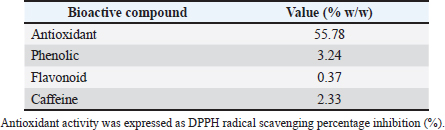
AbstractBackground: Oxidative stress can impair physical performance and delay recovery. Coffee-derived bioactive compounds may provide protective antioxidant effects. Although both have recognized individual benefits, the impact of combining coffee extract supplementation with swimming on oxidative stress and antioxidant status remains unclear. Aim: This study evaluated the effects of Gayo Arabica coffee extract and swimming exercise on oxidative stress biomarkers, antioxidant status, and skeletal muscle histopathology in Wistar rats. Methods: Twenty-four male Wistar rats (170–220 g) were randomly assigned to four groups (n=6/group): control (C), swimming exercise (SE), coffee extract (C400), and combined swimming exercise plus coffee extract (SE + C400). Gayo Arabica coffee extract was administered orally at 400 mg/kg body weight, 4 times per week for 4 weeks, while swimming exercise was performed 3 times per week for 40–60 minutes/session during the same period. Serum levels of malondialdehyde (MDA), 8-hydroxy-2′-deoxyguanosine (8-OHdG), superoxide dismutase (SOD), catalase (CAT), glutathione peroxidase (GPx), glutathione (GSH), and lactate were measured using ELISA. To determine significance, data were analyzed by one-way ANOVA followed by Tukey’s HSD post hoc test, with p ≤ 0.05 considered statistically significant. Results: Compared to controls, the SE + C400 group exhibited the lowest levels of MDA (1.76 vs. 3.25 nmol/ml) and 8-OHdG (1.41 vs. 2.87 ng/ml), alongside the highest SOD activity (80.95% vs. 45.54%). This group also showed increased CAT, GPx, and GSH levels, as well as significantly lower lactate concentrations (p < 0.05). While controls displayed mild inflammatory changes in muscle histopathology, the intervention groups maintained normal muscle architecture. Conclusion: Gayo Arabica coffee extract combined with swimming exercise reduced oxidative stress biomarkers and enhanced antioxidant defense in Wistar rats. The most favorable responses were observed in the combined intervention group, indicating a complementary effect of dietary antioxidants and exercise on redox homeostasis in experimental animal models. Keywords: Antioxidant status, Coffee, Oxidative stress, Swimming, Wistar rats. IntroductionPhysical exercise promotes beneficial physiological adaptations but also increases reactive oxygen species (ROS), which promote oxidative stress, lipid peroxidation, protein oxidation, and DNA damage (Mason et al., 2020; Wang et al., 2025). Excessive oxidative stress can impair recovery and limit physical performance. Common biomarkers of exercise-induced oxidative stress damage include malondialdehyde (MDA) and 8-hydroxy-2'-deoxyguanosine (8-OHdG). The antioxidant defense system comprises enzymatic antioxidants such as superoxide dismutase (SOD), catalase (CAT), and glutathione peroxidase (GPx), as well as non-enzymatic antioxidants such as GSH (Ismael et al., 2024; Niknam et al., 2025; Zhu et al., 2025). Lactate is an important physiological indicator of energy metabolism, exercise-induced fatigue, and physical performance, recognized as a marker of anaerobic metabolism and metabolic regulation in vivo (Brooks, 2020; Wackerhage et al., 2022). Coffee has recently gained considerable attention as an ergogenic beverage that may help attenuate exercise-induced oxidative stress (Martini et al., 2016; Bajaj and Ballal, 2021; Marcinčáková et al., 2022). Coffee contains several bioactive compounds, including caffeine, phenolics, trigonelline, diterpenes, chlorogenic acids, cafestol, kahweol, and melanoidins, all of which exhibit antioxidant activity (Martini et al., 2016; Witkowska, 2020; Wołosiak et al., 2023). These constituents contribute to coffee’s protective effects against the harmful effects of ROS. These compounds may protect against oxidative damage by scavenging ROS and supporting the endogenous antioxidant defense system (EFSA Panel on Dietetic Products et al., 2011; Rebollo- Hernanz et al., 2023; Wołosiak et al., 2023). Among these compounds, caffeine and chlorogenic acids have attracted particular scientific interest because of their potential roles in reducing fatigue, modulating oxidative stress, and enhancing antioxidant defenses (Ősz et al., 2022). Consistent with these effects, studies in humans and experimental animals have shown that coffee consumption may improve antioxidant capacity, increase GSH levels, and reduce oxidative damage, including DNA damage as measured by 8-OHdG (Martini et al., 2016). Chlorogenic acid has also been reported to influence oxidative DNA damage through its interactions with metal ions and ROS (Biesiadecki et al., 2025). Furthermore, coffee-based interventions have been shown to reduce oxidative stress markers while enhancing antioxidant activity (Dludla, 2023; Biesiadecki et al., 2025; Hernández-Aabreu and Álvarez-Martínez, 2025). Arabica and Robusta are the most consumed coffee species in Indonesia. Our previous study found that Arabica was preferred by 43.95% of Indonesian young adults and Robusta by 25.52% (Yusni et al., 2025). Arabica is also widely available worldwide and has many antioxidants (Martini et al., 2016). Therefore, Arabica was selected for this study to align with local habits and to examine its antioxidant activity during exercise-induced oxidative stress. Although both coffee and exercise can affect oxidative stress, few studies have examined their combined effects (Martini et al., 2016; Dludla, 2023; Biesiadecki et al., 2025; Hernández-Aabreu and Álvarez-Martínez, 2025). Most previous investigations have focused on either exercise or coffee interventions separately and have generally assessed only selected oxidative-stress or antioxidant markers. Consequently, it remains unclear whether coffee supplementation can enhance exercise-induced antioxidant responses and provide additional protection against oxidative damage. Moreover, few studies have simultaneously evaluated oxidative-stress biomarkers, antioxidant status, oxidative DNA damage, and histopathological alterations following combined coffee and exercise interventions. Addressing this knowledge gap is important for understanding the potential complementary effects of dietary antioxidants and exercise on redox homeostasis. Swimming exercise was selected based on our previous findings demonstrating significant metabolic effects of combined coffee and swimming interventions on lipid metabolism (Yusni, 2026a,b). In addition, swimming is a well-established aerobic endurance exercise model that modulates oxidative stress by stimulating ROS production while simultaneously enhancing antioxidant defense mechanisms (Lima et al., 2013; Stone et al., 2015). Therefore, swimming provides an appropriate experimental model for investigating oxidative stress and antioxidant responses. This study aimed to investigate the combined effects of Gayo Coffea arabica extract and swimming exercise on lactate, oxidative stress biomarkers (MDA and 8-OHdG), antioxidant status (SOD, CAT, GPx, and GSH), and skeletal muscle histopathology in Wistar rats. The study will assess whether coffee enhances exercise-induced antioxidant responses, reduces oxidative stress markers, or whether the combination provides greater protective effects than either intervention alone. The hypothesis was that the combined intervention would reduce oxidative stress and yield greater improvements in antioxidant status than either intervention alone. The novelty of this study lies in its integrative evaluation of the combined effects of C. arabica extract and swimming exercise on multiple dimensions of oxidative stress, including enzymatic and non-enzymatic antioxidant status, oxidative DNA damage, and histopathological changes. This comprehensive approach provides a broader assessment of redox adaptations than studies that focus on a single intervention or biomarker and may offer new insights into the interaction between dietary antioxidants and exercise-induced oxidative stress. Materials and MethodsExperimental animalsA total of 24 Wistar rats (Rattus norvegicus), aged 2.5–3 months, male, and weighing 170–220 g, were used in this research. The sample size was determined based on our previous experimental findings and was supported by established guidelines for animal studies, which recommend a minimum of 6 animals per group to detect meaningful biological effects (Charan and Kantharia, 2013; Yusni, 2026a,b). Nevertheless, a formal a priori power analysis was not performed, which should be considered a limitation of this study. The rats were acclimated to the laboratory conditions for 7 days to reduce stress and facilitate their adaptation to the environment. After the acclimation period, all rats participated in a 7-day swimming pre-adaptation protocol (5–10 minutes per day) to help them become familiar with the exercise procedure and to minimize water-induced stress-related responses. This brief pre-adaptation was consistently applied across all groups and was insufficient to induce chronic physiological or oxidative stress adaptations, as similar swimming adaptation procedures have been reported to reduce water-induced stress without promoting exercise-training adaptations (Lima et al., 2013; Jiang et al., 2014). After acclimatization and the pre-adaptation period, the rats were divided into two experimental treatments: swimming exercise and coffee extract supplementation. The animals were housed under standard laboratory conditions (22°C ± 2°C, 55% ± 5% humidity, and 12-hours light/dark cycle) with free access to standard chow and water. The animals were monitored daily for signs of pain, distress, illness, or abnormal behavior. No animals met the predefined humane-endpoint criteria during the study period. Experimental designRats were randomly assigned to four groups (n=6 per group): Control (C), Swimming Exercise (SE), Coffee Extract (C400, 400 mg/kg body weight), and Swimming Exercise plus Coffee Extract (SE + C400). The experiment lasted 4 weeks. All animals were handled daily using standardized procedures with similar timing and duration to minimize procedural stress, including control animals, which were handled in the same manner as the intervention groups without exposure to swimming exercise. Group allocation was performed using a pre-generated randomization scheme established during the study design. Interventions were administered by trained laboratory assistants not involved in the study design, while outcome assessors were blinded to group allocation through coded samples prepared by an independent technician. Full blinding of the intervention was not feasible due to the nature of the in vivo experimental procedures. SE procedureThe swimming exercise protocol was conducted in a glass tank (80 × 50 × 90 cm) filled with water to a depth of 70 cm and maintained at 30°C–32°C. The training regimen was adapted from a previous study that used swimming exercise and a coffee intervention in Wistar rats (Yusni, 2026a,b). Sessions were held in the morning (7:00–8:00 a.m.), three times per week (Monday, Wednesday, and Friday), for 30–50 minutes, with an average duration of 40 ± 5 minutes, and without an additional load. Exercise intensity was maintained at a moderate level and monitored through behavioral indicators of fatigue, such as loss of motor coordination and inability to continue swimming. Short rest periods were provided as necessary to prevent excessive fatigue. No physiological or biochemical markers were employed to objectively quantify exercise intensity. Water conditions were consistently maintained to minimize variability between sessions. Coffee interventionGayo Arabica coffee extract was used in this study and administered orally at a dose of 400 mg/kg body weight via intragastric gavage. This dosage was selected based on previous studies that used brewed coffee at the same concentration and reported physiological effects without adverse impacts on renal or hepatic parameters (Yusni and Yusuf, 2022b; Yusni, 2026a,b). The coffee extract was prepared using 96% ethanol and characterized before administration for antioxidant activity, total phenolic content, total flavonoid content, and caffeine content to ensure reproducibility and quality control (Table 1). Comprehensive chromatographic profiling, including quantification of chlorogenic acids by high-performance liquid chromatography (HPLC), was not conducted. The 400 mg/kg dose of Arabica coffee is estimated to provide approximately 4.0 mg/kg/day of caffeine and 8–20 mg/kg/day of total chlorogenic acid (CGA) on a dry-mass basis (Ludwig, 2014; Yusni et al., 2026). The coffee intervention was administered five times per week (Monday, Wednesday, Friday, Saturday, and Sunday) for 4 weeks. Control and swimming exercise groups received an equivalent volume of distilled water. Table 1. Chemical composition of Gayo Arabica coffee extract.
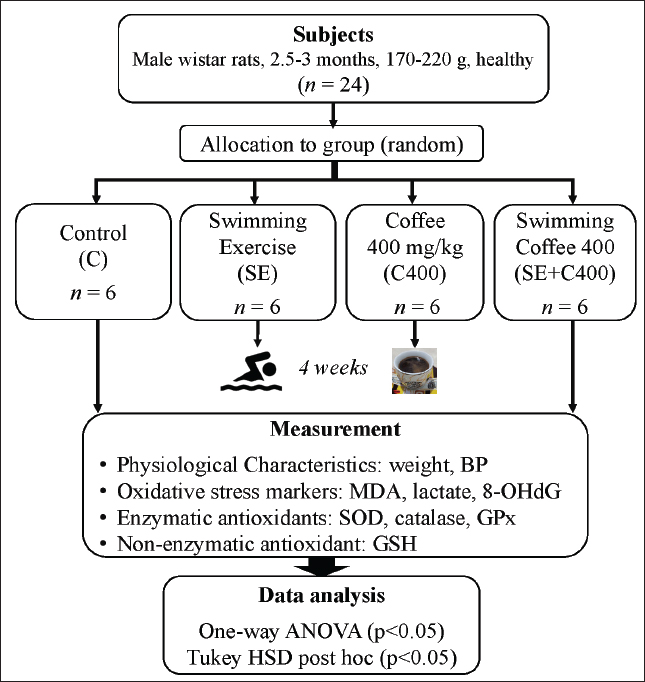
Preparation of Arabica coffee extractMedium-roasted coffee beans were first ground into a coarse powder and then sieved through a 40-mesh sieve. The resulting powder was weighed and stored in a clean, dry, airtight container. For extraction, 500 g of Arabica coffee powder was soaked in 5,000 ml of 96% ethanol. The mixture was agitated every 6 hours for 24 hours and then filtered. The remaining residue was re-macerated with fresh 96% ethanol for an additional 3 days. All resulting filtrates were combined. Finally, the combined filtrate was evaporated using a rotary evaporator at 45°C and further concentrated in a water bath at 50°C until a viscous extract was obtained. Chemical analysis of Arabica coffee extractA variety of chemical compounds in Arabica coffee extracts were analyzed, including total phenolic content, total flavonoid contents, antioxidant activity, and caffeine content, as shown in Table 1. Total phenolic and flavonoid content were determined using spectrophotometry, antioxidant activity was assessed using the DPPH method, and caffeine content was measured using gravimetric analysis. Blood sampling protocolBlood samples were collected once at the end of the experimental period. Retro-orbital bleeding was performed under isoflurane anesthesia, induced at 3%–4% and maintained at 1.5%–2.5% via a nasal cannula. About 2.5–3 ml of blood was aseptically collected from rats (170–220 g) using a heparinized capillary tube. Retro-orbital blood collection was a terminal procedure. After collection, the animals were euthanized according to institutional standards and tissues collected for histological analysis. A trained operator collected blood within recommended rodent limits to minimize physiological disturbance, including terminal limits outlined in animal welfare guidelines. All procedures complied with ARRIVE and AVMA guidelines (Leary, 2020; Percie, 2020). Blood was immediately transferred to plain tubes, allowed to clot at room temperature for 30–60 minutes, and then centrifuged at 1,500–2,000 × g for 10 minutes to obtain serum. Serum was aliquoted into labeled tubes and frozen at −80°C until enzyme-linked immunosorbent assay (ELISA) analysis of seven biochemical variables. Measurement and biochemical analysesBody weight was first measured using a calibrated digital scale. Next, systolic blood pressure was taken from the tail artery using a specialized rat tail-cuff sphygmomanometer (S-2) for small animals (Yusni and Yusuf, 2022a). These parameters were used to describe the initial characteristics of the experimental animals, not as baseline measurements of oxidative stress biomarkers. All biochemical biomarkers, including lactate, oxidative stress, and antioxidant-status markers, were measured by ELISA using a commercial kit according to the manufacturer's protocol. Lactate (mmol/l) was measured as an indicator of anaerobic metabolism. Oxidative-stress markers analyzed included MDA (nmol/ml) and 8-hydroxy-2’-deoxyguanosine (8-OHdG; ng/ml). Antioxidant status was expressed as enzymatic activity: SOD as a percentage, and GPx and CAT activities in U/ml. Non-enzymatic antioxidant levels, specifically GSH, were given in µmol/l. Histopathological analysisGastrocnemius muscle tissue from male Wistar rats was collected immediately after euthanasia and fixed in 10% buffered formalin. The samples were processed through dehydration, clearing, and paraffin embedding. Sections (approximately 4 µm thick) were prepared, mounted on glass slides, and stained using standard hematoxylin–eosin (H&E) procedures. Histopathological evaluation was performed using a light microscope at 100× magnification to assess structural alterations in the gastrocnemius muscle tissue. The primary purpose of the histopathological analysis was to descriptively characterize morphological changes in muscle architecture across the intervention groups. This characterization aimed to provide morphological evidence supporting the outcomes of biochemical markers. No semi-quantitative scoring system or statistical analysis was applied. Biochemical and antioxidant analysesAntioxidant activity was determined using the DPPH radical scavenging assay and expressed as percentage inhibition (%). Total phenolic and flavonoid contents were measured using spectrophotometric methods, while caffeine content was determined using the gravimetric method. Statistical analysisData were described as mean and standard deviation (mean ± SD). Normality and homogeneity of variances were assessed using the Shapiro–Wilk test and Levene’s test, respectively, before one-way ANOVA. Intergroup comparisons were carried out using the one-way ANOVA followed by Tukey’s HSD post hoc analysis. One-way ANOVA was selected because the study was designed to compare the overall responses among four predefined groups (Control, C400, SE, and SE + C400), each representing a distinct experimental condition. A p-value ≤ 0.05 was considered statistically significant. Data analyses were performed using SPSS software (version 22). The overall study design is described in Figure 1. The flowchart summarizes the experimental protocols, including the intervention groups, experiment duration, and statistical analysis, providing a clear overview of the study workflow.
Fig. 1. Schematic overview of the experimental design, including group allocation, interventions, and outcome measurements. Ethical approvalAll procedures involving animals were approved by the Medical and Health Ethics Committee of the Faculty of Medicine, Universitas Syiah Kuala (Approval No. 127/EA/FK/2025, dated June 19, 2025) and were carried out in accordance with the established ethical policy for the care and use of laboratory rat models. All experimental procedures were conducted in accordance with institutional guidelines for the care and use of laboratory animals and were reported in compliance with the ARRIVE guidelines. ResultsThe physical characteristics of the research subjects are displayed in Table 2. Mean body weight varied between 175.3 ± 2.9 g (SE + C400 group) and 179.7 ± 3.6 g (control group), and mean blood pressure varies between 85.0 ± 3.2 mmHg (C400 group) and 88.2 ± 3.7 mmHg (SE + C400 group). No significant differences were observed among groups for either body weight (F=2.75, p=0.07) or blood pressure (F=1.71, p=0.19). Before ANOVA analysis, all variables were assessed for normality and homogeneity of variance. Most variables met these assumptions (p ≥ 0.05). Lactate and 8-OHdG showed non-normal distributions and were therefore log-transformed. Following transformation, all variables satisfied the assumptions for ANOVA (p ≥ 0.05). Table 2. Baseline physiological characteristics of Wistar rats before intervention.
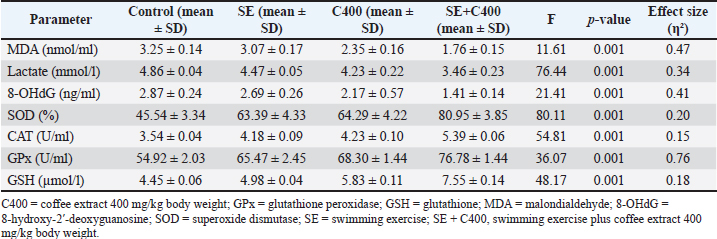
One-way ANOVA revealed significant differences among groups for all oxidative stress and antioxidant biomarkers evaluated in this study (p ≤ 0.05; Table 3). Levels of the oxidative stress biomarker MDA were elevated in the control group and reduced in the SE + C400 group, suggesting that the intervention decreased oxidative stress. Similarly, 8-OHdG followed this pattern, suggesting reduced DNA oxidative damage. Conversely, lactate levels were lower in SE + C400 than in controls, further supporting the beneficial effects of the intervention. The observed effect sizes (partial η²) ranged from 0.15 to 0.76, indicating intervention effect sizes ranging from small to large across the measured variables. Overall, the intervention produced varying, sometimes strong, reductions in oxidative stress and antioxidant biomarkers, with the largest effects in select parameters. Table 3. One-way ANOVA results showing the effects of Arabica coffee extract, swimming exercise, and their combined treatment on oxidative stress and antioxidant status in Wistar rats.
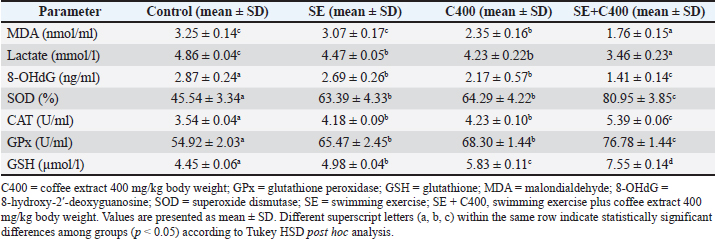
Regarding enzymatic antioxidants, SOD activity markedly escalated from 45.54% ± 3.34% in the control group to 80.95% ± 3.85% in the combined coffee and swimming group. Similar patterns were observed for CAT (3.54 ± 0.04 vs. 5.39 ± 0.06 U/ml) and GPx (54.92 ± 2.03 vs. 76.78 ± 1.44 U/ml), both of which showed substantial elevations, with the highest values persistently established in the combined intervention. For non-enzymatic antioxidants, GSH levels also increased, from 4.45 ± 0.06 µmol/l in the control group to 7.55 ± 0.14 µmol/l in the combined group. Conjointly, these findings reveal a compatible pattern, indicating that the combination of Arabica coffee extract and swimming-exercise intervention produced the most significant impact in reducing oxidative stress while intensifying the antioxidant protective system compared with either single intervention or the control group. Post hoc analysis using Tukey’s HSD test confirmed significant differences among groups for all measured biomarkers (Table 4). The SE + C400 group exhibited significantly lower MDA levels than the control group (mean difference=−1.499, 95% CI [−1.76, −1.24], p ≤ 0.05). Similarly, 8-OHdG levels were significantly lower in the SE + C400 group than in the control group (mean difference=−1.46, 95% CI [−2.02, −0.89], p ≤ 0.05). Lactate concentrations were also lowest in the SE + C400 group, whereas the control group exhibited the highest values. Table 4. Tukey HSD post hoc comparisons of oxidative stress and antioxidant status among treatment groups.
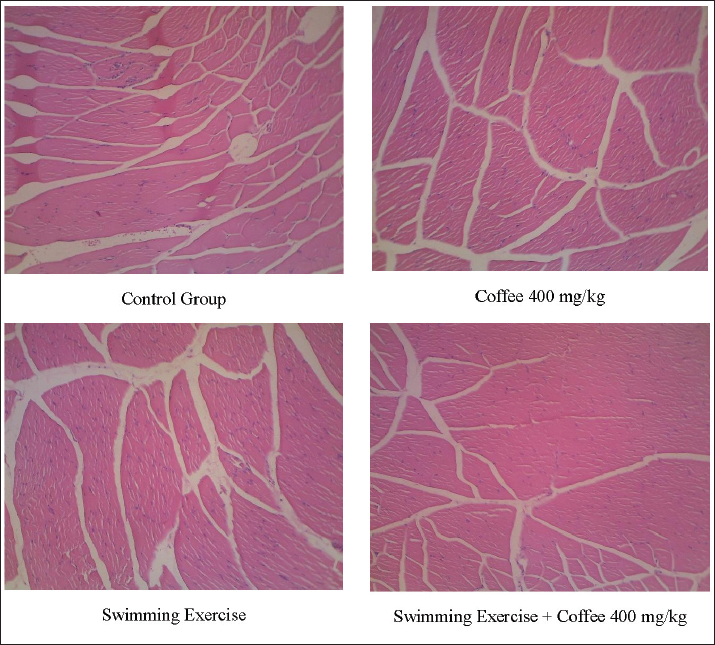
The activities of enzymatic antioxidants were highest in the SE + C400 group. SOD activity was significantly greater in the SE+C400 group than in the control group (18.75, 95% CI [29.02, 41.81], p ≤ 0.05). Likewise, GPx activity was significantly higher in the SE + C400 group than in the control group (mean difference=21.86, 95% CI [18.80, 24.92], p ≤ 0.05). Similar patterns were observed for CAT activity. For the non-enzymatic antioxidant marker, GSH levels increased progressively from the control group to the single-intervention groups and reached the highest concentration in the SE + C400 group. The coffee and swimming-exercise groups were classified within the same subset for several variables, indicating no significant differences between these two interventions. Tukey’s HSD analysis confirmed that each group differed significantly from every other group (p ≤ 0.05), indicating that the combined intervention led to the greatest increase in antioxidant capacity. In contrast, the control group consistently showed the lowest antioxidant values. Histopathological examination of gastrocnemius muscle sections stained with H&E is presented in Figure 2. Mild inflammatory cell infiltration within the interstitial spaces of muscle fibers was observed in the control group. No evidence of myofiber degeneration, necrosis, or major structural disruption was detected. In contrast, the SE, C400, and SE + C400 groups exhibited preserved muscle architecture, characterized by regularly arranged muscle fibers and the absence of apparent pathological abnormalities. Histopathological evaluation was descriptive and not based on a semi-quantitative scoring system.
Fig. 2. Representative H&E-stained sections of gastrocnemius muscle from each experimental group at 100× magnification. DiscussionThe study found that the combined treatment of swimming exercise and Arabica coffee extract has the potential to increase antioxidant protection and reduce oxidative stress better than either treatment alone. The reduction in MDA and 8-OHdG levels indicates reduced lipid peroxidation and DNA oxidation (Wang et al., 2023). Increases in SOD, CAT, GPx, and GSH indicate increased enzymatic and non-enzymatic antioxidant activity (Lu et al., 2021; Fairof, 2025; Xie et al., 2025). The observed effect may be related to the existence of bioactive compounds in coffee extract, including phenolic compounds, flavonoids, and caffeine, which contain antioxidant activity (Martini et al., 2016; Hernández-Abreu and Álvarez-Martínez, 2025). These chemical compounds are known to modulate oxidative balance, which sustains physiological responses to exercise (Hernández-Abreu and Álvarez-Martínez, 2025). Lower serum lactate levels indicate improved energy metabolism, reduced fatigue, and resistance to exercise-induced metabolic stress (Brooks, 2020; Huang et al., 2021; Wackerhage et al., 2022). The observed biomarkers of oxidative stress indicated that the greatest reduction in MDA was found in the combined group of swimming and coffee exercise interventions. These results suggest a combined effect in reducing lipid peroxidation. This finding is consistent with previous reports that found that the polyphenol content in coffee can counteract ROS (Mejia and Ramirez-Mmares, 2014; Legáth et al., 2022). Exercise is also believed to promote adaptive amplification of endogenous antioxidants (Mason et al., 2020). The decrease in 8-OHdG in the combined group supports the protective effect of the intervention against oxidative DNA damage. Although coffee intervention alone showed a partial impact and swimming exercise training alone was insufficient, their combination yielded the strongest attenuation. Hence, 8-OHdG is a sensitive marker of DNA oxidation (Zanolin, 2015; Graille, 2020). These results imply that concurrent nutritional and swimming exercise interventions may be more efficient in preserving genomic integrity than single treatments. The observed increases in antioxidant enzymes (SOD, CAT, and GPx) in the combined intervention group may represent an adaptive response to exercise-induced oxidative stress rather than a compensatory stress reaction. Exercise has been reported to induce mild oxidative stimuli that activate endogenous antioxidant defense systems, leading to increased enzymatic antioxidant activity (Wiecek et al., 2018; Xie et al., 2025). This response is consistent with the concept of hormesis described in the literature, in which low-level oxidative stress triggers beneficial physiological adaptations (Fedullo et al., 2021). Therefore, the increased antioxidant enzyme activity observed in this study may reflect enhanced redox adaptation associated with repeated exercise and coffee supplementation. The chemical compounds that act as antioxidants in coffee, including polyphenolic compounds such as CGA and caffeic acid, are presumed to be evidence of its antioxidant activity (Wołosiak, 2023; Hernández-Aayala et al., 2024; Biesiadecki et al., 2025). Coffee-derived polyphenols and caffeine may enhance antioxidant levels by modulating redox-sensitive enzyme systems (Mejia and Ramirez-Mares, 2014; Lire Wachamo, 2017). These compounds are known to modulate the antioxidant defense system by increasing the activity of antioxidant enzymes, reducing lipid peroxidation, and influencing the regulation of ROS in skeletal muscle (Ősz et al., 2022; Takada et al., 2022; Filip-Sstachnik et al., 2023). These results suggest that dietary or nutritional interventions may be needed to enhance the antioxidant benefits of exercise. ROS and reactive nitrogen species increase substantially and are continuously produced in aerobic tissues during physical exercise (Priftis et al., 2015; Suzuki, 2021; Wang et al., 2025). Moderate-intensity exercise is beneficial for signalling activity that promotes training adaptations, while excessive and exhaustive exercise stimulates increased oxidative stress and impairs muscle performance (Wang et al., 2025). Caffeine, a major bioactive compound in coffee, is stated to expand free fatty acid mobilization and spare muscle glycogen, possibly decreasing lactate formation (Spriet, 2014; Lawrence, 2020). These mechanisms may suggest the additive influence perceived when coffee supplementation was combined with swimming exercise. In addition, the lactate level was lowest in the combined group. While exercise training typically increases lactate levels through enhanced glycolysis, training adaptations can decrease its buildup by refining aerobic metabolism (Brooks, 2020; Huang et al., 2021). The observed improvement in redox balance may be attributed to the action of polyphenols, which exert redox-modulating effects by scavenging ROS and binding pro-oxidant metal ions (Dludla, 2023; Hernández-Aabreu and Álvarez-Martínez, 2025; Wang et al., 2025). Although the exact molecular mechanisms were not investigated in this study, previous reports suggest that the antioxidant and anti-inflammatory effects of coffee bioactive compounds may involve modulation of the Nrf2 and NF-κB signaling pathways. Therefore, these mechanistic interpretations remain speculative and require further experimental confirmation. Polyphenols in Arabica coffee may help boost the body's antioxidant responses in the combined intervention group in several ways. These natural compounds can activate a cellular signaling pathway (Nrf2/ARE) that increases the production of the body's antioxidant enzymes, such as SOD, CAT, and GPx. At the same time, they may help reduce inflammation by blocking another signaling pathway (NF-κB) and support cellular energy production by affecting PGC-1α (Wang et al., 2025). The stronger antioxidant effect observed in the SE + C400 group may result from the combined effects of exercise and coffee on related pathways. Caffeine, a major bioactive compound in coffee, acts as a potent antioxidant that contributes to these effects. Studies have stated that caffeine doses of 30–100 mg/kg/day reduce oxidative stress by decreasing MDA levels in a dose-dependent effect (Ősz et al., 2022). Similarly, a daily intake of 37.5 mg/kg caffeine reduces MDA while increasing GSH and hepatic GPx in the rat model. A clinical trial found that 5 mg/kg caffeine improves antioxidant capacity and increases GPx and SOD levels in endurance athletes. Several other coffee compounds, such as tannins and CGA, also show potent free radical scavenging effects, further decreasing MDA levels and supporting the overall redox balance pathway (Ősz et al., 2022). Taken together, these results suggest that a combination treatment of coffee-derived antioxidants with aerobic exercise can promote redox homeostasis and enhance physiological adaptation during the exercise training program. Caffeine may further contribute to these effects through its anti-inflammatory and antioxidant properties. In support of this, a study of non-alcoholic steatohepatitis (NASH) animal models given caffeine at a dose of 50 mg/kg found that caffeine can attenuate NF-κB activation and reduce ROS generation under oxidative stress conditions (Vargas- Pozada et al., 2022). Despite these findings, evidence regarding the interaction between caffeine supplementation and exercise-induced molecular adaptations remains inconsistent. For instance, the therapeutic effect of caffeine at 5 mg/kg alone did not significantly alter oxidative stress and exercise-induced muscle damage in female athletes after supramaximal exercise (Mahdavi, 2012). Similarly, combined effects of resistance training and caffeine at a dose of 6 mg/kg/body weight for 8 weeks did not significantly affect PGC-1α or NF-κB expression in mice fed a high-fat diet (Rahimi et al., 2025). Regular moderate-intensity aerobic exercise, such as swimming, is known to increase the activity of antioxidant enzymes and to promote their adaptive upregulation through repeated exposure to ROS (Pillon et al., 2014; Avloniti, 2017; Suzuki, 2021; Taherkhani et al., 2021). A previous study indicated that moderate-intensity exercise improves endogenous antioxidant enzyme activity (CAT, GPx, and SOD). A 6-week moderate-intensity training intervention may lower MDA levels and increase total antioxidant capacity in sedentary women, while accommodation in training frequency and intensity may further elevate GSH levels (Wang et al., 2025). A clinical trial in trained men showed that oral caffeine therapy at a dose of 3 mg/kg caused an increase in GSH levels immediately after exercise, but no significant differences were found in antioxidant enzymes (SOD, CAT, and GPx), non-enzymatic antioxidant defenses, or lipid peroxidation markers (MDA) (Filip-Stachnik et al., 2023). These findings suggest that acute caffeine intake has only a minimal impact on the prooxidant–antioxidant balance. GSH levels were highest in the swimming exercise and coffee intervention group, suggesting a combined activation of endogenous antioxidant activity. Several studies have reported that both aerobic training and coffee polyphenols independently enhance redox homeostasis (Mejia and Ramirez-Mares, 2014; Wang et al., 2025). Coffee supplementation was associated with a modest increase in GSH, suggesting a potential improvement in endogenous antioxidant activity (Silvério A dos, 2020). Regular coffee consumption appears to enhance GSH-mediated activity and mitigate DNA oxidative injury, suggesting a potential activity of coffee chemical compounds in enhancing the cellular redox balance pathway (Martini et al., 2016). The post-intake increase in the GSH/GSSG ratio suggests that caffeine in coffee, together with the diterpenes cafestol and kahweol, increases GSH synthesis and antioxidant defense through the activation of key enzymatic pathways involved in redox mechanisms (Radosinska et al., 2024). The findings of this study extend the evidence by suggesting that combining these approaches may offer enhanced benefits for maintaining intracellular antioxidant activity. Histopathological examination of the gastrocnemius muscle was conducted to assess structural changes resulting from swimming exercise and Arabica coffee extract intervention. This analysis was descriptive and not directly correlated with oxidative stress or antioxidant biomarkers. Consequently, serum parameters (MDA, 8-OHdG, SOD, CAT, GPx, and GSH) were interpreted independently as indicators of oxidative status. Histopathological evaluation demonstrated preserved muscle architecture in all intervention groups, including those treated with Arabica coffee extract, swimming exercise, or their combination, with no evidence of degeneration or inflammatory infiltration. In contrast, the control group exhibited mild focal myositis, a spontaneous lesion commonly observed in laboratory rats. These results suggest that neither swimming exercise nor Arabica coffee extract induced detectable histological damage to skeletal muscle. Due to the descriptive nature of the analysis and the absence of semi-quantitative scoring, these observations should be regarded as qualitative findings rather than definitive evidence of tissue-level protection. Overall, the combined intervention of Arabica coffee extract and swimming exercise was associated with improved oxidative status and preserved muscle histoarchitecture in Wistar rats. However, because this study was conducted in an animal model, extrapolation to humans should be approached with caution. Additional studies in human populations, particularly among athletes, are necessary to confirm these findings and clarify the underlying molecular mechanisms. LimitationA limitation of this study was the post-test-only design, which precluded baseline measurements. Although random allocation and standardized pre-adaptation procedures were implemented to minimize inter-group variability, the absence of pre-intervention data limits the assessment of within-subject changes and weakens causal inference. The pre-adaptation swimming protocol (5 to 10 minutes per day for 7 days) was applied uniformly across all groups and served solely to acclimate, not to induce training-related adaptations. Therefore, any potential effects are assumed to be non-differential between groups. In addition, no a priori power analysis was conducted to determine sample size. Although the number of animals was based on previous studies and established guidelines, the lack of a formal sample size calculation may affect the precision and statistical power of the findings. ConclusionA 4-week combined intervention of swimming exercise and Arabica coffee extract (400 mg/kg body weight) reduced lactate levels and the oxidative stress biomarkers MDA and 88-OHdG. It also increased concentrations of the antioxidant biomarkers SOD, CAT, GPx, and GSH, compared with both the control and single-intervention groups. These results suggest that the combined intervention produces a more favorable oxidative stress and antioxidant status than either intervention alone. Further research is required to elucidate the underlying mechanisms and to assess the applicability of these findings in human clinical trials. AcknowledgmentsThe authors would like to express their gratitude and appreciation to the Ministry of Higher Education, Science, and Technology of the Republic of Indonesia for funding this research under funding agreement number 150/UN11.11/PG.01.03/DPPM/2025. We also extend our gratitude to the Institute for Research and Community Service (LPPM) of Universitas Syiah Kuala (USK), Banda Aceh, Indonesia, for their assistance with this research. FundingThis study was funded by the Directorate of Research and Community Service, Directorate General of Research and Development, Ministry of Higher Education, Science, and Technology, under the contract No. 150/UN11.11/PG.01.03/DPPM/2025 dated 4 June 2025, for the Fundamental Regular Research Grant. Authors’ contributionYY: Conceptualization, Methodology, Supervision, Writing – Original Draft, Corresponding Author. SR: Investigation, Resources, Writing–Review and Editing. FM: Investigation (animal experiments), Data Curation, Writing–Review and Editing. SPN: Visualization, Validation, Writing–Review and Editing. All authors have read and approved the final version of the manuscript. Conflict of interestThe authors declare no conflict of interest. Data availabilityThe data supporting this study are obtainable from the corresponding author upon reasonable request. ReferencesArazi, H., Eghbali, E. and Suzuki, K. 2021. Creatine supplementation, physical exercise and oxidative stress markers: a review of the mechanisms and effectiveness. Nutrients 13(3), 1–17; doi:10.3390/nu13030869 Avloniti, Avloniti, A., Chatzinikolaou, A., Deli, C.K, Vlachopoulos, D, Marco, L.G., Leontsini, D., Draganidis, D., Jamurtas, A.Z., Mastorakos, G. and Fatouros, I.G. 2017. Exercise-induced oxidative stress responses in the pediatric population. Antioxidants 6(1), 1–16; doi: 10.3390/antiox6010006 Bajaj, D. and Ballal, S. 2021. Comparative study of antioxidant property of coffee and its additives. J. Pharm. Res. Int. 33(22A), 89–96; doi:10.9734/JPRI/2021/v33i22A31391 Biesiadecki, M., Kuna, E., Galiniak, S. and Mołon, M. 2025. Coffee as a source of antioxidants and an elixir of youth. Antioxidants 14(285), 1–24; doi: 10.3390/antiox14030285 Barcelos, R.P., Souza, M.A., Amaral, G.P., Stefanello, S.T., Bresciani, G., Fighera, M.R., Soares, F.A.A. and Barbosa, N.V. 2014. Caffeine supplementation modulates oxidative stress markers in the liver of trained rats. Life. Sci. 96(1–2), 40–45; doi:10.1016/j.lfs.2013.12.002 Brooks, G.A. 2020. ‘Lactate as a fulcrum of metabolism’. Redox Biol. 35, 1–12; doi:10.1016/j.redox.2020.101454 Cañas, S., Rebollo-Hernanz, M., Martín-Trueba, M., Braojos, C., Gil-Ramírez, A., Benítez, V., Martín-Cabrejas, M.A. and Aguilera, Y. 2023. Exploring the potential of phenolic compounds from the coffee pulp in preventing cellular oxidative stress after in vitro digestion. Food. Res. Int. 172(113116), 1–15; doi:10.1016/j.foodres.2023.113116 Charan, J. and Kantharia, N.D. 2013. How to calculate sample size in animal studies?. J. Pharmacol. Pharmacotherapeutics. 4(4), 303–306; doi:10.4103/0976-500X.119726 Dludla, P.V., Cirilli, I., Marcheggiani, F., Silvestri, S., Orlando, P., Muvhulawa, N., Moetlediwa, M.T., Nkambule, B.B., Mazibuko-mbeje, S.E., Hlengwa, N., Hanser, S., Ndwandwe, D., Marnewick, J.L., Basson, A.K. and Tiano, L. 2023 Potential benefits of coffee consumption on improving biomarkers of oxidative stress and inflammation in healthy individuals and those at increased risk of cardiovascular disease. Molecules 28(6440), 1–16; doi: 10.3390/molecules28186440 EFSA Panel on Dietetic Products, Nutrition and Allergies (NDA). 2011. Scientific Opinion on the substantiation of health claims related to coffee, including chlorogenic acids from coffee, and protection of DNA, proteins and lipids from oxidative damage (ID 1099, 3152, 4301), maintenance of normal blood glucose concentration (ID 1100, 1962), and contribution to the maintenance or achievement of a normal body weight (ID 2031, 4326) pursuant to Article 13(1) of Regulation (EC) No 1924/2006. EFSA J. 9(4), 1–23; doi: 10.2903/j.efsa.2011.2057 Fairof, M.H.Z., Ludin, A.F.M., Anas, N.D., Husna, A., Hasan, A.M.C., Abdullah, A.H.A., Ibrahim, F.W., Pramono, A. and Rajab, N.F. 2025. Early active exercise improves MDA, SOD, and GSH levels without memory or no changes in Wistar Rats. Indonesian Biomed. J. 17(4), 335–342; doi: 10.18585/inabj.v17i4.3663 Fedullo, A.L., Ciccotti, M., Giannotta, P., Alviti, F., Bernardi, M., Raguzzini, A., Toti, E. and Sciarra, T. 2021. Hormetic effects of bioactive compounds from foods, beverages, and food dressing: the potential role in spinal cord injury. Oxid. Med. Cell. Longev. 2021(6615752), 9-15; doi: 10.1155/2021/6615752 Filip-stachnik, A., Krzysztofik, M., Coso, J.D., Pałka, T. and Sadowska-Krępa, E. 2023 The effect of acute caffeine intake on resistance training volume, prooxidant-antioxidant balance and muscle damage markers following a session of full- body resistance exercise in resistance-trained men habituated to Caffeine’. J. Sports Sci. Med. 22, 436–446; doi: 10.52082/jssm.2023.436 Graille, M., Wild, P., Sauvain, J., Hemmendinger, M., Canu, I.G. and Hopf, N.B. 2020. Urinary 8-OHdG as a biomarker for oxidative: a systematic literature review and meta-analysis the chromatograph results. Int. J. Mol. Sci. 21(3743), 1–24; doi: 10.3390/ijms21113743 Hernández-abreu, S.A. and Álvarez-Martínez, F.J. 2025. Health effects of coffee products on oxidative stress-related metabolic disorders: an updated perspective. Proceedings 119(9), 1–7; doi: 10.3390/proceedings2025119009 Hernández-ayala, L.F., Guzmán-lópez, E.G., Pérez-gonzález, A. and Galano, A. 2024. Molecular insights on coffee components as chemical antioxidants. J. Mex. Chem. Soc. 68(4), 888–969; doi: 10.29356/jmcs.v68i4.2238 Huang, Z., Zhang, Y., Zhou, R., Yang, L. and Pan, H. 2021. Lactate as potential mediators for exercise-induced positive effects on neuroplasticity and cerebrovascular plasticity. Front. Physiol. 12(July), 1–12; doi: 10.3389/fphys.2021.656455 Hudáková, J., Marcinčáková, D. and Legáth, J. 2022. Study of antioxidant effects of selected types of coffee. Foliia Veterinaria 60(3), 34–38; doi:10.1515/fv-2016-0026 Jiang, P., Dang, R., Li, H., Zhang, L., Zhu, W., Xue, Y. and Tang, M. 2014. The impacts of swimming exercise on hippocampal expression of neurotrophic factors in rats exposed to chronic unpredictable mild stress. Evid.Based Complement. Alternat. Med. 2014(729827), 1–8; doi: 10.1155/2014/729827 Kobylińska, Z., Biesiadecki, M., Kuna, E., Galiniak, S. and Mołoń, M. 2025. Coffee as a source of antioxidants and an Elixir of Youth. Antioxidants 14(285), 1–24; doi:10.3390/antiox14030285 Lawrence L. Spriet. 2020. Caffeine and exercise performance: an update. Sports Sci. Exchange, 29(203), 1–5; doi: www.gssiweb.org/docs/default-source/sse-docs/spriet_sse_203_a03_final.pdf?sfvrsn=2 Leary, S., Underwood, W., Anthony, R., Cartner, S., Grandin, T., Greenacre, C., Gwaltney-Brant, S., McCrackin, M.A., Meyer, R., Miller, D., Shearer, J., Turner, T. and Yanong, R. (2020) AVMA Guidelines for the Euthanasia of Animals: 2020 Edition. Schaumburg, IL: American Veterinary Medical Association. Lima, F.D., Stamm, D.N., Della-Pace, I.D., Dobrachinski, F., Carvalho, Nelson R. de, Royes, L.F.F., Soares, F.A., Rocha, J. B., Gonzalez-Gallego, J. and Bresciani, G. 2013. Swimming training induces liver mitochondrial adaptations to oxidative stress in rats submitted to repeated exhaustive swimming bouts. PLoS One 8(2), 1–9; doi: 10.1371/journal.pone.0055668 Lire Wachamo, H. 2017. Review on health benefit and risk of coffee consumption. Med. Aromatic Plants 06(04), 1–12; doi: 10.4172/2167-0412.1000301 Lu, Y., Wiltshire, H.D., Baker, J.S. and Wang, Q. 2021. Effects of high intensity exercise on oxidative stress and antioxidant status in untrained humans: a systematic review. Biology 10(1272), 1–24; doi: 10.3390/biology10121272 Ludwig, I.A., Mena, P., Calani, L., Cid, C., Del Rio, D., Lean, M.E.J. and Crozier, A. 2014. Variations in caffeine and chlorogenic acid contents of coffees: What are we drinking?. Food and Funct. 5(8), 1718–1726; doi: 10.1039/c4fo00290c Mahdavi, R., Daneghian, S., Homayouni, A. and Jafari, A. 2012. Effects of caffeine supplementation on oxidative stress, exercise- induced muscle damage and leukocytosis. Pharm. Sci. 18(3), 177–182. Available via http://pharm-sci.tbzmed.ac.ir Martini, D., Bo, C. Del, Tassotti, M., Riso, P., Rio, D. Del, Brighenti, F. and Porrini, M. 2016. Coffee consumption and oxidative stress: a review of human intervention studies. Molecules 21(979), 1–20; doi: 10.3390/molecules21080979 Mason, S.A., Trewin, A.J., Parker, L. and Wadley, G.D. 2020. Antioxidant supplements and endurance exercise: current evidence and mechanistic insights. Redox Biol. 35(101471), 1–21; doi: 10.1016/j.redox.2020.101471 Mejia, E.G. De and Ramirez-mares, M.V. 2014. Impact of caffeine and coffee on our health. Trends Endocrinol. Metab. 25(10), 489–492; doi: 10.1016/j.tem.2014.07.003 Niknam, A., Gaeini, A.A., Hamidvand, A., Jahromi, M.K., Oviedo, G.R., Kordi, M. and Safarpour, F. 2025. High-intensity functional training modulates oxidative stress and improves physical performance in adolescent male soccer players: a randomized controlled tria. BMC Sports Sci. Med. Rehabil. 17(1), 1–13; doi: 10.1186/s13102-024-01037-7 Ősz, B.E., Jîtcă, G., Ștefănescu, R.E., Pușcaș, A., Tero-Vescan, A. and Vari, C.E. 2022. Caffeine and its antioxidant properties:it is all about dose and source. Int. J. Mol. Sci. 23(21), 1–21; doi: 10.3390/ijms232113074 Özdemir, K. and Demir, Y. 2025. Phenolic compounds in exercise physiology: dual role in oxidative stress and recovery adaptation. Food Sci. &. Nutr. 13(e70714), 1–18; doi:10.1002/fsn3.70714 Percie, N., Hurst, V., Ahluwalia, A., Alam, S., Avey, M.T., Baker, M., Browne, W.J., Clark, A., Cuthill, I.C., Dirnagl, U., Emerson, M., Garner, P., Holgate, S.T., Howells, D.W., Karp, N.A., Lazic, S.E., Lidster, K., Maccallum, C.J. and Macleod, M. 2020. The ARRIVE guidelines 2.0: updated guidelines for reporting animal researc. J. Physiol. 598(18), 3793–3801; doi: 10.1113/JP280389 Pillon, R., Assis, M., Pires, G., Terra, S., Bresciani, G., Rechia, M., Alexandre, F., Soares, A. and Vargas, N. 2014. Caffeine supplementation modulates oxidative stress markers in the liver of trained rats. Life Sci. 96(1–2), 40–45; doi: 10.1016/j.lfs.2013.12.002 Piralaiy, E., Ismael, B.R. and Hamidiyan, G. 2024. The effect of aerobic training on MDA, TAC, GPX, and SOD in heart tissue of Wistar rats. J. Sport Biomotor Sci. 16(31), 44–55; doi: 10.22034/SBS.2024.441193.1082 Pozada, V.P. 2022. Caffeine inhibits NLRP3 inflammasome activation by downregulating TLR4/MAPK/NF-κB signaling pathway in an experimental NASH model. Int. J. Mol. Sci. 23(9954), 1–19; doi:10.3390/ijms23179954 Priftis, A., Stagos, D., Konstantinopoulos, K., Tsitsimpikou, C., Spandidos, D.A., Tsatsakis, A.M., Tzatzarakis, M.N. and Kouretas, D. 2015. Comparison of antioxidant activity between green and roasted coffee beans using molecular methods. Mol. Med. Rep. 12, 7293–7302; doi: 10.3892/mmr.2015.4377 Radosinska, D., Jasenovec, T., Golianova, A., Szadvari, I., Vazan, R., Kovacicova, I., Snurikova, D., Vrbjar, N. and Radosinska, J. 2024. Controlled coffee intake enhances erythrocyte deformability, Na, K-ATPase activity, and GSH/GSSG ratio in healthy young adults. Biomedicines 12(2570), 1–12; doi: 10.3390/biomedicines12112570 Rahimi, M.R., Mahmazi, S., Abbaspoor, M., Rahnema, M., Saifald-, D.L., Din, Ghanbari, N., Kolahdouzi, S. and Golpasandi, H. 2025. Caffeine and exercise training alter expression of genes involved in inflammation and the browning of adipose tissue in high-fat diet-fed rats. Physiol. Pharmacol. 29, 171–183; doi: 10.61882/phypha.29.2.171 Rebollo-hernanz, M., Martín-trueba, M., Braojos, C., Gil-ramírez, A., Benítez, V., Martín-cabrejas, M.A. and Aguilera, Y. 2023. Exploring the potential of phenolic compounds from the coffee pulp in preventing cellular oxidative stress after in vitro digestion. Food Res. Int. 172(113116), 1–15; doi: 10.1016/j.foodres.2023.113116 Silvério, A. dos S.D., Pereira, R.G.F.A., Duarte, S.M. da S., Figueiredo, S.A., Ferreira, C. de S., Lima, A.R., Paula, F.B. de A., Araújo, T.H., Ferreira, E.B. and Rodrigues, M.R. 2020. Coffee beverage reduces ROS production and does not affect the organism’s response against Candida albicans. Rev. Ciênc Farm Básica Apl. 41(e684), 1–13; doi: 10.4322/2179-443X.0711 Spriet, L.L. 2014. Exercise and sport performance with low doses of caffeine. Sports Med. 44(Suppl 2), 175–184; doi: 10.1007/s40279-014-0257-8 Stone, V., Kudo, K.Y., Marcelino, T.B., August, M. and Matté, C. 2015. Swimming exercise enhances the hippocampal antioxidant status of female Wistar rats. Redox Rep. 20(3), 133–138; doi: 10.1179/1351000214Y.0000000116 Taherkhani, S., Valaei, K., Arazi, H. and Suzuki, K. 2021. An overview of physical exercise and antioxidant supplementation influences on skeletal muscle oxidative stress. Antioxidants 10(1528), 1–16; doi: 10.3390/antiox10101528 Takada, S., Fumoto, Y. and Kinugawa, S. 2022. Ergogenic effects of caffeine are mediated by myokines. Front. Sports Act. Living 4(5). 1–8; doi: 10.3389/fspor.2022.969623 Vargas-pozada, E.E., Ramos-tovar, E., Rodriguez-callejas, J.D., Cardoso-lezama, I., Galindo-g, S. and Talam, D. 2022. Caffeine inhibits NLRP3 inflammasome activation by downregulating TLR4/MAPK/NF-κB signaling pathway in an experimental NASH Model’. Int. J. Mol. Sci. 23(9954), 1–19; doi: 10.3390/ijms23179954 Wackerhage, H., Gehlert, S., Schulz, H., Weber, S., Ring-dimitriou, S. and Heine, O. 2022. Lactate thresholds and the simulation of human energy metabolism: contributions by the cologne sports medicine Group in the 1970s and 1980s. Front. Physiol. 13(July), 1–10; doi: 10.3389/fphys.2022.899670 Wang, Y., Luo, D., Jiang, H., Song, Y., Wang, Z., Shao, L. and Liu, Y. 2023. Effects of physical exercise on biomarkers of oxidative stress in healthy subjects: a meta-analysis of randomized controlled trials. Open Life Sci. 18(1), 1–11; doi: 10.1515/biol-2022-0668 Wang, Y.Y. et al. 2025. Phenolic compounds in exercise physiology: dual role in oxidative stress and recovery adaptation. Food Sci. Nutr. 13(e70714), 1–18; doi: 10.1002/fsn3.70714 Wiecek, M., Szymura, J., Maciejczyk, M. and Kantorowicz, M. 2018. Anaerobic exercise-induced activation of antioxidant enzymes in the blood of women and men. Front. Physiol. 9, 1–10; doi: 10.3389/fphys.2018.01006 Witkowska, A.M., Miro, I., Terlikowska, K.M., Kulesza, K. and Zujko, E. 2020. Coffee and its biologically active components: is there a connection to breast, endometrial, and ovarian? a review. Pol. J. Food Nutr. Sci. 70(3), 207–222; doi: 10.31883/pjfns/120017 Wołosiak, R., Pakosz, P., Druzynska, B. and Janowicz, M. 2023. Antioxidant activity of coffee components influenced by roast degree and preparation method. Appl. Sci. (Switzerland), 13(2057), 1–13; doi: 10.3390/app13042057 Xie, Y., Gu, Y., Li, Z., Zhang, L. and Hei, Y. 2025. Effects of exercise on different antioxidant enzymes and related indicators: a systematic review and meta-analysis of randomized controlled trials. Sci. Rep. 15(12518), 1–15; doi: 10.1038/s41598-025-97101-4 Yusni, Y. and Yusuf, H. 2022b. The effect of green coffee on blood pressure, liver and kidney functions in obese model rats. Open Access Macedonian J. Med. Sci. 10(A), 346–351; doi:10.3889/oamjms.2022.8134 Yusni, Y. and Yusuf, H. 2022a. A close positive association between obesity and blood pressure in rats. J. Vet. Sci. 16(1), 29–33. Yusni, Y., Yusuf, H. and Murzalina, C. 2025. Coffee drinking patterns and its potential impact on body weight and body mass index among young adults. Med. J. Armed. Forces. India; doi: 10.21157/j.ked.hewan.v16i1.23913, 81(5), 1–8; doi:10.1016/j.mjafi.2025.08.001 Yusni, Y., Yusuf, H., Murzalina, C. and Mahmudati, N. 2026. Synergistic modulation of lipid levels by coffee and swimming with evidence of a strong obesity- dyslipidemia link: a preclinical study. Int. J. Food Sci. 2026, 1–11; doi: 10.1155/ijfo/8436448 Yusni1, Y., Yusuf, H., Usman, S., Ichwansyah, F. and Mahmudati, N. 2026. Antidiabetic potential of brewed arabica coffee: modulation of GLUT4, insulin, and glucagon in STZ-induced rats. .J Nutr. Metab. 2026(2432900), 1–12. Zanolin, M.E., Girardi, P., Degan, P., Rava, M., Olivieri, M., Gennaro, G. Di, Nicolis, M. and Marco, R.D. 2015. Measurement of a urinary marker (8-hydroxydeoxy guanosine, 8-OHdG) of DNA oxidative stress in epidemiological surveys: a pilot study. Int. J. Biol. Markers 30(3), 341–345; doi:10.5301/jbm.5000129 Zhu, Y., Tian, M., Lu, S., Qin, Y., Zhao, T., Shi, H., Li, Z. and Qin, D. 2025. The antioxidant role of aromatic plant extracts in managing neurodegenerative diseases: a comprehensive review. Brain Res. Bull. 222(111253), 1–16; doi:10.1016/j.brainresbull.2025.111253 | ||

| How to Cite this Article |
| Pubmed Style Yusni Y, Rahman S, Meutia F, Nugraha SP. Combined Arabica coffee extract and swimming exercise modulate oxidative stress and antioxidant status in Wistar rats. Open Vet. J.. 2026; 16(7): 4228-4240. doi:10.5455/OVJ.2026.v16.i7.10 Web Style Yusni Y, Rahman S, Meutia F, Nugraha SP. Combined Arabica coffee extract and swimming exercise modulate oxidative stress and antioxidant status in Wistar rats. https://www.openveterinaryjournal.com/?mno=303953 [Access: June 30, 2026]. doi:10.5455/OVJ.2026.v16.i7.10 AMA (American Medical Association) Style Yusni Y, Rahman S, Meutia F, Nugraha SP. Combined Arabica coffee extract and swimming exercise modulate oxidative stress and antioxidant status in Wistar rats. Open Vet. J.. 2026; 16(7): 4228-4240. doi:10.5455/OVJ.2026.v16.i7.10 Vancouver/ICMJE Style Yusni Y, Rahman S, Meutia F, Nugraha SP. Combined Arabica coffee extract and swimming exercise modulate oxidative stress and antioxidant status in Wistar rats. Open Vet. J.. (2026), [cited June 30, 2026]; 16(7): 4228-4240. doi:10.5455/OVJ.2026.v16.i7.10 Harvard Style Yusni, Y., Rahman, . S., Meutia, . F. & Nugraha, . S. P. (2026) Combined Arabica coffee extract and swimming exercise modulate oxidative stress and antioxidant status in Wistar rats. Open Vet. J., 16 (7), 4228-4240. doi:10.5455/OVJ.2026.v16.i7.10 Turabian Style Yusni, Yusni, Safrizal Rahman, Firdalena Meutia, and Shyakilla Poetrie Nugraha. 2026. Combined Arabica coffee extract and swimming exercise modulate oxidative stress and antioxidant status in Wistar rats. Open Veterinary Journal, 16 (7), 4228-4240. doi:10.5455/OVJ.2026.v16.i7.10 Chicago Style Yusni, Yusni, Safrizal Rahman, Firdalena Meutia, and Shyakilla Poetrie Nugraha. "Combined Arabica coffee extract and swimming exercise modulate oxidative stress and antioxidant status in Wistar rats." Open Veterinary Journal 16 (2026), 4228-4240. doi:10.5455/OVJ.2026.v16.i7.10 MLA (The Modern Language Association) Style Yusni, Yusni, Safrizal Rahman, Firdalena Meutia, and Shyakilla Poetrie Nugraha. "Combined Arabica coffee extract and swimming exercise modulate oxidative stress and antioxidant status in Wistar rats." Open Veterinary Journal 16.7 (2026), 4228-4240. Print. doi:10.5455/OVJ.2026.v16.i7.10 APA (American Psychological Association) Style Yusni, Y., Rahman, . S., Meutia, . F. & Nugraha, . S. P. (2026) Combined Arabica coffee extract and swimming exercise modulate oxidative stress and antioxidant status in Wistar rats. Open Veterinary Journal, 16 (7), 4228-4240. doi:10.5455/OVJ.2026.v16.i7.10 |


