




| Short Communication | ||
Open Vet. J.. 2026; 16(7): 4282-4287 Open Veterinary Journal, (2026), Vol. 16(7): 4282-4287 Short Communication Rhinonyssid mites among birds: Brief report from 10 European countriesIvan Dimov1, Ilia Tsachev2,3,4, Borislava Chakarova5 and Magdalena Baymakova6*1Laboratory of Parasitology, Zoological Institute, Russian Academy of Sciences, Saint Petersburg, Russian Federation 2Department of Clinical Sciences, Faculty of Veterinary Medicine, Medical University, Pleven, Bulgaria 3Department of Microbiology, Infectious and Parasitic Diseases, Faculty of Veterinary Medicine, Trakia University, Stara Zagora, Bulgaria 4Department of Agricultural and Forestry Sciences, Bulgarian Academy of Sciences, Sofia, Bulgaria 5Department of Hygiene, Epidemiology, Microbiology, Parasitology and Infectious Diseases, Faculty of Medicine, Trakia University, Stara Zagora, Bulgaria 6Department of Infectious Diseases, Military Medical Academy, Sofia, Bulgaria *Corresponding Author: Magdalena Baymakova. Department of Infectious Diseases, Military Medical Academy, Sofia, Bulgaria. Email: dr.baymakova [at] gmail.com Submitted: 24/12/2025 Revised: 22/05/2026 Accepted: 02/06/2026 Published: 02/07/2026 © 2026 Open Veterinary Journal
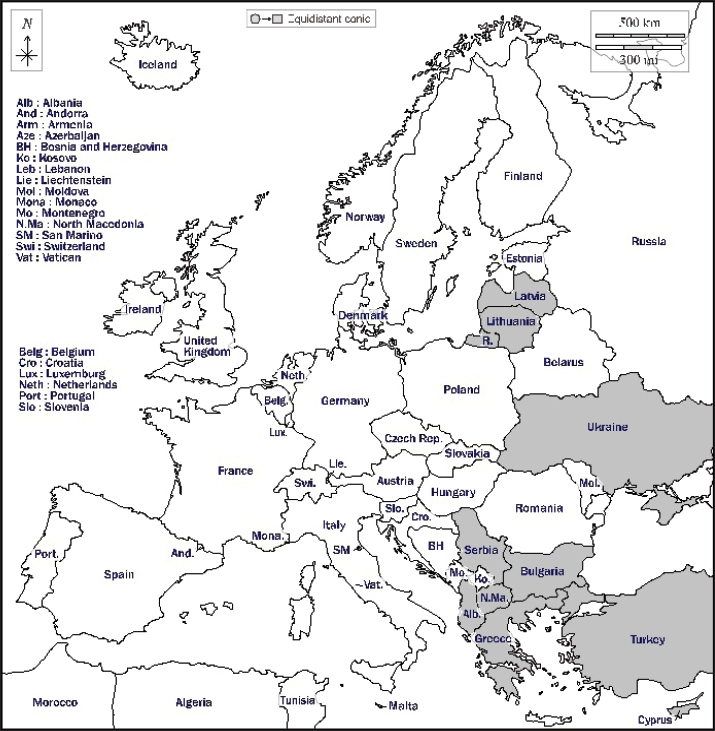
AbstractBackground: In recent years, we have observed rapid dynamics in climate change, and research in the field of parasitology (such as new knowledge and diagnostic techniques) has developed to a high level. Therefore, studying the taxonomy of rhinonyssids has attracted the attention of many researchers worldwide. Aim: The purpose of the present study was to determine the degree of parasitism of Rhinonyssidae mites among birds in 10 European countries (Albania, Bulgaria, Cyprus, Greece, Latvia, Lithuania, North Macedonia, Serbia, Türkiye, and Ukraine). Methods: The survey was conducted between January 1st, 2023, and June 30th, 2025, at the Laboratory of Parasitology, Zoological Institute, Russian Academy of Sciences, Saint Petersburg, Russian Federation. A total of 322 bird specimens belonging to 6 orders, 15 families, 19 genera, and 20 species were studied. The present research was mainly based on morphometric characteristics of the studied animal species. Results: Of all the birds examined, 52 specimens (16.1%) were parasitized by Rhinonyssidae. Parasite mites belong to the genera Larinyssus, Mesonyssus, Ptilonyssus, Rallinyssus, Rhinoecius, Rhinonyssus, and Sternostoma. We found that the yellowhammer (Emberiza citrinella) bird species is a new host for two rhinoyssid species: Ptilonyssus phylloscopi and Sternostoma batis. Conclusion: The current survey complemented and increased knowledge about Rhinonyssid mites among European birds. To the best of our knowledge, this is the first report of P. phylloscopi and S. batis among birds (E. citrinella) from Bulgaria. The results of this study may improve the control and prevention of the spread of certain parasites among animals in European countries. Keywords: Birds, Emberiza citrinella, Europe, Parasitology, Rhinonyssid mites. IntroductionMites of the family Rhinonyssidae are a group of obligate blood-feeding respiratory endoparasites of birds (Fain, 1956; Pence, 1975; Dimov and Spicer, 2013; Dimov, 2018). Currently, the world fauna of rhinonyssids includes more than 600 species arranged in 11 genera (De Rojas et al., 2020; Sаnchez-Carriоn et al., 2023; Haarder and Dimov, 2024; Dimov and Skirnisson, 2025). Rhinonyssid mites parasitize in the respiratory system of birds. Moving along the surface of the epithelial tissue of these parts of the respiratory system, rhinonyssids feed on host blood or lymph (Vitzthum, 1935; Bell, 1996). When fed, rhinonyssids injure the nasal epithelium and blood vessels (De Rojas et al., 2001), causing a bird disease known as Rhinonyssoidosis avium (Dimov, 2011). The study of rhinonyssid mites is of undoubted practical interest for developing effective methods and means of combating them. Studies of these mites are also of theoretical interest, since they are one of the most highly specialized and morphologically advanced phylogenetic lines of parasitic gamasid mites. Using this taxonomic group as an example, one can study the development of parasitism in gamasid mites (Gamasina) and other issues of parasite-host relationships. The aim of the present study was to determine the degree of parasitism of Rhinonyssidae mites among birds in 10 European countries. Materials and MethodsData collectionIn 1724, Peter I (also known as Peter the Great) established the Russian Academy of Sciences (RASs). The RAS consists of 13 specialized scientific divisions, four territorial branches, and 15 regional scientific centers, including the Zoological Institute. This research was cross sectional and prospective. The survey was conducted between January 1st, 2023, and June 30th 2025, at the Laboratory of Parasitology, Zoological Institute, RAS, Saint Petersburg, Russian Federation. Birds were collected from ten European countries: Albania, Bulgaria, Cyprus, Greece, Latvia, Lithuania, North Macedonia, Serbia, Türkiye, and Ukraine (Fig. 1). Veterinarians, molecular biologists, ornithologists, and other scientists collected dead birds that were provided to us. Bird collection efforts were comparable and identical across countries. The birds were collected from the wild—different mountainous areas, plains, lakes, moors, swamps, and so on. The animals were placed in special protective bags, then stored and transported to the laboratory of parasitology. The transportation of the animals was carried out in compliance with all sanitary and environmental standards in accordance with the legislation of the European Union and the Russian Federation.
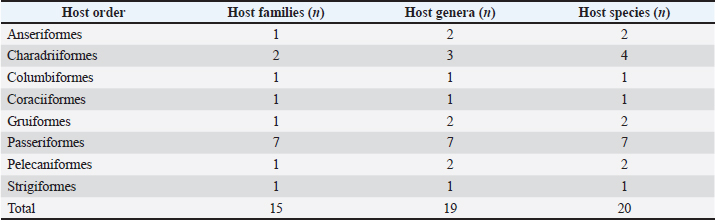
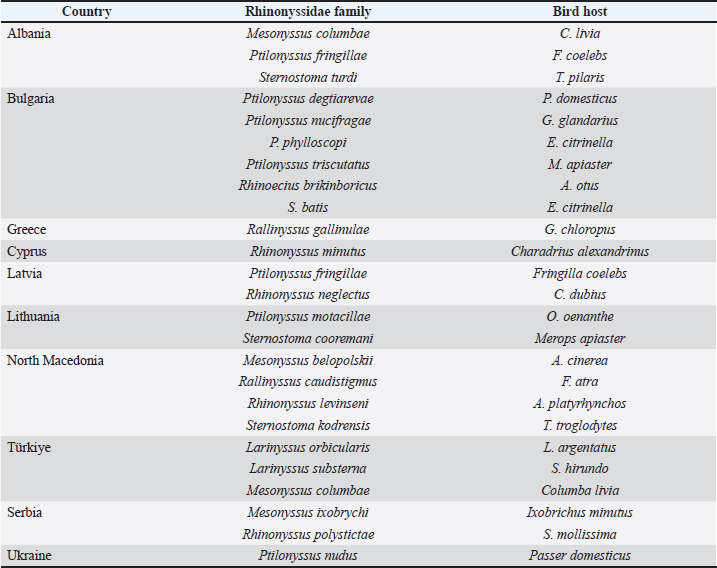
Fig. 1. European countries from which the birds were selected for the present research (in gray) (Map adapted from: https://www.d-maps.com/pays.php?num_pay=186&lang=en). Inclusion and exclusion criteriaThe inclusion criteria for the present survey were as follows: (1) deceased birds; (2) deceased birds in good condition (without decomposition of internal organs); (3) birds suitable for storage, transport, and laboratory testing; (4) birds for which there was written informed consent from the veterinary authorities of the relevant country. The exclusion criteria for the current study were as follows: (1) live birds; (2) deceased birds with decomposing internal organs; (3) birds not suitable for storage and transport to a laboratory; (4) birds for which there is no written informed consent from the veterinary authorities. Data analysisAll dead birds were provided for analysis by ornithologists and placed in glass jars with 80% ethanol. Mites were then collected from these fixed host specimens from the dissected nasal cavities. This dissection was performed using small scissors and a binocular microscope. An Olympus SZX 10 binocular microscope was used to open the nasal cavity of birds. microscopes Leica DM 5000B and DrFocal microscopes with a digital camera Levenhuk C35 NG 350K were used to identify mite species. All mites were placed in test tubes with a detailed description of the collection location and host species for subsequent species identification. The collected mites were then prepared into specimens using a standard method (Dimov, 2018). All found mites were preserved in 70% ethanol. Then, mites were cleared in 75% lactic acid for 2 hours, put again in 70% ethanol for 2 minutes and finally mounted on slides with Hoyer’s medium. In the present study, molecular analysis of Rhinonyssid mites was not performed due to financial and technical reasons. This leads to limitations in the interpretations and conclusions that can be drawn. In this regard, we will consider molecular analysis of Rhinonyssid mites for our future research. Ethical approvalThe current study was permitted and approved by the Local Ethics Committee at Zoological Institute, RAS, Saint Petersburg, Russian Federation (ZIN RAS-12/15 December 2022). Written informed consent for participation in the present study was obtained from the relevant veterinary authorities. All animals involved in the study were found dead in the wild. The direct cause of death was not investigated, as this was not the purpose of this research. No violence or inhumane behavior was used against the different animal species. Results and DiscussionData from the current research showed the presence of rhinoyssids in seven of the ten countries studied. A total of 322 bird specimens belonging to 6 orders, 15 families, 19 genera, and 20 species were studied (Table 1). The following number of birds surveyed by country was as follows: Albania (n=49); Bulgaria (n=50); Cyprus (n=4); Greece (n=5); Latvia (n=46); Lithuania (n=32); North Macedonia (n=31); Serbia (n=25); Türkiye (n=51); and Ukraine (n=29). The host–parasite relationship was presented in Table 2. Table 1. Orders of birds examined for nasal mites from several European countries and numbers of host families, genera, and species examined from each order.
Table 2. Rhinonyssidae mites and bird hosts in 10 European countries.
Fifty-two specimens (16.1%; 52/322) out of all examined birds were parasitized by Rhinonyssidae. Considering the limited number of birds studied, there was a wide distribution of Rhinonyssidae mites on hosts in European countries. During the current research, the percentage of birds parasitized with Rhinonyssidae mites was as follows: common eider (Somateria mollissima), 7.6% (1/13); common moorhen (Gallinula chloropus), 20.0% (1/5); common tern (Sterna hirundo), 8.3% (1/12); Eurasian chaffinch (Fringilla coelebs), 8.5% (3/35); Eurasian coot (Fulica atra), 22.2% (2/9); Eurasian jay (Garrulus glandarius), 14.2% (1/7); Eurasian wren (Troglodytes troglodytes), 11.1% (1/9); European bee-eater (Merops apiaster), 9.5% (2/21); European herring gull (Larus argentatus), 36.3% (4/11); fieldfare (Turdus pilaris), 7.6% (1/13); gray heron (Ardea cinerea), 100.0% (1/1); house sparrow (Passer domesticus), 18.4% (7/38); Kentish plover (Anarhynchus alexandrinus), 25.0% (1/4); little bittern (Botaurus minutus), 33.3% (4/12); little ringed plover (Charadrius dubius), 13.6% (3/22); long-eared owl (Asio otus), 100.0% (1/1); mallard (Anas platyrhynchos), 16.6% (2/12); northern wheatear (Oenanthe oenanthe), 19.0% (4/21); rock dove (Columba livia), 13.2% (7/53); and yellowhammer (Emberiza citrinella), 21.7% (5/23). Parasite mites belonged to the genera Larinyssus, Mesonyssus, Ptilonyssus, Rallinyssus, Rhinoecius, Rhinonyssus, and Sternostoma. The bird species E. citrinella from Bulgaria was reported as a new host for two rhinoyssid species: P. phylloscopi and Sternostoma batis. In Europe, studies of Rhinonyssidae started at the beginning of the 19th century and were carried out in Austria, Belgium, Bulgaria, Denmark, Estonia, former Czechoslovakia (present countries: Czech Republic and Slovakia), France, Germany, Hungary, Iceland, Italy, Latvia, the Netherlands, Poland, Portugal, Republic of Moldova, Romania, Serbia, Spain, Ukraine, and the United Kingdom (UK) (Giebel, 1871; Trouessart, 1894; Trouessart, 1895; Hirst, 1921; Hirst, 1923; Vitzthum, 1935; Castro and Pereira, 1947; Bregetova, 1953; Fain, 1964; Cerny, 1970; Shumilo and Lunkashu, 1970; Sixl, 1972; Beron, 2020; De Rojas et al., 2020; Dimov, 2020; Dimov, 2024; Haarder and Dimov, 2024; Dimov and Skirnisson, 2025; Haarder and Dimov, 2025). Despite the historical background, at this stage, detailed surveys in peer-reviewed journals specifically on Rhinonyssid mites are few. In 2020, De Rojas et al. managed to identify 179 mite specimens belonging to 27 species and eight genera from the northwestern regions of the Russian Federation (De Rojas et al., 2020). This is still one of the few comprehensive surveys on Rhinonyssid mites (Mesostigmata: Rhinonyssidae). Furthermore, these authors reported 18 new mite-bird associations that had been documented for the first time. In 2023, Sánchez-Carrion et al. appreciated the usefulness of specific genomic regions (internal transcribed spacer ITS1, 5.8S rDNA, and ITS2 regions of the ribosomal DNA) from eighteen species of Rhinonyssid mites belonging to four genera (Sánchez-Carrión et al., 2023). Spanish scientists reported on the utility of 28S ribosomal RNA gene domains (domains D1–D3 28S rRNA) for molecular classification and phylogeny of Rhinonyssid mites (Sánchez-Carrión et al., 2025). These Spanish authors found that domains D1–D3 28S rRNA can effectively differentiate between species within the “hirsti”, “motacillae”, “pari”, and “sairae” complexes of the Ptilonyssus genus and the “columbae” and “melloi” complexes of the Tinaminyssus genus. Our research was based on morphometric characteristics of Rhinonyssid mites, which is why it is difficult to compare our results with the few other studies on the topic of the Rhinonyssidae family. The present study has some limitations that need to be addressed. First, the taxonomy of the family Rhinonyssidae has been based on morphometric characteristics, which makes identification very difficult in many groups of closely related species. Second, an important limitation of this research was the small number of birds (n=322), due to logistical challenges in transporting the animals and funding constraints. Despite these limitations, this survey has its merits. To the best of our knowledge, this is the first report of P. phylloscopi and S. batis among birds (E. citrinella) from Bulgaria. Furthermore, the results of the current study may improve the surveillance, prevention, and control of the spread of certain parasites among animal species in Europe. ConclusionThis research’s result is the definition of the degree of parasitism of Rhinonyssidae mites on birds from several European countries. The study of Rhinonyssid mites is important because they can be potential vectors of different infectious or parasitic diseases of zoonotic characteristics. This is a hypothesis that should be considered by the scientific community, and future research may show whether this hypothesis will be confirmed or rejected. In this regard, research in this area of parasitology (Rhinonyssid mites) opens up new horizons in the fight against different diseases among animals. AcknowledgmentsThe authors thank all collaborators from the different European countries for the help and assistance in the collection of the birds. Furthermore, the authors thank their families for providing them with the time and support required to complete this survey in a timely manner. FundingThe main part of the present research was carried out with the support of the Ministry of Science and Higher Education of the Russian Federation (Project № 125013001089-0). The current survey received additional support from the Bulgarian Ministry of Education and Science in the frame of the Bulgarian National Recovery and Resilience Plan, Component “Innovative Bulgaria”, Project BG-RRP-2.004-006 “Development of research and innovation at Trakia University in service of health and sustainable well-being”. Authors’ contributionsAll authors made a significant contribution to the work reported, whether that is in the conception, study design, execution, acquisition of data, analysis and interpretation, or in all these areas; took part in drafting, revising or critically reviewing the article; gave final approval of the version to be published; have agreed on the journal to which the article has been submitted; and agree to be accountable for all aspects of the work. Conflict of interestThe authors declare no conflicts of interest. The funders had no role in the design of the study; in the collection, analyses, or interpretation of data; in the writing of the manuscript; or in the decision to publish the results. Data availabilityAll data are provided in the manuscript. ReferencesBell, P.J. 1996. The life history and transmission biology of Sternostoma tracheacolum Lawrence (Acari: rhinonyssidae) associated with the Gouldian finch Erythrura gouldiae. Exp. Appl. Acarol. 20, 323–341. Beron, P. 2020. Acarorum Catalogus VI. Order mesostigmata. Gamasina: dermanyssoidea (Rhinonyssidae, Spinturnicidae). Pensoft Natn. Mus. Nat. Hist. Sofia. 265. Bregetova, N.G. 1953. On the fauna of the gamasid mites of the Far East. Parazitologicheskiy Sbornik 15, 302–338. Castro, M.P. and Pereira, C. 1947. Acaros nasicolas (Parasitiformes: Rhinonyssidae) do pardal – “Passer domesticus L.”. Archos. Inst. Biol. S. Paulo 18(7), 125–133. Cerny, V. 1970. Die parasitischen Arthropoden der synanthropen Taubenvögel einer Großstadt. Angew. Parasitol. 11(4), 243–248. De Rojas, M., Doña, J. and Dimov, I. 2020. A comprehensive survey of Rhinonyssid mites (Mesostigmata: Rhinonyssidae) in Northwest Russia: New mite-host associations and prevalence data. Biodivers. Data. J. 8, e49535. De Rojas, M., Mora, M.D., Ubeda, J.M., Cutillas, C., Navajas, M. and Guevara, D.C. 2001. Phylogenetic relationships in rhinonyssid mites (Acari: Rhinonyssidae) based on mitochondrial 16S rDNA sequences. Exp. Appl. Acarol. 25(12), 957–967. Dimov, I. 2018. Rhinonyssid mites of birds of the North-West of Russia. Saint Petersburg, 232 pp. (in Russian) Dimov, I. 2024. First record of two nasal mites genus Rhinonyssus (Mesostigmata, Rhinonyssidae) parasitizing birds from Estonia. Parasitologia 4(3), 288–295. Dimov, I.D. 2011. Rhinonyssoidosis avium. VetPharma. 3–4, 88–90. Dimov, I.D. 2020. Taxonomic diversity and morphology of mites of the family Rhinonyssidae of the Northwest of Russia. Russian: LLC Zhigulin, p. 214. Dimov, I.D. and Skirnisson, K. 2025. A new species of nasal mites of the genus Rhinonyssus (Mesostigmata, Rhinonyssidae) from Anser anser and first record of co-parasitism of Rhinonyssus rhinolethrum and Rhinonyssus caledonicus from Iceland. Acarina 33(1), 79–84. Dimov, I.D. and Spicer, G.S. 2013. A new species of nasal mite of the genus Rhinonyssus (Mesostigmata: Rhinonyssidae) from Leningrad Province, Russia. Syst. Appl. Acarol. 18(3), 291–296. Fain, A. 1956. Les acariens de la famille Rhinonyssidae Vitzthum 1935 parasites de fosses nasales des oiseaux au Ruanda-Urundi (Note preliminaire). Rev. Zool. Bot. Afr. 53(1-2), 131–157. Fain, A. 1964. Les acariens parasites nasicoles des oiseaux de Belgique IV. Notes sur quelques Rhinonyssidae avec description de deux especes nouvelles. Bull. Ann. Soc. Roy. Ent. Belg. 100(3), 55–61. Giebel, A. 1871. Ueber einige Milben. Z. Ges. Naturw. 38, 29–32. Haarder, S. and Dimov, I. 2024. A new species of Rhinonyssidae (Mesostigmata) nasal mite (Ptilonyssus simplex n. sp.) from the Bohemian waxwing in Denmark. Acarologia 64(3), 961–967. Haarder, S. and Dimov, I.D. 2025. A new species of nasal mite genus Ptilonyssus (Mesostigmata: Rhinonyssidae) from Parus major and the first record of Rhinoecius brikinboricus from Asio otus in Denmark. Persian. J. Acarol. 14(1), 87–95. Hirst, S. 1921. On some new parasitic mites. Proc. Zool. Soc. 769, 802. Hirst, S. 1923. On some new or little-known species of Acari. Proc. Zool. Soc. Lond. 1000, 971–1000. Pence, D.B. 1975. Keys, species and host list, and bibliography for nasal mites of North American birds (Acarina: Rhinonyssinae, Turbinoptinae, Speleognathinae, and Cytoditidae). Special Pub. Museum Texas Tech. Univ. 148 pp. Sánchez-Carrión, S.A., Dimov, I., Márquez Jiménez, F.J. and De Rojas Álvarez, M. 2023. Morphometrical identification and phylogenetic analysis of Rhinonyssidae (Acari: mesostigmata) parasitizing avian hosts: New molecular data. Microorganisms 11(7), 1783. Sánchez-Carrión, S.A., Márquez, F.J. and De Rojas, M. 2025. Utility of 28S ribosomal RNA gene domains for molecular classification and phylogeny of Rhinonyssid mites. Pathogens 14(2), 156. Shumilo, R.P. and Lunkashu, M.I. 1970. Nasal mites of the family Rhinonyssidae (Parasitiformes: Mesostigmata) of land birds of the SW USSR. Kishinev 1, 127. (in Russian) Sixl, W. 1972. Nasale Milben einheimischer Vögel und Kleinsäuger. Mitt. Naturw. Ver. Steiermark, 102, 173–174. Trouessart. 1894. Note sur les acariens parasites des fosses nasales des oiseaux. Cr. Seanc. Soc. Biol. 1(10), 723–724. Trouessart, E. 1895. Premiere note sur les Acariens des fosses nasales des Oiseaux. Ann. Soc. Ent. France . Vitzthum, H. 1935. Milben aus der Nasenhöhle von Vögeln. J. Ornitol. 83(4), 563–587. | ||
| How to Cite this Article |
| Pubmed Style Dimov I, Tsachev I, Chakarova B, Baymakova M. Rhinonyssid mites among birds: Brief report from 10 European countries. Open Vet. J.. 2026; 16(7): 4282-4287. doi:10.5455/OVJ.2026.v16.i7.15 Web Style Dimov I, Tsachev I, Chakarova B, Baymakova M. Rhinonyssid mites among birds: Brief report from 10 European countries. https://www.openveterinaryjournal.com/?mno=304311 [Access: June 30, 2026]. doi:10.5455/OVJ.2026.v16.i7.15 AMA (American Medical Association) Style Dimov I, Tsachev I, Chakarova B, Baymakova M. Rhinonyssid mites among birds: Brief report from 10 European countries. Open Vet. J.. 2026; 16(7): 4282-4287. doi:10.5455/OVJ.2026.v16.i7.15 Vancouver/ICMJE Style Dimov I, Tsachev I, Chakarova B, Baymakova M. Rhinonyssid mites among birds: Brief report from 10 European countries. Open Vet. J.. (2026), [cited June 30, 2026]; 16(7): 4282-4287. doi:10.5455/OVJ.2026.v16.i7.15 Harvard Style Dimov, I., Tsachev, . I., Chakarova, . B. & Baymakova, . M. (2026) Rhinonyssid mites among birds: Brief report from 10 European countries. Open Vet. J., 16 (7), 4282-4287. doi:10.5455/OVJ.2026.v16.i7.15 Turabian Style Dimov, Ivan, Ilia Tsachev, Borislava Chakarova, and Magdalena Baymakova. 2026. Rhinonyssid mites among birds: Brief report from 10 European countries. Open Veterinary Journal, 16 (7), 4282-4287. doi:10.5455/OVJ.2026.v16.i7.15 Chicago Style Dimov, Ivan, Ilia Tsachev, Borislava Chakarova, and Magdalena Baymakova. "Rhinonyssid mites among birds: Brief report from 10 European countries." Open Veterinary Journal 16 (2026), 4282-4287. doi:10.5455/OVJ.2026.v16.i7.15 MLA (The Modern Language Association) Style Dimov, Ivan, Ilia Tsachev, Borislava Chakarova, and Magdalena Baymakova. "Rhinonyssid mites among birds: Brief report from 10 European countries." Open Veterinary Journal 16.7 (2026), 4282-4287. Print. doi:10.5455/OVJ.2026.v16.i7.15 APA (American Psychological Association) Style Dimov, I., Tsachev, . I., Chakarova, . B. & Baymakova, . M. (2026) Rhinonyssid mites among birds: Brief report from 10 European countries. Open Veterinary Journal, 16 (7), 4282-4287. doi:10.5455/OVJ.2026.v16.i7.15 |


