





| Research Article | ||
Open Vet. J.. 2026; 16(7): 4923-4932
Open Veterinary Journal, (2026), Vol. 16(7): 4923-4932 Research Article General health management of puppies brought for vaccination in the PhilippinesAdrian P. Ybañez1,2,¥*, Joel P. Tolentino3,¥, Elena Sanchez-Diaz4, Massimiliano Baratelli4, Roser M. Morato4, Rochelle Haidee D. Ybañez1,5, Serafin L. Garciano Jr.1, Ruby H. Destajo1, Harvie P. Portugaliza6, Eloiza May Galon-Bedonia7, Adrian Miki C. Macalanda7 and Vernadyn A. Morillo71College of Veterinary Medicine at Barili Campus, Cebu Technological University, Cagay, Barili, Cebu Philippines 2Institute for Molecular Genetics, Parasitology and Vector-Borne Diseases, Cebu Technological University, Cebu City, Philippines 3HIPRA Philippines, Muntinlupa, Philippines 4HIPRA, Amer, Spain 5PhilVets Veterinary Products Trading, Cebu City, Philippines 6Faculty of Veterinary Medicine, Visayas State University, Baybay City, Philippines 7College of Veterinary Medicine and Biomedical Sciences, Cavite State University-Don Severino delas Alas Campus, Cavite, Philippines *Corresponding Author: Adrian P. Ybañez. College of Veterinary Medicine at Barili Campus, Cebu Technological University, Cagay, Barili, Cebu Philippines. Email: dr.adrianpybanez [at] gmail.com Submitted: 21/01/2026 Revised: 11/06/2026 Accepted: 23/06/2026 Published: 27/07/2026 © 2025 Open Veterinary Journal
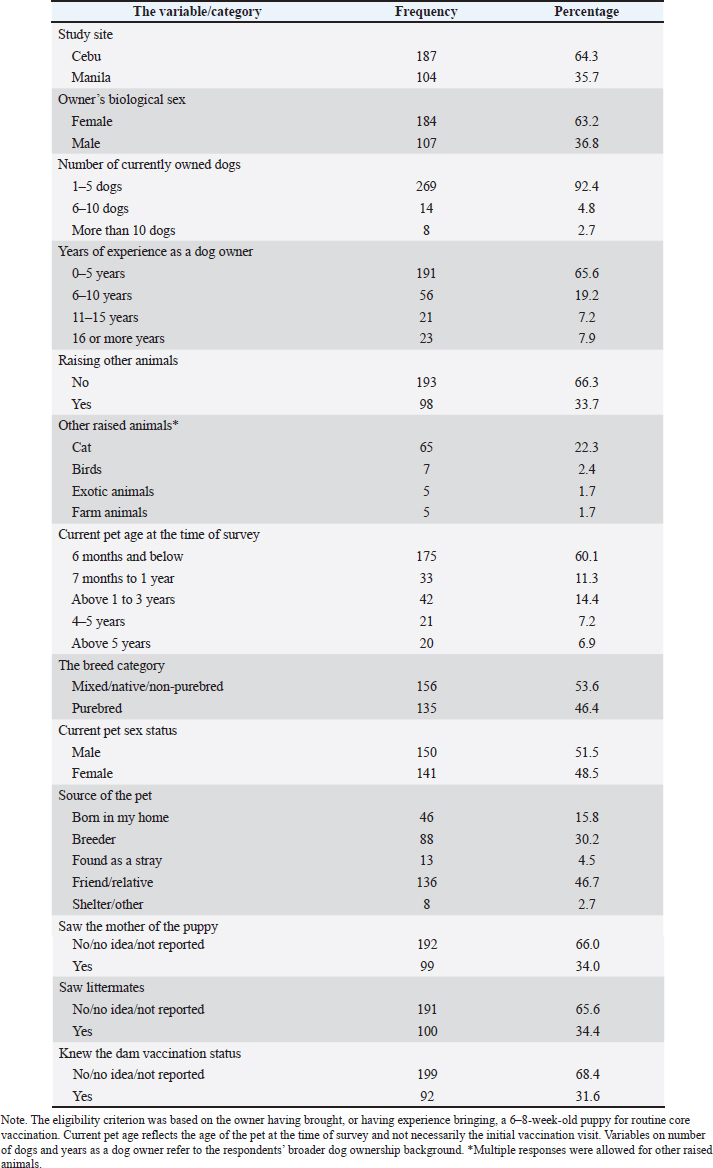
AbstractBackground: Health management, including vaccination, is essential for the prevention of disease in puppies. Philippine data on owner practices during early vaccination of puppies remain limited. Aim: This study assessed general health management knowledge and practices among pet owners in Cebu and Manila, Philippines, who brought or had experience bringing 6–8-week-old puppies for routine core vaccination. Methods: A cross-sectional descriptive-analytical questionnaire study was conducted in 2025 among 291 adult pet owners from Cebu (n=187) and Manila (n=104). The questionnaire collected owner and pet profiles and 26 perception items on the health management of puppies. Items used a five-option Likert-type response format and a 0–4 weighted scoring scheme, with neutral/undecided assigned no score and negatively framed items reverse-coded. Descriptive statistics, domain classifications, nonparametric tests, and robust multivariable linear regression with HC3 standard errors were used to analyze the data. Results: Only 34.0% had seen the puppy’s mother, 34.4% had seen littermates, and 31.6% knew the dam’s vaccination status. High domain levels were most frequent for health communication, hygiene, and vaccination compliance (64.3%); health record-keeping and monitoring (63.2%); veterinary access, financial readiness, trust, and vaccine-related concerns (62.9%); and exposure control and disease-prevention practices (61.9%). The Cebu respondents had higher adjusted scores than the Manila respondents in several domains, including veterinary access, financial readiness, trust, and vaccine-related concerns (B=5.194, p < 0.001), and health record-keeping and monitoring (B=3.534, p < 0.001). Conclusion: Respondents generally reported favorable puppy health management awareness and practices, but gaps remained in dam vaccination history awareness, formal puppy care education, preventive care consistency, vaccine-related concerns, and financial readiness. Veterinary counseling, reminder systems, and client education materials should emphasize vaccination schedules, maternal health history, deworming, parasite prevention, hygiene, nutrition, and preventive-care budgeting. Keywords: Companion animal, General health management, Owner practices, Pet owners, Vaccination. IntroductionProper nutrition, hygiene, parasite control, and vaccination protocols are the foundation of a puppy’s general health and development (Hughes and A, 2015; Little, 2024). The long-term health and behavior of puppies are also influenced by early owner care and the quality of preventive health routines (Holland, 2019; Mai et al., 2021). Vaccination remains central to the prevention of infectious diseases, but its practical effectiveness is shaped by owner awareness, access to veterinary services, schedule adherence, and complementary health-management practices (Ridgway, 2021; Chowdhury, 2023). Puppies ideally remain with their mothers for at least 8 weeks because maternal contact supports social development and maternal antibody transfer (Kinsman et al., 2020). Maternally derived antibodies provide early passive protection against infectious pathogens, including canine parvovirus and canine distemper virus, but these antibodies decline during early puppyhood and may interfere with vaccine responses if schedules are poorly timed (Langel et al., 2022; Shams and Pourtaghi, 2023). The World Small Animal Veterinary Association recommends beginning core vaccination at 6–8 weeks of age and repeating doses every 2–4 weeks until at least 16 weeks of age (Squires et al., 2024). Vaccination adherence does not depend solely on vaccine availability. Proper nutrition, deworming, sanitation, and tick prevention can reduce the burden of concurrent diseases that may affect immune function and overall puppy health (Cline et al., 2021; Ellis et al., 2022; Tizard, 2024). Conversely, financial barriers, limited clinic access, misinformation, and weak knowledge of maternal health history can reduce the consistency of preventive care (Alho et al., 2018; Eschle et al., 2020; Janke et al., 2021; Mshelbwala et al., 2025). In the Philippines, companion animal ownership has increased, yet localized evidence on preventive-care practices for puppies remains limited (San Jose et al., 2020; Dizon et al., 2022). Local evidence is needed because puppy acquisition patterns, access to veterinary clinics, household resources, and owner awareness may differ across urban settings in the Philippines. Hence, this study assessed the general health management knowledge and practices of pet owners in Cebu and Manila who brought or had experience bringing 6–8-week-old puppies for routine core vaccination. Materials and MethodsThis cross-sectional descriptive-analytical questionnaire study was conducted in 2025 among adult pet owners in Cebu and Manila, Philippines. The target respondents were owners who brought or had prior experience bringing 6–8-week-old puppies for routine core vaccination. Two veterinary clinics, one in Cebu and one in Manila, were invited to participate in the study. For privacy and confidentiality reasons, the exact clinic names and specific locations were withheld; therefore, only city-level locations are reported. All eligible owners who visited the participating clinics were invited to participate during the data collection period. Additional eligible owners who had experience bringing 6–8-week-old puppies for vaccination, even if not necessarily through the two participating clinics, were also invited. The respondents were selected using nonprobability purposive sampling. Respondents were eligible if they were at least 18 years old, were pet owners from Cebu or Manila, and had brought or experienced bringing a 6–8-week-old puppy for routine core vaccination. A total of 291 adult pet owners participated in this study. Research instrumentThe authors developed the questionnaire, with item generation guided by the literature on puppy preventive care, owner compliance, veterinary access, vaccine-related concerns, trust in veterinary advice, and health behavior. The instrument consisted of two sections: the respondent and pet profile, and perception items related to health-management practices of puppies. The perception section consisted of 26 statements using a five-option Likert-type response format: strongly disagree, disagree, neutral/undecided, agree, and strongly agree. For score computation, responses were converted to a 0–4 weighted scoring scheme: strongly disagree=1, disagree=2, neutral/undecided=0, agree=3, and strongly agree=4. The neutral/undecided option was retained as a response category for descriptive reporting but was treated as non-contributory in summated scores because it represented a non-directional or no-opinion response rather than a favorable or unfavorable attitude position; survey-methodology literature distinguishes midpoint or no-opinion options from substantive directional responses (Armstrong, 1987; Krosnick and Presser, 2010; Chyung et al., 2017). Items P5 and P23 were negatively framed and were reverse-coded for domain and overall score computation, with neutral/undecided retained as zero. Higher scores indicated more favorable health-management perceptions and practices. The 26 items were grouped into six domains: vaccination awareness and health information seeking; veterinary access, financial readiness, trust, and vaccine-related concerns; health record-keeping and monitoring; routine preventive health care; exposure control and disease-prevention practices; and health communication, hygiene, and vaccination compliance. The veterinary access/financial readiness and trust/vaccine concern items were combined because they collectively reflected enabling factors and perceived barriers to puppy preventive care (PPC). The questionnaire underwent face validation by three experts and pilot testing before implementation. The overall 26-item perception scale showed excellent internal consistency after reverse-coding P5 and P23 (Cronbach’s alpha=0.960). The domain-specific Cronbach’s alpha values were 0.700, 0.759, 0.886, 0.850, 0.911, and 0.836, respectively. Data collection, processing, and analysisA letter of support request was given to the invited clinics. After confirmation, eligible pet owners were invited to participate. Data from the questionnaire were encoded, de-identified, cleaned, and analyzed using statistical software. Personally identifiable information was removed before analysis. Descriptive statistics were used to summarize the owner and pet profiles and item-level responses. Frequencies and percentages were computed for categorical variables. For item-level perception results, responses were collapsed as disagree/strongly disagree, neutral/undecided, and agree/strongly agree to improve interpretability. Domain scores were calculated from the computed item scores. Each domain score was classified as low, moderate, or high for descriptive presentation only by dividing the maximum possible domain score into three equal intervals. These levels were not considered inferential outcomes. Because domain scores were bounded and not normally distributed based on Shapiro–Wilk tests, bivariate comparisons were performed using the Mann–Whitney U test for two-group predictors, and Kruskal–Wallis tests for predictors with more than two groups. The effect sizes were estimated as Cliff’s delta for two-group comparisons and epsilon-squared for Kruskal–Wallis tests. Benjamini–Hochberg false discovery rate adjustment was applied to the exploratory bivariate tests. For multivariable analysis, domain scores and the overall perception score were used as outcomes in robust linear regression models with HC3 robust standard errors. Regression coefficients, 95% confidence intervals, p-values, and FDR-adjusted p-values were reported where applicable. Statistical significance was set at p ≤ 0.05, with FDR-adjusted results interpreted cautiously. Open-ended responses on challenges, recommendations, and vaccination-related experiences were reviewed descriptively. Similar responses were grouped into recurring themes and narratively summarized to complement the quantitative findings. Ethical approvalThis study conformed to the ethical guidelines and regulations of the Philippine Health Research Ethics Board and the principles of the Declaration of Helsinki. The study was approved by the CTU Local Research Ethics Committee (approval no. DB-2025-005) on January 15, 2025. All respondents provided informed consent before completing the questionnaire. Responses were anonymized to maintain confidentiality and reduce the possibility of identification. ResultsMost respondents were from Cebu (187/291, 64.3%), while the remaining respondents were from Manila (104/291, 35.7%). Most were female (184/291, 63.2%), owned dogs for 0–5 years (191/291, 65.6%), and owned 1–5 dogs (269/291, 92.4%). Most respondents did not raise other animals (193/291, 66.3%); among the reported additional animals, cats were the most common (65/291, 22.3%). Pet age in Table 1 refers to the current age of the pet at the time of the survey, whereas eligibility was based on the owner having brought or experienced bringing a 6–8-week-old puppy for routine vaccination. Most current pets were 6 months old or younger at the time of survey (175/291, 60.1%), were mixed/native/non-purebred (156/291, 53.6%), and were male (150/291, 51.5%). The most common sources of pets were friends or relatives (136/291, 46.7%) and breeders (88/291, 30.2%). Important early-life information gaps were observed: only 99 (34.0%) respondents had seen the puppy’s mother, 100 (34.4%) had seen the littermates, and 92 (31.6%) knew the dam’s vaccination status (Table 1). Table 1. Profile of pet owners and current pet characteristics among respondents with experience bringing 6–8-week-old puppies for vaccination in Cebu and Manila, Philippines (n=291).
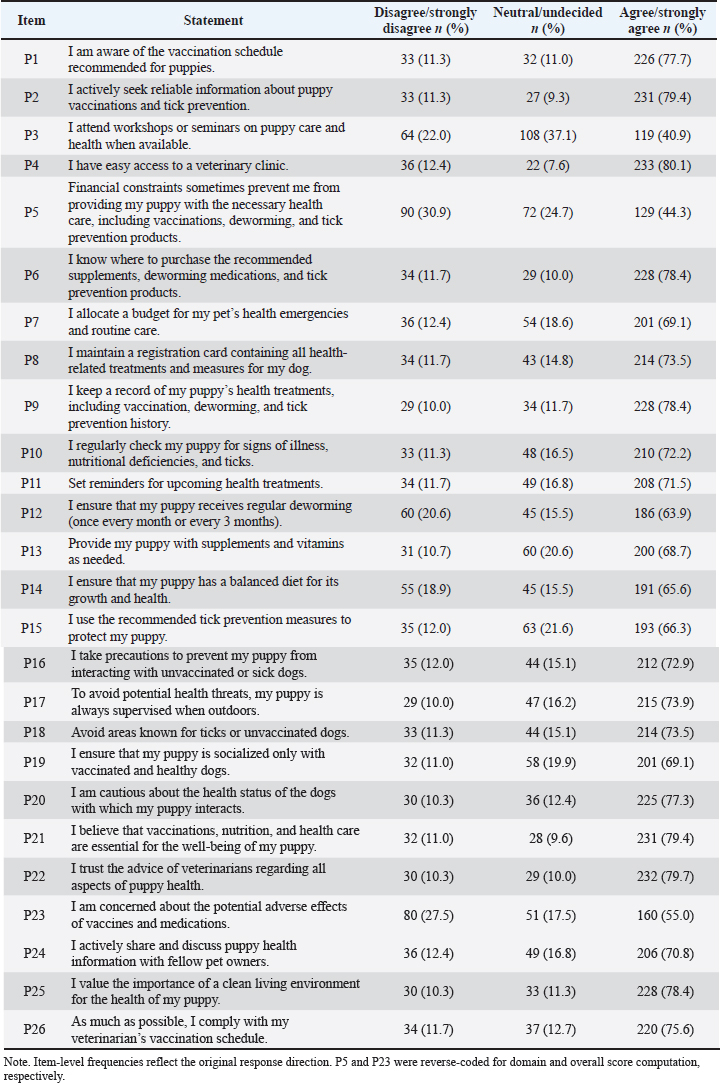
Item-level perception responsesThe majority (77.7%) agreed or strongly agreed that they were aware of the recommended vaccination schedule and actively sought information from reliable sources (79.4%). However, only 40.9% of respondents agreed or strongly agreed that they attended workshops or seminars on puppy care when available. Most respondents reported easy access to a veterinary clinic (80.1%), knowledge of where to purchase preventive products (78.4%), and trust in veterinarian advice (79.7%). Financial and vaccine-related concerns remained evident, with 44.3% of respondents agreeing or strongly agreeing that financial constraints sometimes prevented puppy health care, and 55.0% were concerned about possible vaccine or medication side effects (Table 2). Preventive practices were generally favorable but not universal. Agreement or strong agreement was reported for keeping vaccination, deworming, and tick-prevention records (78.4%), regular puppy health checks (72.2%), treatment reminders (71.5%), regular deworming (63.9%), balanced diet provision (65.6%), tick prevention (66.3%), avoiding interaction with sick or unvaccinated dogs (72.9%), and complying with veterinarian-provided vaccination schedules (75.6%) (Table 2). Table 2. Pet owners’ item-level responses on general health-management practices for puppies brought for vaccination in Cebu and Manila, Philippines (n=291).
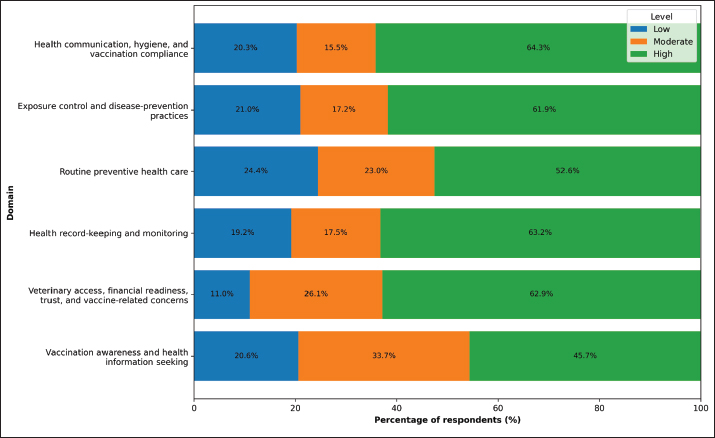
Domain score levelsFor descriptive purposes, high levels were most frequent for health communication, hygiene, and vaccination compliance (64.3%); health record-keeping and monitoring (63.2%); veterinary access, financial readiness, trust, and vaccine-related concerns (62.9%); and exposure control and disease-prevention practices (61.9%). Routine preventive health care had the largest low-level proportion (24.4%), followed by exposure control and disease-prevention practices (21.0%) and vaccination awareness and health information seeking (20.6%) (Fig. 1).
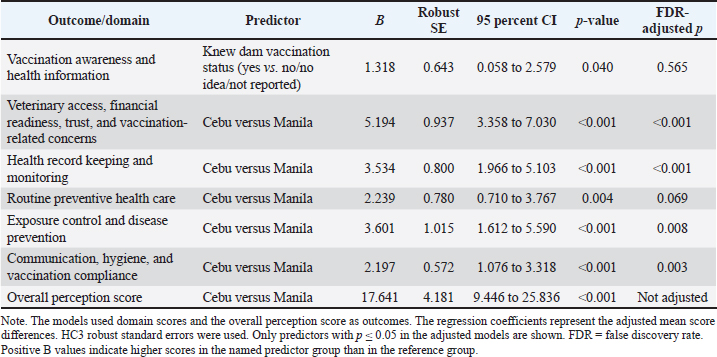
Fig. 1. Descriptive levels of health-management perceptions and practices of puppies by domain. Factors associated with the domain scoresIn the adjusted robust regression models, the study site was the most consistent factor associated with the domain scores. Compared with the Manila respondents, the Cebu respondents had higher scores for veterinary access, financial readiness, trust, and vaccine-related concerns (B=5.194, 95% CI=3.358 to 7.030, p < 0.001); health record-keeping and monitoring (B=3.534, 95% CI=1.966 to 5.103, p < 0.001); exposure control and disease-prevention practices (B=3.601, 95% CI=1.612 to 5.590, p < 0.001); and health communication, hygiene, and vaccination compliance (B=2.197, 95% CI=1.076 to 3.318, p < 0.001). These site associations remained significant after the FDR adjustment. The Cebu respondents also had higher overall perception scores than the Manila respondents (B=17.641, 95% CI=9.446–25.836, p < 0.001) (Table 3). Knew dam vaccination status was positively associated with vaccination awareness and health information seeking before the FDR adjustment (B=1.318, p=0.040), but this association did not remain significant after the FDR adjustment. The association between the Cebu site and routine preventive health care was significant before the FDR adjustment (B=2.239, p=0.004) but did not remain significant after the FDR adjustment (FDR-adjusted p=0.069). These findings were interpreted as exploratory (Table 3). Table 3. Adjusted robust regression findings for domain- and overall perception score-associated factors.
Open-ended responsesOpen-ended responses provided the quantitative findings’ context. Reported challenges centered on financial constraints, limited time, difficulty accessing veterinary services, forgetfulness, lack of information about puppy vaccination schedules, and concern about vaccine or medication effects. The suggested strategies included reminders from clinics, clearer communication from veterinarians, accessible educational materials, family support, and more affordable preventive-care options. These responses supported the quantitative finding that favorable awareness can coexist with practical barriers to consistent health management in puppies. DiscussionThis study showed that pet owners in Cebu and Manila who brought or had experience bringing 6–8-week-old puppies for vaccination generally reported favorable awareness and practices related to puppy health management. However, persistent gaps in formal puppy-care education, maternal vaccination history awareness, routine preventive care, and financial readiness were also identified. These gaps are important because puppy vaccination is not an isolated event; it is embedded within broader owner behaviors involving nutrition, deworming, tick control, hygiene, social exposure management, and adherence to veterinarian-provided schedules (Ellis et al., 2022; Squires et al., 2024). A notable finding was the low proportion of respondents who had seen the dam, littermates, or dam vaccination records. Puppies acquired without knowledge of maternal health history may have uncertain maternally derived antibody status, which can complicate early vaccination planning (Langel et al., 2022; Shams and Pourtaghi, 2023). Similar concerns have been raised in studies of puppy acquisition, where failure to view the mother or obtain health-history information can reflect weaker acquisition safeguards and reduced owner awareness of early-life risk factors (Holland, 2019; Kinsman et al., 2020). Therefore, veterinary teams should include questions regarding dam vaccination history during puppy visits and explain why maternal information is relevant to vaccination scheduling and disease prevention. The results suggest that although many owners recognized the importance of vaccination and trusted veterinary advice, practical barriers remained. Financial constraints were reported by a sizeable proportion of respondents, and routine preventive-care practices, such as deworming, balanced diet provision, and tick prevention, were reported less consistently than general trust or awareness. This pattern is consistent with broader evidence that access to veterinary care is shaped by cost, availability, transport, and owner decision-making capacity, not by knowledge alone (Kogan et al., 2021; Pasteur et al., 2024; Niemiec et al., 2024). The study site was the most consistent factor associated with the domain scores. The Cebu respondents had higher adjusted scores than the Manila respondents in veterinary access, financial readiness, trust, and vaccine-related concerns; record-keeping and monitoring; exposure control and disease-prevention practices; and health communication, hygiene, and vaccination compliance. These differences should be carefully interpreted because purposive sampling was used in this study, and only two invited clinics were used as recruitment anchors. The findings may reflect differences in recruitment pathways, client profile, clinic communication practices, local access conditions, or owner experience rather than city-level differences in the wider population. The domain-level results also showed that routine preventive health care had the largest low-level proportion of the total population. These results suggest that future client education should go beyond explaining vaccine schedules and include practical, repeatable routines for deworming, tick prevention, nutrition, hygiene, and illness monitoring. Reminder systems may be especially useful because many preventive-care activities require repeated actions over time. Digital reminders, vaccination cards, clinic follow-up messages, and family-supported scheduling can help translate owner awareness into consistent practice (Creevy et al., 2019; Somrup et al., 2025). Concerns about the adverse effects of vaccines and medications should not be dismissed as simple misinformation. Vaccine-related concerns may co-exist with trust in veterinarians and may reflect a need for clearer communication regarding expected reactions, warning signs, and the risk-benefit balance of core vaccination. During puppy vaccination visits, communication should invite owner questions and provide concise anticipatory guidance. Studies on veterinary communication and vaccination consultations have shown that owner satisfaction and adherence can be affected by alignment between owner expectations and veterinary recommendations (Belshaw et al., 2018; Janke et al., 2021; Mills, 2024). The open-ended responses reinforced the importance of practical support. Owners commonly described cost, time, access, forgetfulness, and knowledge gaps as barriers to vaccination adherence. These barriers point to feasible interventions within veterinary practice, including structured counseling at the first puppy visit, written or digital vaccination schedules, follow-up reminders, bundled preventive-care explanations, and low-cost educational materials. Such interventions may be particularly important for owners who acquire puppies informally from friends, relatives, or breeders without complete maternal or litter health information. LimitationsThis study used nonprobability purposive sampling and included adult pet owners from Cebu and Manila who brought or had experience bringing 6–8-week-old puppies for vaccination. The recruitment was partly clinic-based through two invited participating veterinary clinics and partly based on additional eligible owners with relevant prior puppy vaccination experience. Hence, the findings may not represent all puppy owners in the Philippines, particularly those who do not seek veterinary care, those from rural or underserved areas, or those without access to vaccination services. Because some respondents reported prior experiences and the pet age in Table 1 reflected the current pet age at the time of the survey, recall bias may have influenced some responses. The questionnaire’s self-reported nature may also introduce social desirability bias. In addition, the exact clinic locations were withheld for privacy reasons, which limited the detailed assessment of the clinic-level context. The findings should be interpreted as associations and should not be used to infer causal relationships between owner characteristics and health-management practices because the study was cross-sectional. ConclusionPet owners who brought or had experience bringing 6–8-week-old puppies for vaccination in Cebu and Manila generally reported favorable awareness and practices related to puppy health management. However, maternal vaccination history awareness, formal puppy care education, routine preventive care, vaccine-related concerns, and financial preparedness remained important gaps. The Cebu respondents had higher adjusted scores in several health-management domains than the Manila respondents, although this finding should be interpreted within the limits of purposive and partly clinic-based sampling. The findings support consistent veterinary counseling, reminder systems, and client education materials focused on vaccination schedules, maternal health history, deworming, parasite prevention, hygiene, nutrition, and preventive-care budgeting. AcknowledgmentsThe authors would like to thank the participating veterinary clinics and pet owners for their support and participation. The authors also thank the staff of GPY Veterinare Animale Veterinary Clinic, Cebu City for their kind assistance in the sample and data collection and HIPRA Philippines for partially funding the research. Conflict of interestSome authors are affiliated with the HIPRA veterinary product-related companies. These affiliations are disclosed for transparency. The authors declare that data analysis, interpretation, and manuscript preparation were conducted with scientific independence. FundingThis study was partially supported by the GAA funds of Cebu Technological University. Authors' contributionsA.P.Y. and J.P.T. equally contributed to the conceptualization, study design, data gathering, analysis, interpretation, and final manuscript writing. E.S.D., M.B., and R.M.M. contributed to the conceptualization, interpretation, and writing of the final manuscript. R.H.D.Y., S.L.G., R.H.D., H.P.P., E.M.G.B., A.M.M., and V.A.M. contributed to data collection, data checking, and manuscript writing. All authors have reviewed and approved the final version of the manuscript. Data availabilityThe data that support the findings of this study are not openly available due to privacy and sensitivity considerations but may be made available from the corresponding author upon reasonable request and subject to applicable ethical and institutional approvals. ReferencesAlho, A.M., Lima, C., Colella, V., Madeira De Carvalho, L., Otranto, D. and Cardoso, L. 2018. Awareness of zoonotic diseases and parasite control practices: a survey of dog and cat owners in Qatar. Parasites Vectors 11, 133; doi:10.1016/j.parasitv.2018.09.010 Armstrong, R.L. 1987. The midpoint on a five-point Likert-type scale. Percept. Mot. Skills 64, 359–362. Belshaw, Z., Robinson, N., Dean, R. and Brennan, M. 2018. Owners and veterinary surgeons in the United Kingdom disagree about what should happen during a small-animal vaccination consultation. Vet. Sci. 5, 7. Chowdhury, S.R. 2023. Importance of preventive care for pets: a guide for pet owners. Acad. Int. J. Vet. Med. 1, 20–25. Chyung, S.Y., Roberts, K., Swanson, I. and Hankinson, A. 2017. Evidence-based survey design: the use of a midpoint on the Likert scale. Perform. Improvization. 56, 15–23. Cline, M.G., Burns, K.M., Coe, J.B., Downing, R., Durzi, T., Murphy, M. and Parker, V.J. 2021. 2021 AAHA nutrition and weight management guidelines for dogs and cats. J. Am. Anim. Hosp. Assoc. 57, 153. Creevy, K.E., Grady, J., Little, S.E., Moore, G.E., Strickler, B.G., Thompson, S. and Webb, J.A. 2019. 2019 AAHA canine life stage guidelines. J. Am. Anim. Hosp. Assoc. 55, 267. Dizon, T.J.R., Saito, N., Inobaya, M.T., Tan, A., Reñosa, M.D.C., Bravo, T.A., Bermejo, R., Amparo, A.C.E. and Quiambao, B.P. 2022. Household survey on dog ownership and rabies knowledge in selected municipalities in Bulacan, Philippines: a cross-sectional study. PLoS Negl. Trop. Dis. 16, 9948. Ellis, J., Marziani, E., Aziz, C., Brown, C.M., Cohn, L.A., Lea, C., Moore, G.E., Stillman, B.A. and Taneja, N. 2022. 2022 AAHA canine vaccination guidelines. J. Am. Anim. Hosp. Assoc. 58, 213–230. Eschle, S., Hartmann, K., Rieger, A., Fischer, S., Klima, A. and Bergmann, M. 2020. Canine vaccination in Germany: a survey of owner attitudes and compliance. PLoS One 15, 238371. Holland, K.E. 2019. Acquiring a pet dog: factors affecting the decision-making of prospective dog owners. Animals 9, 124. Hughes, A. 2015. Preventive healthcare: a life-stage approach. In BSAVA Manual of Canine Practice: A Foundation Manual, eds. T. Hutchinson and K. Robinson. Gloucester, UK: British Small Animal Veterinary Association, pp. 25–39 Janke, N., Coe, J.B., Bernardo, T.M., Dewey, C.E. and East, S. 2021. Perceptions of pet owners and veterinarians regarding information exchange and clinical decision-making in companion animal practice. PLoS One 16, 245632. Kinsman, R.H., Casey, R.A., Knowles, T.G., Tasker, S., Lord, M.S., Da Costa, R.E.P., Woodward, J.L. and Murray, J.K. 2020. Puppy acquisition: factors associated with the acquisition of a puppy under 8 weeks of age and without viewing the mother. Vet. Rec. 187, 112. Kogan, L., Accornero, V.H., Gelb, E. and Slater, M.R. 2021. Community veterinary medicine programs: perceptions and experiences of pet owners. Front. Vet. Sci. 8, 678595. Krosnick, J.A. and Presser, S. 2010. Question and questionnaire design. In Handbook of survey research. Eds., Marsden, P.V. and Wright, J.D. Bingley, UK: Emerald Group Publishing, pp: 263–313. Langel, S.N., Blasi, M. and Permar, S.R. 2022. Maternal immune protection against infectious diseases. Cell. Host. Microbe. 30, 660–674. Little, C. 2024. The dog care handbook: things I wish my vet had told me. 5-m Books Ltd. Mai, D.L., Howell, T., Benton, P. and Bennett, P.C. 2021. Beyond puppy selection—the role of puppy raisers in bringing out the best in assistance dog puppies should be considered. J. Vet. Behav. 42, 1–10. Mills, P.C. 2024. Education and communication in clinical veterinary practice. Animals 14, 2622. Mshelbwala, P.P., Weese, J.S., Adegboye, O., Suluku, R., Akanbi, I., Jalloh, A.G., Bunting-Graden, J.A., Hassan, M.M. and Rupprech, C.E. 2025. Factors associated with perceived barriers to canine rabies vaccination among owners of unvaccinated dogs. Prev. Vet. Med. 246, 106698. Niemiec, R., Champine, V., Frey, D., Lobdell, A., Steele, A., Vaiden, C., Kogan, L. and Mertens, A. 2024. Veterinary and pet owner perspectives on addressing access to veterinary care and workforce challenges. Front. Vet. Sci. 11, 1419295; doi:10.1016/j.fvsci.2024.04.219295 Pasteur, K., Diana, A., Yatcilla, J.K., Barnard, S. and Croney, C.C. 2024. Access to veterinary care: evaluating definitions, barriers, and implications for animal welfare. Front. Vet. Sci. 11, 1335410. Ridgway, M. 2021. Preventive health care for working dogs. Vet. Clin. North Am. Small Anim. Pract. 51, 745. San Jose, R.D., Magsino, P.J.P. and Bundalian Jr, R.D. 2020. Factors affecting the knowledge, attitude, and practices of responsible pet ownership among pet owners in Magalang, Pampanga, Philippines: a cross-sectional study. Philipp. J. Vet. Med. 57, 182–195. Shams, F. and Pourtaghi, H. 2023. Effect of maternally derived antibodies on two commercial vaccines in changes of serum antibody titers against distemper in puppies. Vet. Med. Sci. 9, 698; doi:10.1016/j.vms.2023 Somrup, S., Sirimalaisuwan, A., Chaisowwong, W. and Na–Lampang, K. 2025. Advancing pet care through technology: an evaluation of the LINE-based VET PROMPT notification system. J. Adv. Vet. Anim. Res. 12, 849–860. Squires, R.A., Crawford, C., Marcondes, M. and Whitley, N. 2024. 2024 guidelines for the vaccination of dogs and cats compiled by the Vaccination Guidelines Group (VGG) of the World Small Animal Veterinary Association (WSAVA). J. Small Anim. Pract. 65, 277–316. Tizard, I.R. 2024. Veterinary immunology-E-book: veterinary immunology-E-book. St. Louis, MI: Elsevier Health Sciences, Inc. | ||
| How to Cite this Article |
| Pubmed Style Ybañez AP, Tolentino JP, Sanchez-diaz E, Baratelli M, Morato RM, Ybañez RHD, Jr. SLG, Destajo RH, Portugaliza HP, Galon-bedonia EM, Macalanda AMC, Morillo VA. General health management of puppies brought for vaccination in the Philippines. Open Vet. J.. 2026; 16(7): 4923-4932. doi:10.5455/OVJ.2026.v16.i7.69 Web Style Ybañez AP, Tolentino JP, Sanchez-diaz E, Baratelli M, Morato RM, Ybañez RHD, Jr. SLG, Destajo RH, Portugaliza HP, Galon-bedonia EM, Macalanda AMC, Morillo VA. General health management of puppies brought for vaccination in the Philippines. https://www.openveterinaryjournal.com/?mno=307527 [Access: July 27, 2026]. doi:10.5455/OVJ.2026.v16.i7.69 AMA (American Medical Association) Style Ybañez AP, Tolentino JP, Sanchez-diaz E, Baratelli M, Morato RM, Ybañez RHD, Jr. SLG, Destajo RH, Portugaliza HP, Galon-bedonia EM, Macalanda AMC, Morillo VA. General health management of puppies brought for vaccination in the Philippines. Open Vet. J.. 2026; 16(7): 4923-4932. doi:10.5455/OVJ.2026.v16.i7.69 Vancouver/ICMJE Style Ybañez AP, Tolentino JP, Sanchez-diaz E, Baratelli M, Morato RM, Ybañez RHD, Jr. SLG, Destajo RH, Portugaliza HP, Galon-bedonia EM, Macalanda AMC, Morillo VA. General health management of puppies brought for vaccination in the Philippines. Open Vet. J.. (2026), [cited July 27, 2026]; 16(7): 4923-4932. doi:10.5455/OVJ.2026.v16.i7.69 Harvard Style Ybañez, A. P., Tolentino, . J. P., Sanchez-diaz, . E., Baratelli, . M., Morato, . R. M., Ybañez, . R. H. D., Jr., . S. L. G., Destajo, . R. H., Portugaliza, . H. P., Galon-bedonia, . E. M., Macalanda, . A. M. C. & Morillo, . V. A. (2026) General health management of puppies brought for vaccination in the Philippines. Open Vet. J., 16 (7), 4923-4932. doi:10.5455/OVJ.2026.v16.i7.69 Turabian Style Ybañez, Adrian P., Joel P. Tolentino, Elena Sanchez-diaz, Massimiliano Baratelli, Roser M. Morato, Rochelle Haidee D. Ybañez, Serafin L. Garciano Jr., Ruby H. Destajo, Harvie P. Portugaliza, Eloiza May Galon-bedonia, Adrian Miki C. Macalanda, and Vernadyn A. Morillo. 2026. General health management of puppies brought for vaccination in the Philippines. Open Veterinary Journal, 16 (7), 4923-4932. doi:10.5455/OVJ.2026.v16.i7.69 Chicago Style Ybañez, Adrian P., Joel P. Tolentino, Elena Sanchez-diaz, Massimiliano Baratelli, Roser M. Morato, Rochelle Haidee D. Ybañez, Serafin L. Garciano Jr., Ruby H. Destajo, Harvie P. Portugaliza, Eloiza May Galon-bedonia, Adrian Miki C. Macalanda, and Vernadyn A. Morillo. "General health management of puppies brought for vaccination in the Philippines." Open Veterinary Journal 16 (2026), 4923-4932. doi:10.5455/OVJ.2026.v16.i7.69 MLA (The Modern Language Association) Style Ybañez, Adrian P., Joel P. Tolentino, Elena Sanchez-diaz, Massimiliano Baratelli, Roser M. Morato, Rochelle Haidee D. Ybañez, Serafin L. Garciano Jr., Ruby H. Destajo, Harvie P. Portugaliza, Eloiza May Galon-bedonia, Adrian Miki C. Macalanda, and Vernadyn A. Morillo. "General health management of puppies brought for vaccination in the Philippines." Open Veterinary Journal 16.7 (2026), 4923-4932. Print. doi:10.5455/OVJ.2026.v16.i7.69 APA (American Psychological Association) Style Ybañez, A. P., Tolentino, . J. P., Sanchez-diaz, . E., Baratelli, . M., Morato, . R. M., Ybañez, . R. H. D., Jr., . S. L. G., Destajo, . R. H., Portugaliza, . H. P., Galon-bedonia, . E. M., Macalanda, . A. M. C. & Morillo, . V. A. (2026) General health management of puppies brought for vaccination in the Philippines. Open Veterinary Journal, 16 (7), 4923-4932. doi:10.5455/OVJ.2026.v16.i7.69 |


