




| Research Article | ||
Open Vet. J.. 2026; 16(7): 4590-4608
Open Veterinary Journal, (2026), Vol. 16(7): 4590-4608 Research Article Toxicological assessment of thiamethoxam in Apis melliferaAmina Brhich1, Rachid Hnini1,2*, Hasna Merzouki1, Hayat Bouighajd3, Hicham Chatoui1,4 and Mohamed Merzouki1*1Biological Engineering Laboratory, Faculty of Science and Technology, Sultan Moulay Slimane University, Beni Mellal, Morocco 2School of Medicine and Biomedical Sciences of the University of Porto (ICBAS-UP), Rua de Jorge Viterbo Ferreira, Porto, Portugal 3Laboratory of Anthropogenetics, Biotechnology and Health, Faculty of Sciences, Chouaib Doukkali University, El Jadida, Morocco 4Higher Institute of Nursing Professions and Health Techniques, Ministry of Health, Marrakech, Morocco *Corresponding Author: Rachid Hnini and Mohamed Merzouki. Biological Engineering Laboratory, Faculty of Science and Technology, Sultan Moulay Slimane University, Beni Mellal, Morocco. Email: rachid.hnini [at] hotmail.com and m.merzouki [at] usms.ma Submitted: 28/01/2026 Revised: 22/05/2026 Accepted: 08/06/2026 Published: 17/07/2026 © 2025 Open Veterinary Journal
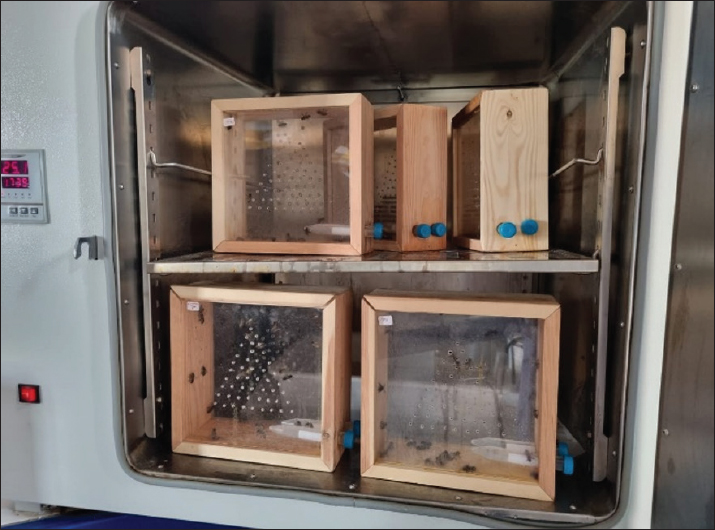
AbstractBackground: Thiamethoxam, a neonicotinoid insecticide known for its harmful effects on bees and other pollinators, was banned in the European Union in 2013 because of its proven environmental risks. However, in Morocco, this compound is still used in agriculture and may contribute to the decline of honey bee populations. Aim: This study aimed to assess whether environmentally relevant doses of thiamethoxam affect the survival of honey bee (Apis mellifera) workers over a 10-day exposure period. Methods: Queenless worker microcolonies were established using 20-day-old bees orally exposed to sucrose syrup containing increasing doses of thiamethoxam (0, 1, 10, 20, 50, and 70 ng/bee). Results: Bee mortality increased in a dose-dependent manner. At doses of 20 ng/bee or higher, 100% mortality was observed within 48 hours, compared with 16.67% in the control group. The LD₅₀ values decreased over time (from 10.65 ng/bee at 24 hours to 4.18 ng/bee at 72 hours), indicating a time-dependent expression of thiamethoxam toxicity in honey bees. Conclusion: Overall, these results show that thiamethoxam is highly toxic to Apis mellifera and that high exposure levels can severely compromise colony survival in contaminated environments. The reduced reliability of LD₅₀ estimates at later time points is likely due to mortality saturation at higher doses, which limits the range of intermediate responses required for robust probit modeling. Keywords: Apis mellifera, Honey bee, LD₅₀, Neonicotinoid, Thiamethoxam. IntroductionThe western honey bee, Apis mellifera, is the most economically important pollinator of crops worldwide. Beyond crop production, honey bees also contribute to the maintenance of biodiversity by pollinating numerous wild plant species that depend on animal-mediated pollination. However, over recent decades, both wild and managed pollinators have suffered significant declines in abundance or diversity in many regions, with implications for food security and ecosystem health (Brunet and Fragoso, 2024; Quandahor et al., 2024). Biodiversity assessments based on extensive datasets widely support the idea of a global bee diversity decrease (fewer species detected over time), while long-term monitoring highlights strong declines in pollinator abundance and richness across agricultural landscapes (Potts et al., 2010; Dicks et al., 2021). Simultaneously, peer-reviewed global analyses have identified pollinator decline as a transcontinental phenomenon largely impacted by land-use change, agricultural intensification, and pesticide use that frequently interact with pathogens and climate change (Potts et al., 2016; Dicks et al., 2021; Brunet and Fragoso, 2024). These trends indicate an increasing discrepancy between the growing demand for pollination services and the ability of pollinator communities to provide such services. Morocco had long seemed to be relatively spared from the phenomenon of large-scale colony losses. However, in recent years, the situation has changed markedly. Partial or total colony losses have been reported, leading to a substantial decrease in honey production in 2022 and 2023 (La Vie Éco, 2022). As in other parts of the world, multiple interacting drivers are likely to be involved, including pathogens, nutritional stress, climate variability, and, more recently, the widespread use of pesticides in agriculture. Honey bees can be exposed to plant protection products in several ways. The primary route of exposure occurs during field spraying: although applications are intended to target specific crops at specific times, spray drift can contaminate field margins, hedgerows, and neighboring vegetation, where foraging bees may come into contact with pesticide residues (Ward et al., 2022; Adriaanse et al., 2023). In addition, bees can be exposed systemically through the pollen and nectar they collect when active ingredients (AIs) are taken up and translocated within the plant (Zioga et al., 2020; Faburé et al., 2025). Many insecticides, particularly neonicotinoids, are used as seed coatings (Girolami et al., 2009). The AIs are then taken up by the roots and distributed to the leaves, stems, and flowers. Bees are consequently contaminated by ingesting contaminated nectar, pollen, or water, by bringing these resources back to the hive, or by contact during grooming of returning foragers (Zioga et al., 2020; Ward et al., 2022). Neonicotinoids are generally more toxic by the oral route than by contact (Blacquiere et al., 2012), as their relatively low hydrophobicity limits penetration through the insect cuticle (Yamamoto et al., 1998). Therefore, the contamination level depends strongly on the systemic properties of the product and on its persistence in plant tissues. Bees are at risk when treated plants include attractive flowering species and when residues are still present in nectar and pollen at the time of bloom. The public debate on the environmental risks of pesticides is not new. Rachel Carson’s seminal book Silent Spring (Carson, 1962) highlighted the ecological impacts of dichlorodiphenyltrichloroethane (DDT) , including the collapse of non-target species, and profoundly challenged public confidence in pesticide use. The subsequent banning of several older compounds accelerated the development and marketing of new pesticide classes (Mansouri et al., 2016; Li, 2022). Since their introduction in the 1990s, neonicotinoids have become one of the most widely used classes of insecticides worldwide. These nicotine-derived compounds act on nicotinic acetylcholine receptors (nAChRs), disrupting the nervous system of insects, including bees (Paoli and Giurfa, 2024). Thiamethoxam is a second-generation neonicotinoid used on a wide range of crops, both as a foliar treatment and as a seed treatment (Sharma and Sanyal, 2024). It remained widely used in many agricultural systems until 2013, when its use was restricted or banned in the European Union due to its adverse effects on bees and other pollinators (Klaas-Fábregas et al., 2024). However, in Morocco, thiamethoxam is still authorized, raising concerns about its potential contribution to the deterioration of bee health and the sustainability of beekeeping. Given the growing amount of evidence regarding neonicotinoid toxicity in honey bees, most studies have focused on non-local populations, with limited data available for the North African subspecies. Since the major Moroccan subspecies is Apis mellifera intermissa, which has specific ecological and genetic features, evaluating its sensitivity to thiamethoxam is crucial to enhance the relevance and robustness of regional risk assessment. The aim of this study was to assess the acute and short-term oral toxicity of thiamethoxam to adult worker bees from the Beni Mellal region under controlled laboratory conditions. In this context, laboratory test doses of the pesticide need to be related to field-realistic exposure levels—in other words, concentrations found in nectar and pollen from treated crops—while higher doses should be tested to characterize dose–response relationships and safety margins. In addition, the lowest dose tested here (1 ng/bee) is within the range of maximum acute exposures expected for foragers consuming nectar containing 10–20 ng/g thiamethoxam in the nectar and pollen of treated crops (≈ 1–20 ng/g but exceptionally >100 ng/g in a few cucurbit systems) (Stephenson and Solomon, 2017; Nora et al., 2021; De Souza et al., 2024; Guo et al., 2025). The 10 ng/bee dose is a relatively high daily exposure scenario. Higher doses (20–70 ng/bee) greatly surpass expected environmental exposure through nectar/pollen and may be regarded as supra-realistic, chosen to investigate dose–response relationships and safety margins (Tosi et al., 2016; Coulon et al., 2017; Overmyer et al., 2018; Thompson et al., 2019). Following this experimental design, the specific aims of the study were (i) to characterize dose–response relationships and temporal patterns of mortality, (ii) to estimate LD₅₀ values for different exposure times (24 hours, 48 hours, and 72 hours) and compare these with published data, as well as (iii) to analyze survival over a 10-day period in order to more accurately assess the potential risks that thiamethoxam poses to local honey bee populations. Materials and MethodsBiological materialThe experiments were carried out using 20-day-old worker bees (Apis mellifera intermissa) from a single apiary colony in Bou Attas, Beni Mellal, Morocco, sampled in spring (April). This subspecies corresponds to the North African honey bee subspecies and is specifically distributed across Morocco, which accounts for the largest honey bee population in the study area. Workers were collected from brood frames and reared under controlled conditions until the age of 20 days to standardize subjects for age experiments, as all individuals used in trials belonged to the same cohort. To minimize genetic and environmental variability of the test subjects, a single source colony was used, as this reduced confounding by inter-colonial variation such as genetic background and microenvironmental conditions. This method enhances experimental control and precision, facilitating a clearer attribution of observed effects to the treatments rather than colony-specific variability. Although this design necessarily limits the generalizability of final toxicity estimates, including LD₅₀, and therefore performance across unrelated colonies, it is an expected and necessary practice in controlled studies that aim to maximize reproducibility while reducing noise. Future studies may extend these findings by testing multiple colonies for more generalizability. This would facilitate balancing internal validity and external validation in honey bee toxicology research (Maucourt et al., 2018; Kistler et al., 2021). Experimental cagesBees were maintained in wooden cages (12 × 11 × 8 cm), which were closed on two sides by thin removable panels and perforated with small holes to ensure adequate aeration (Köhler et al., 2013). One fixed wooden side had two openings fitted with plastic tubes: one for water and the other for sucrose syrup. Exposure to thiamethoxamBees were acclimatized to laboratory conditions for 24 hours and then randomly assigned into groups of 30 individuals. Random repositioning was performed to achieve an equal distribution of subjects among experimental groups. Bees were starved for 2 hours before exposure to ensure rapid ingestion of the treated syrup. This randomization approach mitigates systematic differences between groups aside from the treatment itself, increasing confidence in causal findings. Each cage was fitted with two 15 ml tubes offering water and sucrose syrup. Feeding solutions were provided ad libitum and renewed every 24 hours to ensure continuous availability and avoid nutritional limitation during the experiment. The treated sucrose solution was typically consumed within a few hours after being dispensed into the cages under these experimental conditions. To prevent possible degradation of thiamethoxam, feeding solutions were made freshly and renewed at 24 hours intervals, and cages were kept in controlled laboratory conditions with limited light exposure. The experimental design comprised six groups of 30 bees each, housed in separate cages: Five treated groups received, by oral exposure, 300 µl of a 55.5% (w/v) sucrose solution containing thiamethoxam dissolved in acetone. This volume corresponded to an estimated ingestion of 10 µl per bee. As the syrup was supplied communally, strict control over intake by individual bees was not possible, and trophallaxis among workers possibly resulted in variability in the dose ingested. Thiamethoxam was applied in five increasing applications: 1, 10, 20, 50, and 70 ng/bee. These doses were selected from previous studies, such as Chahbar et al. (2011), which were used to search for sublethal and lethal effects in honey bees at the nanogram level. The lower doses were within or near the environmentally relevant levels observed in nectar and pollen, whereas the higher doses were included to describe the complete dose–response curve under controlled conditions. One solvent control group received 55.5% (w/v) sucrose solution containing acetone only (no thiamethoxam) and was maintained under the same laboratory conditions as the treated groups, allowing potential effects of confinement or handling stress to be controlled. This solvent control group was used as the reference to assess mortality independently of thiamethoxam exposure. Acetone (99% purity) was used as a solvent carrier of thiamethoxam in all treatments at a 1% (v/v) final concentration in the syrup solutions. This solvent concentration was chosen according to the OECD guideline for honey bee oral toxicity tests, which states that solvent concentrations should be minimized and typically not exceed 1% (OECD, 1998). Contamination with thiamethoxam was achieved exclusively via the syrup tubes, as described by Chahbar et al. (2011). During the 10-day experimental period, cages were kept in a ventilated incubator at 25°C, a temperature selected as it matches the normal range for survival and activity of adult honey bees under laboratory conditions, allowing an invariant environment conducive to physiological functions and behavior. This temperature is lower than the typical brood nest temperature (34°C–35°C) but is widely used in cage bioassays with adult workers to reduce thermal stress and promote reproducible experimental results. Nonetheless, differences in environmental temperature could affect metabolic and detoxification dynamics and must therefore be taken into account when comparing toxicity estimates with studies considering higher incubation temperatures. Relative humidity was maintained at approximately 60% by placing an open tray of water inside the incubator (Fig. 1).
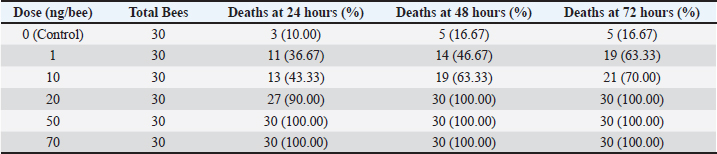
Fig. 1. Experimental cages containing honey bees placed inside the incubator. Survival monitoringAfter exposure of the different groups to the selected thiamethoxam concentrations, including the unexposed control group, bee survival was monitored every 24 hours throughout the experimental period. At each time point, the number of dead bees in each cage was recorded. A bee was considered dead if it failed to respond to a gentle physical stimulus. Behavioral observations were conducted during routine monitoring of the cages; however, observers knew the treatment groups; thus, assessments were not performed under blinded conditions. Statistical analysisSurvival curves were estimated using the Kaplan–Meier method to describe and compare survival probabilities between experimental groups over time. This non-parametric approach allows survival probability to be represented as a function of time without assuming any specific distribution of survival times. Comparisons between survival curves were performed using the log-rank (Mantel–Cox) test (Peto & Peto, 1972; Mantel, 1985), which evaluates differences in the risk of death between groups over time. When the proportional hazards assumption was not met, survival distributions were compared using the Gehan–Wilcoxon test, which gives greater weight to early events (Gehan, 1965). Median survival times (LT₅₀) were derived from Kaplan–Meier survival curves and used to quantify the time required to reach 50% mortality for each dose. Hazard ratios (HRs) and their 95% confidence intervals (CIs) were calculated to estimate the relative risk of mortality between groups. LD₅₀ values and their 95% (95% CI) were estimated using a probit regression model fitted to binomial mortality data, with the logarithm (base 10) of the dose as the independent variable. To avoid infinite probit values, mortality proportions of 0% and 100% were adjusted using a standard continuity correction before transformation. The goodness-of-fit of the probit models was assessed using the chi-square (χ²) test, with corresponding degrees of freedom (df) and p-values. All statistical analyses were performed using Python, with Kaplan–Meier survival curves, log-rank tests, and hazard ratios computed using the lifelines library, and probit regression analysis conducted using the statsmodels package. Additional calculations, including probit transformation, were carried out in Microsoft Excel. The raw survival data used for the Kaplan–Meier analysis are provided in the Supplementary Table S1. The significance threshold was set at p < 0.05. Results were compiled from these analyses and reported as survival curves, median lethal times (LT₅₀), hazard ratios, and LD₅₀ estimates. Ethical approvalThis study was performed on invertebrates (honey bees); thus, no specific ethical approval is required according to institutional and national guidelines. All procedures were designed to limit stress and handling of the bees. ResultsThe results of this study are presented using two complementary approaches. First, an acute toxicity analysis was carried out to determine the lethality of thiamethoxam to adult honey bees (Apis mellifera) during the first hours following exposure. Observed mortalities were corrected using Abbott’s formula, transformed into probits, and LD₅₀ values were estimated at 24, 48, and 72 hours. Second, a survival analysis was conducted over a 10-day period to characterize how the risk of mortality varied with dose. This latter approach provides additional insight into the temporal dynamics of pesticide effects beyond the single time points used for LD₅₀ estimation. Early symptoms of neurotoxicity in exposed beesWithin the first hour after exposure to thiamethoxam, early signs of intoxication were observed in treated bees, even before any deaths occurred. These symptoms included marked weakness, tremors, and a pronounced reduction in spontaneous activity. In several individuals, rolling onto their backs was also observed. These behavioral disturbances, characteristic of an acute neurological disorder, were particularly pronounced in the groups exposed to the highest doses (20, 50, and 70 ng/bee). These behavioral observations were recorded qualitatively during routine monitoring of the cages and were not quantified using a standardized intoxication scoring system or by recording the frequency of specific behaviors. Observed mortalityTable 1 summarizes the number of deaths recorded for each dose at different exposure times. Natural mortality remained low in the control group (10% at 24 hours), confirming the adequacy of the experimental conditions. In contrast, mortality increased rapidly with dose: at 20 ng/bee and above, nearly 90% of bees died within 24 hours. Complete mortality (100%) was observed within 48 hours for doses of 20 ng/bee and higher, highlighting the high acute toxicity of thiamethoxam to A. mellifera. Table 1. Total number of bees and mortality rate (%) observed at 24, 48, and 72 hours for each dose of thiamethoxam.
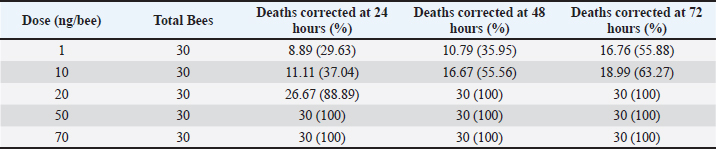
Corrected mortality (Abbott’s method)To account for natural mortality observed in the control group, corrected mortality rates were calculated using Abbott’s formula Corrected mortality rate (%)= (OMR − CMR) / (100 − CMR) × 100 Here, OMR is the observed mortality rate in the exposed group, and CMR is the mortality rate recorded in the control group. The resulting corrected mortality rates are summarized in Table 2. p<>Table 2. Total number of bees and Abbott-corrected mortality (%) at 24, 48, and 72 hours for each dose of thiamethoxam.
After correction, even the lowest tested doses showed a clear lethal effect on A. mellifera compared with the control group. Corrected mortality reached 100% within 48 hours at 20 ng/bee and above, confirming the rapid and time-dependent toxicity of thiamethoxam to honey bees. Control mortality remained below 20% at 48 hours and 72 hours (16.7%), ensuring the validity of Abbott’s correction for LD₅₀ estimation. At 10 days, the control mortality reached 33.3%; however, this time point was not used for LD₅₀ calculation. Probit transformation of mortality dataThe corrected mortality rates are converted into probit values based on the standardized normal distribution (Table 3). On this scale, a probit of 5 corresponds to 50% mortality, facilitating LD₅₀ estimation. Table 3. Log dose and probit values at 24, 48, and 72 hours for each dose of thiamethoxam.
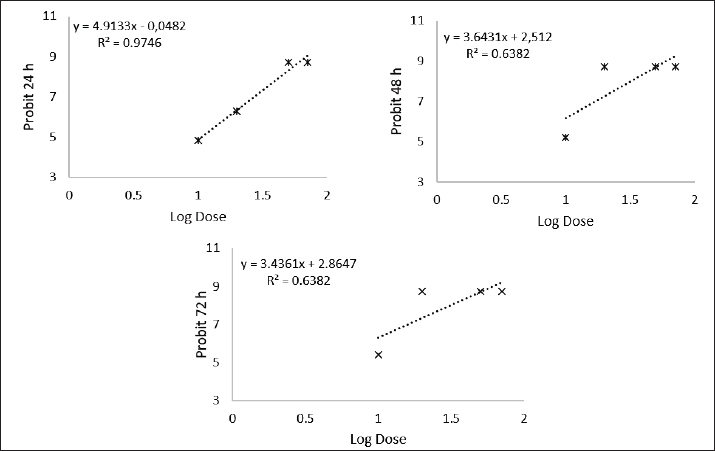
Linear regression between probit and log doseTo estimate LD₅₀ values, a linear relationship was established between probit-transformed mortality and the logarithm of the administered dose (Fig. 2).
Fig. 2. Probit–log(dose) regression lines for thiamethoxam after exposure for 24, 48, and 72 hours. The solvent control group (0 ng/bee) was excluded from the regression analysis because it represents natural mortality unrelated to thiamethoxam exposure. The 1 ng/bee dose was also excluded because it produced mortality values close to control levels with high variability. At such low concentrations, responses are difficult to distinguish from background mortality, which introduces noise and reduces the robustness of the regression model. Consequently, only doses of 10, 20, 50, and 70 ng/bee were used to construct the probit–log(dose) regression models. At 24 hours, the probit model showed a statistically significant dose–response relationship (p=0.0128), indicating a reliable estimation of LD₅₀. The regression also exhibited a strong linear trend (R²=0.975; r=0.987), consistent with the observed dose–response trend. At 48 hours and 72 hours, the regression models were not statistically significant (p=0.201 for both time points), indicating a weaker dose–response relationship. This reduced significance is mainly explained by mortality saturation at higher doses (≥ 20 ng/bee), where mortality rapidly reached 100%. Such saturation limits the range of intermediate responses and reduces variability in the dataset, thereby weakening the linear relationship between probit-transformed mortality and log(dose). As a result, the goodness-of-fit of the models at 48 hours and 72 hours was reduced, and LD₅₀ estimates at these time points should be interpreted with caution. Therefore, LD₅₀ values at 48 hours and 72 hours should be considered indicative estimates, reflecting general mortality patterns rather than precise quantitative endpoints. These estimates may be associated with reduced precision and potentially wide CIs due to the lack of intermediate mortality values at higher doses. LD₅₀ estimationTable 5 presents the estimated LD₅₀ values for thiamethoxam in adult worker honey bees at 24, 48, and 72 hours. Table 4. Linear regression analysis of probit mortality versus log dose at 24 hours, 48 hours, and 72 hours.
Table 5. Median lethal dose (LD₅₀) values for thiamethoxam in adult worker honeybees (Apis mellifera).
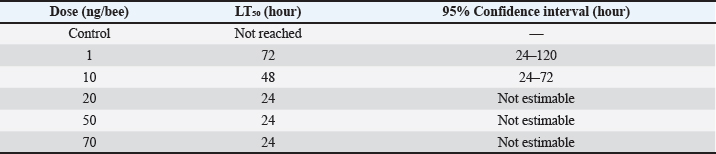
Table 6. Median lethal time (LT₅₀) values for adult worker honey bees (Apis mellifera) exposed to thiamethoxam.
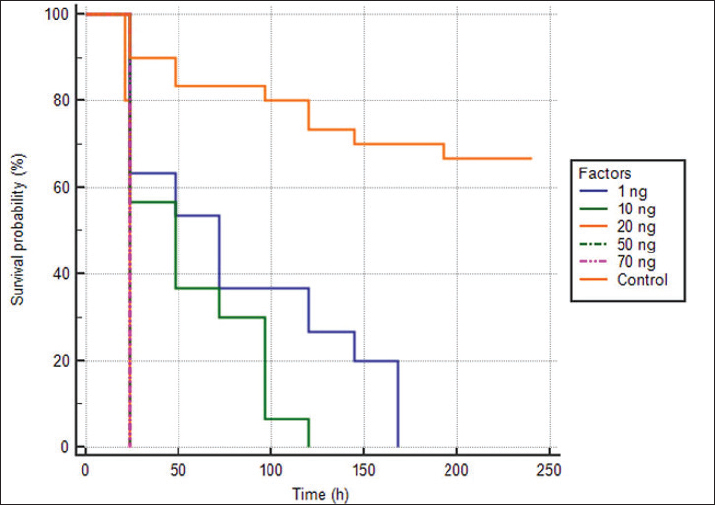
LD₅₀ values were estimated using probit regression based on log-transformed doses. Estimates at 48 hours and 72 hours should be interpreted with caution due to reduced model fit, wide CIs, and mortality saturation at higher doses. The estimated LD₅₀ values were 10.65 ng/bee at 24 hours (95% CI: 4.17–27.15), 4.82 ng/bee at 48 hours (95% CI: 0.26–91.03), and 4.18 ng/bee at 72 hours (95% CI: 0.27–64.07). This progressive reduction in LD₅₀ values over time suggests an increase in mortality with prolonged exposure, as lower doses are required to induce 50% mortality at later time points. However, the LD₅₀ estimates at 48 hours and 72 hours should be interpreted with caution. The very wide CIs indicate low precision in the estimates, most likely due to mortality saturation at intermediate and high doses. Indeed, mortality rapidly reached 100% at doses ≥ 20 ng/bee, reducing the number of intermediate mortality responses available for the probit regression. This limits the ability of the model to accurately describe the dose–response relationship and may explain the weaker model fit and non-significant regression parameters at later time points. Therefore, although the LD₅₀ values suggest increased toxicity over time, the exact estimates at 48 hours and 72 hours should be considered approximate. Overall, these findings confirm that thiamethoxam is highly toxic to honey bees and underline the importance of considering both dose and exposure time when assessing the environmental risk of neonicotinoid insecticides for pollinators, as reflected by changes in mortality and survival probability. Dose effect on survivalThe Kaplan–Meier survival curves describe the probability of bee survival over a 10-day period following exposure to different oral doses of thiamethoxam (1, 10, 20, 50, and 70 ng/bee) compared with an unexposed solvent control group (Fig. 3). The solvent control group exhibited high survival throughout the experiment, with survival probabilities above 90% at 24 hours, 83% at 48 hours, and still above 80% up to 96 hours. Thereafter, only a slight decline was observed, with survival remaining around 70% at 144 hours and 66.7% at 192 hours.
Fig. 3. Kaplan–Meier survival curves for adult worker honey bees (Apis mellifera) exposed orally to different doses of thiamethoxam (1, 10, 20, 50, and 70 ng/bee), compared with an untreated control group. In contrast, the exposed groups showed a clear dose-dependent decrease in survival. At 1 ng/bee, survival probability was 63% at 24 hours and 53% at 48 hours, with complete mortality observed by 168 hours. At 10 ng/bee, survival declined more rapidly, with no bees surviving beyond 120 hours. At 20 ng/bee and above, mortality occurred very rapidly, reaching 100% within 24 hours for the highest doses (50 and 70 ng/bee). LT₅₀ values were derived from Kaplan–Meier survival curves. Confidence intervals could not be estimated for higher doses (≥ 20 ng/bee) due to rapid and complete mortality. Median survival times were expressed as LT₅₀ values (time required to reach 50% mortality), derived from Kaplan–Meier survival curves, allowing a quantitative comparison of the speed of toxic effects across different doses. The LT₅₀ was 72 hours (95% CI: 24–120 hour) at 1 ng/bee and 48 hours (95% CI: 24–72 hour) at 10 ng/bee. At higher doses (20, 50, and 70 ng/bee), the LT₅₀ was estimated at 24 hours; however, the corresponding 95% CIs could not be reliably estimated due to the rapid and complete mortality observed at these concentrations. Taken together, these results demonstrate a pronounced dose–response relationship, with higher doses leading to faster mortality and reduced survival probability. LT₅₀ values decreased markedly with increasing dose, indicating an acceleration of toxic effects at higher concentrations. Even at the lowest tested dose, mortality increased progressively over time following a single exposure. Statistical comparison of survival curves revealed highly significant differences between dose groups (log-rank test: χ²=146.11, df=5, p < 0.0001), confirming a strong dose-dependent effect of thiamethoxam on honey bee survival. Hazard ratios were calculated to quantify the relative risk of mortality. Compared with the solvent control group, all exposed groups showed a markedly increased risk of death. For example, the hazard ratio was 4.25 (95% CI: 2.70–6.70) at 1 ng/bee and increased to 8.29 (95% CI: 4.71–14.61) at 20 ng/bee, indicating a substantial increase in mortality risk with increasing dose. DiscussionThe present study shows that honey bees exposed to thiamethoxam quickly exhibit signs of neurotoxicity, leading to severe mortality that varies with dose and exposure time. Within the first hour after ingestion, treated bees displayed behavioural symptoms such as tremors, reduced spontaneous activity, and sometimes rolling onto their backs, especially at the highest doses (20, 50, and 70 ng/bee). These behavioral issues preceded paralysis and death, which occurred within a few hours at the highest concentrations. Such behavioural disturbances are consistent with the neurotoxic mode of action of neonicotinoids, which act as agonists of insect nAChRs, causing persistent receptor activation and neuronal hyperexcitation (Ihara and Matsuda, 2018). Thiamethoxam is known to function as a partial agonist of nAChRs, thereby causing cholinergic neurotransmission imbalance, which causes neuronal hyperexcitation and impaired motor coordination. Previous studies have reported that exposure to neonicotinoids may be associated with neuroanatomical and physiological alterations, including calcium dysregulation, oxidative stress, and pyknosis of mushroom bodies (Cabirol and Haase, 2019; Ahsan et al., 2025). Sublethal doses impair synaptic transmission and function of neural networks, leading to sublethal effects on motor performance, flight, learning, and decision-making (Sun et al., 2024; Ahsan et al., 2025). These disruptions become more pronounced at higher doses due to receptor desensitisation and evocation of altered neurotransmitter release, leading to disorganized motor behavior and loss of coordination (Casida, 2018). Moreover, neonicotinoids blunt immune pathways, such as NF-κB signaling, which can indirectly aggravate neural dysfunction by promoting susceptibility to pathogens and parasites, such as Varroa mites (Annoscia et al., 2020). Molecular docking studies further suggest strong interactions between neonicotinoids and honey bee chemosensory proteins that could mediate their neurotoxicity via hydrogen bonding and hydrophobic forces (Li et al., 2025). Control mortality reached 10% at 24 hours, which remains within the acceptable range for honey bee oral toxicity tests (OECD, 1998). This early mortality may partly reflect handling, confinement, and cage-related stress, as laboratory bioassays can expose bees to several non-chemical stressors (Perry et al., 2015; Ellis and Rangel, 2024). Although acetone was used at a low concentration and a solvent control was included, a minor contribution of the solvent or a solvent–thiamethoxam interaction cannot be entirely excluded. Therefore, corrected mortality and dose–response estimates should be interpreted with this experimental context in mind. From an ecotoxicological standpoint, repeated exposure to sublethal doses is likely more representative of real-world conditions in agricultural landscapes than acute exposure to high doses, because honey bees repeatedly forage on treated crops and contaminated floral resources. Thiamethoxam residues in nectar and pollen, as measured by field monitoring studies, typically range from a few ng/g up to several tens of ng/g, with some exceptions, depending on the crop system. Pollen residues as high as 14.5 ng/g and 4.3 ng/g in nectar have been observed in seed-treated cotton (Jiang et al., 2018). For maize and oilseed rape, median pollen residues vary from 1 to 7 ng/g, whereas nectar concentrations vary from 0.65 to 2.4 ng/g (Pilling et al., 2013). For some crops, e.g., squash, certain application methods can produce even greater nectar and pollen residues (Dively and Kamel, 2012; Stoner and Eitzer, 2012; Obregon et al., 2022). Previous results show environmental concentrations indicating that honey bees experience predominantly low-dose repeated contamination in agricultural landscapes. Accordingly, the two lowest doses tested in the present study remain either within or similar to relevant concentrations from environmental exposure, while one of the higher doses represents a supra-environmental scenario useful for exploring the extent of any potential dose–response relationship (Martínez-Ferrer et al., 2019; Thompson et al., 2019). However, laboratory studies on mortality and survival under repeated, low-dose neonicotinoid exposure have yielded mixed results. In our study, bees exposed to increasing doses of thiamethoxam (1, 10, 20, 50, and 70 ng/bee) for 10 days showed a steady decline in survival probability as the dose increased. Survival analysis indicated a strong negative relationship between thiamethoxam concentration and survival probability. At the colony scale, these individual reductions in survival and sublethal impairments may affect resource foraging efficiency, thereby affecting worker availability and therefore negatively impacting both colony productivity and stability. Other neonicotinoids, such as clothianidin and imidacloprid, have also been found to cause high mortality in honey bees upon ingestion or indirect contact even at low concentrations (Scholer and Krischik, 2014; Brandt et al., 2016; Orčić et al., 2022). For instance, Laurino et al. (2011) observed the lethal effects of thiamethoxam at concentrations appreciably lower than those commonly applied in agricultural settings, indicating that toxic impacts might linger long after pesticide application. Likewise, Negi et al. (2021) reported elevated mortality in bees subjected to semicontrolled conditions inside cages after treatment of thiamethoxam on mustard crops but less clear effects on survival when measured at the colony level in field exposure. These differences highlight how variations in environmental context and exposure pathways can affect the apparent toxicity of neonicotinoids. Studies examining repeated or prolonged exposure to other neonicotinoids have reported variable outcomes. While some investigations found no significant differences in mortality between control bees and individuals exposed to very low concentrations of imidacloprid (2–20 ppb) over several weeks (Schmuck et al., 2001), others documented increased mortality after prolonged exposure at concentrations of only a few µg/l (Moncharmont et al., 2003). Suchail et al. (2001) also reported high mortality within 8 days in bees exposed to low concentrations of imidacloprid or its metabolites. However, similar experiments conducted with bees from multiple colonies did not reproduce the same level of mortality, highlighting substantial colony-to-colony variability (Schmuck, 2004). These discrepancies may reflect biological factors such as bee age, genetic background, physiological condition, and detoxification capacity, which may ultimately influence survival outcomes under pesticide exposure. Sensitivity to neonicotinoids has been shown to vary among colonies and honey bee subspecies or strains (Suchail et al., 2000; Schmuck et al., 2001; Russell et al., 2007; Bovier et al., 2024). These sources of variability may influence how colonies respond to pesticide exposure under field conditions, potentially leading to differences in resilience, foraging performance, and overall colony stability. To better characterise the toxicity of thiamethoxam in our study, we tracked how LD₅₀ values changed over time. Estimating LD₅₀ not only measures a compound's acute toxicity but also reflects changes in mortality over time. In our results, LD₅₀ values dropped significantly over time: from 10.65 ng/bee at 24 hours to 4.82 ng/bee at 48 hours, and down to 4.18 ng/bee at 72 hours. This pattern indicates a time-dependent expression of toxicity since mortality at lower doses increases with prolonged exposure and survival probability decreases accordingly. Such a decline may result from the progressive accumulation of thiamethoxam in tissues or from impaired or saturated detoxification pathways that normally limit toxic effects. Although the selected dose range of 1–70 ng/bee did result in rapid saturation of mortality at higher doses (≥ 20 ng/bee), particularly at 48 hours and 72 hours, restricting clearer elucidation of the linear portion of the dose–response curve at later time points. As a result, regression models at these time points were associated with lower statistical significance, and this limitation would probably impact the precision of LD₅₀ estimates at 48 hours and 72 hours, which can be linked to broad or poorly defined CIs. Thus, LD₅₀ values should only be viewed as an estimation of time-dependent toxicity and not true long-term toxicity thresholds (Negi et al., 2021; De Souza et al., 2024). This finding also underscores a limitation of the most common approaches currently used in pesticide risk assessments, which are based primarily on acute toxicity endpoints and often do not take into account the complexity of multiple exposures that pollinators experience in field conditions (Mulvey and Cresswell, 2020; Wang et al., 2023). In contrast to acute toxicity caused by rapid overstimulation of nicotinic acetylcholine receptors leading to paralysis and death, repeated low-dose exposure may lead to more insidious changes in physiology that interact with metabolic pathways and detoxification processes involved in neuronal function. While they cause rapid lethality, prolonged exposure to low levels of neonicotinoids has been linked to several additional physiological pathways. In experimental studies, these compounds can induce oxidative stress by increasing the production of reactive oxygen species (ROS), causing neurological and metabolic disorders (Wang et al., 2018; Martelli et al., 2020; Xu et al., 2022). Drosophila models exposed to neonicotinoids confirmed this with mitochondrial dysfunction and glial cell damage (Martelli et al., 2020), whereas chronically exposed bumblebees had impaired mitochondrial function and navigation ability (Moffat et al., 2015). In addition, comparable hindrances of antioxidant enzymes and neurotransmission processes have been observed in aquatic organisms (Mukherjee et al., 2022). Wider neurophysiological consequences may occur in vertebrates, where long-term low-dose exposure during development impacts neurogenesis and induces neuroinflammatory responses (Costas-Ferreira and Faro, 2021). These observations highlight oxidative stress and mitochondrial disruption as key mechanisms underlying systemic neonicotinoid toxicity (Xu et al., 2022; Ahsan et al., 2025). The stronger decline in LD₅₀ values observed in the present study compared with Laurino et al. (2013) may partly reflect differences in incubation temperature. Our bees were maintained at 25°C, whereas Laurino et al. (2013) used higher temperatures. Because honey bees are ectothermic, temperature can influence feeding activity, metabolic rate, detoxification enzyme activity, and pesticide elimination (Wood et al., 2019; Zhang et al., 2021; Kumar et al., 2023). Lower temperatures may reduce detoxification capacity or alter energy allocation, thereby increasing susceptibility to thiamethoxam (Tang et al., 2026). This point is particularly relevant for Moroccan conditions, where seasonal and regional temperature variability may modulate pesticide risk (Tosi et al., 2016; Saleem et al., 2020). However, because the temperature was not experimentally varied in the present study, this explanation remains interpretative and should be tested directly in future work. LD₅₀ estimates obtained late in the experimental period should therefore be interpreted with caution, as mortality is already largely saturated at high doses and increases sharply with dose within this range, leading to higher background mortality, which both reduces statistical power and accelerates the saturation of dose–response regressions over time. More importantly, rearing bees at 25°C—a temperature lower than the normal brood nest temperature—can cause low-intensity heat stress and alter feeding behaviour as well as detoxification pathways (Kovalskyi et al., 2024). These changes could affect how the physiological responses measured under these conditions compare to what would be observed in the field. Similar physiological mechanisms also influence resilience under natural conditions. Genetic diversity and colony strength enhance robustness, leading to increased social immunity and resilience, as well as nutritional status that improves detoxification efficiency, ultimately enhancing the overall health of bees (Kegley et al., 2024; Wueppenhorst et al., 2024). Pest burdens negatively impact immune responses and are therefore considered to increase pesticide toxicity, leading to a synergistic decline in colony performance (Traynor et al., 2016; Traynor et al., 2021). Environmental stressors, such as habitat simplification or the scarcity of floral resources, can further reduce resilience by limiting responses and making bees more sensitive to chemical exposure (Gill et al., 2012; Nicholson et al., 2024). Colonies subjected to multiple exposures to pesticides or stressors frequently exhibit foraging behaviour disorders, reduced brood development, and increased mortality, highlighting the cumulative impact of these exposures (Gill et al., 2012; Schott et al., 2021). Notwithstanding the above insights, some limitations should be noted with regard to the current study. The present study focuses primarily on mortality and survival endpoints, and sublethal effects, such as behavior, learning, and navigation, were not quantitatively assessed. In addition, no direct biochemical measurements were included in the present manuscript to confirm bioaccumulation, detoxification impairment, receptor-level mechanisms, or other physiological pathways. Therefore, mechanistic explanations related to cumulative toxicity should be interpreted as plausible hypotheses rather than experimentally demonstrated mechanisms. Furthermore, potential differences related to behavioral roles (e.g., foragers vs. nurses) were not specifically considered. The experiments were performed in controlled laboratory conditions that utilized caged bees from a single colony (which do not fully reflect the complexity of field environments where multiple stressors interact and social buffering mechanisms occur at the colony level; Ahsan et al., 2025). Moreover, the final data are limited to a single colony, and all bees were kept in controlled laboratory conditions with temperature stabilized at 25°C, which may not be representative of bee colonies exposed either to natural field conditions or valuable physiological adjustments in other Moroccan colonies, while limiting the extrapolation of the results to real-world scenarios. Another limitation of the present study is the relatively limited number of bees per treatment group. Although this group size allowed controlled laboratory comparisons between treatments, it may reduce statistical power and increase uncertainty around LD₅₀ estimates, especially at 48 hours and 72 hours, when mortality saturation reduced the number of intermediate responses. In addition, the very wide CIs associated with these LD₅₀ estimates indicate low precision, likely resulting from this mortality saturation at higher doses and the limited number of intermediate responses available for probit regression. Future studies using larger sample sizes and multiple colonies would improve the precision and generalizability of these toxicity estimates. Acute toxicity testing provides important baseline data for assessing pesticide risk, but long-term laboratory or field studies are required to assess effects on colony health and ecosystem services (Hladik et al., 2018; Lu et al., 2020). Thus, the LD₅₀ values obtained in this study should be considered with caution and cannot be considered fully representative of all Moroccan honeybee populations. In summary, the present findings corroborate the high toxicity of thiamethoxam to honey bees, as reflected by increased mortality and reduced survival probability at relatively low doses. These results add to the growing body of evidence concerning ecological risks surrounding neonicotinoid use, particularly given that agricultural landscapes have a high potential for repeated exposure. These findings add to the significant scientific discourse over the regulation of neonicotinoid insecticides. The global regulation of these compounds is active, and discussions continue regarding the use of such compounds in all countries across regions where their usage has been shown to be detrimental to pollinator health. However, both laboratory- and field-based evidence need further evaluation. Consequently, integrating laboratory investigations with field observations remains critical for accurately understanding pesticide effects on pollinator populations and for establishing sustainable pest management and pollinator conservation strategies. ConclusionExposure of honeybees to thiamethoxam caused early behavioral symptoms within the first hour, long before any mortality occurred. These signs, including weakness, tremors, reduced activity, and, in some cases, rolling onto their backs, are typical of an acute neurological disorder and were especially noticeable at the highest doses, indicating rapid neurotoxicity that severely affects bee vitality. The acute toxicity of thiamethoxam was clearly demonstrated by the observed and corrected mortality data, which showed a strong dose-dependent response. Over time, LD₅₀ estimates declined, indicating time-dependent toxicity, where the toxic effects of thiamethoxam become more apparent with increasing time after exposure. Overall, these findings underline the harmful effects of thiamethoxam on A. mellifera and highlight the importance of considering both dose and exposure duration in pesticide risk assessment. However, caution is warranted when extrapolating laboratory results to all colonies in the field; environmental conditions are influenced by additional ecological and social interactions that can lead to variations in the overall resilience of colonies. Furthermore, studies combining long-term and field-based assessment methods are therefore necessary to more realistically evaluate the potential risks posed by exposure to thiamethoxam to pollinator populations. AcknowledgmentsThe authors express their deep gratitude to all those who participated in the success of this work, especially the ASSAMER Beekeeping Cooperative (especially Zouhair Hnini). Conflicts of interestThe authors declare no conflicts of interest. FundingThis research received no specific grant. Author contributionsConceptualization, Amina Brhich; Mohamed Merzouki; Rachid Hnini; Methodology, Amina Brhich; Rachid Hnini; Mohamed Merzouki; Formal analysis, MohamedMerzouki; Rachid Hnini; Amina Brhich; Investigation, Amina Brhich, Rachid Hnini, Hasna Merzouki, Hayat Bouighajd, Hicham Chatoui, Mohamed Merzouki; Data curation, Rachid Hnini; Amina Brhich; Mohamed Merzouki; Visualization, Amina Brhich, Rachid Hnini, Hasna Merzouki, Hayat Bouighajd, Hicham Chatoui, Mohamed Merzouki; Writing—original draft preparation, Amina Brhich; Writing—review and editing, Rachid Hnini, Hasna Merzouki; Mohamed Merzouki; Supervision, Mohamed Merzouki and Rachid Hnini. All authors have read and agreed to the published version of the manuscript. Data availabilityThe data supporting the findings of this study are not openly available due to sensitivity reasons. However, they are available from the corresponding author upon reasonable request. ReferencesAdriaanse, P., Arce, A., Focks, A., Ingels, B., Jölli, D., Lambin, S., Rundlöf, M., Süßenbach, D., Del Aguila, M., Ercolano, V., Ferilli, F., Ippolito, A., Szentes, C., Neri, F.M., Padovani, L., Rortais, A., Wassenberg, J. and Auteri, D. 2023. Revised guidance on the risk assessment of plant protection products on bees (Apis mellifera, Bombus spp. and solitary bees). EFSA J. 21(5), 7989; doi: 10.2903/j.efsa.2023.7989 Ahsan, Z., Wu, Z., Lin, Z., Ji, T. and Wang, K. 2025. The Sublethal Effects of Neonicotinoids on Honeybees. Biology 14(8), 1076; doi: 10.3390/biology14081076 Annoscia, D., Di Prisco, G., Becchimanzi, A., Caprio, E., Frizzera, D., Linguadoca, A., Nazzi, F. and Pennacchio, F. 2020. Neonicotinoid Clothianidin reduces honey bee immune response and contributes to Varroa mite proliferation. Nature Commun. 11(1), 5887; doi: 10.1038/s41467-020-19715-8 Blacquière, T., Smagghe, G., Van Gestel, C.A.M. and Mommaerts, V. 2012. Neonicotinoids in bees: a review on concentrations, side-effects and risk assessment. Ecotoxicology 21(4), 973–992. Bovier, M., Camenzind, D.W., Brown, A.F., Jeker, L., Retschnig, G., Neumann, P. and Straub, L. 2024. Colony environment and absence of brood enhance tolerance to a neonicotinoid in winter honey bee workers, Apis mellifera. Ecotoxicol. (London. England). 33, 608–621; doi: 10.1007/s10646-024-02758-8 Brandt, A., Gorenflo, A., Siede, R., Meixner, M. and Büchler, R. 2016. The neonicotinoids thiacloprid, imidacloprid, and clothianidin affect the immunocompetence of honey bees (Apis mellifera L.). J. Insect Physiol. 86, 40–47; doi:10.1016/j.jinsphys.2016.01.001 Brunet, J. and Fragoso, F.P. 2024. What are the main reasons for the worldwide decline in pollinator populations?. CABI Rev. 19, 1; doi: 10.1079/cabireviews.2024.0016 Cabirol, A. and Haase, A. 2019. The neurophysiological bases of the impact of neonicotinoid pesticides on the behaviour of honeybees. Insects 10(10), 344; doi: 10.3390/insects10100344 Carson, R. 1962. Silent Spring. Boston, MA: Houghton Mifflin Company. Casida, J.E. 2018. Neonicotinoids and other insect nicotinic receptor competitive modulators: progress and prospects. Annu. Rev. Entomol. 63, 125–144; doi:10.1146/annurev-ento-020117-043042 Chahbar, N., Belzunces, L.P. and Doumandji, S. 2011. Effet d’un insecticide utilisé en protection des végétaux: Thiamethoxam sur l’abeille saharienne Apis mellifera sahariensis. AJAE 1(2), 11–21. Costas-Ferreira, C. and Faro, L.R.F. 2021. Neurotoxic effects of neonicotinoids on mammals: what is there beyond the activation of nicotinic acetylcholine receptors?—a systematic review. Int. J. Mol. Sci. 22(16), 8413. Coulon, M., Schurr, F., Martel, A.C., Cougoule, N., Bégaud, A., Mangoni, P., Dalmon, A., Alaux, C., Le Conte, Y., Thiéry, R., Ribière-Chabert, M. and Dubois, E. 2017. Metabolisation of thiamethoxam (a neonicotinoid pesticide) and interaction with the Chronic bee paralysis virus in honeybees. Pesticide Biochem. Physiol. 144, 10–18; doi:10.1016/j.pestbp.2017.10.009 De Souza, D., Urbanowicz, C., Ng, W.H., Baert, N., Fersch, A.A., Smith, M.L. and Mcart, S.H. 2024. Acute toxicity of the fungicide captan to honey bees and mixed evidence for synergism with the insecticide thiamethoxam. Sci. Rep. 14, 15709; doi: 10.1038/s41598-024-66248-x Dicks, L.V., Breeze, T.D., Ngo, H.T., Senapathi, D., An, J., Aizen, M.A., Basu, P., Buchori, D., Galetto, L., Garibaldi, L.A., Gemmill-Herren, B., Howlett, B.G., Imperatriz-Fonseca, V.L., Johnson, S.D., Kovács-Hostyánszki, A., Kwon, Y.J., Lattorff, H.M.G., Lungharwo, T., Seymour, C.L., Vanbergen, A.J. and Potts, S.G. 2021. A global-scale expert assessment of drivers and risks associated with pollinator decline. Nature. Ecol. Evol. 5, 1453–1461; doi:10.1038/s41559-021-01534-9 Dively, G.P. and Kamel, A. 2012. Insecticide residues in pollen and nectar of a cucurbit crop and their potential exposure to pollinators. J. Agricult. Food. Chem. 60(18), 4449–4456. Ellis, J.T. and Rangel, J. 2024. Stress drives premature hive exiting behavior that leads to death in young honey bee (Apis mellifera) workers. Biol. Res. 57(1), 92. Faburé, J., Hedde, M., Le Perchec, S., Pesce, S., Sucré, E. and Fritsch, C. 2025. Role of trophic interactions in transfer and cascading impacts of plant protection products on biodiversity: a literature review. Environ. Sci. Pollut. Res. 32(6), 2993–3031. Gehan, E.A. 1965. A generalized two-sample Wilcoxon test for doubly censored data. Biometrika 52(3/4), 650–653. Gill, R.J., Ramos-Rodriguez, O. and Raine, N.E. 2012. Combined pesticide exposure severely affects individual-and colony-level traits in bees. Nature 491(7422), 105–108. Girolami, V., Mazzon, L., Squartini, A., Mori, N., Marzaro, M., Di Bernardo, A., Greatti, M., Giorio, C. and Tapparo, A. 2009. Translocation of neonicotinoid insecticides from coated seeds to seedling guttation drops: a novel way of intoxication for bees. J. Econ. Entomol. 102(5), 1808–1815. Guo, Y., Ma, C., Zhao, W., Kuang, H., Tian, Y., Zhang, H., Xue, Y., Li-Byarlay, H., Dong, K. and Gong, X. 2025. Chronic exposure to field-level thiamethoxam impairs gut tissue and reduces honeybee (Apis cerana) survival. Insects 16(4), 372; doi: 10.3390/insects16040372 Hladik, M.L., Main, A.R. and Goulson, D. 2018. Environmental risks and challenges associated with neonicotinoid insecticides. Environ. Sci. Technol. 52(6), 3329–3335; doi: 10.1021/acs.est.7b06388. Ihara, M. and Matsuda, K. 2018. Neonicotinoids: molecular mechanisms of action, insights into resistance and impact on pollinators. Curr. Opinion Insect Sci. 30, 86–92; doi:10.1016/j.cois.2018.09.009 Jiang, J., Ma, D., Zou, N., Yu, X., Zhang, Z., Liu, F. and Mu, W. 2018. Concentrations of imidacloprid and thiamethoxam in pollen, nectar and leaves from seed-dressed cotton crops and their potential risk to honeybees (Apis mellifera L.). Chemosphere 201, 159–167; doi:10.1016/j.chemosphere.2018.02.168 Kegley, S.E., Radford, R., Brown, T.J., Anderson, J., Cox, D., Ellis, S. and Marcy, G.W. 2024. Longitudinal analysis of honey bee colony health as a function of pesticide exposure. Agronomy 14(11), 2505. Kistler, T., Basso, B. and Phocas, F. 2021. A simulation study of a honeybee breeding scheme accounting for polyandry, direct and maternal effects on colony performance. Genet. Sel. Evol. 53(1), 71; doi: 10.1186/s12711-021-00665-8 Klaas-Fábregas, M., Gómez-Ramírez, P., Fernández-Gómez, L., Alfonso I Prieto, J., Garrido, I., Cava, J., Martínez-Escudero, C.M., Fenoll, J. and Pérez-García, J.M. 2024. First detection of thiamethoxam in a free-ranging insectivorous bird after its agricultural use ban in Spain. Environ. Toxicol. Chem. 43(8), 1836–1843. Köhler, A., Nicolson, S.W. and Pirk, C.W.W. 2013. A new design for honey bee hoarding cages for laboratory experiments. J. Apicultural Res. 52(2), 12–14. Kovalskyi, I., Kovalska, L., Druzhbiak, A., Kovalchuk, I., Boyko, A., Zhmur, V., Havdan, R., Druzhbiak, М., Perig, D., Lunyk, I., Fiialovych, L., Petryshak, O., Paskevych, G., Bogdan, B. and Leshchyshyn, I. 2024. Ontogenesis of honey bees (Apis mellifera) under the influence of temperature stress. Regul. Mech. Biosyst. 15(2), 300–305; doi: 10.15421/022443 Kumar, S., Suby, S.B., Vasmatkar, P., Nebapure, S.M., Kumar, N. and Mahapatro, G.K. 2023. Influence of temperature on insecticidal toxicity and detoxifying enzymes to Spodoptera frugiperda. Phytoparasitica 51(3), 533–545. La Vie Éco. 2022. Apiculture : Un effondrement des colonies est constaté dans la plupart des régions. Casablanca, Morocco: La Vie Éco Presse SA. Available via https://www.lavieeco.com/affaires/apiculture-un-effondrement-des-colonies-est-constate-dans-la-plupart-des-regions/ Laurino, D., Manino, A., Patetta, A. and Porporato, M. 2013. Toxicity of neonicotinoid insecticides on different honey bee genotypes. Bull. Insectology. 66(1), 119–126. Laurino, D., Porporato, M., Patetta, A. and Manino, A. 2011. Toxicity of neonicotinoid insecticides to honey bees: laboratory tests. Bull. Insectol. 64(1), 107–113. Li, B.A. 2022. Dichloro-diphenyl-trichloroethane (DDT): an unforgettable and powerful pesticide. J. High School Sci. 6(2); doi: 10.64336/001c.35824. Li, X., Li, S., Liu, Y., Cui, L., Yang, D., Chen, S., Shao, X., Yuan, H. and Yan, X. 2025. Molecular mechanisms of cis-oxygen bridge neonicotinoids to Apis mellifera Linnaeus chemosensory protein: surface plasmon resonance, multiple spectroscopy techniques, and molecular modeling. Ecotoxicol. Environ. Saf. 290, 117719; doi:10.1016/j.ecoenv.2025.117719 Lu, C., Hung, Y.T. and Cheng, Q. 2020. A review of sub-lethal neonicotinoid insecticides exposure and effects on pollinators. Curr. Pollut. Rep. 6, 137–151. Mansouri, A., Cregut, M., Abbes, C., Durand, M.J., Landoulsi, A. and Thouand, G. 2016. The environmental issues of DDT pollution and bioremediation: a multidisciplinary review. Appl. Biochem. Biotechnol. 181, 309–339; doi:10.1007/s12010-016-2214-5 Mantel, N. 1985. Propriety of the Mantel-Haenszel variance for the log rank test. Biometrika 72(2), 471–472. Martelli, F., Zhongyuan, Z., Wang, J., Wong, C.O., Karagas, N.E., Roessner, U., Rupasinghe, T., Venkatachalam, K., Perry, T., Bellen, H.J. and Batterham, P. 2020. Low doses of the neonicotinoid insecticide imidacloprid induce ROS triggering neurological and metabolic impairments in Drosophila. Proc. Nat. Acad. Sci. United States Amer. 117, 25840–25850; doi:10.1073/pnas.2011828117 Martínez-Ferrer, M.T., Campos-Rivela, J.M., Hernando-Guil, M.D. and García-Valcárcel, A.I. 2019. Evaluation of residue levels of imidacloprid and thiamethoxam after foliar application to the citrus varieties lane late, valencia late, rohde summer, and nules. J. Econ. Entomol. 112(6), 2676–2685. Maucourt, S., Fournier, V. and Giovenazzo, P. 2018. Comparison of three methods to multiply honey bee (Apis mellifera) colonies. Apidologie 49, 314–324; doi:10.1007/s13592-017-0556-9 Moffat, C., Pacheco, J.G., Sharp, S., Samson, A.J., Bollan, K.A., Huang, J., Buckland, S.T. and Connolly, C.N. 2015. Chronic exposure to neonicotinoids increases neuronal vulnerability to mitochondrial dysfunction in the bumblebee (Bombus terrestris). FASEB J. 29(5), 2112–2119. Moncharmont, F.X.D., Decourtye, A., Hennequet., Hantier, C., Pons, O., Pham. and Delègue, M.H. 2003. Statistical analysis of honeybee survival after chronic exposure to insecticides. Environ. Toxicol. Chem. Int. J. 22(12), 3088–3094. Mukherjee, R.K., Kumar, V. and Roy, K. 2022. Chemometric modeling of plant protection products (PPPs) for the prediction of acute contact toxicity against honey bees (A. mellifera): a 2D-QSAR approach. J. Hazardous. Mater. 423, 127230. Mulvey, J. and Cresswell, J.E. 2020. Time-dependent effects on bumble bees of dietary exposures to farmland insecticides (imidacloprid, thiamethoxam and fipronil). Pest Manag. Sci. 76(8), 2846–2853; doi: 10.1002/ps.5838 Negi, B.R., Sharma, H.K., Thakur, M. and Prashad, H. 2021. Lethal and sublethal effects of thiamethoxam, a neonicotinoid molecule, on colony performance of A. mellifera. Environ. Sci. Pollut. Res. 29, 10826–10837; doi:10.1007/s11356-021-16426-5 Nicholson, C.C., Lonsdorf, E.V., Andersson, G.K.S., Knapp, J.L., Svensson, G.P., Gönczi, M., Jonsson, O., De Miranda, J.R., Williams, N.M. and Rundlöf, M. 2024. Landscapes of risk: a comparative analysis of landscape metrics for the ecotoxicological assessment of pesticide risk to bees. J. Appl. Ecol. 61(5), 975–986. Nora, C., Hamadi, K., Chahbar, M., Belaid, M., Acheuk, F. and Doumandji, S. 2021. Variation in Oral Acute Toxicity of Thiamethoxam According to the Volume Administered in Algerian Honeybees. Egypt. Academic. J. Biol. Sci. 14, 123–131; doi:10.21608/eajbsa.2021.156533 Obregon, D., Pederson, G., Taylor, A. and Poveda, K. 2022. The pest control and pollinator protection dilemma: the case of thiamethoxam prophylactic applications in squash crops. PLos One. 17(5), 267984. OECD. 1998. OECD guideline for the testing of chemicals No. 213: Honeybees, acute oral toxicity test. Paris, France: Organisation for Economic Co-operation and Development. Orčić, S.M., Čelić, T.V., Purać, J.S., Vukašinović, E.L. and Kojić, D.K. 2022. Acute toxicity of sublethal concentrations of thiacloprid and clothianidin to immune response and oxidative status of honey bees. Apidologie 53, 1–16; doi:10.1007/s13592-022-00959-w Overmyer, J., Feken, M., Ruddle, N., Bocksch, S., Hill, M. and Thompson, H. 2018. Thiamethoxam honey bee colony feeding study: linking effects at the level of the individual to those at the colony level. Environ. Toxicol. Chem. 37(3), 816–828; doi: 10.1002/etc.4018 Paoli, M. and Giurfa, M. 2024. Pesticides and pollinator brain: how do neonicotinoids affect the central nervous system of bees?. Eur. J. Neurosci. 60(8), 5927–5948. Perry, C.J., Søvik, E., Myerscough, M.R. and Barron, A.B. 2015. Rapid behavioral maturation accelerates failure of stressed honey bee colonies. Proc. Nat. Acad. Sci. 112(11), 3427–3432. Peto, R. and Peto, J. 1972. Asymptotically efficient rank invariant test procedures. J. Roy. Stat. Soc. Ser. A. (Gen). 135(2), 185–198. Pilling, E., Campbell, P., Coulson, M., Ruddle, N. and Tornier, I. 2013. A four-year field program investigating long-term effects of repeated exposure of honey bee colonies to flowering crops treated with Thiamethoxam. PLoS One 8(10), e77193; doi: 10.1371/journal.pone.0077193 Potts, S.G., Biesmeijer, J.C., Kremen, C., Neumann, P., Schweiger, O. and Kunin, W.E. 2010. Global pollinator declines: trends, impacts and drivers. Trends Ecol. &. Evol. 25(6), 345–353; doi:10.1016/j.tree.2010.01.007 Potts, S.G., Imperatriz-Fonseca, V., Ngo, H.T., Aizen, M.A., Biesmeijer, J.C., Breeze, T.D., Dicks, L.V., Garibaldi, L.A., Hill, R., Settele, J. and Vanbergen, A.J. 2016. Safeguarding pollinators and their values to human well-being. Nature 540, 220–229; doi:10.1038/nature20588 Quandahor, P., Kim, L., Kim, M., Lee, K., Kusi, F. and Jeong, I.H. 2024. Effects of agricultural pesticides on decline in insect species and individual numbers. Environments 11(8), 182. Russell, R.M., Preisler, H.K., Savin, N.E. and Robertson, J.L. 2007. Bioassays with arthropods. Boca Raton, FL: CRC Press / Taylor & Francis Group. Saleem, M., Huang, Z. and Milbrath, M. 2020. Neonicotinoid pesticides are more toxic to honey bees at lower temperatures: implications for overwintering bees. Front. Ecol. Evol. 8, 556856; doi: 10.3389/fevo.2020.556856 Schmuck, R. 2004. Effects of a chronic dietary exposure of the honeybee Apis mellifera (Hymenoptera: apidae) to imidacloprid. Arch. Environ. Contamination Toxicol. 47, 471–478. Schmuck, R., Schöning, R., Stork, A. and Schramel, O. 2001. Risk posed to honeybees (Apis mellifera L, Hymenoptera) by an imidacloprid seed dressing of sunflowers. Pest Manage. Sciformerly. Pesticide Sci. 57(3), 225–238. Scholer, J. and Krischik, V. 2014. Chronic Exposure of Imidacloprid and Clothianidin Reduce Queen Survival, Foraging, and Nectar Storing in Colonies of Bombus impatiens. PLoS One 9(3), e91573; doi: 10.1371/journal.pone.0091573 Schott, M., Sandmann, M., Cresswell, J.E., Becher, M.A., Eichner, G., Brandt, D.T., Halitschke, R., Krueger, S., Morlock, G., Düring, R.A., Vilcinskas, A., Meixner, M.D., Büchler, R. and Brandt, A. 2021. Honeybee colonies compensate for pesticide-induced effects on royal jelly composition and brood survival with increased brood production. Scientific. Rep. 11(1), 62. Sharma, H. and Sanyal, D. 2024. Neonicotinoids: regulatory status vis-à-vis its sustainable future. In: Neonicotinoids in the Environment: Emerging Concerns to the Human Health and Biodiversity. Eds., Singh, R., Singh, V.K., Kumar, A., Tripathi, S. and Bhadouria, R. Cham, Switzerland: Springer Nature Switzerland, pp: 185–198 Stephenson, G.L. and Solomon, K.R. 2017. Quantitative weight of evidence assessment of higher tier studies on the toxicity and risks of neonicotinoids in honeybees. 4. Thiamethoxam. J. Toxicol. Environ. Health. Part B 20, 365–382; doi:10.1080/10937404.2017.1388568 Stoner, K.A. and Eitzer, B.D. 2012. Movement of soil-applied imidacloprid and thiamethoxam into nectar and pollen of squash (Cucurbita pepo). PLos One. 7(6), e39114. Suchail, S., Guez, D. and Belzunces, L.P. 2000. Characteristics of imidacloprid toxicity in two Apis mellifera subspecies. Environ. Toxicol. Chem. Int. J. 19(7), 1901–1905. Suchail, S., Guez, D. and Belzunces, L.P. 2001. Discrepancy between acute and chronic toxicity induced by imidacloprid and its metabolites in Apis mellifera. Environ. Toxicol. Chem. Int. J. 20(11), 2482–2486. Sun, J., Wu, J., Zhang, X., Wei, Q., Kang, W., Wang, F., Liu, F., Zhao, M., Xu, S. and Han, B. 2024. Enantioselective toxicity of the neonicotinoid dinotefuran on honeybee (Apis mellifera) larvae. Sci. Total Environ. 944, 174014; doi: 10.1016/j.scitotenv.2024.174014 Tang, R., Wei, D., Luo, C.H., Qin, J.R., Mobarak, S.H., Yu, X.L. and Liu, T.X. 2026. High-temperature acclimation during development modulates efficacy of emamectin benzoate against Mythimna separata (Lepidoptera: Noctuidae). J. Econ. Entomol. 119(1), 196–207; doi: 10.1093/jee/toaf277 Thompson, H., Overmyer, J., Feken, M., Ruddle, N., Vaughan, S., Scorgie, E., Bocksch, S. and Hill, M. 2019. Thiamethoxam: long-term effects following honey bee colony-level exposure and implications for risk assessment. Sci. Total. Environ. 654, 60–71; doi:10.1016/j.scitotenv.2018.11.003 Tosi, S., Démares, F.J., Nicolson, S.W., Medrzycki, P., Pirk, C.W.W. and Human, H. 2016. Effects of a neonicotinoid pesticide on thermoregulation of African honey bees (Apis mellifera scutellata). J. Insect Physiol. 93, 56–63; doi: 10.1016/j.jinsphys.2016.08.010 Traynor, K.S., Pettis, J.S., Tarpy, D.R., Mullin, C.A., Frazier, J.L., Frazier, M. and Vanengelsdorp, D. 2016. In-hive Pesticide Exposome: assessing risks to migratory honey bees from in-hive pesticide contamination in the Eastern United States. Scientific Rep. 6(1), 33207. Traynor, K.S., Tosi, S., Rennich, K., Steinhauer, N., Forsgren, E., Rose, R., Kunkel, G., Madella, S., Lopez, D., Eversole, H., Fahey, R., Pettis, J., Evans, J.D. and Dennis Vanengelsdorp. 2021. Pesticides in honey bee colonies: establishing a baseline for real world exposure over seven years in the USA. Environ. Pollut. 279, 116566. Wang, D., Lv, L., Gao, Z., Zhu, Y.C., Weng, H., Yang, G. and Wang, Y. 2023. Joint toxic effects of thiamethoxam and flusilazole on the adult worker honey bees (Apis mellifera L.). Environ. Pollut. 317, 120806; doi: 10.1016/j.envpol.2022.120806 Wang, X., Anadón, A., Wu, Q., Qiao, F., Ares, I., Martínez-Larrañaga, M.R., Yuan, Z. and Martínez, M.A. 2018. Mechanism of Neonicotinoid Toxicity: impact on Oxidative Stress and Metabolism. Annu. Rev. Pharmacol. Toxicol. 58, 471–507; doi:10.1146/annurev-pharmtox-010617-052429 Ward, L.T., Hladik, M.L., Guzman, A., Winsemius, S., Bautista, A., Kremen, C. and Mills, N.J. 2022. Pesticide exposure of wild bees and honey bees foraging from field border flowers in intensively managed agriculture areas. Sci. Total Environ. 831, 154697; doi: 10.1016/j.scitotenv.2022.154697 Wood, S.C., Kozii, I.V., Medici De Mattos, I., De Carvalho Macedo Silva, R., Klein, C.D., Dvylyuk, I., Moshynskyy, I., Epp, T. and Simko, E. 2019. Chronic High-Dose Neonicotinoid Exposure Decreases Overwinter Survival of Apis mellifera L. Insects 11(1), 30; doi: 10.3390/insects11010030 Wueppenhorst, K., Alkassab, A.T., Beims, H., Ernst, U., Friedrich, E., Illies, I., Janke, M., Kirchner, W.H., Seidel, K., Steinert, M., Yurkov, A., Erler, S. and Odemer, R. 2024. Honey bee colonies can buffer short-term stressor effects of pollen restriction and fungicide exposure on colony development and the microbiome. Ecotoxicol. Environ. Saf. 282, 116723. Xu, X., Wang, X., Yang, Y., Ares, I., Martínez, M., Lopez-Torres, B., Martínez-Larrañaga, M.R., Wang, X., Anadón, A. and Martinez, M.A. 2022. Neonicotinoids: mechanisms of systemic toxicity based on oxidative stress-mitochondrial damage. Arch. Toxicol. 96, 1493–1520; doi:10.1007/s00204-022-03267-5 Yamamoto, I., Tomizawa, M., Saito, T., Miyamoto, T., Walcott, E.C. and Sumikawa, K. 1998. Structural factors contributing to insecticidal and selective actions of neonicotinoids. Arch. Insect Biochem. Physiol. Published. Collaboration. With. Entomological. Soc. Amer. 37(1), 24–32. Zhang, Y., Cai, T., Ren, Z., Liu, Y., Yuan, M., Cai, Y., Yu, C., Shu, R., He, S., Li, J., Wong, A.C.N. and Wan, H. 2021. Decline in symbiont-dependent host detoxification metabolism contributes to increased insecticide susceptibility of insects under high temperature. ISME. J. 15(12), 3693–3703. Zioga, E., Kelly, R., White, B. and Stout, J.C. 2020. Plant protection product residues in plant pollen and nectar: a review of current knowledge. Environ. Res. 189, 109873; doi:10.1016/j.envres.2020.109873 Supplementary Table S1. Raw survival data used for Kaplan–Meier analysis, including individual survival time (hours), event status (1=death, 0=censored), and treatment group.
| ||




| How to Cite this Article |
| Pubmed Style Brhich A, Hnini R, Merzouki H, Bouighajd H, Chatoui H, Merzouki M. Toxicological assessment of thiamethoxam in Apis mellifera. Open Vet. J.. 2026; 16(7): 4590-4608. doi:10.5455/OVJ.2026.v16.i7.42 Web Style Brhich A, Hnini R, Merzouki H, Bouighajd H, Chatoui H, Merzouki M. Toxicological assessment of thiamethoxam in Apis mellifera. https://www.openveterinaryjournal.com/?mno=308419 [Access: July 15, 2026]. doi:10.5455/OVJ.2026.v16.i7.42 AMA (American Medical Association) Style Brhich A, Hnini R, Merzouki H, Bouighajd H, Chatoui H, Merzouki M. Toxicological assessment of thiamethoxam in Apis mellifera. Open Vet. J.. 2026; 16(7): 4590-4608. doi:10.5455/OVJ.2026.v16.i7.42 Vancouver/ICMJE Style Brhich A, Hnini R, Merzouki H, Bouighajd H, Chatoui H, Merzouki M. Toxicological assessment of thiamethoxam in Apis mellifera. Open Vet. J.. (2026), [cited July 15, 2026]; 16(7): 4590-4608. doi:10.5455/OVJ.2026.v16.i7.42 Harvard Style Brhich, A., Hnini, . R., Merzouki, . H., Bouighajd, . H., Chatoui, . H. & Merzouki, . M. (2026) Toxicological assessment of thiamethoxam in Apis mellifera. Open Vet. J., 16 (7), 4590-4608. doi:10.5455/OVJ.2026.v16.i7.42 Turabian Style Brhich, Amina, Rachid Hnini, Hasna Merzouki, Hayat Bouighajd, Hicham Chatoui, and Mohamed Merzouki. 2026. Toxicological assessment of thiamethoxam in Apis mellifera. Open Veterinary Journal, 16 (7), 4590-4608. doi:10.5455/OVJ.2026.v16.i7.42 Chicago Style Brhich, Amina, Rachid Hnini, Hasna Merzouki, Hayat Bouighajd, Hicham Chatoui, and Mohamed Merzouki. "Toxicological assessment of thiamethoxam in Apis mellifera." Open Veterinary Journal 16 (2026), 4590-4608. doi:10.5455/OVJ.2026.v16.i7.42 MLA (The Modern Language Association) Style Brhich, Amina, Rachid Hnini, Hasna Merzouki, Hayat Bouighajd, Hicham Chatoui, and Mohamed Merzouki. "Toxicological assessment of thiamethoxam in Apis mellifera." Open Veterinary Journal 16.7 (2026), 4590-4608. Print. doi:10.5455/OVJ.2026.v16.i7.42 APA (American Psychological Association) Style Brhich, A., Hnini, . R., Merzouki, . H., Bouighajd, . H., Chatoui, . H. & Merzouki, . M. (2026) Toxicological assessment of thiamethoxam in Apis mellifera. Open Veterinary Journal, 16 (7), 4590-4608. doi:10.5455/OVJ.2026.v16.i7.42 |


