Open Veterinary Journal, (2026), Vol. 16(7): 4819-4827
Research Article
10.5455/OVJ.2026.v16.i7.60
Natural aromatase blockers accelerate the onset of egg production in laying hens through estradiol suppression and enhancement of follicle-stimulating hormone
Claude Mona Airin1*, Salsabila Ayuningtyas Sukma2, Sarmin Sarmin1, Pudji Astuti1
and Rizki Fitrawan Yuneldi3
1Department of Physiology, Faculty of Veterinary Medicine, Universitas Gadjah Mada, Yogyakarta, Indonesia
2Master Program of Veterinary Sciences, Faculty of Veterinary Medicine, Universitas Gadjah Mada, Yogyakarta, Indonesia
3Research Center for Applied Zoology, Research Organization for Life Sciences and Environment, National Research and Innovation Agency (BRIN), Cibinong, Indonesia
*Corresponding Author: Claude Mona Airin. Department of Physiology, Faculty of Veterinary Medicine, Universitas Gadjah Mada, Yogyakarta, Indonesia. Email: monaairin [at] ugm.ac.id
Submitted: 09/02/2026 Revised: 11/06/2026 Accepted: 22/06/2026 Published: 20/07/2026
© 2025 Open Veterinary Journal
This is an Open Access article distributed under the terms of the Creative Commons Attribution-Non Commercial-No Derivatives License (http://creativecommons.org/licenses/by-nc-nd/4.0/), which permits non-commercial re-use, distribution, and reproduction in any medium, provided the original work is properly cited, and is not altered, transformed, or built upon in any way.
ABSTRACT
Background: Anadara granosa clam shell powder, as a natural aromatase blocker (NAB), may inhibit the conversion of testosterone to estradiol (E2). It triggered the feedback mechanism of follicle-stimulating hormone (FSH) secretion. The mechanism potentially accelerated the development of ovarian follicles and the first egg-laying age.
Aim: This study aimed to evaluate the effect of A. granosa clam shell powder as an NAB on egg production (particularly age at first egg), number of ovarian follicles, egg quality, FSH, and E2 levels in laying hens.
Methods: It was a completely randomized study of 30 laying hens of 14 weeks of age classified into three treatment groups: T0 (control), T1 (basal feed + 1 g of A. granosa clam shell powder as NAB), and T2 (basal feed + 2 g of A. granosa clam shell powder as NAB). The chickens were treated for 30 days and raised in a battery coop. The egg production parameters, namely age at first egg, number of eggs, and egg-laying percentage (production percentage). Blood samples were drawn on days 0, 7, and 30 and analyzed using enzyme-linked immunosorbent assay to establish FSH and E2 levels. At the end of the treatment, one laying hen at the age of first egg with the highest productivity from each group was slaughtered using the halal method to observe ovarian follicle characteristics. The number of ovarian follicles, egg production, and number of ovarian follicles were collected and analyzed descriptively.
Results: The NAB supplementation (T1 and T2) could increase the number of ovarian follicles, especially small white follicles (SWF), small yellow follicles (SYF), and hierarchical follicles (F1) as compared to T0. The laying hens in T1 and T2 began to lay eggs earlier (117 days) than those in T0 (126 days). The egg production percentage of T1 and T2 increased faster and reached 50% at 128–129 days of age. The egg weight and the yolk color of T1 and T2 were significantly different (p < 0.05) from those of T0. The NAB supplementation (T1 and T2) on day 7 could significantly increase the FSH level compared to T0. The inter-column E2 hormone level on days 7 and 30 showed that treatments T1 and T2 were significantly different from T0.
Conclusion: NAB supplementation accelerated the onset of egg production in laying hens without decreasing egg quality, increased the number of ovarian follicles, especially SWF, SYF, and hierarchical follicles (F1); improved egg quality, including egg weight and yolk color; and increased FSH and E2 hormone levels in laying hens.
Keywords: Egg production, Egg quality, Natural aromatase blocker, Number of ovarian follicles, Reproductive hormone.
Introduction
The first egg-laying age of laying hens was one of reproduction success indicators (Abbasi et al., 2022). Laying hens’ folliculogenesis began with the gradual growth of pre-hierarchical follicles into dominant pre-ovulatory follicles. Egg production in laying hens is largely determined by follicular growth and development processes, including follicle recruitment, follicle selection, and hierarchical follicle maturation (Ma et al., 2024). Ovarian follicles in laying hens develop through several stages before entering the hierarchical follicle stage that ultimately leads to ovulation (Nie et al., 2022). This follicular development process is mainly regulated by gonadotropin hormones, particularly follicle-stimulating hormone (FSH). The FSH played an important role at the phase in stimulating granulosa cell proliferation and differentiation, increasing LH receptor (LHR) expression, and supporting early steroidogenesis through the increase in steroidogenic acute regulatory protein (StAR) and cytochrome P450 family 11 subfamily A member 1 (CYP11A1) enzymes (Johnson, 2014; Johnson, 2015; Liu et al., 2021). Therefore, strategies that modulate hormonal regulation may help accelerate follicular development and the onset of egg production in laying hens.
The acceleration of the first egg-laying age of laying hens required natural supplements able to inhibit aromatase enzyme action that results in low estrogen or estradiol (E2) levels and can stimulate the feedback. Two of the natural supplements were Anadara granosa and Anadara nodifera clam shells. According to Astuti et al. (2019) the zinc content of the A. granosa clam shells was 61.55 mg/kg and has been proven to play the role of natural aromatase blocker (NAB) and to have low CYP19 aromatase expression in brain cells, Leydig cells, and spermatogenesis. Aromatase blockers were also widely used in hormonal engineering for various purposes. It has been proven that the NAB supplement was useful in increasing male performance through the inhibiting mechanism of the conversion of testosterone into E2, so that the testosterone level was high (Astuti et al., 2019). Several studies have reported that NAB can increase testosterone levels and improve reproductive-related performance in poultry (Yuneldi et al., 2025). NAB supplementation increased testosterone in canaries (Astuti et al., 2022), male laying hens (Yuneldi et al., 2021a), and Bangkok chickens (As Sidiqi et al., 2023), as well as testosterone, crowing frequency, and pectoralis muscle performance in Pelung chickens (Yuneldi et al., 2021b; Yuneldi et al., 2023). The inhibition of the conversion of testosterone in female animals would result in low E2 levels. It would trigger negative feedback for the hypothalamus and pituitary gland that would, in turn, increase gonadotropin-releasing hormone (GnRH) secretion. The GnRH secretion would accelerate FSH and luteinizing hormone (LH) release, which resulted in follicle development stimulation (Palomba et al., 2024). The compound acts by binding to the active site of the enzyme, thereby almost completely inhibiting the conversion of androgens into estradiol (E2). In silico analysis also confirmed its binding interaction with Cyp19 (Amalia et al., 2025a). However, the use of NAB in female laying hens to accelerate first egg-laying age has not been studied.
This study aimed to evaluate the effect of A. granosa clam shell powder as an NAB on egg production (particularly age at first egg), egg quality, FSH, and E2 levels in laying hens. NAB supplementation may inhibit the conversion of testosterone to E2, leading to reduced E2 levels. This reduction may trigger a feedback mechanism on FSH secretion, thereby accelerating the development of the follicular hierarchy and advancing the age at first egg.
Materials and Methods
Study period and location
This preliminary study was conducted from June to October 2025. Treatment in a closed house cage at the Faculty of Veterinary Medicine, Universitas Gadjah Mada (UGM), Indonesia. Furthermore, FSH and estradiol (E2) levels were analyzed in the Physiology Laboratory, Faculty of Veterinary Medicine, UGM, Indonesia.
Preparation A. granosa clam shell powder
The preparation of A. granosa clam shell powder was conducted following the method of Yuneldi et al. (2023)with slight modifications. The clam meat was removed by boiling, and the shells were then cleaned and sun-dried for 1–2 days. Subsequently, the shells were boiled in 1.0 N NaOH at 50°C for 3 hours to remove remaining organic materials, rinsed under running water, and oven-dried at 120°C for 6–8 hours. The dried shells were then ground into a fine powder to obtain A. granosa clam shell powder. Previous analysis reported that blood clam shells powder (A. granosa) contains several minerals, including Zn (61.55 mg/kg), Mg (1,666.09 mg/kg), Fe (600.54 mg/kg), Ca (41.4 mg/dl), Na (9,262.98 mg/kg), and K (369.29 mg/kg) (Astuti et al., 2019).
Experimental design and treatment
The study used a completely randomized design with 30 Lohmann Brown-Classic laying hens of 14 weeks of age classified into three treatment groups: T0 (control), T1 (basal feed + 1 g of A. granosa clam shell powder as NAB), and T2 (basal feed + 2 g of A. granosa clam shell powder as NAB). The chickens were acclimatized for 7 days before the treatments. They were individually raised in a battery coop with a close house cage system. The NAB supplement was administered through dietary supplementation by mixing it with the basal feed. For feed preparation, 1 g of NAB was mixed with 120 g of basal feed for the T1 group, whereas 2 g of NAB was mixed with 120 g of basal feed for the T2 group. The mixture was thoroughly homogenized before feeding to ensure uniform distribution of the supplement. The feed was given twice a day (in the morning and in the evening) for 30 days, and drinking water was supplied ad libitum. The administration method was developed by Yuneldi et al. (2021b). The whole chicken management followed the standard of the laying hen management of the strain Lohmann Brown-Classic (Kidie et al., 2024).
Blood sample collection
Blood samples were collected on days 0, 7, and 30. The blood samples were then centrifuged at 3,000 rpm for 10 minutes to obtain serum. The serum was stored at −20oC till the enzyme-linked immunosorbent assay (ELISA) analysis was carried out (Araujo-Lopes et al., 2026; Özcan et al., 2026).
FSH and estradiol analysis
The levels of the FSH and E2 hormones were measured using an ELISA kit according to the manufacturer’s instructions. The FSH level was measured using an ELISA kit (ECH0020, FineTest, Wuhan, China). Standard, biotin-labeled antibody, and washing buffer were prepared before analysis. 1 ml of diluted sample was added to a standard tube, then the standard was serially diluted into tubes at ratios of 1/2, 1/4, 1/8, 1/16, and 1/32. Biotin-labeled Antibody Working Solution prepared using antibody dilution buffer at a ratio of 1/100. The prepared washing buffer was added: 30 ml of concentrated wash buffer to 750 ml of deionized water. The pre-wash microplate procedure was carried out twice, then 50 µl of the sample and standard were added to the well, followed by the addition of 50 µl of biotinylated antibody. The plate was incubated for 45 minutes at 37°C. Horseradish peroxidase (HRP)-Streptavidin conjugate (SABC) preparation was added to the concentrated SABC with the SABC dilution buffer at a 1/100 dilution. Next, it was washed three times, and 100 µl of SABC was added, incubated for 30 minutes at 37°C, and then washed again. Subsequently, it was washed five times with 350 µl of washing buffer. 90 µl of TMB substrate was added, and the mixture was incubated for 20 minutes. The reaction was stopped by adding 50 µl of stop solution, and the absorbance was read using an ELISA or microplate reader (ZENIX-320) at 450 nm for 15 minutes.
The E2 hormone level analysis was performed according to the manufacturer’s instructions in the ELISA kit (Calbiotech®️, California, USA). Briefly, 25 µl of the sample and the standard were added to each well. Furthermore, 100 µl of biotin reagent was added, and the plate was incubated for 45 minutes at room temperature. The enzyme conjugate was prepared by adding dilution buffer to the conjugate at a ratio of 1:10; then, 50 µl of the enzyme conjugate was added. The plate was incubated for 45 minutes at room temperature. The washing buffer was prepared by diluting the 30× washing concentrate with 475 ml of deionized water. After incubation, the plate was washed three times with 350 µl of washing buffer. Subsequently, 100 µl of TMB reagent was added, and the plate was re-incubated in a dark room for 15 minutes. And then, 90 µl of stop solution was added to stop the reaction. Absorption was read using ELISA or a microplate reader (ZENIX-320) at an absorbance of 450 nm for 15 minutes.
Egg production, egg quality, and slaughtering
The data on egg production in the preliminary study were obtained from observations of age at first egg, number of eggs, and egg-laying percentage (production percentage). At the end of the treatment, one laying hen at the age of first egg with the highest productivity from each group was slaughtered using the halal method to observe ovarian follicle characteristics. The ovary was carefully removed and placed in physiological saline, and the ovarian follicles were visually inspected and manually separated using forceps before being classified based on their size and morphological characteristics according to Zhu et al. (2022). The collected data included the number of ovarian follicles, namely small white follicle (SWF), large white follicle (LWF), small yellow follicle (SYF), large yellow follicle (LYF), hierarchical follicles F5 to F1, and premature ovarian failure (POF) (Zhu et al., 2022). The egg production and number of ovarian follicles were analyzed descriptively. The egg quality was quantitatively evaluated using three eggs randomly collected from each treatment group at the end of the experimental period based on egg weight, albumen index, yolk index, and yolk color following the method of Aysöndü and Özyürek (2025). Egg weight was recorded individually using a digital balance with an accuracy of 0.01 g. For albumen and yolk index measurements, eggs were carefully broken onto a flat glass surface. Albumen height and yolk height were measured using a micrometer. Albumen length and width, as well as yolk diameter, were measured in two perpendicular directions using a digital caliper and averaged. Yolk color was assessed visually using the Roche Yolk Color Fan. All instruments were calibrated before measurement (Ikusika et al., 2025).
According to Aysöndü and Özyürek (2025) yolk index and albumen index were calculated using the following formulas:
Yolk index=100 × (yolk height/yolk diameter)
Albumen index=100 × albumen height / [(albumen length + albumen width) / 2].
Statistical analysis
The data of the normality and homogeneity of variance were assessed using the Shapiro–Wilk and Levene’s tests. A two-way repeated measures ANOVA was performed with groups (T0, T1, and T2) as the between-subject factor and time (days 0, 7, and 30) as the within-subject factor to evaluate changes in the dependent variables over time. When a significant main effect was observed, post hoc comparisons were conducted using the Bonferroni correction to identify differences among group or time means (Armstrong, 2014; Madadizadeh and Abdoli, 2025). In addition, differences among sampling days within each group (rows) and differences among groups on each sampling day (columns) in FSH and E2 hormones, as well as quality eggs, were further analyzed using one-way ANOVA. The analysis was confirmed with the Duncan test (Çilek and Tekin, 2007). All statistical analyses were conducted using SPSS version 29.0 (IBM Corp., New York, USA) at the confidence level of 95% (α=0.05) (Yuneldi et al., 2024).
Ethical approval
All of the procedures in the study have met the existing ethical requirements of experimental animals, as proven with the ethical approval of the Ethic Committee of Integrated Trial and Research Laboratory, Universitas Gadjah Mada, number 00055/XI/UN1/LPPT/EC/2025.
Results
The egg production and the egg quality of laying hens after NAB supplementation
The results of the study showed that the supplementation of a NAB increased the number of ovarian follicles in laying hens (T2=213 and T1=151), which were higher than those in the control group (T0=144) (Table 1). Furthermore, T1 and T2 showed a greater number of SWF (157 follicles in T2 and 91 in T1) than those in T0 (88 follicles). Moreover, the number of SYF in the T1 and T2 groups was higher than that in the T0 group (T2=22 follicles, T1=12 follicles, and T0=9 follicles). The presence of hierarchical follicles (F5–F1) was identified in all groups, but the T1 and T2 groups showed a higher number of hierarchical follicles, especially F1, than the T0 group (Table 1).
Table 1. Number of ovarian follicles in laying hens after administration of NAB supplementation.

The results of the egg production parameters also showed higher values in the T1 and T2 groups compared to the T0 group, including an earlier onset of egg laying than that in the T0 group. The chickens in the T1 and T2 groups laid their first eggs at 117 days of age, which was earlier than those in the T0 group (126 days). The egg production percentage of T1 and T2 increased more rapidly and reached 50% production at 128–129 days of age, while that of T0 increased more slowly, as shown in Figure 1.
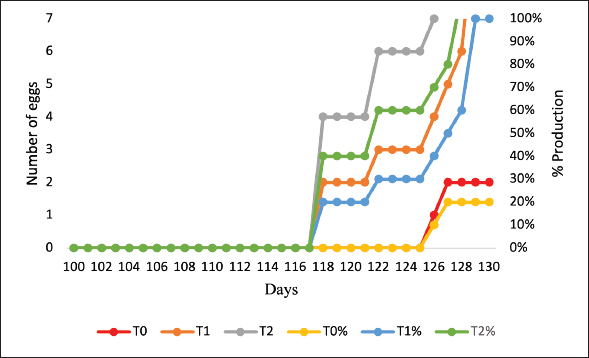
Fig. 1. Egg production parameters (age at first egg, number of eggs, and egg production percentage) of laying hens after NAB supplementation. T0 (control), T1 (basal feed + 1 g of A. granosa clam shell powder as NAB), and T2 (basal feed + 2 g of A. granosa clam shell powder as NAB).
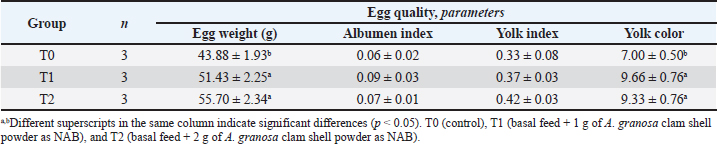
The NAB supplementation also had a significant effect on egg quality (Table 2). The results of one-way ANOVA statistical analysis followed by inter-column Duncan test of the egg weight and the yolk color showed that the egg weight and the yolk color in T1 and T2 were significantly different from those in T0 (p < 0.05), while the parameters of albumen index and yolk index were not significantly different in all of the treatments (p > 0.05).
Table 2. Egg quality of laying hens after administration of NAB supplementation.
FSH and estradiol hormone levels in laying hens after NAB supplementation
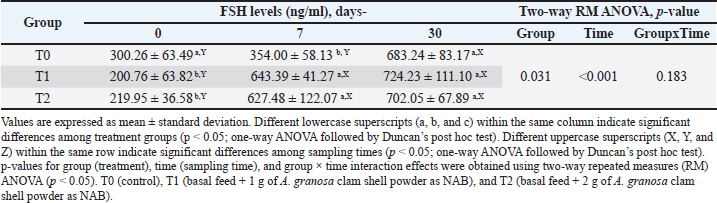
The results of two-way repeated measures ANOVA showed that the treatments (T1 and T2) had a significant effect on FSH levels (p=0.031). In addition, the sampling time (days 0, 7, and 30) also had a very significant effect on FSH level (p < 0.001). However, there was no significant interaction between the treatments (T1 and T2) and the sampling time (days 0, 7, and 30) (p=0.183). The results of the statistical analysis of one-way ANOVA followed by inter-column Duncan test showed that on day 7, the FSH levels in T1 and T2 were significantly higher than those in T0 (p < 0.05), while T0 on day 0 was significantly higher than T1 and T2. The results of the inter-row analysis of T1 and T2 showed that on days-7 and 30 were significantly higher from the day 0. On the contrary, the FSH level in T0 increased gradually, with the value on day 30 being significantly higher than those on days 0 and 7 (Table 3). Generally, the FSH level increased with observation time in all of the groups. At baseline (day 0), the FSH level in T0 was higher than in T1 and T2. However, after NAB supplementation (T1 and T2), there was a higher FSH level than T0, especially on day 7.
Table 3. FSH levels of laying hens after administration of NAB supplementation.
The results of two-way repeated measures ANOVA showed that the treatments (T1 and T2) had a significant effect on estradiol (E2) hormone levels (p=0.001). In addition, the sampling time (days 0, 7, and 30) also had a very significant effect on the E2 hormone levels (p < 0.001). However, there was no significant interaction between the treatments (T1 and T2) and the sampling time (days 0, 7, and 30) (p=0.057). The results of the one-way ANOVA statistical analysis, followed by the Duncan test of the E2 hormone levels of inter-column on days 7 and 30, showed that T1 and T2 were significantly higher than T0 (p < 0.05), while on day 0, showed that T0 and T2 were significantly higher than T1. The results of the inter-row analysis of the E2 hormone level in T2 showed that day 30 was significantly higher than day 7, and day 30 was significantly higher than day 0. However, T1 and T0 on day 30 were significantly higher than on days 7 and 0 (Table 4). Generally, the E2 levels increased from day 0 to day 30 in all of the treatment groups. The laying hens with the NAB supplementation consistently indicated higher E2 levels than T0. The standard curves of FSH and E2 hormones are shown in Figure 2.
Table 4. Estradiol (E2) levels of laying hens after administration of NAB supplementation.
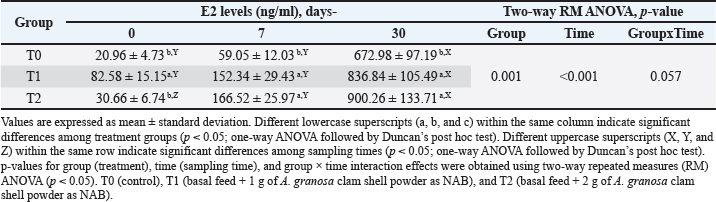
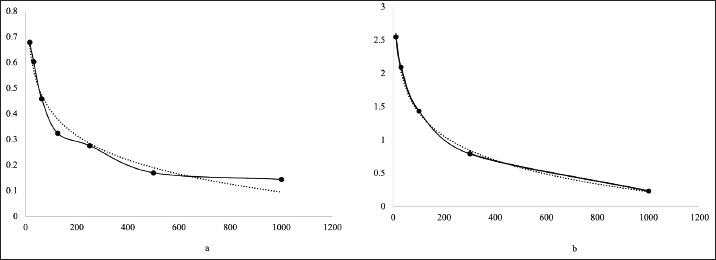
Fig. 2. Standard curve of the hormones (a) FSH, R²=0.9708, and (b) estradiol, R²=0.9972. FSH contents were examined using an ELISA method capable of converting the optical density (OD) value into content with a standard curve and the formula y=−0.137ln(x) + 1.0408 for the FSH standard and y=−0.516ln(x) + 3.7888 for the estradiol standard.
Discussion
Generally, laying hens enter the egg-laying phase at 126 days or 18 weeks of age. However, the laying hens that were given a NAB supplement in the study formed follicular hierarchy and began to lay eggs earlier at 117 days of age. It showed that the NAB supplementation was potential to accelerate sexual maturity and egg production onset. The acceleration of the first egg-laying age was consistent with Yang et al. (2023)and Mfoundou et al. (2021)who reported that when laying hens reached sexual maturity, ovarian activity intensively increased as indicated by the development of follicles in various sizes and the classification that was followed by nutrient accumulation. Once the follicular hierarchy has been formed, granulosa cells begin to produce progesterone hormone in small amounts to support the next follicular development (Johnson and Woods, 2009; Johnson, 2014). Thus, the acceleration of the formation of the follicular hierarchy resulting from the NAB supplementation directly contributed to the increase in the reproduction performance of laying hens.
Egg weight was one of the main targets in laying hen breeding because it has a significant effect on hatchability, chick quality, and next production performance (Iqbal et al., 2017). In addition, egg quality could also be an indicator of follicle hierarchy formation in laying hens (Hlokoe et al., 2022; Yang et al., 2025). The laying hens with the NAB supplementation of 1 and 2 g (T1 and T2) in the study laid eggs earlier than T0, and the observation showed that the egg quality and the egg weight in the treatment groups tended to be higher. In addition, the parameters of the yolk index and albumen index were not significantly different in all of the groups. The findings showed that the acceleration of egg-laying age in the groups with the NAB supplementation (T1 and T2) did not have any negative effect on internal egg quality. According to Roberts (2004) and Samiullah et al. (2017) the internal egg quality, as indicated by albumen index, consistently decreased with flock age. Thus, the acceleration of the age at first egg production in laying hens due to NAB supplementation did not negatively affect egg quality. According to Puglisi and Fernandez (2022)lipids and cholesterol were fundamental components of eggs and synthetic regulation, and lipid deposition could increase the lipid content of yolk, which directly affected egg weight. Clark (2012) and Gao et al. (2022)also suggested that lipid balance directly affected yolk size. Based on the results of this preliminary study, NAB supplementation did not affect egg quality, and egg production in laying hens remained stable.
The FSH plays an important role in the early ovarian cycle with granulosa cell proliferation and differentiation, LHR expression, and early steroidogenesis through the increase in StAR enzyme and CYP11A1 (Johnson, 2014; Johnson, 2015; Liu et al., 2021). Optimal FSH level contributed to the acceleration of follicular development and the stable formation of follicular hierarchy. This finding is consistent with Yang et al. (2019) who reported that the concentration of FSH was maintained within a certain range during prehierarchical follicular development, confirming its important role in regulating follicular growth. FSH levels in laying hens supplemented with 1g NAB (T1) and 2 g NAB (T2) for 7 days increased compared with control (T0). It indicated that the NAB supplementation in a short period of time could stimulate the FSH feedback mechanism through the inhibition of the conversion of testosterone into estrogen or estradiol (E2). The increasing FSH levels would accelerate the folliculogenesis period for egg hierarchy formation. It was consistent with Nubatois et al. (2018) and Prastiya et al. (2022) suggesting that optimal FSH and LH levels could stimulate follicle growth relatively fast and increase egg production. The regulation of hormones in birds has a notable characteristic: gonadotropin secretion is influenced not only by the largest follicle that is ready for ovulation, but also plays a crucial role in maintaining the stability of the follicular hierarchy (Sevilhano et al., 2017).
Normal follicular growth from the complementary action of FSH and LH levels (Rama Raju et al., 2013). Several studies have proven that the NAB supplementation of male Pelung chicken increased testosterone, crowing frequency, and pectoralis muscle performance (Yuneldi et al., 2021b; Yuneldi et al., 2023); increased testosterone in male laying hens (Yuneldi et al., 2021a); increased testosterone and sound frequency of Canaries (Astuti et al., 2020); and increased the testosterone level and the testosterone level of pectoralis muscle of Bangkok chickens through the inhibition of the conversion of testosterone into E2 (As Sidiqi et al., 2023). The results of a study that used the NAB of broccoli and cauliflower showed that they stimulated the same mechanism to increase testosterone in male rats because of their ability to inhibit the conversion of testosterone into E2 (Amalia et al., 2025b; Pratama et.al., 2025). It may also apply to laying hens, meaning that low E2 hormone levels could stimulate feedback of FSH secretion.
The E2 hormone plays an important role in maintaining folliculogenesis rhythm and egg production of laying hens. The E2 level on day 7 in the study increased in all of the groups. However, T1 (1 g NAB) and T2 (2 g NAB) indicated higher levels than T0. The increase in the estradiol level was consistent with the increase in the FSH level, and it indicated that the NAB supplementation could stimulate the hormonal feedback mechanism and accelerate the activation of the folliculogenesis phase. Wu et al. (2024) reported that a low serum estrogen level was related to the absence of follicular hierarchy formation, while a high E2 level played an important role in maintaining egg-laying rhythm. The finding was consistent with the results of the study showing that the laying hens with good follicular hierarchy would express E2 hormone to maintain egg-laying hierarchy formation rhythm. The higher FSH and E2 levels in T1 and T2 would have a significant effect on egg-laying frequency and a more stable egg-laying rhythm. The remaining high E2 level in T1 and T2 up to 18 weeks of age indicated that the existing folliculogenesis and egg production rhythms tended to be stable in the early production period. It was consistent with Eusemann et al. (2018); Hanlon et al. (2021); Mehlhorn et al. (2022) suggesting that modern laying hens consistently had high E2-17β plasma resulting from the change in the feedback mechanism of the hypothalamus–pituitary–gonadal axis to maintain egg-laying rhythm till the end of the production period.
The acceleration of egg laying in chickens may provide practical economic benefits for the poultry industry, as earlier egg production can improve farm efficiency, shorten the non-productive period, and accelerate income generation for poultry farmers. A limitation of this preliminary study is the limited sampling for ovarian follicle observation, as only one laying hen at the age of first egg from each treatment group was slaughtered to examine ovarian follicle characteristics. Therefore, the follicular observations should be interpreted descriptively and may not fully represent individual biological variability. Further studies with larger sample sizes are required to validate these findings.
Conclusion
The supplementation of A. granosa clam shell powder as a NAB accelerated the onset of egg production in laying hens without decreasing egg quality, increased the number of ovarian follicles, especially SWF, SYF, and hierarchical follicles (F1); improved egg quality, including egg weight and yolk color; and increased FSH and E2 hormone levels in laying hens.
Acknowledgments
We express our gratitude to drh. Raditya Adjie Yulianto and team research.
Conflict of interest
The authors declare that there is no conflict of interest.
Funding
This research was supported by the Grantee Innovation Development Program with contract number: 1409/UN1/DPU/DPU/HK.06/2025.
Authors’ contributions
C.M.A., P.A., and S.S.: Planned and designed the study. C.M.A., R.F.Y., P.A., S.S., and S.A.S.: Collected, analyzed the samples, performed statistical analysis, and drafted. All authors revised the manuscript, read, and approved the final manuscript.
Data availability
All data supporting the findings of this study are available within the manuscript.
References
Abbasi, M., Dastar, B., Afzali, N., Shargh, M.S. and Hashemi, S.R. 2022. The effects of nano and micro particle size of zinc oxide on performance, fertility, hatchability, and egg quality characteristics in laying Japanese quail. Biol. Trace Elem. Res. 200, 2338–2348.
Amalia, R., Airin, C.M., Budiyanto, A. and Astuti, P. 2025a. Modulatory effect of indole-3-carbinol on testicular testosterone and estrogen receptors: a dose-dependent study in rats. Int. J. Vet. Sci. 14, 1008–1014.
Amalia, R., Ohama, T., Parhar, I.S., Airin, C.M., Sato, H., Budiyanto, A. and Astuti, P. 2025b. Potential of Indole-3-Carbinol compounds from broccoli (Brassica oleracea var. italica) as natural aromatase blockers: in silico prediction and in vivo studies. Open Vet. J. 15, 1663–1672.
Araujo-Lopes, R., Gomes, A.F., Viana, M., Santos, M.S., Campideli-Santana, A.C., Macari, S., Reis, A.M. and Szawka, R.E. 2026. Profile of gonadotropin secretion in male and female rats determined in the tail-tip blood by ultrasensitive ELISA. J. Neuroendocrinol. 38, 1–11.
Armstrong, R.A. 2014. When to use the Bonferroni correction. Ophthalmic Physiol. Optician. 34, 502–508.
As Sidiqi, A.A., Airin, C.M., Sarmin, S. and Astuti, P. 2023. A combination of Anadara nodifera shell and milkfish thorns powder effectively promote springiness index, serum testosterone, and breast muscle testosterone in Bangkok rooster. HAYATI J. Biosci. 30, 701–710.
Astuti, P., Airin, C.M., Nurrurozi, A., Aidi, R., Hana, A., Hadi, S. and Harimurti, H. 2020. Potential natural aromatase blockers on enhance the frequency and sound quality of male canaries. In E3S Web of Conferences, EDP Sciences, vol. 151, pp 1–3. Banda Aceh, Indonesia.
Astuti, P., Airin, C.M., Sarmin, S., Nururrozi, A. and Harimurti, S. 2019. Effect of shell as natural testosterone boosters in Sprague Dawley rats. Vet. World. 12, 1677–1681.
Astuti, P., Putra, M.N.P., Shiddiq, M.F.A., Yuneldi, R.F., Airin, C.M. and Sarmin, S. 2022. The potency of Anadara nodifera shell as natural testosterone booster for male canary (Serinus canaria). HAYATI J. Biosci. 29, 107–113.
Aysöndü, M.H. and Özyürek, S. 2025. The effect of egg shape index on egg quality in partridges. Akademik. Ziraat. Dergisi. 14, 324–332.
Çilek, S. and Tekin, M.E. 2007. Environmental factors affecting milk yield traits of brown Swiss cows raised at Ulaş State Farm and phenotypic correlations between milk yield and fertility traits. Indian. J. Anim. Sci. 77, 154–157.
Clark, B.J. 2012. The mammalian START domain protein family in lipid transport in health and disease. J. Endocrinol. 212, 257–275.
Eusemann, B.K., Sharifi, A.R., Patt, A., Reinhard, A.K., Schrader, L., Thöne-Reineke, C. and Petow, S. 2018. Influence of a sustained release deslorelin acetate implant on reproductive physiology and associated traits in laying hens. Front. Physiol. 9, 1–17.
Gao, Z., Zhang, J., Li, F., Zheng, J. and Xu, G. 2022. Effect of oils in feed on the production performance and egg quality of laying hens. Animals 11, 1–16.
Hanlon, C., Takeshima, K. and Bédécarrats, G. 2021. Changes in the control of the hypothalamic-pituitary gonadal axis across three differentially selected strains of laying hens (Gallus gallus domesticus). Front. Physiol. 12, 1–20.
Hlokoe, V.R., Tyasi, T.L. and Gunya, B. 2022. Chicken ovarian follicles morphology and growth differentiation factor 9 gene expression in chicken ovarian follicles: review. Heliyon 8, 1–5.
Ikusika, O.O., Dwakasa, H., Luphuzi, S., Akinmoladun, O.F. and Mpendulo, C.T. 2025. Assessment of egg quality across seasons, storage durations, and temperatures in commercial laying hens. Appl. Sci. 15, 1–10.
Iqbal, J., Mukhtar, N., Rehman, Z.U., Khan, S.H., Ahmad, T., Anjum, M.S., Pasha, R.H. and Umar, S. 2017. Effects of egg weight on the egg quality, chick quality, and broiler performance at the later stages of production (week 60) in broiler breeders. J. Appl. Poult. Res. 26, 183–191.
Johnson, A.L. 2014. The avian ovary and follicle development: some comparative and practical insights. Turkish. J. Vet. Anim. Sci. 38, 660–669.
Johnson, A.L. 2015. Ovarian follicle selection and granulosa cell differentiation. Poult. Sci. 94, 781–785.
Johnson, A.L. and Woods, D.C. 2009. Dynamics of avian ovarian follicle development: cellular mechanisms of granulosa cell differentiation. Gen. Comp. Endocrinol. 163, 12–17.
Kidie, H., Alebel, M. and Abdo, M. 2024. Performance evaluation of Lohman Brown commercial layer chicken breeds under on-station management at Pawe, Benishangul Gumuz, Ethiopia. Am. J. Zool. 7, 12–21.
Liu, W.X., Zhang, Y.J., Wang, Y.F., Klinger, F.G., Tan, S.J., Farini, D., De Felici, M., Shen, W. and Cheng, S.F. 2021. Protective mechanism of luteinizing hormone and follicle-stimulating hormone against nicotine-induced damage of mouse early folliculogenesis. Front. Cell. Develop. Biol. 9, 1–14.
Ma, Y., Cheng, B., Zhou, S., Wang, Y., Jing, Y., Leng, L., Wang, S., Li, Y., Luan, P., Cao, Z. and Li, H. 2024. Comparative analyses of laying performance and follicular development characteristics between fat and lean broiler lines. Poult. Sci. 103, 1–12.
Madadizadeh, F. and Abdoli, M. 2025. Tutorial on Bonferroni correction as a post hoc analysis of a significant chi-squared test: a methodological guide in food science. J. Food. Qual. Hazards. Control. 12, 317–324.
Mehlhorn, J., Höhne, A., Baulain, U., Schrader, L., Weigend, S. and Petow, S. 2022. Estradiol-17ß is influenced by age, housing system, and laying performance in genetically divergent laying hens (Gallus gallus f.d.). Front. Physiol. 13, 1–9.
Mfoundou, J.D.L., Guo, Y.J., Liu, M.M., Ran, X.R., Fu, D.H., Yan, Z.Q., Li, M.N. and Wang, X.R. 2021. The morphological and histological study of chicken left ovary during growth and development among Hy-line brown layers of different ages. Poult. Sci. 100, 1–12.
Nie, R., Zheng, X., Zhang, W., Zhang, B., Ling, Y., Zhang, H. and Wu, C. 2022. Morphological characteristics and transcriptome landscapes of chicken follicles during selective development. Animals 12, 1–18.
Nubatois, A., Nalley, W.M. and Hine, T.M. 2018. Effectiveness of cow pituitary extract on the productivity of laying hens (Gallus gallus) Afkir strain Hisex brown. J. Sain. Peter. Indones. 13, 244–251.
Özcan, C., Safak, T. and Risvanli, A. 2026. The impact of serum oestradiol and progesterone levels on intraocular pressure and systemic health: hormonal and physiological interactions in female dogs. Vet. Med. Sci. 12, 1–10.
Palomba, S., Caserta, D., Levi-Setti, P.E. and Busnelli, A. 2024. Efficacy and safety of follitropin delta for ovarian stimulation in vitro fertilization/intracytoplasmic sperm injection cycles: a systematic review with meta-analysis. J. Ovarian. Res. 17, 1–29.
Prastiya, R.A., Madyawati, S.P., Sari, S.Y. and Nugroho, A.P. 2022. Effect of follicle-stimulating hormone and luteinizing hormone levels on egg-laying frequency in hens. Vet. World. 15, 2890–2895.
Pratama, J.W., Astuti, P., Airin, C.M. and Prakoso, Y.A. 2025. Role of Brassica oleracea var. botrytis (L.) as an aromatase inhibitor in Sprague–Dawley rats: analysis of serum aromatase and testosterone. Open. Vet. J. 15, 6635–6643.
Puglisi, M.J. and Fernandez, M.L. 2022. The health benefits of egg protein. Nutrients 14, 1–14.
Rama Raju, G., Chavan, R., Deenadayal, M., Gunasheela, D., Gutgutia, R., Haripriya, G., Govindarajan, M., Patel, N. and Patki, A. 2013. Luteinizing hormone and follicle stimulating hormone synergy: a review of role in controlled ovarian hyper-stimulation. J. Hum. Reprod. Sci. 6, 227–234.
Roberts, J.R. 2004. Factors affecting egg internal quality and egg shell quality in laying hens. J. Poult. Sci. 41, 161–177.
Samiullah, S., Omar, A.S., Roberts, J. and Chousalkar, K. 2017. Effect of production system and flock age on eggshell and egg internal quality measurements. Poult. Sci. 96, 246–258.
Sevilhano, T., Carvalho, R.F.D., Oliveira, N.A.D.J., Oliveira, J.E., Maltarollo, V.G., Trossini, G., Garcez, R. and Bartolini, P. 2017. Molecular cloning and characterization of pirarucu (Arapaima gigas) follicle-stimulating hormone and luteinizing hormone β-subunit cDNAs. PLos One 12, 1–22.
Wu, X., Zhang, Z., Li, Y., Zhao, Y., Ren, Y., Tian, Y., Hou, M., Guo, Y., Li, Q., Tian, W., Jiang, R., Zhang, Y., Gong, Y., Li, H., Li, G., Liu, X., Kang, X., Li, D. and Tian, Y. 2024. Estrogen promotes gonadotropin-releasing hormone expression by regulating tachykinin 3 and prodynorphin systems in chicken. Poultry Sci. 103, 1–13.
Yang, L., Fan, X., Tian, K., Yan, S., Xu, C., Tian, Y., Xiao, C., Jia, X., Shi, J., Bai, Y. and Li, W. 2023. Dynamic expression profile of follicles at different stages in high- and low-production laying hens. Genes 15, 1–15.
Yang, L., Yang, Y., Jing, Y., Zhang, M., Zhang, M., Zhang, S., Qi, C., Ma, W., Khan, M.Z. and Zhu, M. 2025. Research progress on genetic factors of poultry egg quality: a review. Animals 15, 1–19.
Yang, Y.Z., Yao, Y., Cao, Z.F., Gu, T.T., Xu, Q. and Chen, G.H. 2019. Histological characteristics of follicles and reproductive hormone secretion during ovarian follicle development in laying geese. Poult. Sci. 98, 6063–6070.
Yuneldi, R.F., Airin, C.M., Saragih, H.T. and Astuti, P. 2021. Application of natural aromatase blocker towards the level of testosterone in rooster layer Gallus gallus gallus (Linn., 1758). Key Eng. Mater. 884, 251–255.
Yuneldi, R.F., Airin, C.M., Saragih, H.T.S., Prawira, A.Y. and Astuti, P. 2024. Testosterone hormone levels and breast muscle performance of Pelung chickens after zinc sulfate and synthetic testosterone supplementation. Vet. World. 17, 2365–2369.
Yuneldi, R.F., Airin, C.M., Saragih, H.T.S., Sarmin, S., Astuti, P. and Alimon, A.R. 2023. Growth, pectoralis muscle performance, and testis of pelung cockerels (Gallus gallus gallus Linnaeus, 1758) supplemented with blood clam shell powder (Anadara granosa Linnaeus, 1758). Vet. World 16, 474–482.
Yuneldi, R.F., Airin, C.M., Sarmin, S., Prawira, A.Y. and Astuti, P. 2025. Benefits of aromatase blockers for increased testosterone in poultry: a mini-review. Vet. World. 18, 1190–1198.
Yuneldi, R.F., Astuti, P., Saragih, H.T.S. and Airin, C.M. 2021b. Anadara granosa shell powder improves the metabolism, testosterone level, and sound frequency of Pelung chickens. Vet. World. 14, 1564–1571.
Zhu, M., Wang, D., Zou, K., Wang, F., Zhang, Z., Song, X., Jia, C. and Wei, Z. 2022. Insulin-like growth factor-1 regulates follicle selection of hens by promoting proliferation and inhibiting apoptosis of granulosa cells in prehierarchical follicles in vitro. Anim. Reprod. Sci. 247, 1–10.
SWF=small white follicle, LWF=large white follicle, SYF=small yellow follicle, LYF=large yellow follicle, POF=
premature ovarian failure. T0 (control), T1 (basal feed + 1 g of
A. granosa clam shell powder as NAB), and T2 (basal feed + 2 g of
A. granosa clam shell powder as NAB).
a,bDifferent superscripts in the same column indicate significant differences (
p < 0.05). T0 (control), T1 (basal feed + 1 g of
A. granosa clam shell powder as NAB), and T2 (basal feed + 2 g of
A. granosa clam shell powder as NAB).
Values are expressed as mean ± standard deviation. Different lowercase superscripts (a, b, and c) within the same column indicate significant differences among treatment groups (p < 0.05; one-way ANOVA followed by Duncan’s post hoc test). Different uppercase superscripts (X, Y, and Z) within the same row indicate significant differences among sampling times (
p < 0.05; one-way ANOVA followed by Duncan’s post hoc test). p-values for group (treatment), time (sampling time), and group × time interaction effects were obtained using two-way repeated measures (RM) ANOVA (
p < 0.05).
T0 (control), T1 (basal feed + 1 g of
A. granosa clam shell powder as NAB), and T2 (basal feed + 2 g of
A. granosa clam shell powder as NAB).
Values are expressed as mean ± standard deviation. Different lowercase superscripts (a, b, and c) within the same column indicate significant differences among treatment groups (
p < 0.05; one-way ANOVA followed by Duncan’s post hoc test). Different uppercase superscripts (X, Y, and Z) within the same row indicate significant differences among sampling times (
p < 0.05; one-way ANOVA followed by Duncan’s post hoc test). p-values for group (treatment), time (sampling time), and group × time interaction effects were obtained using two-way repeated measures (RM) ANOVA (
p < 0.05).
T0 (control), T1 (basal feed + 1 g of
A. granosa clam shell powder as NAB), and T2 (basal feed + 2 g of
A. granosa clam shell powder as NAB).