





| Case Report | ||
Open Vet. J.. 2026; 16(7): 4987-4991
Open Veterinary Journal, (2026), Vol. 16(7): 4987-4991 Case Report Clinical course of three dogs with BRAF-mutated urinary bladder transitional cell carcinoma following autologous tumor antigen vaccinationShigeki Imamoto* and Mikako ImamotoShinjo Animal Hospital, Katsuragi, Nara, Japan *Corresponding Author: Shigeki Imamoto. Shinjo Animal Hospital, Katsuragi, Nara, Japan. Email: imamoto [at] celery.ocn.ne.jp Submitted: 10/02/2026 Revised: 30/05/2026 Accepted: 15/06/2026 Published: 27/07/2026 © 2025 Open Veterinary Journal
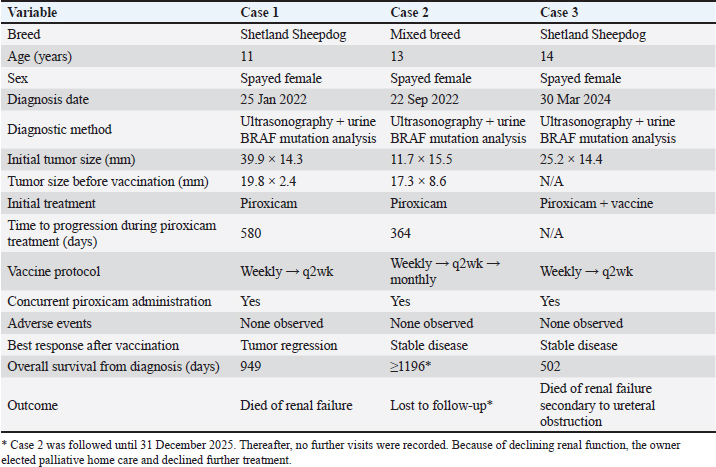
ABSTRACTBackground: Canine urinary bladder transitional cell carcinoma (TCC) is a locally invasive malignancy commonly associated with hematuria and progressive lower urinary tract signs. Although piroxicam is widely used as a medical treatment, tumor progression is frequently observed during follow-up. Additional therapeutic options are, therefore, needed for dogs with progressive disease. Case Description: Three dogs with BRAF-mutated urinary bladder TCC were treated with an autologous tumor antigen vaccine prepared from urine sediment. In Cases 1 and 2, vaccination was introduced after tumor progression during prolonged piroxicam treatment. In Case 3, vaccination and piroxicam were initiated concurrently at diagnosis. Serial ultrasonographic examinations were performed throughout follow-up. Case 1 showed tumor regression after vaccination and survived 949 days from diagnosis. Case 2 was followed for at least 1,196 days and maintained a relatively slow clinical course. Case 3 survived 502 days from diagnosis. No severe adverse events attributable to vaccination were observed in any dog. Conclusion: Autologous tumor antigen vaccination was safely administered in all three dogs. Although treatment efficacy cannot be determined from this uncontrolled case series, prolonged survival and acceptable tolerability were observed. Further investigation of individualized immunotherapeutic approaches for canine urinary bladder TCC is warranted. Keywords: Autologous tumor vaccine, BRAF mutation, Canine bladder cancer, Immunotherapy, Transitional cell carcinoma. IntroductionTransitional cell carcinoma (TCC) is the most common malignant tumor of the canine urinary bladder and is frequently associated with hematuria and lower urinary tract signs (Mutsaers et al., 2003; Knapp and McMillan, 2020). Although nonsteroidal anti-inflammatory drugs, including piroxicam, are widely used for palliation, long-term disease control remains difficult (Mutsaers et al., 2003). Activating mutations of the BRAF gene (V595E) have been identified in a high proportion of canine TCC cases and are associated with distinct clinicopathological characteristics (Decker et al., 2015; Gedon et al., 2022). These mutations can be detected noninvasively from urinary sediment, facilitating diagnosis and longitudinal monitoring (Mochizuki et al., 2015; Decker et al., 2015). Recent studies have also demonstrated the utility of immunohistochemical detection of BRAF V595E in canine urothelial carcinomas (Aeschlimann et al., 2024). In parallel with advances in molecular diagnostics, immunotherapeutic strategies have gained attention in veterinary medicine. Cancer vaccines, including autologous tumor antigen vaccines, aim to stimulate host antitumor immunity by presenting tumor-associated antigens derived from the patient’s own neoplastic tissue (Bergman, 2014; Regan et al., 2016; Marconato et al., 2019). Although clinical evidence remains limited, previous reports have demonstrated the feasibility and acceptable safety of autologous cancer vaccines in dogs with spontaneous tumors (Bergman, 2014; Lucroy et al., 2020). Reports describing autologous tumor antigen vaccination, specifically for canine urinary bladder TCC, remain scarce. The objective of this report is to describe the clinical course of three dogs with BRAF-mutated urinary bladder TCC treated with autologous tumor antigen vaccination. Materials and MethodsAutologous tumor antigen was prepared from urine sediment obtained from dogs with urinary bladder TCC. Because exfoliated tumor cells are commonly present in the urine of dogs with TCC, urine sediment was used as the source of tumor-associated antigens (Mutsaers et al., 2003; Mochizuki et al., 2015; Knapp and McMillan, 2020). Urine samples were collected by the owners over two consecutive days and brought to the hospital immediately after collection. Each sample was centrifuged promptly, and the resulting sediment was retained. Cytological examination of the urine sediment was performed microscopically to confirm the presence of atypical urothelial cells consistent with TCC. Sediment collection was continued until approximately 1 ml of urine sediment had accumulated. In most cases, this required a cumulative urine volume of approximately 500 ml. The accumulated sediment was fixed in 10% formalin to inactivate viable cells. Following fixation, the sediment was washed repeatedly with sterile saline to remove residual formalin and mechanically disrupted using a homogenizer. Additional processing was performed using an ultrasonic homogenizer to facilitate the extraction of tumor-associated antigens. The homogenized suspension was centrifuged, and the supernatant was collected and filtered through a 0.45-μm membrane filter to remove residual particulate material. Allogeneic testis antigen was prepared from surgically excised testicular tissue obtained during routine castration procedures. The tissue was processed using the same fixation, homogenization, centrifugation, and filtration procedures as described for the urine sediment. Testis-derived antigen was included based on the concept of cancer-testis antigens, which are aberrantly expressed in various malignancies and may enhance immune recognition of tumor-associated antigens (Marconato et al., 2019). Each vaccination consisted of 0.5 ml of autologous tumor antigen and 0.5 ml of allogeneic testis antigen. The antigen mixture was emulsified with Freund’s complete adjuvant for the initial vaccination and Freund’s incomplete adjuvant for subsequent vaccinations. Vaccines were administered intradermally together with interferon-γ. Vaccinations were initially performed weekly and subsequently extended to intervals of 2–3 weeks according to the clinical course of each patient. Tumor-cell fraction, antigen quantity, and immunogenic potency were not quantitatively assessed. In addition, no immunological assays were performed to evaluate antigen-specific immune responses. Accordingly, this preparation was conducted as individualized clinical care and was not intended as a standardized or commercially applicable protocol. Furthermore, no formal sterility testing, endotoxin testing, or other quality-control assays were performed. Case DetailsCase 1A 12-year-old spayed female Shetland Sheepdog was presented with hematuria. Abdominal ultrasonography revealed an intravesical mass located in the cranial portion of the urinary bladder (Fig. 1A). A BRAF mutation was confirmed using urinary sediment. Longitudinal tumor measurements and clinical course are summarized in Table 1. At diagnosis, the tumor measured 39.9 × 14.3 mm. Following initiation of piroxicam therapy, a reduction in tumor size to 15.7 × 2.9 mm was observed at day 347 (Fig. 1B). However, subsequent follow-up demonstrated tumor re-enlargement to 19.8 × 2.4 mm at day 580 (Fig. 1C). Based on progressive changes during piroxicam therapy, autologous tumor antigen vaccination was introduced. At day 640, ultrasonography demonstrated morphological changes in the tumor (16.2 × 3.3 mm; Fig. 1D). At long-term follow-up (day 877), the tumor size remained relatively stable at 16.8 × 3.1 mm without evidence of rapid progression (Fig. 1E). Clinically, the dog remained stable with manageable urinary signs during the observation period, as shown in Fig. 1. Case 2Case 2 presented with hematuria and was diagnosed with urinary bladder TCC based on ultrasonographic identification of an intravesical mass (Fig. 2A) and detection of a BRAF mutation. Clinical characteristics, treatment course, and outcome are summarized in Table 1. At diagnosis, the tumor measured 11.7 × 15.5 mm. During piroxicam therapy, tumor progression was observed, with an increase in size to 17.3 × 8.6 mm at day 364 (Fig. 2B). Autologous tumor antigen vaccination was subsequently introduced. At day 417, tumor size was 17.7 × 11.3 mm, consistent with stable disease. At long-term follow-up (day 1,118), tumor size increased to 24.3 × 16.0 mm, indicating progressive disease (Fig. 2C). Despite gradual tumor enlargement, the dog maintained a relatively slow clinical course. The patient was followed until 31 December 2025. Thereafter, no further visits were recorded because the owner elected palliative home care owing to declining renal function.
Fig. 2. Representative ultrasonographic images of the urinary bladder mass in Case 2 obtained at three time points: (A) 22 September 2022 at diagnosis, (B) 21 September 2023 during follow-up, and (C) 14 October 2025 at long-term follow-up. Tumor measurements corresponding to these time points are summarized in Table 1. Case 3Case 3 presented with hematuria and was diagnosed based on ultrasonographic identification of an intravesical mass (Fig. 3A) and detection of a BRAF mutation. Clinical characteristics, treatment course, and outcome are summarized in Table 1. Unlike Cases 1 and 2, autologous tumor antigen vaccination was initiated concurrently with piroxicam treatment at diagnosis. At diagnosis, the tumor measured 25.2 × 14.4 mm. During follow-up, the tumor size decreased to 23.1 × 10.6 mm at day 41 and remained relatively stable at 23.3 × 14.9 mm at day 195 (Fig. 3B, C). The dog survived for 502 days after diagnosis. During the later stage of the disease, tumor progression resulted in ureteral obstruction and subsequent deterioration of renal function. The patient ultimately died of renal failure associated with urinary tract obstruction.
Fig. 3. Representative ultrasonographic images of the urinary bladder mass in Case 3 obtained at diagnosis (March 2024) and during follow-up (May 2024; and 11 October 2024). Tumor measurements corresponding to these time points are summarized in Table 1. Table 1. Clinical characteristics, treatment course, and outcomes of three dogs with BRAF-mutated urinary bladder transitional cell carcinoma treated with autologous tumor antigen vaccination.
DiscussionThis report describes the clinical course of three dogs with BRAF-mutated urinary bladder TCC treated with autologous tumor antigen vaccination. No severe systemic or autoimmune adverse events were observed, suggesting that repeated administration of the vaccine was well-tolerated under clinical conditions. Similar favorable safety profiles have been reported in previous studies evaluating autologous cancer vaccines in dogs (Lucroy et al., 2020). An important observation in the present cases was that Cases 1 and 2 initially responded to piroxicam treatment but subsequently demonstrated tumor progression during follow-up, prompting the introduction of vaccination. In Case 1, tumor regression was observed after vaccination despite prior tumor re-enlargement during piroxicam therapy. In Case 2, gradual tumor enlargement eventually occurred; however, the patient maintained a relatively slow clinical course and was followed for at least 1,196 days after diagnosis. These observations suggest that autologous tumor antigen vaccination may have contributed to prolonged disease stabilization in some dogs, although a causal relationship cannot be established from the present case series. Case 3 differed from the first two cases because vaccination was initiated concurrently with piroxicam treatment at diagnosis. Tumor size remained relatively stable during follow-up, and the dog survived 502 days after diagnosis. Although direct comparisons among the three cases are not possible, the favorable clinical courses observed in Cases 1 and 2 influenced the decision to introduce vaccination earlier in Case 3. Together, these observations support the feasibility of incorporating individualized immunotherapy into the management of canine urinary bladder TCC. Autologous tumor antigen vaccination aims to expose the host immune system to a broad repertoire of patient-specific tumor-associated antigens (Bergman, 2014; Regan et al., 2016; Marconato et al., 2019). In the present study, tumor antigens were prepared from urine sediment containing atypical urothelial cells. Although the quantity and composition of tumor-derived antigens were not evaluated, this approach allowed repeated antigen preparation without invasive tissue sampling. In addition, urine sediment was fixed in formalin before antigen extraction, allowing safe handling of the material. Whether formalin fixation influenced antigenicity remains unknown. Interestingly, renal dysfunction ultimately influenced the clinical outcome in all three dogs. Case 1 died of renal failure, Case 2 developed progressive renal dysfunction leading to discontinuation of active treatment, and Case 3 died of renal failure secondary to ureteral obstruction. These observations suggest that preservation of urinary tract function may remain an important determinant of outcome even in dogs with relatively slow tumor progression. Control of local tumor burden alone may, therefore, be insufficient to prevent deterioration of renal function in advanced cases. This report has several limitations. The number of cases was small, there was no control group, and standardized response criteria were not applied. Tumor measurements were obtained retrospectively from clinical ultrasonographic records, and no immunological monitoring was performed. Furthermore, the quantity and immunogenicity of the prepared antigens were not assessed. Therefore, the contribution of vaccination to the observed clinical courses cannot be determined with certainty. Future prospective studies incorporating standardized response assessment and immunological monitoring will be necessary to clarify the therapeutic role of this approach. ConclusionIn this case series, autologous tumor antigen vaccination was technically feasible and well-tolerated in dogs with BRAF-mutated urinary bladder TCC. Although therapeutic efficacy cannot be determined from these limited observations, the findings support further investigation of individualized immunotherapeutic strategies in canine bladder cancer. AcknowledgmentsThe authors thank the pet owners for their cooperation and consent for the publication of clinical data and images. FundingThis study received no external funding. Authors’ contributionsAll authors participated in data analysis, manuscript drafting, and revision. All authors approved the final manuscript and agree to be accountable for all aspects of the work. Conflict of interestAll authors declare no conflicts of interest. Data availabilityThe data supporting the findings of this study are available from the corresponding author upon reasonable request. ReferencesAeschlimann, L., Kehl, A., Guscetti, F., Posthaus, C., Aupperle-Lellbach, H., Rottenberg, S. and De Brot, S. 2024. Effective detection of BRAF V595E mutation in canine urothelial and prostate carcinomas using immunohistochemistry. Vet. Comp. Oncol. 22, 295–302. Bergman, P.J. 2014. Cancer immunotherapy. Vet. Clin. North. Am. Small. Anim. Pract. 44, 925–939. Decker, B., Parker, H.G., Dhawan, D. and et al. 2015. Homologous mutation to human BRAF V600E is common in canine bladder cancer. Proc. Natl. Acad. Sci. U. S. A. 112, 15359–15364. Gedon, J., Kehl, A., Aupperle-Lellbach, H., Von Bomhard, W. and Schmidt, J.M. 2022. BRAF mutation status and its prognostic significance in 79 canine urothelial carcinomas: a retrospective study (2006–2019). Vet. Comp. Oncol. 20, 449–457. Knapp, D.W. and McMillan, S.K. 2020. Tumors of the urinary system. In: Withrow and MacEwen’s Small Animal Clinical Oncology, 6th ed. St. Louis, MO: Elsevier. Lucroy, M.D., Clauson, R.M., Suckow, M.A., El-Tayyeb, F. and Kalinauskas, A. 2020. Evaluation of an autologous cancer vaccine for the treatment of metastatic canine hemangiosarcoma: a preliminary study. BMC. Vet. Res. 16, 447. Marconato, L., Aresu, L., Stefanello, D., Comazzi, S., Martini, V., Ferrari, R., Riondato, F., Rouquet, N., Frayssinet, P. and Sabattini, S. 2019. Opportunities and challenges of active immunotherapy in dogs with B-cell lymphoma: a 5-year experience in two veterinary oncology centers. J. Immunother. Cancer. 7, 146. Mochizuki, H., Kennedy, K., Shapiro, S.G. and Breen, M. 2015. BRAF mutations in canine cancers. PLos One. 10, 129534. Mutsaers, A.J., Widmer, W.R. and Knapp, D.W. 2003. Canine transitional cell carcinoma. J. Vet. Intern. Med. 17, 136–144. Regan, D., Coy, J., Chahal, B. and et al. 2016. Cancer immunotherapy in veterinary medicine. Vet. Clin. North Am. Small Anim. Pract. 46, 119–136./ | ||


| How to Cite this Article |
| Pubmed Style Imamoto S, Imamoto M. Clinical course of three dogs with BRAF-mutated urinary bladder transitional cell carcinoma following autologous tumor antigen vaccination. Open Vet. J.. 2026; 16(7): 4987-4991. doi:10.5455/OVJ.2026.v16.i7.77 Web Style Imamoto S, Imamoto M. Clinical course of three dogs with BRAF-mutated urinary bladder transitional cell carcinoma following autologous tumor antigen vaccination. https://www.openveterinaryjournal.com/?mno=310012 [Access: July 27, 2026]. doi:10.5455/OVJ.2026.v16.i7.77 AMA (American Medical Association) Style Imamoto S, Imamoto M. Clinical course of three dogs with BRAF-mutated urinary bladder transitional cell carcinoma following autologous tumor antigen vaccination. Open Vet. J.. 2026; 16(7): 4987-4991. doi:10.5455/OVJ.2026.v16.i7.77 Vancouver/ICMJE Style Imamoto S, Imamoto M. Clinical course of three dogs with BRAF-mutated urinary bladder transitional cell carcinoma following autologous tumor antigen vaccination. Open Vet. J.. (2026), [cited July 27, 2026]; 16(7): 4987-4991. doi:10.5455/OVJ.2026.v16.i7.77 Harvard Style Imamoto, S. & Imamoto, . M. (2026) Clinical course of three dogs with BRAF-mutated urinary bladder transitional cell carcinoma following autologous tumor antigen vaccination. Open Vet. J., 16 (7), 4987-4991. doi:10.5455/OVJ.2026.v16.i7.77 Turabian Style Imamoto, Shigeki, and Mikako Imamoto. 2026. Clinical course of three dogs with BRAF-mutated urinary bladder transitional cell carcinoma following autologous tumor antigen vaccination. Open Veterinary Journal, 16 (7), 4987-4991. doi:10.5455/OVJ.2026.v16.i7.77 Chicago Style Imamoto, Shigeki, and Mikako Imamoto. "Clinical course of three dogs with BRAF-mutated urinary bladder transitional cell carcinoma following autologous tumor antigen vaccination." Open Veterinary Journal 16 (2026), 4987-4991. doi:10.5455/OVJ.2026.v16.i7.77 MLA (The Modern Language Association) Style Imamoto, Shigeki, and Mikako Imamoto. "Clinical course of three dogs with BRAF-mutated urinary bladder transitional cell carcinoma following autologous tumor antigen vaccination." Open Veterinary Journal 16.7 (2026), 4987-4991. Print. doi:10.5455/OVJ.2026.v16.i7.77 APA (American Psychological Association) Style Imamoto, S. & Imamoto, . M. (2026) Clinical course of three dogs with BRAF-mutated urinary bladder transitional cell carcinoma following autologous tumor antigen vaccination. Open Veterinary Journal, 16 (7), 4987-4991. doi:10.5455/OVJ.2026.v16.i7.77 |


