



| Research Article | ||
Open Vet. J.. 2026; 16(7): 4862-4877
Open Veterinary Journal, (2026), Vol. 16(7): 4862-4877 Research Article Estrus synchronization and ovulation induction in pigsOlena Karatieieva*, Yevhen Barkar, Aleksandr Kramarenko and Serhii KramarenkoDepartment of Production and Processing of Animal Husbandry Products, Standardization and Biotechnology, Mykolayiv National Agrarian University, Mykolayiv, Ukraine *Corresponding Author: Olena Karatieieva. Department of Production and Processing of Animal Husbandry Products, Standardization and Biotechnology, Mykolayiv National Agrarian University, Mykolayiv, Ukraine. Submitted: 27/02/2026 Revised: 11/06/2026 Accepted: 26/06/2026 Published: 20/07/2026 © 2025 Open Veterinary Journal
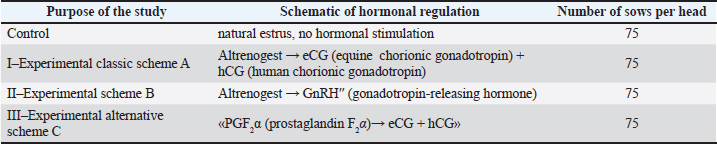
AbstractBackground: Synchronization of estrus with artificial hormonal suppression and fixed insemination time is a promising tool in modern pig farming, which contributes to the optimization of reproductive processes, reduction of labor costs, and increase of herd productivity. At the same time, the effectiveness of this technology depends on the level of hormonal preparation of animals and the chosen synchronization protocol. Aim: The study assessed the effectiveness of modern biotechnological methods for regulating the sexual function of sows to increase their reproductive capacity and optimize reproduction in pig farming. Methods: Three hormonal protocols of estrus synchronization and ovulation induction were used in this study. Scheme A used oral administration of altrenogest for 14 days, followed by administration of eCG and hCG, and a fixed time of artificial insemination. According to scheme B, after 14 days of altrenogest use, a GnRH analog was administered to induce ovulation, followed by insemination according to the reaction time of the animals. According to scheme C, prostaglandin F2α or its analogues were used, followed by the introduction of eCG and hCG, and artificial insemination according to the unified scheme. Results: A comparison of the schemes shows that scheme A provides the highest synchronization efficiency, allowing the accurate regulation of the cycle. It ensures the highest rate of estrus expression (92%), a statistically significant increase in litter size (up to 12.1 piglets; p < 0.05), and a reduction in the inter-farrowing interval (to 153 days; p < 0.05). Scheme B is characterized by more natural stimulation, but the effect may vary depending on the animal’s physiological state. Scheme C is technologically simpler but less effective from the point of view of synchronization, especially in different post-weaning statuses of sows. Conclusion: The use of scheme A made it possible to obtain an additional nearly 11 kg of piglet live weight at weaning per sow, corresponding to an additional income of +16.98 USD per head. Particularly important is the reduction of the inter-farrowing interval by 6–13 days in the experimental groups, which increases the potential number of farrowings from 2.1 to 2.3 per year, thereby allowing the production of up to 4–5 additional piglets per sow annually. Keywords: Altrenogest, Artificial insemination, Estrus, Induction of ovulation, GnRH. IntroductionAnimal producers are progressively integrating advanced technologies into routine animal husbandry practices in response to the increasing demand for production efficiency. One area in which technological innovation has considerable potential to improve current management is estrus detection in pigs. Accurate identification of this phase of the reproductive cycle is crucial for improving the artificial insemination success rate. In modern pig production, the effectiveness of managing sow reproductive function largely depends on the use of hormonal protocols that enable estrous cycle synchronization, service period reduction, and regular farrowing rhythm maintenance (Glencorse et al., 2025). Lykhach et al. (2022) and Lykhach et al. (2023) focused on the influence of not only internal but also external factors, such as timely detection of estrus, proper insemination, and heat stress, on the reproductive system’s functioning in animals, which is of direct importance for the estrous cycle’s formation and stability. The return to estrus after farrowing is a major source of reproductive inefficiency in commercial pig herds. Therefore, the use of chorionic gonadotropins, with or without progestogens, can be a valuable strategy, especially for breeding herds practicing batch farrowing (Quirino et al., 2026). Accordingly, estrus synchronization through artificial hormonal inhibition followed by controlled induction at a fixed time represents a valuable tool for pig production. However, the response to and effectiveness of synchronization protocols depend on multiple factors, including the hormonal regimen, treatment protocol, breed, management conditions, and production system (Brüssow and Wähner, 2011). A fundamental understanding of the sow estrous cycle is essential for the development of reliable tools for identifying physiological markers associated with estrus detection. The estrous cycle in sows lasts approximately 18–21 days and consists of two distinct phases: the follicular and luteal phases. The follicular phase is characterized by estrogen dominance and follicular development in preparation for ovulation, whereas the luteal phase is dominated by progesterone and prepares the reproductive tract for potential pregnancy. Domestic sows are polyestrous animals that exhibit continuous estrous cycles throughout the year, regardless of the season. Therefore, accurate detection of estrus and prediction of ovulation timing are critical for successful insemination (Geisert et al., 2020). The determination of the optimal insemination time requires a clearly expressed estrus period with pronounced behavioral and physiological signs. Approximately 80% of sows treated with hormonal preparations exhibit moderate to strong estrus intensity. In addition, synchronized sows demonstrated a significantly longer estrus duration than untreated animals. Hormonal treatment increases circulating estradiol concentrations due to accelerated follicular growth, thereby prolonging estrus duration and enhancing its intensity (Roy and Prakash, 2009). According to Rodrigues et al. (2020), the estrus can be synchronized using various timing schemes and hormonal treatments, which is a key factor in maintaining a stable farrowing output. Synchronization protocols allow specialists to control the timing of estrus and ovulation, enabling the implementation of fixed-time AI programs. Consequently, several estrous cycle synchronization protocols are currently used in pig production worldwide. Souza-Fabjan et al. (2023) demonstrated the advantages of applying reproductive biotechnologies in animal husbandry. These technologies contribute to increased animal protein production, facilitate the use of small animals as experimental models, and support the development of innovative biomedical approaches for regulating estrus in livestock species. Estrus and ovulation control form the basis of reproductive management in intensive pork production systems. Various hormonal agents, including altrenogest, equine chorionic gonadotropin (eCG), human chorionic gonadotropin (hCG), luteinizing hormone (LH), gonadotropin-releasing hormone (GnRH), and GnRH analogs, are used to promote estrus and ovulation synchronization in pigs. However, no single hormonal product can be universally considered optimal for the use of reproductive biotechnologies. The long-term or repeated use of certain hormones, particularly eCG, may be associated with adverse effects. For example, combined treatment with altrenogest and exogenous gonadotropins may increase the incidence of follicular cysts, negatively affecting ovulation rates. Furthermore, repeated eCG administration can induce a humoral immune response, resulting in the formation of neutralizing antibodies and a gradual decline in treatment efficacy (Zhang et al., 2025a). These limitations stimulate ongoing research aimed at improving existing protocols and developing new approaches to estrus synchronization. Zhang et al. (2025b) recommended the use of gonadotropin-releasing hormone (GnRH), a key regulator of pituitary gonadotropin secretion that plays a central role in mammalian reproductive physiology. Similarly, Jeyakumar et al. (2022) proposed the inclusion of follicle-stimulating hormone (FSH), which regulates follicular growth and development, as well as estrogens responsible for the onset of behavioral estrus and ovulation induction in synchronization programs. Feugang et al. (2025) also emphasized the transformative potential of modern reproductive biotechnologies, highlighting their capacity to enhance animal husbandry productivity and profitability. One of the modern approaches in reproductive biotechnology in pig breeding is the use of prolonged-acting recombinant hormonal drugs. Zhang et al. (2025b) used recombinant porcine follicle-stimulating hormone of long action (rpFSH-pFc) to stimulate and synchronize estrus in sows. The results indicate the high potential of this drug as an effective means for inducing estrus and improving reproductive performance. Therefore, reproductive biotechnologies, particularly in pig production, play a crucial role in ensuring food security and sustainable agricultural development. Given the growing global demand for pork, optimizing reproductive efficiency is essential for increasing productivity while maintaining genetic diversity and environmental sustainability. Advanced reproductive technologies, including controlled breeding, estrus synchronization and stimulation, and artificial insemination, have significantly accelerated genetic improvement and ensured consistent reproductive performance in pigs. This issue remains particularly relevant in Ukraine due to the absence of unified approaches to regulating sow reproductive function. This gap provided the rationale for the present study, which aimed to scientifically substantiate and evaluate the effectiveness of modern reproductive biotechnologies in pig farming, with particular emphasis on methods for regulating sow reproductive function to enhance reproductive capacity, optimize reproductive processes, and support sustainable industry development. Materials and MethodsThe research was conducted in the private agricultural enterprise “Techmet-Yug”, Mykolaiv region, Ukraine. The study included healthy crossbred sows of commercial genotype (Large White × Landrace) with 2–6 farrowings, average fatness (3–3.5 points), no acute diseases, and fertility confirmed by anamnesis, which were kept under identical feeding and housing conditions (Khalak et al., 2024). Animals were randomly assigned to groups based on their age and previous performance. The formation scheme of research groups is shown in Table 1, where one control group and three experimental groups were formed. Table 1. Scheme of the formation of research groups.
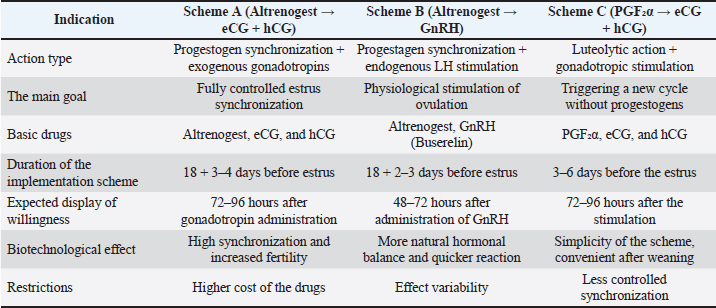
Scheme A (Altrenogest → eCG + hCG) (Gonzalez-Ramiro et al., 2021). 1. Oral Altrenogest: 15 mg/head/day for 14 days (days 0–13). 2. 24–48 hours after the last day of taking altrenogest, 1,000 IU of eCG is administered intramuscularly (or subcutaneously). 3. At 72 hours after eCG administration, hCG 500 IU is administered, or GnRH is administered intramuscularly to induce ovulation at the appointed time. 4. Insemination: artificial insemination twice (in 24 and 40–48 hours after ovulation induction) or according to the practice accepted in the farm (Zhang et al., 2025a). Scheme B (Altrenogest → GnRH) (Willmann et al., 2011). 1. Altrenogest: 15 mg/day, orally for 14 days. 2. After 24–48 hours. After completion, the introduction of a GnRH analog (e.g., buserelin) 0.01–0.02 mg intramuscularly to induce ovulation. 3. Insemination: artificial insemination according to reaction time (24–36 hours after GnRH administration) (Willmann et al., 2011). The timing of insemination was determined based on the individual behavioral signs of estrus (standing reflex, hyperemia, swelling of the vulva, and mucous discharge) (Steverink et al., 1999). Scheme C (PGF2α → eCG + hCG) (Mirzaei et al., 2023). 1. PGF2α/analogues: once or twice (with an interval of 14 days) intramuscularly according to the manufacturer’s instructions (e.g., cloperstenol 0.075 mg/head). 2. 2–4 days after the last administration of PGF2α—administration of eCG 1,000 IU; after 72 hours, hCG was administered intramuscularly at 500 IU. 3. Insemination: as in Scheme A (Zhang et al., 2025a). The described protocols comply with modern biotechnological approaches in pig production and the manufacturer’s recommendations for swine production. The interval from weaning to the onset of treatment was determined through the daily clinical observation of the animals after weaning. The date of weaning and the date of the first clinical signs requiring therapeutic intervention were recorded. The interval (in days) was calculated as the difference between these dates (3–5 days). Individual observation cards were used to improve recording accuracy (Khalak et al., 2022). Estrus detection in sows was performed twice a day (morning and evening) by visual observation of behavioral signs (restlessness, decreased feed intake, and characteristic sounds), assessment of physiological changes (hyperemia and edema of the external genitalia), and application of the “immobility reflex” in the presence of a boar or by pressing on the back. The onset of estrus was defined as a sustained immobility reflex moment. The period during which this reflex was maintained determined the duration of estrus (Khalak et al., 2024). Artificial insemination of sows using ready-to-use semen doses was performed twice during estrus (12–24 hours after the establishment of the standing reflex) using a sterile catheter (Roca et al., 2006). The following reproductive parameters were evaluated: the proportion of individuals that exhibited estrus (after synchronization); time from drug administration to the onset of estrus (hours); interval between farrowings (days); conception rate (%); number of piglets born alive per litter (heads); average piglet birth weight (kg); piglet pre-weaning mortality (%); litter weight at weaning (кг); and coefficient of reproductive efficiency (Khalak et al., 2022). Physiological and laboratory indicators: concentrations of hormones in the serum (estradiol, progesterone, and luteinizing hormone); sampling times: before treatment (baseline), on the day of ovulation induction, at the time of insemination, and on the 21st day after insemination; and determination by enzyme-linked immunosorbent assay (Choi et al., 1987; Manickum et al., 2015). The study was conducted on a single farm, which limits the generalizability of the results. Uncontrolled factors such as housing conditions, feeding methods, and individual animal variability could have influenced the parameters obtained. Therefore, further validation of the data on other farms is desirable. The Pearson chi-square test of independence was used to compare the proportion of individuals that exhibited estrus and the conception rate depending on the estrus synchronization and stimulation scheme. Comparisons with the control group were performed using odds ratios (ORs) calculated from 2 × 2 contingency tables. A one-way analysis of variance (ANOVA) was applied to assess the effect of different synchronization and stimulation schemes on the variability of reproductive traits of sows (quantitative variables), followed by post hoc multiple comparisons using Fisher’s least significant difference test. All statistical analyses were conducted according to the methods described by Sokal and Rohlf (1995) using the JAMOVI v. 2.6.19 freeware software (Navarro and Foxcroft, 2025). Because two sow-related variables, namely the time from drug administration to the onset of estrus and the interval between farrowings, represent time-to-event outcomes, survival analysis methods were applied. For each variable, Kaplan–Meier survival curves with 95% confidence intervals were constructed according to the estrus synchronization and stimulation scheme. The differences between survival curves were evaluated using the log-rank test. In addition, pairwise comparisons were performed using adjustment for multiple testing using the Holm–Bonferroni correction. Survival analyses were conducted following the methodologies described by Klein and Moeschberger (2003) and Machin et al. (2006) using JAMOVI v. 2.6.19 (Navarro and Foxcroft, 2025). The rules for the treatment of animals in experiments are fully consistent with European legislation (European Union Council Directive No. 98/58/EC, 1998; Nalon and Stevenson, 2019). Ethical approvalThe protocol for the study of physiological and laboratory parameters of sows was approved by the local Bioethics Committee of the Mykolaiv National Agrarian University, Ukraine, in accordance with Good Clinical Practice for the protection and humane treatment of experimental animals. ResultsBiotechnological schemes for synchronization and stimulation of estrus in sows. Three different biotechnological schemes were used in the study, which differ in the mechanism of action, exposure duration, and pharmacological means (Table 2). Scheme A (Altrenogest → eCG + hCG, classic scheme). The scheme is based on the use of the progestagen drug altrenogest, which suppresses follicle maturation and delays ovulation. After stopping the administration of altrenogest, exogenous gonadotropins are prescribed, including endocrine chorionic gonadotropin (eCG) and human chorionic gonadotropin (hCG), which stimulate follicle growth and cause controlled ovulation. The average duration of action is 18 days of progestagen + 3–4 days before the onset of estrus. Signs of estrus appear synchronously 72–96 hours after the introduction of gonadotropins, ensuring a high rhythmicity of estrus e and allowing planning insemination in the specified time. The biotechnological effect of the scheme consists of high controllability of the process, increased fertility, and optimal egg quality. However, the disadvantage is the higher cost of the program due to the use of several expensive drugs and the need to strictly follow the protocol. Table 2. Comparative characteristics of biotechnological schemes of heat synchronization and stimulation in sows.
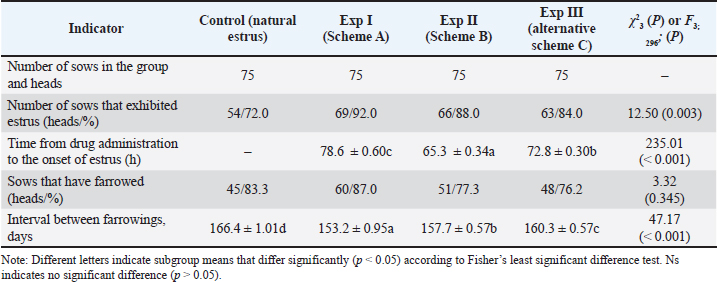
Scheme В (Altrenogest → GnRH, physiological stimulation of ovulation)Altrenogest is also used in this scheme to pre-equalize the sexual cycle, but instead of exogenous gonadotropins, a recombinant analog of gonadotropin-releasing hormone (GnRH), specifically buserelin, is used. The mechanism of action of the drug consists of stimulating the secretion of endogenous LH, which initiates natural ovulation. The duration of the protocol is somewhat shorter, i.e., 18 days of altrenogest + 2–3 days before the appearance of estrus, and its manifestation is usually fixed 48–72 hours after the introduction of GnRH. The advantage of this scheme is the more physiological nature of hormonal regulation, which interferes less with the animal’s endocrine system. However, the effect may be less stable due to the variability of the endogenous response to GnRH, especially in weaning sows with different ovarian functional status. Scheme С (PGF₂α → еCG + hCG, alternative scheme)This scheme involves the use of prostaglandin F₂α (PGF₂α), which causes luteolysis, which is the dissolution of the corpus luteum of pregnancy or the sexual cycle, allowing you to start a new cycle without the use of progestogens. After luteolysis is induced, eCG and hCG are administered to the animals to stimulate follicular growth and ovulation, similar to the classical scheme. The duration of action is short, i.e., 3–6 days before estrus appears, and the first signs of sexual activity are usually observed 72–96 hours after stimulation. The biotechnological advantage of this scheme is its ease of implementation and use in sows after piglets are weaned, when the cycle recovery is natural. Simultaneously, the synchronization of the heat is less controlled, and the response of the animals can be heterogeneous, which reduces the accuracy of insemination planning. Evaluation of the reproductive performance of sows under different estrus synchronization schemesFertilization with fresh sperm within 24 hours before ovulation is a prerequisite for optimal fertility of sows. However, the large individual variability of the beginning of estrus and the interval between ovulation limits the possibility of detecting and inseminating sows in heat. Therefore, to achieve high fertility, careful estrus detection is usually performed along with at least two artificial inseminations with high sperm count. Estrus detection and repeated insemination take a long time. Consequently, many producers are interested in switching to AI with a specific schedule, ideally using only one AI. The only approach that can achieve the optimal time interval between ovulation and artificial insemination is to control the time of ovulation (Gonzalez-Ramiro et al., 2023). The ability of exogenous gonadotropin-releasing hormone (GnRH) or equine chorionic gonadotropin to induce LH release is often used to synchronize ovulation in sows to minimize variability in the time interval between estrus and ovulation. The optimal breeding time of sows is difficult to predict, and the detection of estrus and repeated inseminations takes a long time. Therefore, controlling the time of ovulation is the only approach that can achieve the optimal time interval between artificial insemination and ovulation (Crespo and Gadea, 2024). An important stage in increasing the efficiency of pig reproduction is the use of hormonal schemes for estrus synchronization and stimulation, which allow optimizing the time of insemination, shortening the inter-sparrow interval, and increasing the output of offspring. The estrus synchronization and stimulation scheme had a significant effect on the proportion of individuals that exhibited estrus (Pearson’s chi-square test: χ²=12.50, df=3, p=0.006). The largest differences were observed between the control group and sows subjected to scheme A (odds ratio [OR]= 4.47; 95% CI: 1.69…11.85; p=0.003) and scheme B (OR=2.86; 95% CI: 1.21…6.74; p=0.017). On the contrary, the proportion of sows that exhibited estrus did not differ significantly between the control and C groups (OR=2.04; 95% CI: 0.92…4.53; p=0.079). Analysis of estrus manifestation showed that 54 out of 75 sows in the control group exhibited estrus, corresponding to 72.0% of the total sows (Table 3). This proportion was higher in the experimental groups, reaching 92.0% in scheme A, 88.0% in scheme B, and 84.0% in scheme C. Table 3. Reproductive performance of sows (M ± SE) under different estrus synchronization and stimulation schemes.
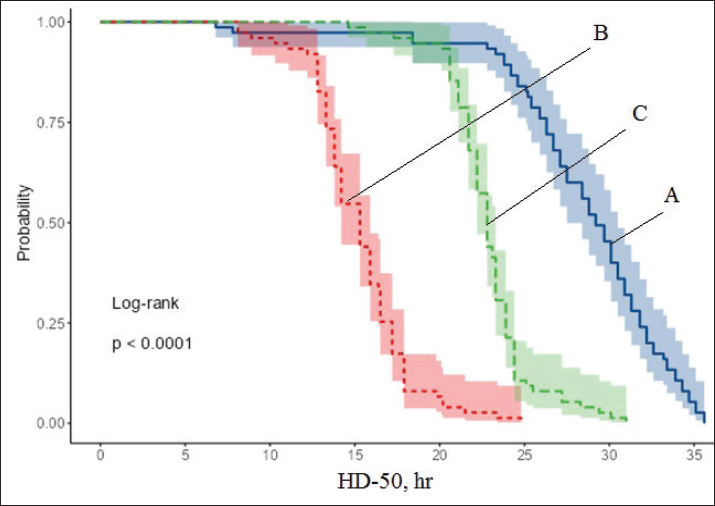
The highest level of estrus manifestation was established when using the classical scheme A, where cycle synchronization was provided by altrenogest and stimulation was provided by a combination of endocrine drugs with gonadotropic action. Compared with the control, the increase in sexual cycle activity was +20%. Such an effect is probably due to the inhibition of endogenous luteolysis under the action of progestagen, with the subsequent synchronous response of the ovaries to the introduction of estrogen-prolonging hormones. Analysis of the mean time from drug administration to the onset of estrus demonstrated significant differences among experimental groups (one-way ANOVA: F₂,₂₂₂=235.01; p < 0.001). The average interval between drug withdrawal and the appearance of estrus signs was 78.6 hours in sows treated with altrenogest followed by equine chorionic gonadotropin (eCG) and human chorionic gonadotropin (hCG) (scheme A), 65.3 hours in sows treated according to scheme B, and 72.8 hours in animals treated with prostaglandin followed by eCG and hCG (scheme C). Figure 1 presents Kaplan–Meier survival curves for the time from drug administration to the onset of estrus in sows subjected to different estrus synchronization and stimulation schemes. The shapes of the curves indicate significant differences among the groups (log-rank test: p < 0.001). Moreover, all pairwise comparisons of the survival curves revealed significant differences between groups (for all comparisons: p < 0.001).
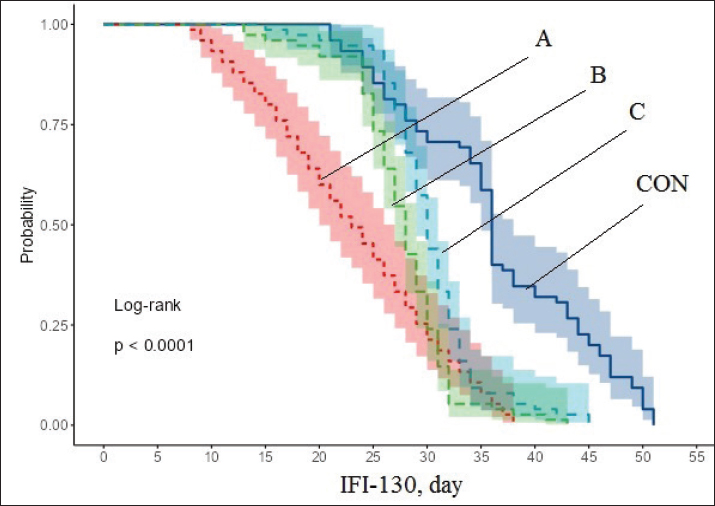
Fig. 1. Kaplan–Meier survival curves for the time from drug administration to estrus onset in sows subjected to different estrus synchronization and stimulation schemes: A, scheme; B, scheme; C, scheme. Note: HD refers to the interval between drug administration and estrus onset (adjusted by 50 hours). Probability indicates the likelihood that no sow has yet exhibited estrus. Survival estimates for all groups are presented with 95% confidence intervals. For animals treated according to the classical scheme (scheme A), the first manifestations of eagerness are registered later, compared to animals of other groups, but all animals of this group gradually came to eagerness with a more or less uniform frequency between the 70th and 85th hour. In sows treated according to the classical protocol (scheme A), the onset of estrus occurred later than in the other groups; however, all animals in this group gradually exhibited estrus with a relatively uniform distribution over time between 70 and 85 hours after treatment. Animals subjected to the alternative protocol (scheme C) also demonstrated a delayed onset of estrus, but a marked synchronization was observed between 70 and 75 hours, when estrus was simultaneously exhibited by 65 out of 75 sows (approximately 85%). On the contrary, sows treated according to scheme B exhibited estrus earlier than those in the other groups, with the first signs appearing at 58–60 hours after treatment. Furthermore, a higher proportion of animals (approximately 90%) exhibited estrus within a narrow time window of 61–70 hours. Thus, synchronization schemes B and C were characterized by a high degree of uniformity in the onset of estrus, which may contribute to improved herd reproductive management. As the sows treated according to scheme B, which were injected with GnRH, which stimulates the secretion of endogenous gonadotropins of the pituitary gland after withdrawal of altrenogest, responded to hormonal stimulation the fastest, this ensured faster follicle maturation and synchronous ovulation. Simultaneously, in schemes A and C, estrus appeared later, probably due to the need for a period of biochemical transformation of the injected gonadotropic hormones (eCG, hCG) in the receptor structures of the ovaries. No significant effect of the estrus synchronization and stimulation scheme on sow conception rate was detected (Pearson’s chi-square test: χ²=3.32, df=3, p=0.345). Accordingly, no significant differences were observed between the control group and any of the three experimental groups (all comparisons: p > 0.05). The fertilization dynamics and the number of pregnant sows showed that the fertilization rate after artificial insemination was 83.3% of the control group, which is a typical indicator of the conditions of industrial pig farming in the absence of sexual cycle synchronization. Ambiguous results were shown in research groups where various biotechnological schemes of sexual function regulation were used. Thus, according to scheme A, the fertilization level was 87.0%, which ensured the pregnancy of 60 sows. According to scheme B, the fertilization percentage was 77.3% or 51 sows. In scheme C, this indicator was somewhat lower than the previous groups and was 76.2% or 48 pregnant sows. Despite the higher level of estrus in the animals of the experimental groups compared to the control (by 12%–20%), no statistically significant differences in fecundity were found between the groups (in all cases: p > 0.05). This indicates that the applied hormonal protocols mainly have a regulatory effect on the estrous cycle synchronization and ensure the consistent manifestation of estrus but do not guarantee an increase in the frequency of successful fertilization. The fertilization percentage of sows in the experiment ranged from 76.2% to 87.0%, depending on the applied estrous cycle regulation scheme. The fertilization rate was 83.3% in the control group, where fertilization was carried out under conditions of natural estrus without hormonal stimulation. The highest fertilization rate was noted in the 1st experimental group, where the classical scheme A was used (87.0%), which is 3.7% higher than the control. This indicates that the complex use of altrenogest with eCG and hCG has a positive effect on the synchronization of ovulation and increases the efficiency of fertilization. In the II (scheme B) and III (scheme C) experimental groups, the fertilization rate was slightly lower (77.3% and 76.2%, respectively), which may be due to the peculiarities of the hormonal protocols and the response of sows to ovulation induction. At the same time, the obtained values remained at a level acceptable for production conditions and provided satisfactory, reproducible results. A significant effect of the estrus synchronization and stimulation schemes on the variability of the farrowing interval was also detected (one-way ANOVA: F3; 297=47.17; p < 0.001). The control group had the longest farrowing interval, averaging 166.4 days. The application of synchronization protocols had a positive effect on reproductive rhythm. The interval between consecutive farrowings was significantly reduced to 153.2 days in sows treated according to the classical protocol (scheme A) compared with the control group. A reduction in the farrowing interval was also observed in sows treated according to schemes B and C, reaching 157.7 and 160.3 days, respectively. Figure 2 presents Kaplan–Meier survival curves for the farrowing interval in sows from different experimental groups subjected to various estrus synchronization and stimulation schemes. The shapes of the curves indicate significant differences among the groups (log-rank test: p < 0.001). Pairwise comparisons revealed significant differences between most groups (p=0.001…0.004), with the exception of the comparison between schemes B and C, where no significant difference was detected (p=0.313).
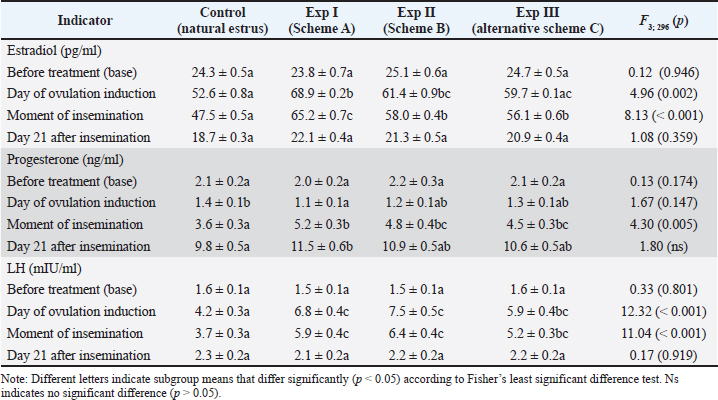
Fig. 2. Kaplan–Meier survival curves for the farrowing interval in sows from different experimental groups subjected to various estrus synchronization and stimulation schemes: CON, control group; A, scheme A; B, scheme B; C, scheme C. Note: IFI refers to the farrowing interval (130 days adjusted). Probability indicates the likelihood that no sow has farrowed again. Survival estimates for all groups are presented with 95% confidence intervals. In the control group, farrowing onset occurred noticeably later than in sows treated with the estrus synchronization and stimulation protocols. On the contrary, sows treated according to the classical protocol (scheme A) began farrowing earlier, and the occurrence of farrowing in this group was relatively evenly distributed over time between days 140 and 165. The survival curves did not significantly differ for sows treated according to schemes B and C (p=0.313). Farrowing in these groups began at approximately the same time as in the control group; however, the process was completed more rapidly and in a more synchronized manner, coinciding with the completion of farrowing observed in sows treated according to scheme A. Therefore, the reduction in the interval between farrowings in sows of the classical treatment regimen can be explained by the faster recovery of sexual function after farrowing due to the controlled action of progestogen, which stabilizes the hormonal status and provides a more predictable return to estrus. Evaluation of the sow's hormonal backgroundInduced ovulation is of great interest in commercial pig farming. It is a technology that can help obtain more genetic gains and increase the efficiency of pig production through the use of single insemination from the breeder and optimal insemination time. In addition, it can serve as a technology for transitioning to cryopreserved boar sperm, sex-sorted sperm of the future offspring, and low-dose single-use artificial insemination (Knox, 2015). Several species of mammals and birds, with both spontaneous and induced ovulation, can respond to exogenous hormones for controlled ovulation. Ovulation induction has been performed using highly purified human chorionic gonadotropin, partially purified pituitary isolates (follicle-stimulating hormone and luteinizing hormone, as well as synthetic gonadotropin-releasing hormone and GnRH analogs) for many years. The approach used to induce ovulation in pigs varied depending on the maturity of the animal and whether follicular development synchronization was used. Induction of ovulation was used to study the physiology of ovulation, oocyte maturation, fertilization, embryo development, and survival, as well as to determine the effect of AI time on ovulation (Pal and Dar, 2021). The dynamics of the main sex hormones, namely estradiol, progesterone, and luteinizing hormone, in the blood serum of sows under different schemes of sexual cycle synchronization were analyzed. Sampling was performed at four control points: before the start of treatment (baseline), on the day of ovulation induction, at the time of insemination, and on the 21st day after insemination (Table 4). Table 4. Concentration of the main hormones in the blood serum of sows (M ± SE) under different estrus synchronization and stimulation schemes.
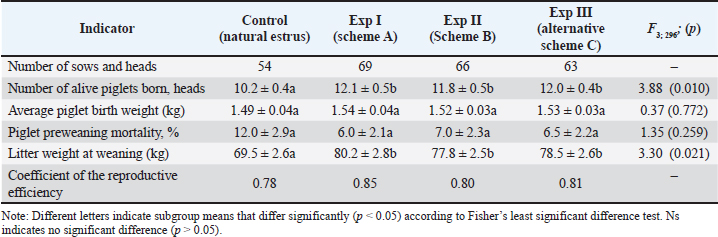
Estradiol concentrations were significantly affected by the synchronization and estrus stimulation scheme both on the day of ovulation induction (one-way ANOVA: F3; 296=4.96; p=0.002) and at the time of insemination (F3; 296=8.13; p < 0.001). Estradiol levels were lowest in sows of the control group and highest in animals treated according to scheme A, whereas intermediate concentrations were observed in sows subjected to schemes B and C. The estrus synchronization and stimulation scheme at the time of insemination also significantly influenced progesterone concentrations (one-way ANOVA: F3; 296=4.30; p=0.005). As observed for estradiol, the lowest progesterone levels were recorded in the control group, whereas the highest concentrations were found in sows treated according to scheme A. Animals treated according to schemes B and C again showed intermediate hormone levels. Luteinizing hormone (LH) concentrations were significantly affected by the estrus synchronization and stimulation scheme both on the day of ovulation induction (one-way ANOVA: F3; 296=12.32; p < 0.001) and at the time of insemination (F3; 296=11.04; p < 0.001). LH concentrations were lowest in the control group and highest in sows treated according to schemes A and B, whereas intermediate values were observed in animals treated according to scheme C. Hormone concentrations in the control group (natural estrus without hormonal stimulation) fluctuated within the physiological values typical for the natural sexual cycle. The estradiol level increased to 52.6 pg/ml during the estrous period, after which it gradually decreased. On the 21st day after insemination, the progesterone concentration increased to 9.8 ng/ml, indicating the formation of a functionally active corpus luteum. In scheme A, the most pronounced increase in the concentrations of estradiol (68.9 pg/ml) and LH (6.8 mIU/ml) was observed on the day of ovulation induction, confirming the effective stimulation of growth and maturation of follicles under the influence of exogenous gonadotropins. Accelerated corpus luteum formation was observed after hCG administration, as evidenced by a higher progesterone level on the 21st day after insemination (11.5 ng/ml, p < 0.05). These changes were correlated with the highest indicators of willingness (92.0%) and fertilization (87.0%). In scheme B, an increase in the LH concentration (7.5 mIU/ml) and a moderately significant (p < 0.05) increase in estradiol (61.4 pg/ml) were also noted. The use of the GnRH antagonist (buserelin) contributed to the physiological stimulation of ovulation due to the activation of the endogenous release of gonadotropins, but the level of estradiol remained lower than in group A, which could cause a slightly lower synchrony of the ovulation reaction. An increase in progesterone on day 21 (10.9 ng/ml) indicated sufficient functional activity of the corpus luteum, although the fertilization rate was 77.3%, which was 5.7% lower than the control. In scheme C, where synchronization was based on the luteolytic action of prostaglandin, the hormone dynamics had a slightly different character. The estradiol level increased to 59.7 pg/ml, while the LH concentration increased to 5.9 mIU/ml, indicating the activation of a new follicular cycle. On day 21, progesterone level was 10.6 ng/ml, i.e., it remained at a level close to control, indicating stable development of the corpus luteum, but fertilization efficiency was lower (76.2%), which is likely due to greater variability in ovulation timing and lower synchronization of reproductive processes. Analysis of the reproductive performance of sows using different estrus synchronization schemesReversion to estrus after artificial insemination is one of the most common infertility problems that causes delayed pregnancy in sows. Fertilization rates and embryo numbers are maximal when sows are inseminated between 0 and 12 hours before ovulation. Optimum sperm doses and optimal timing of insemination relative to ovulation in sows are key factors in fertility improvement (Kadirvel et al., 2017; Karatieieva, 2025). When the ovulation of weaned sows is synchronized with gonadotropic hormones followed by artificial insemination at a fixed time, 30–33 hours after their administration, the reproductive performance of sows is significantly improved. Controlling the development of follicles and the time of ovulation helps increase the reproductive capacity of sows. This sparked our interest in determining the effect of estrus synchronization schemes on the reproductive qualities of sows. Table 5 shows the comparative characteristics of the reproductive qualities of sows under different schemes of farrowing synchronization and stimulation, allowing the evaluation of the biotechnological efficiency of the hormonal protocols in comparison with natural (control) reproduction. Table 5. Reproductive qualities of sows (M ± SE) under different estrus synchronization and stimulation schemes.
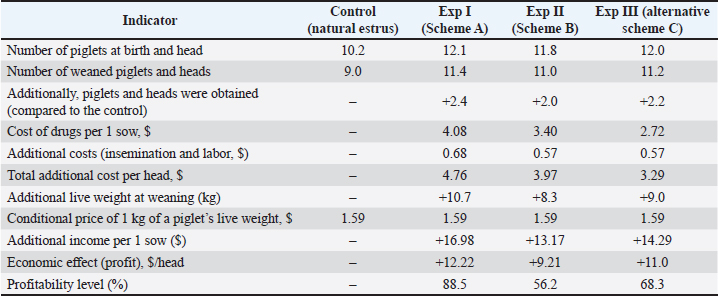
When analyzing the variability of the reproductive traits of sows, a statistically significant effect of the farrowing synchronization scheme was observed only for the number of piglets born alive (F3; 296=3.88; p=0.010) and litter weight at weaning (F3; 296=3.30; p=0.021). In both cases, sows in the control group showed lower values than animals in all three experimental groups. Multifertility of sows, as one of the key indicators of reproductive capacity, was 10.2 piglets per farrowing in the control group (natural farrowing without stimulation). In the experimental groups, this parameter increased significantly: under scheme A to 12.1 piglets, under scheme B to 11.8 piglets, and under the alternative scheme C to 12.0 piglets (in all cases: p < 0.05). Thus, all three stimulation schemes contributed to an increase in the number of newborn piglets, but the most pronounced effect was observed under the classical scheme A, where estrus synchronization and controlled ovulation provided optimal conditions for a larger number of gametes to be fertilized. The indicator of large fattening, i.e., the average weight of piglets at birth, varied within 1.49–1.54 kg, without statistically significant differences between groups (p=0.772). This indicates that hormonal stimulants do not negatively impact fetal development during the prenatal period. A slight increase in the weight of piglets in the experimental groups (especially in scheme A) indicates a better physiological readiness of sows for pregnancy and a more balanced hormonal background during fertilization. Before weaning, piglet mortality was 12.0% in the control group and decreased to 6.0%, 7.0, and 6.5% in scheme A, B, and C sows, respectively. The weight of the nest at weaning, an integral indicator that combines the effect of multiple fecundity, high fecundity, and preservation, was 69.5 kg in the control group, whereas it increased significantly in the experimental groups: under scheme A, it was 80.2 kg, under scheme B, it was 77.8 kg, and under scheme C, it was 78.5 kg (in all cases: p < 0.05). This confirms the positive effect of hormonal stimulation on the reproductive potential of sows and the development of piglets before the weaning period. The coefficient of reproductive efficiency, which comprehensively reflects the results of insemination, farrowing, and piglet survival, in the control group was 0.78 points, and in the experimental group it increased to 0.85 points in scheme A, to 0.80 points in scheme B, and to 0.81 points in scheme C. Thus, the highest level of biological and economic efficiency was established when the classic scheme altrenogest → eCG + hCG, indicating its optimality for the planned regulation of reproduction and increasing sow productivity. Biotechnological methods of reproductive management in pigs, particularly hormonal estrus synchronization, represent an important tool for intensifying the industry. They can shorten the farrowing interval, increase the number of litters per year, and improve the output of viable offspring. However, the implementation of such protocols is associated with additional costs for pharmaceuticals, labor, and veterinary support; therefore, assessing their economic feasibility is a key component of a comprehensive evaluation of technological efficiency (Banerjee et al., 2026). The implementation of estrus synchronization protocols involves certain expenses related to hormonal preparations, veterinary services, and additional labor resources; however, these costs can be fully offset by higher productivity and overall profitability of the production system, provided that reproductive performance and the number of viable offspring increase (Crespo and Gadea, 2024). According to the data presented in Table 6, the highest economic effect was achieved using the classical scheme A, where the profit amounted to +12.22 USD per sow with a profitability level exceeding 88.5%. This result is explained by the greatest increase in litter size (+1.9 piglets) and weaning litter weight (+10.7 kg), which ensured the highest additional income at relatively moderate drug costs. Such a high outcome can be attributed to the combined action of progestagen (altrenogest), which establishes a controlled hormonal balance, and gonadotropins (eCG and hCG), which stimulate synchronous ovulation and improve embryo survival. Table 6. Economic indicators of the effectiveness of estrus synchronization schemes in sows.
Scheme B also demonstrated a positive economic outcome, with a profit of 9.21 USD per head at a profitability level exceeding 56.2%, although its efficiency was somewhat lower due to reduced litter size and higher variability in the hormonal response. This protocol may be effective under stable hormonal status conditions in sows, but it requires high precision in determining the timing of insemination. Despite lower drug costs, scheme C ensured a relatively high level of profitability (11.0 USD per head, 68.3% profitability), indicating its feasibility for farms with limited budgets, especially in the post-weaning period when rapid restoration of the reproductive cycle is required. This scheme is optimal for small- and medium-sized farms because it does not require prolonged preparation and rapid resumption of the reproductive cycle after piglet weaning. DiscussionBreeding is one of the main areas of development of animal husbandry. One of the most common reproductive management methods in pig farming is estrus synchronization. It allows you to obtain year-round farrowings. However, the effectiveness of synchronization largely depends on correctly selected and implemented protocols. Therefore, additional adjustments to the methods of stimulating the reproductive system of sows are relevant when applying innovative scientific ideas (Julanov et al., 2024). Simultaneously, an integral part of sow reproductive management is the quick and accurate detection of estrus, which directly determines the overall productivity of the use of sows, influencing the optimal moment of insemination, reducing inefficient feeding, and eliminating sows with low reproductive capacity (Xin et al., 2023). In the work of Lugovoy et al. (2018), general physiological mechanisms of reproductive function regulation in farm animals are considered. The authors also indicated the role of hormonal and metabolic factors in ensuring the normal sexual cycle. For a long time, the most promising method of controlling estrus and ovulation in pigs was believed to be the use of an orally active synthetic progestogen compound, L-allyltrenbolone. However, there is currently no single method of managing the estrous cycle of sows, which is consistent with our findings. Thus, Bielas et al. (2025) studied the effect of peforelin, i.e., synthetic l-GnRH-III, on the reproductive parameters of sows treated with altrenogest. Young sows were synchronized with altrenogest for 18 days. Forty-eight hours after the last administration of altrenogest, young sows and 24 hours after weaning, adult sows received peforelin according to the manufacturer’s instructions. Based on the presented results, the use of peforelin in the conditions of industrial farms improved the reproductive performance of production batches in young pigs and adult sows after estrous cycle synchronization. Degenstein et al. (2008) showed that porcine luteinizing hormone can reliably synchronize ovulation in weaned sows. According to Viana et al. (2006), the most common treatment protocol for ovulation control in pigs involves the use of a combination of eCG to stimulate follicular growth, followed by human chorionic gonadotropin (hCG) to trigger ovulation. However, many variations of such procedures have been found, suggesting that no single approach has consistently yielded optimal results (Cassar et al., 2005; Knox, 2015; Li et al., 2024). Quirino et al. (2024) recommended using both horse and human chorionic gonadotropin (eCG and hCG, respectively) for the treatment of weaned sows during lactation to control the expression of estrus and ovulation in them. Ovulation may be weak or variable only after hCG treatment. To improve the pregnancy rate, combined treatment with both chorionic gonadotropins is recommended after the second week of lactation. This approach is consistent with the results of our research. Brüssow and Wähner claimed a “reproductive biotechnology” that included estrus synchronization procedures based on the use of altrenogest in gilts and adult sows. Simultaneously, eCG was used to stimulate follicle development, and hCG or LH and a GnRH analog were used to induce ovulation. The researchers noted that if the goal is a fixed insemination time, the estrus should be synchronized, and follicular development and ovulation should be induced with GnRH and hCG analogs, with ovulation occurring 36–42 hours later. It is usually recommended to inseminate these animals twice, 24 and 40 hours after ovulation induction. However, this technology requires healthy and careful animal care (Banerjee et al., 2026). The results obtained prove the effectiveness of such approaches, provided that the animals are healthy and carefully cared for. The discovery of the structure and synthesis of a GnRH analog has led to its emergence as a potential replacement for hCG and eCG for follicular growth stimulation and ovulation induction. Gonadotropin-releasing hormone (GnRH) analogs can mimic endogenous GnRH to stimulate the synthesis and secretion of gonadotropic hormones, such as follicle-stimulating hormone (FSH) and luteinizing hormone (LH). Thus, GnRH analogs are widely used as ovulation-inducing agents in the reproductive management of gilts and sows, particularly to trigger the endogenous LH surge, thereby synchronizing ovulation in sows during artificial insemination procedures (Hassanein et al., 2024; Shi et al., 2025). The use of GnRH to induce LH release has several advantages over hCG treatment. While hCG acts directly on ovarian receptors, GnRH stimulates the release of LH from the pituitary gland, which then reaches the ovaries to aid in the ovulation process. Treatment involving exogenous gonadotropins and altrenogest can also cause ovarian follicular cysts in sows (Falceto et al., 2023). The estrus synchronization protocol used by Leal et al. (2022) produced encouraging results. Estrus in sows was synchronized with a single application of EC and two applications of PGF2α with greater than 90% efficiency. No adverse effects on ovarian function or fertility were observed. Another alternative for estrus synchronization in repair pigs (Leal et al., 2022). According to Liu et al. (2024), most sows experience a negative energy balance during lactation, which leads to impaired follicle development. Therefore, the authors recommend treatment of 28-day-old lactating sows with altrenogest (ALT) to inhibit follicular enlargement during lactation and to assess estrus and reproductive performance after weaning. Thus, ALT treatment significantly suppressed the increase in follicle size (p < 0.05) and reduced the levels of FSH, LH, and E2 in the serum (p > 0.05). In addition, ALT treatment increased estrus concentration and preovulatory follicle size (p < 0.05), while it delayed WEI (p < 0.001). However, the estrus rate, pregnancy rate, and total number of piglets born and live births did not differ between the treatment groups (p > 0.05) (Liu et al., 2024). In other studies, an improved fixed-time artificial insemination protocol for sows was proposed, which included ALT tablets, long-acting rpFSH, and rhCG. Compared with conventional regimens, this protocol achieved comparable synchronization efficiency while improving litter performance, thereby confirming its potential as an effective alternative for reproductive management in gilts and sows (Liu et al., 2025). Therefore, the functional state of the reproductive system of animals is closely related to the general physiological state of the body and its hormonal background, which determines the variability of sexual cycle manifestations and reproductive activity in general (Snegin et al., 2021). ConclusionThe classical scheme (altrenogest + eHCG + hCG) is the most effective way to synchronize and stimulate the estrous cycle in sows. It provides the highest farrowing rate (92%), a significant increase in fertility (up to 12.1 piglets; p < 0.05), and a reduction in the period between farrowings (up to 153 days; p < 0.05). Schemes using GnRH (B) or PGF₂α (C) also help to increase the number of live-born piglets, but they are somewhat inferior to the classic option in terms of synchronization and results stability. Although the difference in fecundity and offspring mortality up to 30 days between the groups did not reach statistical significance, the experimental variants exhibited a positive biological tendency to increase these indicators. Comparative analysis showed that the use of combined schemes with progestagen (altrenogest) and gonadotropins (eCG + hCG) provided the highest hormonal activity and better synchronization of heat in sows. It contributed to a more intense maturation of follicles, an increase in estradiol and LH levels, and the formation of full-fledged corpora lutea, which was confirmed by an increased progesterone level on the 21st day after insemination. Scheme A provided the highest concentrations of all three hormones, confirming its effectiveness in stimulating ovulation and maintaining the luteal phase. Simultaneously, the use of hormonal schemes for estrus synchronization significantly improves reproductive performance, and the most effective is the combination of altrenogest with eCG and hCG, which provides the highest fertility and litter weight at weaning (p < 0.05). The results of the economic evaluation indicate that all studied hormonal synchronization protocols are effective and provide additional profit compared to conventional technology. The highest economic effect was achieved using the classical scheme, which ensured maximum litter size and sow productivity and, consequently, the highest profitability level of 88.5% or 12.22 USD per sow. Scheme B demonstrated a stable but somewhat lower economic effect (56.2% and 9.21 USD) and may be appropriate under conditions of strict insemination timing control. Scheme C showed a sufficiently high level of profitability (68.3% and 11.0 USD) despite lower biological efficiency due to lower drug costs, making it a rational alternative for farms with limited resources. Therefore, the choice of hormonal stimulation scheme should be based on production goals, the physiological state of the livestock, and the economic feasibility of using the drugs. AcknowledgmentsThe authors would like to thank the owner and staff of the private agricultural enterprise “Techmet-Yug”, where the experimental study was conducted. The authors are also grateful to Yana Hekalo for English editing of the manuscript. Conflict of interestThe authors have no conflicts of interest to declare. FundingThis study did not receive a special grant. Authors’ contributionsYevhen Barkar participated in the study development and coordinated the experiment methodology. Olena Karatіeіeva wrote the original manuscript. Oleksandr Kramarenko assisted in data organization and synchronization. Serhii Kramarenko performed the biometric calculation processing. Serhii Kramarenko, Oleksandr Kramarenko, and Yevhen Barkar made the final revisions to the manuscript. All authors have read and approved the final version of the manuscript. Data availabilityAll data are available. ReferencesBanerjee, R., Sunwasiya, D.K. and Mondal, S. 2026. Introduction to genetic and reproductive approaches for sustainable livestock production. In Genetic and reproductive approaches for sustainable livestock production. Academic Press, pp: 1–14; doi: 10.1016/B978-0-443-24812-2.00004-X Bielas, W., Krasowski, P. and Rzasa, A. 2025. Peforelin (GnRH analogue) stimulation of oestrus as a tool to improve reproductive performance in gilts and sows. Med. Weter. 81(10), 557–561; doi:10.21521/mw.7060 Cassar, G., Kirkwood, R.N., Poljak, Z., Bennett-Steward, K. and Friendship, R.M. 2005. Effect of single or double insemination on fertility of sows bred at an induced oestrus and ovulation. J. Swine Health Prod. 13(5), 254–258; https://www.aasv.org/shap/issues/v13n5/v13n5p254.html Choi, H.S., Kiesenhofer, E., Gantner, H., Hois, J. and Bamberg, E. 1987. Pregnancy diagnosis in sows by estimation of oestrogens in blood, urine or faeces. Anim. Reprod. Sci. 15(3–4), 209–216; doi:10.1016/0378-4320(87)90043-1 Council Directive 98/58/EC. 1998. Concerning the protection of animals kept for farming purposes. Available via https://surl.li/mtlxxu (Accessed 20 July 1998). Crespo, S. and Gadea, J. 2024. Use of a vaginally administered gel containing the GnRH agonist triptorelin and a single, fixed-time artificial insemination in pigs under commercial conditions: productive and economic impacts. Animals 14(18), 2673; doi:10.3390/ani14182673 Degenstein, K.L., O’Donoghue, R., Patterson, J.L., Beltranena, E., Ambrose, D.J., Foxcroft, G.R. and Dyck, M.K. 2008. Synchronization of ovulation in cyclic gilts with porcine luteinizing hormone (pLH) and its effects on reproductive function. Theriogenology 70(7), 1075–1085; doi:10.1016/j.theriogenology.2008.06.027 Falceto, M.V., Suárez‐Usbeck, A., Tejedor, M.T., Ausejo, R., Garrido, A.M. and Mitjana, O. 2023. GnRH agonists: updating fixed‐time artificial insemination protocols in sows. Reprod. Domest. Anim. 58(5), 571–582; doi:10.1111/rda.14326 Feugang, J.M., Othman, O.E.M., Nandolo, W., Kugonza, D.R. and Osei-Amponsah, R. 2025. Prospect for utilization of modern technologies for small ruminant and pig improvement in african input systems: case studies. In African livestock genetic resources and sustainable breeding strategies: unlocking a treasure trove and guide for improved productivity. Cham, Switzerland: Springer Nature Switzerland, pp: 1049–1068; doi: 10.1007/978-3-031-92076-9_24 Geisert, R.D., Sutvosky, P., Lucy, M.C., Bartol, F.F. and Meyer, A.E. 2020. Reproductive physiology of swine. In Animal agriculture. London, UK: Academic Press, pp: 263–281; doi:10.1016/B978-0-12-817052-6.00015-X Glencorse, D., Grupen, C.G. and Bathgate, R. 2025. A review of the monitoring techniques used to detect ooestrus in sows. Animals 15(3), 331; doi:10.3390/ani15030331 Gonzalez-Ramiro, H., Cuello, C., Cambra, J.M., Gonzalez-Plaza, A., Vazquez, J.M., Vazquez, J.L. and Martinez, E.A. 2021. A short-term altrenogest treatment post-weaning followed by superovulation reduces pregnancy rates and embryo production efficiency in multiparous sows. Front. Vet. Sci. 8, 771573; doi:10.3389/fvets.2021.771573 Gonzalez-Ramiro, H., Gil, M.A., Cuello, C., Cambra, J.M., Gonzalez-Plaza, A., Vazquez, J.M. and Martinez, E.A. 2023. The use of a brief synchronization treatment after weaning, combined with superovulation, has moderate effects on the gene expression of surviving pig blastocysts. Animals 13(9), 1568; doi:10.3390/ani13091568 Hassanein , E.M., Szelényi, Z. and Szenci, O. 2024. Gonadotropin-releasing hormone (GnRH) and its agonists in bovine reproduction I: structure, biosynthesis, physiological effects, and its role in estrous synchronization. Animals 14(10), 1473; doi:10.3390/ani14101473 Jeyakumar, S., Balasubramanian, S., Vedamurthy, G.V., Lavanya, M., Chethan, H.S., Kumaresan, A. and Ramesha, K.P. 2022. Advances in estrous synchronization and timed breeding programs for fertility enhancement in cattle and buffaloes. In Current concepts in bovine reproduction. Singapore: Springer Nature Singapore, pp: 119–167; doi:10.1007/978-981-19-0116-4_9 Julanov, M., Jumatayeva, K., Koibagarov, K., Tagayev, O., Baitlessov, Y. and Julanova, N. 2024. Improving the efficiency of oestrus synchronization in cows. J. Adv. Vet. Anim. Res. 11(1), 100; doi:10.5455/javar.2024.k753 Kadirvel, G., Bujarbaruah, K.M., Kumar, S. and Ngachan, S.V. 2017. Ooestrus synchronization with fixed-time artificial insemination in smallholder pig production systems in north-east India: success rate and benefits. S. Afr. J. Anim. Sci. 47(2), 140–145; doi:10.4314/sajas.v47i2.5 Karatieieva, O. 2025. Application of comprehensive integrated indices of breeding boars in DanBred breeding programmes. Ukr. Black Sea Reg. Agrar. Sci. 29(3), 71–81; doi:10.56407/bs.agrarian/3.2025.71 Khalak, V.I., Gutyj, B.V. and Bordun, O.M. 2022. Innovative methods of evaluation of sows by indicators of reproductive qualities and criteria for their selection by some multicomponent mathematical models. Sci. Messeng. LNU Vet. Med. Biotechnol., Ser. Agric. Sci. 24(96), 70–77; doi:10.32718/nvlvet-a9609 Khalak, V.I., Gutyj, B.V. and Bordun, O.M. 2024. Some innovations in pig farming and their zootechnical assessment. Ukr. J. Vet. Agric. Sci. 7(2), 50–54; doi:10.32718/ujvas7-2.07 Klein, J.P. and Moeschberger, M.L. 2003. Survival analysis: techniques for censored and truncated data. New York, NY: Springer; 536 p. Knox, R.V. 2015. Recent advancements in the hormonal stimulation of ovulation in swine. Vet. Med. Res. Rep. 6, 309–320; doi:10.2147/VMRR.S68960 Leal, D.F., Viana, C.H.C., Almond, G.W., Monteiro, M.S., Garbossa, C.A.P., Carnevale, R.F. and Marques, M.G. 2022. Oestrus synchronization of replacement gilts using estradiol cipionate and PGF2α and its effects on reproductive outcomes. Animals 12(23), 3393; doi:10.3390/ani12233393 Li, J., Zhu, X., Zhu, W., Li, L., Wei, H. and Zhang, S. 2024. Research progress on the impact of human chorionic gonadotropin on reproductive performance in sows. Animals 14(22), 3266; doi:10.3390/ani14223266 Liu, K., Xu, X., Song, Y., Xiao, L., Wen, J., Ding, H. and Liu, Y. 2024. Effect of altrenogest treatment before weaning on reproductive performance and production efficiency in primiparous and multiparous sows. Porcine Health Manag. 10(1), 25; doi:10.1186/s40813-024-00377-7 Liu, K., Zhang, H., Xu, X., Huang, Z., Ji, F., Qin, Y. and Bai, J. 2025. Effect of the new fixed-time artificial insemination technology based on novel hormone preparations in gilts. Anim. Reprod. Sci. 280, 107971; doi:10.1016/j.anireprosci.2025.107971 Lugovoy, S.I., Kharzinova, V.R., Kramarenko, S.S., Lykhach, A.V., Kramarenko, A.S. and Lykhach, V.Y. 2018. Genetic polymorphism of microsatellite loci and their association with reproductive traits in Ukrainian meat breed pigs. Cytol. Genet. 52(5), 360–367; doi:10.3103/S0095452718050079 Lykhach, A., Lykhach, V., Mylostyvyi, R., Barkar, Y., Shpetny, M. and Izhboldina, O. 2022. Influence of housing air temperature on the behavioural acts, physiological parameters, and performance responses of fattening pigs. J. Anim. Behav. Biometeorol. 10(3), 2226. doi:10.31893/jabb.22026 Lykhach, A., Lykhach, V., Barkar, Y., Shpetny, M. and Kucher, O. 2023. Dependence between behavioural acts and sperm parameters of boars of modern and local breeds of Ukraine. J. Anim. Behav. Biometeorol. 11(1), e2023008; doi:10.31893/jabb.23008 Machin, D., Cheung, Y.B. and Parmar, M. 2006. Survival analysis: a practical approach. Chichester, UK: John Wiley & Sons Ltd, p 266. Manickum , T. and John, W. 2015. The current preference for the immuno-analytical ELISA method for quantitation of steroid hormones (endocrine disruptor compounds) in wastewater in South Africa. Anal. Bioanal. Chem. 407(17), 4949–4970; doi:10.1007/s00216-015-8546-0 Mirzaei, A., Javidi, M. and Boostani, A. 2023. The effect of progesterone injection combined with prostaglandineF2α, GnRH and hCG administrations on the pregnancy and lambing rate of lactating and non‐lactating fat‐tailed ewes during the breeding season. Reprod. Domest. Anim. 58(2), 307–313; doi:10.1111/rda.14287 Nalon, E. and Stevenson, P. 2019. Protection of dairy cattle in the EU: state of play and directions for policymaking from a legal and animal advocacy perspective. Animals 9(12), 1066; doi:10.3390/ani9121066 Navarro, D. and Foxcroft, D.R. 2025. Learning statistics with JAMOVI: a tutorial for beginners in statistical analysis. Cambridge, UK: Open Book Publishers; doi:10.11647/OBP.0333 Pal, P. and Dar, M.R. 2021. Induction and synchronization. In Animal reproduction in veterinary medicine. Eds., Aral, F., Payan-Carreira, R. and Quaresma, M. IntechOpen; doi:10.5772/intechopen.78921 Quirino, M.W., Schultz, C., Franz, M.D.P.D., Lucia Jr., T., Martelli, A., Gonçalves, P.B.D. and Bianchi, I. 2024. Use of chorionic gonadotropins during lactation to optimize postpartum sow reproductive performance: a review. Anim. Reprod. 21(2), e20230118; doi:10.1590/1984-3143-AR2023-0118 Quirino, M.W., Franz, M.D., Martelli, A., Lucia, T., Moreira, F., Peripolli, V. and Bianchi, I. 2026. Gilts not detected in estrus in a batch farrowing breeding herd: a hormonal strategy to improve gilt utilization. Anim. Reprod. 23(2), e20250131; doi:10.1590/1984-3143-AR2025-0131 Roca, J., Vázquez, J.M., Gil, M.A., Cuello, C., Parrilla, I. and Martínez, E.A. 2006. Challenges in pig artificial insemination. Reprod. Domest. Anim. 41, 43–53; doi:10.1111/j.1439-0531.2006.00768.x Rodrigues, L., Amezcua, R., Cassar, G., O’Sullivan, T.L. and Friendship, R. 2020. Comparison of single, fixed-time artificial insemination in gilts using two different protocols to synchronize ovulation. Animals 10(2), 306; doi:10.3390/ani10020306 Roy, K.S. and Prakash, B.S. 2009. Plasma progesterone, oestradiol‐17β and total oestrogen profiles in relation to oestrous behaviour during induced ovulation in Murrah buffalo heifers. J. Anim. Physiol. Anim. Nutr. 93(4), 486–495; doi:10.1111/j.1439-0396.2008.00830.x Shi, Z., Wang, Z., An, L., Li, Z., Cheng, L., Yue, Y. and Wang, S. 2025. Buserelin shortens the estrus-to-ovulation interval and improves the pregnancy outcomes in gilts treated with a fixed-time artificial insemination. Front. Vet. Sci. 12, 1612713; doi:10.3389/fvets.2025.1612713 Snegin, E.A., Kramarenko, A.S., Artemchuk, O.Y. and Kramarenko, S.S. 2021. Intra-and interbreed genetic heterogeneity and divergence in four commercial pig breeds based on microsatellite markers. Regul. Mech. Biosyst. 12(1), 128–135; doi:10.15421/022120 Sokal, R.R. and Rohlf, F.J. 1995. Biometry: the principles and practice of statistics in biological research, 3rd ed. New York: Freeman and Co., pp: 1–887. Souza-Fabjan, J.M., Alves, B.R., Batista, R.I., Pereira, A.F., Melo, L.M., Freitas, V.J.F. and Oliveira, M.E.F. 2023. Reproductive biotechnologies applied to the female sheep and goat. In Sustainable agriculture reviews 59: Animal biotechnology for livestock production 3. Cham, Switzerland: Springer Nature Switzerland, pp: 1–57; doi:10.1007/978-3-031-21630-5_1 Steverink, D.W.B., Soede, N.M., Groenland, G.J.R., Van Schie, F.W., Noordhuizen, J.P.T.M. and Kemp, B. 1999. Duration of estrus in relation to reproduction results in pigs on commercial farms. J. Anim. Sci. 77(4), 801–809; doi:10.2527/1999.774801x Viana, C.H.C., Candini, P.H., Gama, R.D., Carbone, A. and Barnabe, R.C. 2006. Effect of the insemination-induced ovulation interval on fertilization rate, embryonic viability, and number of accessory spermatozoa in sows. Braz. J. Vet. Res. Anim. Sci. 43(1), 132–138; doi:10.11606/issn.1678-4456.bjvras.2006.26258 Willmann, C., Schuler, G., Hoffmann, B., Parvizi, N. and Aurich, C. 2011. Effects of age and altrenogest treatment on conceptus development and secretion of LH, progesterone and eCG in early-pregnant mares. Theriogenology 75(3), 421–428; doi:10.1016/j.theriogenology.2010.05.009 Xin, H., Li, B., Meng, F., Hu, B., Wang, S., Wang, Y. and Li, J. 2023. Quantitative proteomic analysis and verification identify global protein profiling dynamics in pig during the estrous cycle. Front. Vet. Sci. 10, 1247561; doi:10.3389/fvets.2023.1247561 Zhang, J., Shi, L., Zhong, X., Bai, Y., Dou, J., Zhang, L. and Luo, H. 2025a. Development of highly bioactive long-acting recombinant porcine FSH for batch production management of sows. Sci. Rep. 15(1), 4775; doi:10.1038/s41598-025-89356-8 Zhang, J., Shi, L., Huang, Z., Cheng, S., Han, G., Xiong, J. and Luo, H. 2025b. Effects of long-acting recombinant porcine FSH on reproductive performance and production efficiency of gilts and weaned sows. Anim. Reprod. Sci. 107951; doi:10.1016/j.anireprosci.2025.107951 | ||
| How to Cite this Article |
| Pubmed Style Karatieieva O, Barkar Y, Kramarenko A, Kramarenko S. Estrus synchronization and ovulation induction in pigs. Open Vet. J.. 2026; 16(7): 4862-4877. doi:10.5455/OVJ.2026.v16.i7.64 Web Style Karatieieva O, Barkar Y, Kramarenko A, Kramarenko S. Estrus synchronization and ovulation induction in pigs. https://www.openveterinaryjournal.com/?mno=312071 [Access: July 20, 2026]. doi:10.5455/OVJ.2026.v16.i7.64 AMA (American Medical Association) Style Karatieieva O, Barkar Y, Kramarenko A, Kramarenko S. Estrus synchronization and ovulation induction in pigs. Open Vet. J.. 2026; 16(7): 4862-4877. doi:10.5455/OVJ.2026.v16.i7.64 Vancouver/ICMJE Style Karatieieva O, Barkar Y, Kramarenko A, Kramarenko S. Estrus synchronization and ovulation induction in pigs. Open Vet. J.. (2026), [cited July 20, 2026]; 16(7): 4862-4877. doi:10.5455/OVJ.2026.v16.i7.64 Harvard Style Karatieieva, O., Barkar, . Y., Kramarenko, . A. & Kramarenko, . S. (2026) Estrus synchronization and ovulation induction in pigs. Open Vet. J., 16 (7), 4862-4877. doi:10.5455/OVJ.2026.v16.i7.64 Turabian Style Karatieieva, Olena, Yevhen Barkar, Aleksandr Kramarenko, and Serhii Kramarenko. 2026. Estrus synchronization and ovulation induction in pigs. Open Veterinary Journal, 16 (7), 4862-4877. doi:10.5455/OVJ.2026.v16.i7.64 Chicago Style Karatieieva, Olena, Yevhen Barkar, Aleksandr Kramarenko, and Serhii Kramarenko. "Estrus synchronization and ovulation induction in pigs." Open Veterinary Journal 16 (2026), 4862-4877. doi:10.5455/OVJ.2026.v16.i7.64 MLA (The Modern Language Association) Style Karatieieva, Olena, Yevhen Barkar, Aleksandr Kramarenko, and Serhii Kramarenko. "Estrus synchronization and ovulation induction in pigs." Open Veterinary Journal 16.7 (2026), 4862-4877. Print. doi:10.5455/OVJ.2026.v16.i7.64 APA (American Psychological Association) Style Karatieieva, O., Barkar, . Y., Kramarenko, . A. & Kramarenko, . S. (2026) Estrus synchronization and ovulation induction in pigs. Open Veterinary Journal, 16 (7), 4862-4877. doi:10.5455/OVJ.2026.v16.i7.64 |


