Open Veterinary Journal, (2026), Vol. 16(7): 4835-4847
Research Article
10.5455/OVJ.2026.v16.i7.62
Molecular docking analysis of curcumin and its analogs as an antiviral against NSP4 protein of porcine reproductive and respiratory syndrome virus
Putri Pandarangga1*, Maria E. Amalo2, Adi B. E. R. H. Liu3, Fransiska A. Dangur2 and
Meity M. Laut4
1Laboratorium Klinik, Reproduksi, Patologi, dan Nutrisi, Fakultas Kedokteran dan Kedokteran Hewan, Universitas Nusa Cendana, Kupang, Indonesia
2Program Studi Kedokteran Hewan, Fakultas Kedokteran dan Kedokteran Hewan, Universitas Nusa Cendana, Kupang, Indonesia
3Program Studi Farmasi, Fakultas Kedokteran dan Kedokteran Hewan, Universitas Nusa Cendana, Kupang, Indonesia
4Laboratorium Anatomi, Fisiologi, Farmakologi, dan Biokimia, Fakultas Kedokteran dan Kedokteran Hewan, Universitas Nusa Cendana, Kupang, Indonesia
*Corresponding Author: Putri Pandarangga. Laboratorium Klinik, Reproduksi, Patologi, dan Nutrisi, Fakultas Kedokteran dan Kedokteran Hewan, Universitas Nusa Cendana, Kupang, Indonesia. Email: putri.pandarangga [at] staf.undana.ac.id
Submitted: 01/03/2026 Revised: 11/06/2026 Accepted: 23/06/2026 Published: 20/07/2026
© 2025 Open Veterinary Journal
This is an Open Access article distributed under the terms of the Creative Commons Attribution-Non Commercial-No Derivatives License (http://creativecommons.org/licenses/by-nc-nd/4.0/), which permits non-commercial re-use, distribution, and reproduction in any medium, provided the original work is properly cited, and is not altered, transformed, or built upon in any way.
Abstract
Background: Porcine reproductive and respiratory syndrome virus (PRRSV) represents a reproductive and respiratory disorder in pigs. Current application of various PRRSV vaccines demonstrated a partial activity against infection, and the role of curcumin in providing effective antiviral properties.
Aim: This study aimed to assess the ability of curcumin and its analogs to inhibit PRRSV NSP4 using molecular docking.
Methods: Curcumin structure was modified to increase bioavailability by removing the β-diketone unit and converting it to a monoketone. The structure of PRRSV NSP4 protein, which functions as a suppressor of nuclear factor kappa B (NF-κB), was downloaded from the RCSB Protein Data Bank and prepared as a protein receptor. Then, all these analogs were screened using drug-likeness, Lipinski's law of five, Absorption, distribution, metabolism, excretion, and toxicity, and molecular docking analyses to identify analogs with potential as PRRSV antivirals.
Results: Curcumin compounds have been modified into 24 analogs: analogs A–X. Based on further analysis, analogs O and P were selected as the likely best antivirals for inhibiting PRRSV NSP4.
Conclusion: Analog O and P have potential as drug candidates for PRRSV, as they indirectly inhibit NSP4. Therefore, these analogs are speculated to block NF-κB or adapter proteins in the host, including retinoic acid-inducible gene I, melanoma differentiation-associated protein 5, and mitochondrial antiviral signaling Protein, thereby inducing IFN production. However, further testing is needed. Investigating molecular dynamics will reveal the bond stability between the analog compound and the protein, and in vivo testing will help determine the best route for applying this antiviral candidate.
Keywords: Curcumin and its Analogs, IFN-β, Molecular docking, NSP4 Protein, PRRSV.
Introduction
Porcine Reproductive and Respiratory Syndrome (PRRS) causes substantial economic losses in pig farming worldwide, including in the USA and Germany, resulting in annual financial losses of US$664 million and US$518,000, respectively (Holtkamp et al., 2013; Nathues et al., 2017). In Indonesia, symptoms consistent with this disease have been widely reported by farmers and breeders (Faisal et al., 2015). The clinical signs of PRRS are abortion in pregnant pigs and severe respiratory syndrome in piglets (Ruedas-Torres et al., 2021). The PRRS virus causes this disease; it is a single-stranded ribonucleic acid (RNA) virus belonging to the genus Betaarterivirus, family Arteriviridae, and order Nidovirales (ICTV, 2024). The genome has 11 Open Reading Frames (ORFs): ORF1 (α and β), ORF2 (α and β), ORF3, ORF4, ORF5, ORF5α, ORF6, ORF7, and a short trans frame ORF, which controls the formation of 8 structural proteins (Zimmerman et al., 2019). Of them, ORF1 compiles 75% of the Porcine Reproductive and Respiratory Syndrome Virus (PRRSV) genome and plays a crucial role in stimulating the host’s immune response through the non-structural protein (NSP) (Risser et al., 2021). In particular, ORF1 controls the formation of 16 NSPs: NSP1α, NSP1β, NSP2, NSP-2N, NSP-2TF, NSP3, NSP4, NSP5, NSP6, NSP7α, NSP7β, and NSP8-12, all of which are essential for virus replication and modulate host immune response (Lalonde et al., 2020). Specifically, NSP4 is a protein that plays a role in virus replication by cleaving viral polyproteins (Zhang et al., 2024). Moreover, NSP4 can inhibit interferon beta, an antiviral produced by a host (Chen et al., 2019).
Commercially available PRRSV vaccines include the modified live and killed vaccines, which have drawbacks as they cause viral shedding in the field and are less effective against PRRSV (Li et al., 2024). Because RNA-dependent RNA polymerase lacks proofreading capabilities, this virus is highly susceptible to mutation (Peck and Lauring, 2018). One common mutation is a gene encoding a non-structural protein that suppresses the IFN pathway. Therefore, plant-active ingredients that mitigate the effects of the virus have been used, including turmeric. The reason for choosing turmeric as an antiviral is its curcumin content, which has potential against 24 human viruses (Ardebili et al., 2021). Curcumin can inhibit virus proliferation in RNA viruses, such as SARS-CoV-2, and deoxyribonucleic acid viruses, such as Bovine herpesvirus 1 (Balasubramanian et al., 2019; Jennings & Parks, 2020; Ferreira et al., 2022). Moreover, curcumin has been tested for its ability to inhibit PRRSV membrane fusion using the N protein and to block viral progeny production in MARC-145 cells (Du et al., 2017). However, curcumin's weakness is that its ability to inhibit PRRSV entry into host cells varies with virus strain.
Understanding which proteins interact with the host cells is a crucial step to developing antivirals for PRRSV (Zhang et al., 2023). Additionally, the availability of viral proteins in the RCSB Protein Data Bank (RCSB-PDB) is another factor to consider when selecting viral proteins for antiviral analysis using molecular docking. Therefore, the PRRS protein tested in this study was NSP4. NSP4 was identified as a key protein that inhibits type I interferons and suppresses the activity of transcription factors nuclear factor kappa B (NF-κB ) and IRF3 (Ke et al., 2022). Additionally, the binding between NSP4 and the drug candidate's replacement ligand is stable, indicating that it can be used as an antiviral candidate (Pathak et al., 2022). However, curcumin has several limitations, including low bioavailability in vivo, instability at physiological pH, and rapid degradation into ineffective products (Jennings and Parks, 2020). Therefore, curcumin needs to be modified to enhance biological activity, solubility, and stability for in vivo applications while retaining biological efficacy (Chung et al., 2019).
This study was designed to identify the most effective ligand among natural curcumin and its analogs, which are more potent, stable, safe, and efficacious. As a first step, curcumin and its analogs were screened using Lipinski's law of five and the ADME (absorption, distribution, metabolism, and excretion) standards. The selected analogs were then docked onto the PRRSV NSP4 protein to identify the most promising antiviral candidate.
Materials and Methods
Study period and location
The research was conducted from November 2024 to March 2025 at the Faculty of Medicine and Veterinary Medicine of Universitas Nusa Cendana, Kupang, Indonesia.
Target protein preparation
Despite its lack of known natural ligands, NSP4 was chosen as the target protein and has been validated in a previous study as a substitute for protein ligands (Pathak et al., 2022). The PRRSV NSP4 protein (PDB ID 5Y4L) was downloaded from the RCSB-PDB (https://www.rcsb.org/ structure) in .pdb format. BIOVIA Discovery Studio Software (Dassault Systèmes BIOVIA) separated the protein structure from solvents or non-standard residues that interfered with the docking process. Polar hydrogen atoms and Gasteiger charges were added to the ligand using AutoDockTools 1.5.6 (The Center for Computational Structural Biology). Then, the cleaned target protein file was saved in pdbqt format for further analysis. This protein was validated using the CASTp 3.0 (http://sts.bioe.uic.edu/castp/) server to visualize its surface topography.
Evaluation of target protein structure
The conformation of the NSP4 protein was confirmed using the SAVES v6.0 tool, which comprises five tools: ERRAT, VERIFY3D, PROVE, PROCHECK, and WHAT_CHECK (https://saves. mbi.ucla.edu/). This tool generates a Ramachandran plot to visualize the energetically allowed regions for the backbone dihedral angles psi (ψ) versus phi (φ) of amino acid residues in the protein structure.
Ligand preparation
Curcumin must be modified into more stable analog compounds by reducing one diketone unit in the β-diketone core structure of curcumin to a monotone structure and modifying halogen groups on the curcumin benzene ring by adding chloro (Cl) and bromo (Br) electron-withdrawing groups, or a methoxy (OCH3) and a hydroxyl group (OH) as the electron-donating groups (Astuti et al., 2021). The curcumin structure was sourced from https://pubchem.ncbi.nlm.nih.gov/. Curcumin and its analogs were drawn in 2D using ChemDraw Ultra 8.0 (PerkinElmer). In addition, the naming of curcumin and its analogs followed the International Union of Pure and Applied Chemistry (IUPAC) guidelines, as determined by ChemDraw Ultra 8.0 software (CambridgeSoft Corporation). The Open Parser for Systematic IUPAC nomenclature website (http://opsin.ch.cam.ac.uk/) was used to validate these compounds. Then, the ligand was modeled and optimized into a 3D structure using the semiempirical Parameterized Model version 6 (PM6) method in Gaussian® 09W (Gaussian, Inc). The geometry optimization and energy minimization process was carried out to obtain the most stable molecular structure with the lowest energy. The optimized proposed ligand was saved and converted to Sybyl mol2 format. Sybyl MOL2.
Screening of compounds
Drug-likeness properties
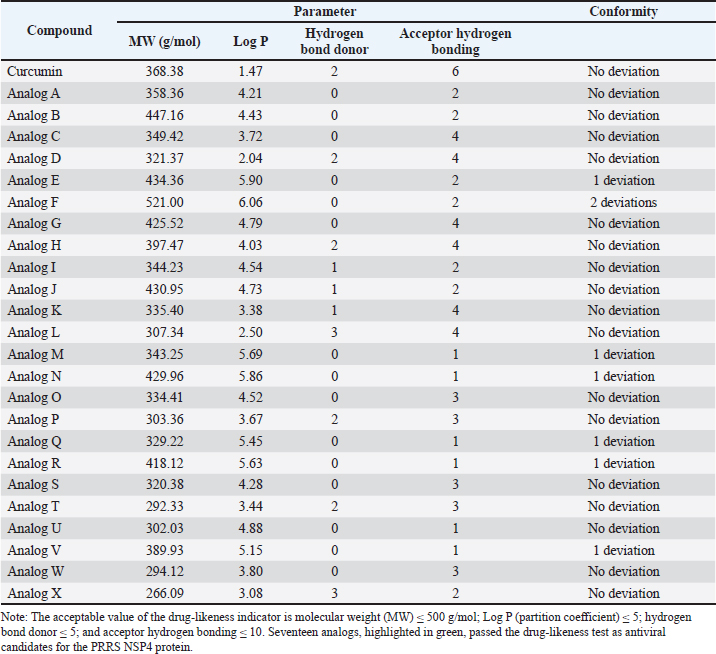
Curcumin and its analogs were converted to Simplified Molecular Input Line Entry System codes on the SwissADME website (http://www.swissadme.ch/). Drug similarity indicates whether a molecule is similar to a known drug, based on its molecular and structural features. Essential properties of drug similarity include hydrophobicity, hydrogen bonding, electron distribution, molecular size, and other pharmacophore features that influence the molecule's behavior, including bioavailability, transport, toxicity, reactivity, and other properties within living organisms. The SwissADME server can calculate molecular properties in accordance with Lipinski's rule of five. The parameters of Lipinski's law of five are a molecular weight (MW) ≤ 500 g/mol, Log P (partition coefficient) ≤ 5, donor hydrogen bonds ≤ 5, and acceptor hydrogen bonds ≤ 10 (Lipinski et al., 2012).
Absorption, distribution, metabolism, excretion, and toxicity (ADMET) prediction
Absorption, distribution, metabolism, excretion, and toxicity predictions for curcumin and its analogs were evaluated using the web-based application pkCSM (https://biosig.lab.uq. edu.au/pkcsm/prediction) (Pires et al., 2015). ADMET is the most crucial parameter in drug discovery studies. It is considered before designing a drug because molecular attributes play a decisive role in the preclinical and clinical phases. The ADMET parameters included intestinal absorption (%), volume of distribution (VDss) (Log L/Kg), metabolism substrate of cytochrome P450 3A4 (CYP3A4) as an inhibitor for the analog being tested, excretion/total clearance, and toxicity (AMES toxicity and hepatotoxicity) (Pires et al., 2015).
Docking ligand proposal
The molecular docking procedure was modified from that described in our previous study (Pandarangga et al., 2024). Selected analogs were docked to the PRRSV NSP4 protein using AutoDock4 software in a grid box set to center on the ligand (40 × 40 × 40 Å) with coordinate X=−4.034, Y=6.285, and Z=17.57 and a spacing of 0.375 Å; runs 20x. Docking was performed under the AutoDock4 program, and 20 docked ligand poses were sorted based on the resulting binding affinity values. The conformation test with the lowest binding affinity was selected as the best-tethered test ligand conformation. The interaction of the proposed ligands with the amino acids of the protein target was visualized in pdbqt format. BIOVIA Discovery Studio 2021 (Dassault Systèmes) was applied to visualize the interaction of ligands and receptors.
Ethical approval
Not needed for this study.
Results
The study was designed to identify curcumin (Fig. 1B) as an antiviral agent against the PRRSV NSP4 protein (Fig. 1A). Natural curcumin (Fig. 1B) has several weaknesses as an antiviral agent. Therefore, natural curcumin was modified into 24 analogs to enhance its antiviral properties by replacing the β-diketone with a monoketone (Table 1). Analogs A-D, E-H, and I-L were made by adding N-methyl-4-piperidone, N-benzyl-4-piperidone, and N-4-piperidone as monoketone structures to the curcumin. The N-cyclohexanone, N-cyclopentanone, and N-acetone were bound to curcumin compounds to produce analogs M-P, Q-T, and U-X, respectively. In addition, each alteration analog was further modified by adding electron-withdrawing groups (Cl and Br) or electron-donating groups (OCH3 and OH).
Table 1. Structure of modified curcumin analogs.
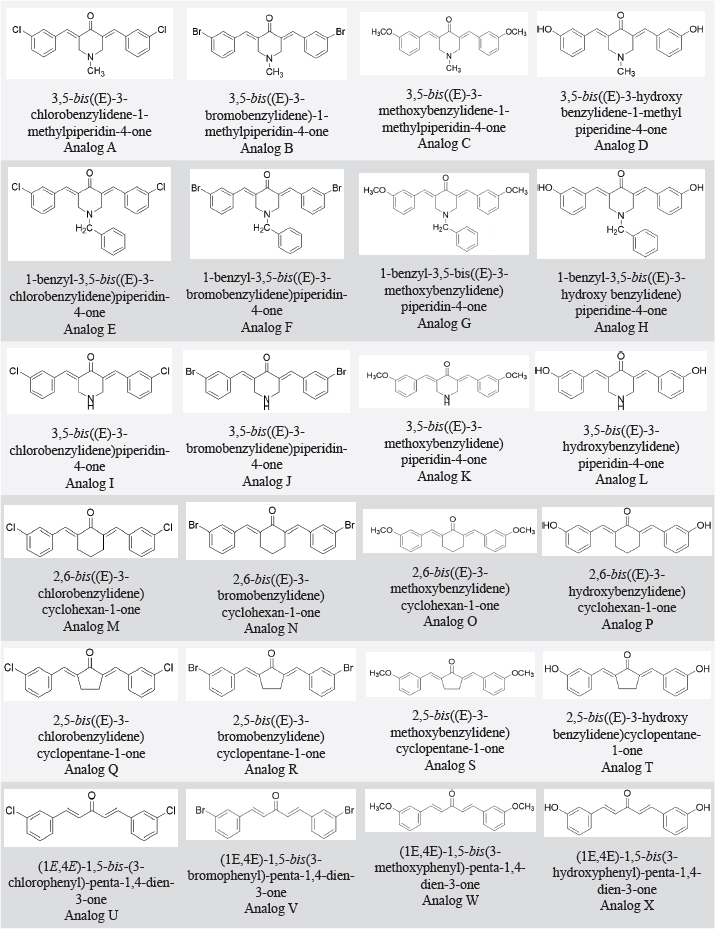
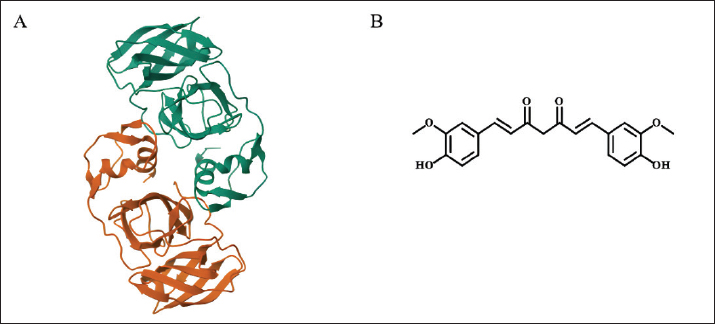
Fig. 1. The target protein and natural curcumin structures. A) 3D structure of PRRSV NSP4 protein as a target protein with PDBid code: 5Y4L; B) 2D structure of natural curcumin (1,7-bis-(4-hydroxy-3-methoxyphenyl)-1,6-heptadiene-3,5-dione) as a proposed ligand.
Based on the first parameter of Lipinski's law of five, analog F was excluded as an antiviral candidate, as the molecular weight was 521,00 g/mol. The second and third parameters are that the number of donor and acceptor hydrogen bonds should not exceed 5 and 10, respectively. An excessive number of hydrogen bonds will increase the energy required for the body's absorption process. The Log p value is a solubility coefficient in fat or water, where a value of less than 5 is a good value based on Lipinski's law of five. However, the results showed that analogs E, F, M, N, Q, R, and V have Log p values greater than 5, indicating that these compounds are hydrophobic and violate Lipinski's law of five. So, only 17 of 24 analogs, highlighted in green, passed Lipinski's law of five drug-likeness test (Table 2).
Table 2. The drug-like properties result from the curcumin compound and its analogs.
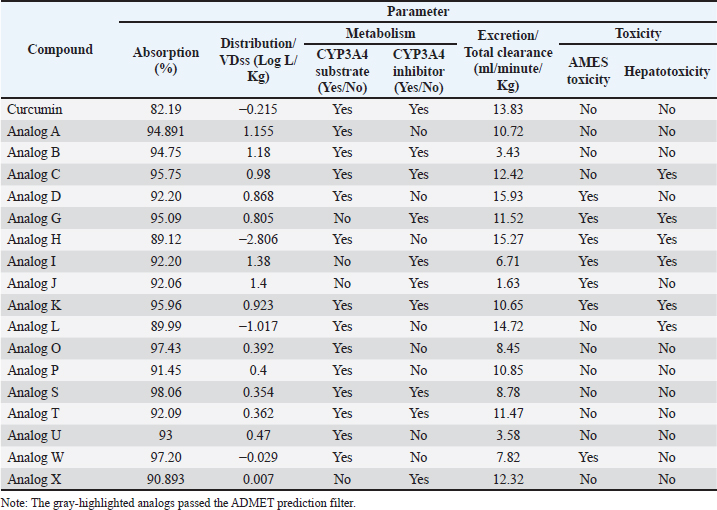
Then, curcumin and the seventeen analogs (analogs A–D, H–L, O, P, S–U, W, and X) were screened using ADMET predictions. The results are summarized in Table 3. Curcumin and 17 analogs can be absorbed more than 30% in the intestine. However, based on the volume of distribution at steady state VDss parameter with a threshold of ≥ -0.15 Log L/Kg, curcumin, analogs H, and L were excluded as drug candidates. Analogs G, I, J, and X were excluded from the list because they cannot be CYP3 substrates. Moreover, analogs C, G, I, J, K, S, T, and X were also removed from the list because they are CYP3 inhibitors. Analogs B, J, and U have a low excretion rate, with total clearance below 5 ml/minute/kg. Then, analogs C, D, G, H, I, J, K, L, and W had toxicity. So, only three compounds —analogs A, O, and P— remained for further analysis.
Table 3. The absorption, distribution, metabolism, excretion, and toxicity (ADMET) prediction results for the curcumin compound and its analogs.
Meanwhile, based on PRRSV NSP4 protein structure analysis using CASTp 3.0, several potential pockets on the protein surface were identified. Among the detected pockets, pocket one was selected as a potential docking site due to its favorable characteristics for ligand interactions. This is because pocket one has a surface area of 722,471 Ų and a volume of 687,311 ų, the largest values among the pockets. Its constituent residues include His129, Asp134, Lys136, Thr139, Val140, Gly141, Cys143, Ala173, and Lys200. Moreover, the stability of the PRRSV NSP4 protein was confirmed using Ramachandran plot analysis (Fig. 2), making it suitable for use as a receptor in molecular docking, as the amino acid residues in quadrant IV are less than 20%. The PRRSV NSP4 protein structure shows that the distribution of receptor amino acid residues in quadrant I (most favored regions) is 89.1%, quadrant II (additional allowed regions) is 10.9%, and quadrant III (generously allowed regions) is 0.0%. At the same time, quadrant IV (disallowed regions) is 0.0%. The smaller the percentage of disallowed regions residues in quadrant IV, the better the quality of the protein used.
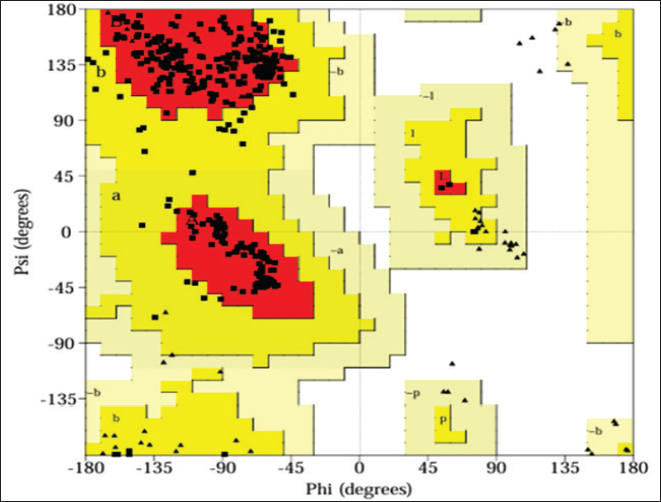
Fig. 2. Visualization of the NSP4 protein structure in the Ramachandran plot, with red, yellow, and light yellow representing the most favored, allowed, and generously allowed regions, respectively.
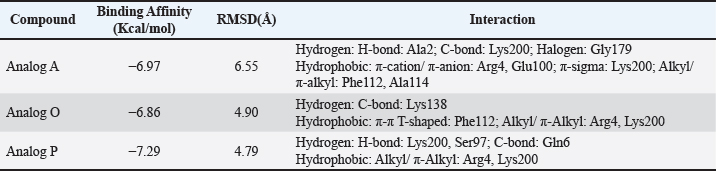
Then, the analogs A, O, and P were tested for binding to the NSP4 protein using molecular docking analysis, as summarized in Table 4. The binding affinity value, the root mean square deviation (RMSD) value, and the ligand interaction with the protein's amino acid residues are the parameters that determine whether these ligands can replace the natural ligand in virus proteins. The NSP4 protein lacks a natural ligand, but it can bind the tested ligand when it is attached to the protein. Thus, this study aims to identify a suitable ligand among curcumin analogs that can be tethered to an amino acid on the viral protein. Based on molecular docking results, analog A has a binding affinity of −6.97 Kcal/mol and an RMSD value of 6.55 Å. The bond resulting from the interaction between analog A and the PRRSV NSP4 protein is depicted in Fig. 3A. These include one conventional hydrogen bond on the amino acid Ala2, one carbon-hydrogen bond on the amino acid Lys200, and a halogen bond on the amino acid Gly179. The hydrophobic bonds resulting from this interaction were Pi-cation/Pi-anion bonds with amino acids Arg4 and Glu100, Pi-sigma bonds with amino acid Lys200, and Alkyl/Pi-alkyl bonds with amino acids Ala114 and Phe112. Analog O had a binding affinity of −6.86 Kcal/mol and an RMSD value of 4.90 Å. The bonding of analog O to the socket of protein was a single carbon–hydrogen bond in the amino acid Lys138, with several hydrophobic hydrogen bonds, namely a T-shaped Pi-Pi bond in the amino acid Phe112 and an Alkyl/Pi-alkyl bond in the amino acid Arg4 (Fig. 3B). Meanwhile, the analog P has a binding affinity of −7.29 Kcal/mol and an RMSD value of 4.79 Å. The interaction of the analog P compound with the PRRSV NSP4 protein produces conventional hydrogen bonds at amino acids Ser97 and Lys200; in addition, there are carbon–hydrogen bonds at amino acid Gln6, as well as hydrophobic Alkyl/Pi-alkyl bonds at amino acids Arg4 and Lys200 (Fig. 3C). The molecular docking results showed that only the P and O analogs had RMSDs of 4.79 Å and 4.90 Å, respectively, exceeding the acceptable threshold of ≤2–3 Å.
Table 4. Results of molecular docking of analogs A, O, and P.
Discussion
PRRSV has spread globally, and no current vaccine has proven effective in controlling the virus (Fiers et al., 2022). This is because the role of each PRRSV protein and the host immune response elicited against PRRSV are still not fully understood (Zhang et al., 2023). Until now, only five PRRSV proteins, namely, NSP1, NSP2, NSP4, NSP11, and N protein, have been identified that can inhibit host immune responses, particularly IFN (An et al., 2020). Due to the limited molecular docking literature on PRRS proteins, only NSP4 was selected in this study because it has been tested for zinc inhibition using molecular docking (Pathak et al., 2022). The selection of the NSP4 protein was also confirmed using protein structure analysis, which revealed a pocket with a surface area of 722.471 Ų and a volume of 687.311 ų, potentially serving as a docking site in molecular docking analysis (Jiang et al., 2013). Furthermore, as in the previous study (Veit et al., 2022), the reasonable structure and receptor compatibility of the NSP4 protein in molecular docking were assessed using the Ramachandran plot.
Of the 24 analogs successfully modified from curcumin, only O and P have potential as antivirals against NSP4, as no effective PRRS vaccine has been widely adopted globally (Chae, 2021). Curcumin is a curcuminoid that comes from the Curcuma longa plant and has antibacterial, antifungal, and antiviral potency. However, curcumin's weaknesses include low bioavailability, poor absorption, and rapid clearance, so it does not remain in the plasma for long (Tabanelli et al., 2021). By converting the β-diketone into a monoketone, this study has synthesized 24 curcumin analogs (A–X) to increase their bioavailability and, by screening for drug-likeness using Lipinski’s law of five and ADMET prediction, has identified three curcumin analogs (A, O, and P) as PRRSV antiviral candidates for further molecular docking analysis. Modifying curcumin into monoketone has been successfully carried out in increasing curcumin bioavailability, including C5-monoketone type curcumin analog, which can be an inhibitor of amyloid β aggregation (Hotsumi et al., 2019); monoketone curcumin analogs, EF24, can act as anticancer agents by inhibiting cell proliferation and inducing apoptosis in human cancer cells (Jeon et al., 2012); and cyclopentanone has antimalarial activity against Plasmodium falciparum (Astuti et al., 2021).
To determine the physicochemical and pharmacokinetic properties of these 24 analog compounds as antiviral candidates against PRRSV NSP4, they must be screened for drug-likeness using Lipinski's law of five and ADMET prediction to determine whether compounds can be used as drug candidates (Pires et al., 2015; Jing et al., 2024). The parameters used for Drug-likeness under Lipinski's law of five: molecular weight less than 500; a Log p value, which is a solubility coefficient in fat or water, where a value of less than 5; and the number of donor and acceptor hydrogen bonds, should not exceed 5 and 10, respectively. An excessive number of hydrogen bonds will increase the energy required for the body's absorption process (Lipinski et al., 2012). Based on these rules, only 17 analog compounds were screened with ADMET. Although a study suggests that candidate compounds that violate the five rules can still be good candidates for antibiotic or antiviral use (Lohit et al., 2024).
A drug candidate will pass ADMET parameters if intestinal absorption is above 30%, the compound's volume of distribution, known as VDss, is ≥ −0.15 Log L/Kg, it can be metabolized by cytochrome P450, total body clearance is > 5 ml/minute/kg, and it does not cause toxicity. VDss value is the volume required for the total dose of the drug to be distributed evenly from the body's circulation to the tissues and body fluids (Islam et al., 2024). Another important ADMET parameter is the ability of cytochrome P450 3A4 (CYP3A4) to act as a substrate or inhibitor for the tested analogs (Manikandan and Nagini, 2018). Cytochromes are involved in the detoxification of drugs by eliminating active drug ingredients, in oxidative and cellular metabolism, and in regulating drug effects, safety, and biological availability (Zhao et al., 2021). If a drug compound inhibits CYP3A4, it can cause toxic side effects or unwanted drug reactions when it is not appropriately metabolized and accumulates in the body (Rudik et al., 2022). Moreover, another parameter is drug excretion, which estimates the drug's total clearance from the liver and kidneys (Shou, 2020). The final ADMET parameter is toxicity, measured using the Ames and hepatotoxicity tests. The Ames test estimates a compound's carcinogenic potential relative to that of a commercial drug (Zeiger, 2019). Moreover, a hepatotoxicity test is used because the liver is the primary organ responsible for metabolizing and eliminating compounds susceptible to toxicity (Quintás et al., 2023). The ADMET tests predicted that analogs A, O, and P passed, and the analogs were then subjected to molecular docking to assess their stability as replacement ligands in the NSP4 protein. Analogs A, O, and P passed the previous two tests and continued with the molecular docking test.
Due to the lack of natural ligands for the PRRS NSP4 protein, the selection of replacement ligands, curcumin analogs, was based on RMSD values and binding affinities that were close to the standards. The molecular docking results showed that only the P and O analogs had RMSDs of 4.79 Å and 4.90 Å, respectively, exceeding the acceptable threshold of ≤2–3 Å. Although the values exceed the standard, these two analogs are likely candidate ligands for the NSP4 protein, as they interfere with protein function by inhibiting IFN signaling. The ability of drug compounds to dissolve in water is a crucial pharmacological factor when administered orally. The binding affinity value predicts a compound's ability to bind to a target protein. Analogs A, O, and P have binding affinities ranging from −6.86 to −7.29 (Table 4). These three analogs exhibit strong binding affinities, exceeding the cutoff of −5 kcal/mol reported in COVID-19 drug testing (Rahman et al., 2021). The lower the binding affinity, the stronger the interaction between the compound and the protein. Another reference parameter is the RMSD value. The RMSD value predicts the ligand's pose position relative to the target protein in the crystallographic structure. The best RMSD value is <2 Å, with an acceptable value of 3 Å (Ramírez and Caballero, 2018). Meanwhile, the three analogs tested as ligands have values greater than 3 Å: analog A (6.55 Å), analog O (4.90 Å), and analog P (4.79 Å). An RMSD >3 Å indicates the pose is unreliable; additional validation, such as molecular dynamics, is required for further analysis. Another essential aspect to consider is the interaction between the ligand and the amino acids of the NSP4 protein. The ideal amount of hydrogen is no more than five bonds. Hydrogen and hydrophobic bonds are crucial for estimating the stability of tested ligands when replacing natural ligands. All three ligands passed this parameter. Therefore, based on these three parameters of molecular docking, only analogs O and P are more likely to become candidate ligands for the NSP4 protein.
Several studies have shown that the NSP4 protein inhibits IFN activity by blocking multiple IFN pathways. The NSP4 protein is essential for inhibiting the host's innate immune response by preventing the production of IFN in the nucleus, thereby inhibiting antiviral responses (Huang et al., 2014; Zhao et al., 2020). It affects the pig's immune response by inhibiting the activity of nuclear factor kappa B essential modulator (NEMO), a component involved in NF-κB activation (Chen et al., 2019). NEMO is a subunit of I Kappa β Kinase (IKK), which is inhibited by the NSP4 protein (Jiao et al., 2023). IKK plays a role in releasing NF-κB to induce the expression of various proinflammatory genes, including cytokine and chemokine genes, and in regulating inflammation (Liu et al., 2017). In addition, the NSP4 protein can indirectly inhibit the action of IFN by inhibiting the action of adaptor proteins, namely retinoic acid-inducible gene I (RIG-I), melanoma differentiation-associated protein 5 (MDA5), and mitochondrial antiviral signaling Protein (MAVS), protein complex sensors in the activation of type 1 IFN (Wang et al., 2021). This study demonstrates that O and P analogs can replace the natural ligand of NSP4. We speculate that this ability indirectly indicates that O and P analogs have the potential to inhibit NSP4 activity, thereby allowing the host immune response to produce IFN, a potent antiviral.
However, this study has two weaknesses. First, there is no preliminary study on the subtype of PRRSV circulating in the field. To enhance the biological relevance and potential effectiveness of the antiviral candidate in real-world settings, a phylogenetic analysis of circulating PRRSV in the field is needed, with a particular focus on the genes encoding the NSP4 protein. Second, there is no natural ligand for the NSP4 protein, so the replacement ligand lacks a reference point to determine its correct position upon binding. This is evident from the RMSD of more than 2 Å, indicating that the ligand is slightly off its proper position. To overcome this, the binding stability of these two analogs to the NSP4 protein should be assessed using molecular dynamics in future studies. Despite its limitations, this study could serve as a reference for developing an antiviral for the PRRS virus.
Conclusion
The natural curcumin modification obtained 24 analogs. Then, these analogs were screened using the drug-likeness test, following Lipinski's law of five, ADMET predictions, and molecular docking analysis, which showed that analogs O and P could be potential antiviral candidates for the PRRSV NSP4 protein. Analog O and P have potential as drug candidates for PRRSV, as they indirectly inhibit NSP4. Therefore, these analogs are speculated to block NF-κB or adapter proteins in the host, including RIG-I, MDA5, and MAVS, thereby inducing IFN production. In a further study, the stability of these two analogs as ligand replacements can be tested using molecular dynamics simulations. Moreover, analogs O and P can be tested biologically (in vivo) against the NSP4 protein.
Acknowledgments
This research was conducted with our gratitude to Dr. Rick Tearle from the University of Adelaide for proofreading and editing this manuscript in English.
Conflict of interest
The authors declare that there is no conflict of interest.
Funding
Fakultas Kedokteran dan Kedokteran Hewan, Universitas Nusa Cendana, fully funded this research.
Authors' contributions
MA: data curation, formal analysis, investigation, methodology, writing-original draft, writing-review and editing. AL: conceptualization, methodology, supervision, formal analysis, writing-review, and editing. FD: Writing, review, and editing. ML: methodology, supervision, writing, review, and editing. PP: conceptualization, project administration, methodology, supervision, writing-review, and editing.
Data availability
All data supporting the findings of this study are available within the manuscript.
References
An, T.Q., Li, J.N., Su, C.M. and Yoo, D. 2020. Molecular and cellular mechanisms for PRRSV pathogenesis and host response to infection. Virus Res. 286, 197980; doi: 10.1016/j.virusres.2020.197980
Ardebili, A., Pouriayevali, M.H., Aleshikh, S., Zahani, M., Ajorloo, M., Izanloo, A., Siyadatpanah, A., Razavi Nikoo, H., Wilairatana, P. and Coutinho, H.D.M. 2021. Antiviral therapeutic potential of curcumin: an update. Molecules 26(22), 6994; doi:10.3390/molecules26226994
Astuti, E., Raharjo, T.J., Manalu, P.B., Putra, I.S., Waskitha, S.S. and Solin, J. 2021. Synthesis, molecular docking, and evaluation of some new curcumin analogs as antimalarial agents. Indonesian. J. Chem. 21(2), 452; doi:10.22146/ijc.57646
Balasubramanian, A., Pilankatta, R., Teramoto, T., Sajith, A.M., Nwulia, E., Kulkarni, A. and Padmanabhan, R. 2019. Inhibition of dengue virus by curcuminoids. Antiviral Res. 162, 71–78; doi:10.1016/j.antiviral.2018.12.002
Chae, C. 2021. Commercial PRRS modified-live virus vaccines. Vaccines 9(2), 185; doi:10.3390/vaccines9020185
Chen, J., Wang, D., Sun, Z., Gao, L., Zhu, X., Guo, J., Xu, S., Fang, L., Li, K. and Xiao, S. 2019. Arterivirus nsp4 antagonizes interferon beta production by proteolytically cleaving NEMO at multiple sites. J. Virol. 93(12), 10–1128; doi:10.1128/JVI.00385-19
Chung, S.S., Dutta, P., Chard, N., Wu, Y., Chen, Q.H., Chen, G. and Vadgama, J. 2019. A novel curcumin analog inhibits canonical and non-canonical functions of telomerase through STAT3 and NF-κB inactivation in colorectal cancer cells. Oncotarget 10(44), 4516–4531; doi:10.18632/oncotarget.27000
Du, T., Shi, Y., Xiao, S., Li, N., Zhao, Q., Zhang, A., Nan, Y., Mu, Y., Sun, Y., Wu, C., Zhang, H. and Zhou, E.M. 2017. Curcumin is a promising inhibitor of genotype 2 porcine reproductive and respiratory syndrome virus infection. BMC. Vet. Res. 13(1), 298; doi:10.1186/s12917-017-1218-x
Faisal, F., Widayanti, R., Haryanto, A. and Tabu, C.R. 2015. Molecular identification and genetic diversity of open reading frame 7 field isolated porcine reproductive and respiratory syndrome in North Sumatera, Indonesia, in the period of 2008-2014. Vet. World 8(7), 875–880; doi:10.14202/vetworld.2015.875-880
Ferreira, L.L.C., Abreu, M.P., Costa, C.B., Leda, P.O., Behrens, M.D. and Dos Santos, E.P. 2022. Curcumin and its analogs as a therapeutic strategy in infections caused by RNA genome viruses. Food. Environ. Virol. 14(2), 120–137; doi:10.1007/s12560-022-09514-3
Fiers, J., Tignon, M., Cay, A.B., Simons, X. and Maes, D. 2022. Porcine reproductive and respiratory syndrome virus (PRRSv): a cross-sectional study on ELISA seronegative, multivaccinated sows. Viruses 14(9), 1944; doi:10.3390/v14091944
Holtkamp, D., Kliebenstein, J., Neumann, E., Zimmerman, J., Rotto, H., Yoder, T., Wang, C., Yeske, P., Mowrer, C. and Haley, C. 2013. Assessment of the economic impact of Porcine Reproductive and Respiratory Syndrome virus on United States pork producers. J. Swine Health Prod. 21(2), 72–84; doi:10.54846/jshap/754
Hotsumi, M., Tajiri, M., Nikaido, Y., Sato, T., Makabe, K. and Konno, H. 2019. Design, synthesis, and evaluation of a water soluble C5-monoketone type curcumin analogue as a potent amyloid β aggregation inhibitor. Bioorganic. MedChem. Lett. 29(16), 2157–2161; doi: 10.1016/j.bmcl.2019.06.052
Huang, C., Zhang, Q., Guo, X.K., Yu, Z.B., Xu, A.T., Tang, J. and Feng, W.H. 2014. Porcine reproductive and respiratory syndrome virus nonstructural protein 4 antagonizes beta interferon expression by targeting the NF-κB essential modulator. J. Virol. 88(18), 10934–10945; doi: 10.1128/jvi.01396-14
ICTV. 2024. Virus taxonomy. International Committee on Taxonomy of Viruses. Available via https://ictv.global/report/chapter/arteriviridae/arteriviridae/betaarterivirus
Islam, A.U., Hadni, H., Ali, F., Abuzreda, A. and Kawsar, S.M.A. 2024. Synthesis, antimicrobial activity, molecular docking, molecular dynamics simulation, and ADMET properties of the mannopyranoside derivatives as antimicrobial agents. J. Taibah Univ. For Sci. 18(1), 1–25; doi: 10.1080/16583655.2024.2327101
Jennings, M.R. and Parks, R.J. 2020. Curcumin as an antiviral agent. Viruses 12(11), 1242; doi:10.3390/v12111242
Jeon, H.S., Jo, M.H., Kim, H.J., Lee, M.H., Yu, S.K., Kim, C.S., Lee, S.Y., Kim, S.G., Chun, H.S., Park, E. and Kim, D.K. 2012. Anticancer activities of diphenyl difluoroketone, a novel curcumin analog, on KB human oral cancer cells. J. Korean Soc. For Appl. Biol. Chem. 55(4), 451–456; doi:10.1007/s13765-012-1168-8
Jiang, Y., Khan, F., Pandupuspitasari, N., Kadariya, I., Cheng, Z., Ren, Y., Chen, X., Zhou, A., Yang, L., Kong, D. and Zhang, S. 2013. Analysis of the binding sites of porcine sialoadhesin receptor with PRRSV. Int. J. Mol. Sci. 14(12), 23955–23979; doi: 10.3390/ijms141223955
Jiao, S., Li, C., Liu, H., Xue, M., Zhou, Q., Zhang, L., Liu, X., Feng, C., Ye, G., Liu, J., Li, J., Huang, L., Xiong, T., Zhang, Z. and Weng, C. 2023. Porcine Reproductive and Respiratory Syndrome virus infection inhibits NF-κB signaling pathway through cleavage of IKKβ by NSP4. Vet. Microbiol. 282; doi: 10.1016/j.vetmic.2023.109767
Jing, Y., Luo, L., Zeng, Z., Zhao, X., Huang, R., Song, C., Chen, G., Wei, S., Yang, H., Tang, Y. and Jin, S. 2024. Targeted screening of curcumin derivatives as pancreatic lipase inhibitors using computer-aided drug design. ACS Omega 9(25), 27669–27679; doi: 10.1021/acsomega.4c03596
Ke, W., Zhou, Y., Lai, Y., Long, S., Fang, L. and Xiao, S. 2022. Porcine reproductive and respiratory syndrome virus nsp4 positively regulates cellular cholesterol to inhibit type I interferon production. Redox. Biol. 49, 102207; doi:10.1016/j.redox.2021.102207
Lalonde, C., Provost, C. and Gagnon, C.A. 2020. Whole-genome sequencing of Porcine Reproductive and Respiratory Syndrome virus from field clinical samples improves the genomic surveillance of the virus. J. Clin. Microbiol. 58(11), 1–25; doi:10.1128/JCM.00097-20
Li, J., Miller, L.C. and Sang, Y. 2024. Current status of vaccines for porcine reproductive and respiratory syndrome: interferon response, immunological overview, and future prospects. Vaccines 12(6), 606; doi: 10.3390/vaccines12060606
Lipinski, C.A., Lombardo, F., Dominy, B.W. and Feeney, P.J. 2012. Experimental and computational approaches to estimate solubility and permeability in drug discovery and development settings. Adv. Drug Del. Rev. 64(4), 4–17; doi:10.1016/j.addr.2012.09.019
Liu, T., Zhang, L., Joo, D. and Sun, S.C. 2017. NF-κB signaling in inflammation. Signal Transduction Targeted Therapy 2(1), 17023; doi:10.1038/sigtrans.2017.23
Lohit, N., Singh, A.K., Kumar, A., Singh, H., Yadav, J.P., Singh, K. and Kumar, P. 2024. Description and in silico ADME studies of US-FDA approved drugs or drugs under clinical trial which violate the Lipinski’s rule of 5. Lett. Drug Design. Discovery 21(8), 1334–1358; doi: 10.2174/1570180820666230224112505
Manikandan, P. and Nagini, S. 2018. Cytochrome P450 structure, function and clinical significance: a review. Curr. Drug. Targets. 19(1), 38–54; doi: 10.2174/1389450118666170125144557
Nathues, H., Alarcon, P., Rushton, J., Jolie, R., Fiebig, K., Jimenez, M., Geurts, V. and Nathues, C. 2017. Cost of Porcine Reproductive and Respiratory Syndrome virus at individual farm level—an economic disease model. Prev. Vet. Med. 142, 16–29; doi:10.1016/j.prevetmed.2017.04.006
Pandarangga, P., Simarmata, Y.T.R.M.R., Liu, A.B.H. and Haryati, D.A.F. 2024. In silico simulation of hyperoside, isoquercetin, quercetin, and quercitrin as potential antivirals against the pNP868R protein of African Swine Fever virus. Vet. World. 17(1), 171–178; doi:10.14202/vetworld.2024.171-178
Pathak, R.K., Seo, Y.J. and Kim, J.M. 2022. Structural insights into inhibition of PRRSV Nsp4 revealed by structure-based virtual screening, molecular dynamics, and MM-PBSA studies. J. Biol. Eng. 16(1), p4; doi:10.1186/s13036-022-00284-x
Peck, K.M. and Lauring, A.S. 2018. Complexities of viral mutation rates. J. Virol. 92(14), 10–1128; doi: 10.1128/jvi.01031-17
Pires, D.E.V., Blundell, T.L. and Ascher, D.B. 2015. PkCSM: predicting small-molecule pharmacokinetic and toxicity properties using graph-based signatures. J. MedChem. 58(9), 4066–4072; doi: 10.1021/acs.jmedchem.5b00104
Quintás, G., Castell, J.V. and Moreno-Torres, M. 2023. The assessment of the potential hepatotoxicity of new drugs by in vitro metabolomics. Front. Pharmacol. 14, 1155271; doi: 10.3389/fphar.2023.1155271
Rahman, M.M., Saha, T., Islam, K.J., Suman, R.H., Biswas, S., Rahat, E.U., Hossen, M.R., Islam, R., Hossain, M.N., Mamun, A.A., Khan, M., Ali, M.A. and Halim, M.A. 2021. Virtual screening, molecular dynamics and structure–activity relationship studies to identify potent approved drugs for Covid-19 treatment. J. Biomolecular Struct. Dyn. 39(16), 6231–6241; doi:10.1080/07391102.2020.1794974
Ramírez, D. and Caballero, J. 2018. Is it reliable to take the molecular docking top scoring position as the best solution without considering available structural data?. Molecules 23(5), 1038; doi:10.3390/molecules23051038
Risser, J., Ackerman, M., Evelsizer, R., Wu, S., Kwon, B. and Hammer, J.M. 2021. Porcine reproductive and respiratory syndrome virus genetic variability a management and diagnostic dilemma. Virol. J. 18, 1–12; doi:10.1186/s12985-021-01675-0
Rudik, A., Dmitriev, A., Lagunin, A., Filimonov, D. and Poroikov, V. 2022. Computational prediction of inhibitors and inducers of the major isoforms of cytochrome P450. Molecules 27(18), 5875; doi:10.3390/molecules27185875
Ruedas-Torres, I., Rodríguez-Gómez, I.M., Sánchez-Carvajal, J.M., Larenas-Muñoz, F., Pallarés, F.J., Carrasco, L. and Gómez-Laguna, J. 2021. The jigsaw of PRRSV virulence. Vet. Microbiol. 260, 109168; doi:10.1016/j.vetmic.2021.109168
Shou, W.Z. 2020. Current status and future directions of high-throughput ADME screening in drug discovery. J. Pharm. Anal. 10(3), 201–208; doi:10.1016/j.jpha.2020.05.004
Tabanelli, R., Brogi, S. and Calderone, V. 2021. Improving curcumin bioavailability: current strategies and future perspectives. Pharmaceutics 13(10), 1715; doi: 10.3390/pharmaceutics13101715
Wang, T.Y., Sun, M.X., Zhang, H.L., Wang, G., Zhan, G., Tian, Z.J., Cai, X.H., Su, C. and Tang, Y.D. 2021. Evasion of antiviral innate immunity by Porcine Reproductive and Respiratory Syndrome virus. Front. Microbiol. 12, 693799; doi:10.3389/fmicb.2021.693799
Zeiger, E. 2019. The test that changed the world: the Ames test and the regulation of chemicals. Mutation Research/Genetic Toxicol. Environ. Mutagenesis 841, 43–48; doi:10.1016/j.mrgentox.2019.05.007
Zhang, H., Li, G., Zheng, Y., Luo, Q., Sha, H., Sun, W. and Zhao, M. 2024. NSP4 promotes replication of porcine reproductive and respiratory syndrome virus-2. Vet. Microbiol. 295, 110121; doi:10.1016/j.vetmic.2024.110121
Zhang, H., Luo, Q., He, Y., Zheng, Y., Sha, H., Li, G., Kong, W., Liao, J. and Zhao, M. 2023. Research progress on the development of Porcine Reproductive and Respiratory Syndrome vaccines. Vet. Sci. 10(8), 491; doi:10.3390/vetsci10080491
Zhao, M., Ma, J., Li, M., Zhang, Y., Jiang, B., Zhao, X., Huai, C., Shen, L., Zhang, N., He, L. and Qin, S. 2021. Cytochrome P450 enzymes and drug metabolism in humans. Int. J. Mol. Sci. 22(23), 12808; doi: 10.3390/ijms222312808
Zhao, Y., Song, Z., Bai, J., Liu, X., Nauwynck, H. and Jiang, P. 2020. Porcine Reproductive and Respiratory Syndrome virus NSP4 cleaves ZAP to antagonize its antiviral activity. Vet. Microbiol. 250, 108863; doi:10.1016/j.vetmic.2020.108863
Zimmerman, J.J., Dee, S.A., Holtkamp, D.J., Murtaugh, M.P., Stadejek, T., Stevenson, G.W., Torremorell, M., Yang, H. and Zhang, J. 2019. Porcine Reproductive and Respiratory Syndrome Viruses (Porcine Arteriviruses). In Diseases of Swine. Wiley, pp: 685–708; doi: 10.1002/9781119350927.ch41