





| Research Article | ||
Open Vet. J.. 2026; 16(7): 4141-4146 Open Veterinary Journal, (2026), Vol. 16(7): 4141-4146 Research Article PCR-based molecular detection and bcsp31 gene characterization of Brucella abortus in small ruminants from Punjab, PakistanMuhammad Shakeel Khaliq1, Muhammad Hassan Mushtaq1*, Abdul Rehman1, Farhat Nazir Awan2 and Muhammad Avais31Department of Epidemiology and Public Health, University of Veterinary and Animal Sciences, Lahore, Pakistan 2Livestock and Dairy Development Department, Govt. of Punjab, Lahore, Pakistan 3Department of Veterinary Medicine, University of Veterinary and Animal Sciences, Lahore, Pakistan *Corresponding Author: Muhammad Hassan Mushtaq. Department of Epidemiology and Public Health, University of Veterinary and Animal Sciences, Lahore, Pakistan. Email: hassan.mushtaq [at] uvas.edu.pk Submitted: 08/03/2026 Revised: 01/06/2026 Accepted: 12/06/2026 Published: 02/07/2026 © 2026 Open Veterinary Journal
AbstractBackground: Brucellosis is a major zoonotic disease with significant implications for animal and human health worldwide. Bacterial culture remains the gold standard for diagnosis; however, it is labor-intensive, time-consuming, and poses biosafety risks. Molecular diagnostic methods offer rapid, sensitive, and safe alternatives for detecting Brucella infections, particularly in resource-limited settings. Aim: This study aimed to detect and partially characterize Brucella abortus DNA in sheep and goats from Punjab, Pakistan, using species-specific conventional polymerase chain reaction (PCR) targeting the bcsp31 gene. Methods: Whole blood (n=16) and vaginal swab (n=5) samples were collected from seropositive and recently aborted small ruminants. DNA was extracted and analyzed by conventional PCR targeting the bcsp31 gene of B. abortus and the IS711 element of Brucella melitensis. Positive polymerase chain reaction products were subjected to partial gene sequencing and nucleotide BLAST analysis for species confirmation. Results: Brucella abortus DNA was detected in two out of five vaginal swab samples (40%), whereas all whole blood samples tested negative for both B. abortus and B. melitensis. Partial sequencing of the bcsp31 gene from the positive samples revealed 99% nucleotide identity with reference B. abortus strains available in public databases. Conclusion: This study provides preliminary molecular evidence of B. abortus infection in small ruminants in Punjab, Pakistan, and highlights the utility of PCR-based diagnosis using vaginal swabs over whole blood. However, the findings should be interpreted cautiously due to the limited sample size, and larger-scale molecular surveillance is recommended to confirm these observations. Keywords: bcsp31 gene, Brucella abortus, Molecular epidemiology, PCR, Small ruminants. IntroductionBrucellosis is an important zoonotic disease that affects livestock and human populations worldwide. It causes reproductive losses in animals and poses significant public health concerns in low- or middle-income countries, such as Pakistan. Bacterial culture is considered the gold standard; however, it requires biosafety level 3 facilities, is time-consuming, and poses infection risks. Polymerase chain reaction (PCR) offers a rapid, sensitive, and safer alternative, particularly in resource-limited settings. Therefore, molecular diagnostic techniques have been adopted to provide safer and faster detection of Brucella organisms with higher accuracy (Khaliq et al., 2025a). The first PCR assay for detecting Brucella abortus was developed in 1990. In this newly evolved diagnostic method, the outer membrane protein gene was targeted for rapid identification of the Brucella organism without the need for culture (Fekete et al., 1990). Later, with the emergence of technologies, the abortus, melitensis, ovis, and suis-PCR assay was introduced to facilitate the differentiation of B. abortus, Brucella melitensis, Brucella ovis, and Brucella suis in a single reaction, with further modification to differentiate vaccine and field strains (Bricker and Halling, 1995). These advanced molecular techniques have been adopted in medical and veterinary research for diagnosing brucellosis in humans and animals. Initially, the aborted fetus material was used as a specimen for PCR diagnosis compared with the limited use of peripheral blood due to the presence of PCR inhibitors such as hemoglobin and host DNA. Although new methods have evolved and the sensitivity of PCR methods has increased for brucellosis diagnosis from blood and serum specimens; however, reproductive samples such as vaginal swabs remain more reliable for molecular detection of brucellosis DNA in naturally infected animals (Morata et al., 2001). In Pakistan, a lot of literature is available on the serological diagnosis of brucellosis, with limited published data on the molecular evidence of brucellosis infection in small ruminants. This lack of molecular epidemiological data regarding the confirmation of brucellosis diagnosis limits the use of evidence-based control strategies in mixed livestock production systems. This molecular study provided confirmatory evidence of B. abortus in sheep and goats along with genetic relatedness of Brucella strains in small ruminants in Punjab, Pakistan. Material and MethodsStudy design and sample collectionSheep and goats with a history of seropositivity for brucellosis or recent abortion were sampled from three districts of Punjab, Pakistan. These samples were selected from a previously published sero-epidemiological study (Khaliq et al., 2025b), which reported detailed serological results (RBT and ELISA). Samples were collected from sheep and goats in different districts of Punjab, Pakistan, where mixed farming systems are common. A total of 16 blood samples (nine goats and seven sheep) were collected from seropositive small ruminants identified in a serological study. In addition, vaginal swab samples (n=5) were collected only from recently aborted animals among those already sampled for blood collection, including three goats and two sheep. Blood samples were obtained from all seropositive animals, whereas vaginal swabs were collected exclusively from animals with a recent history of abortion. The samples were transported to the Provincial Diagnostic Laboratory, Lahore, under cold chain conditions and processed within 72 hours. Serological screening was performed using the Rose Bengal Test and indirect enzyme-linked immunosorbent assay, and only samples from seropositive or aborted animals were retained for molecular analysis. Seronegative animal samples were excluded from further testing. PCR testDNA was extracted from whole blood and vaginal swab specimens using a silica membrane–based genomic DNA extraction kit according to the manufacturer’s instructions. A commercially available kit (GeneJET Genomic DNA Purification Kit, Thermo Scientific™) was used for DNA extraction from whole blood and vaginal swabs. Conventional PCR assays were performed to detect Brucella DNA using species-specific primers targeting the bcsp31 gene for B. abortus and the IS711 element for B. melitensis (Table 1). Each reaction was performed in a final volume of 25 µl containing 12.5 µl of PCR master mix, 0.5 µM of each primer, and 2 µl of template DNA. The vaccine strain B. abortus RB51 was used as a positive control, whereas nuclease-free water was used as a negative control. The PCR method for B. abortus started with initial denaturation at 94℃ for 3 minutes, followed by 30 cycles of denaturation at 94℃ for 30 seconds, annealing at 62℃ for 30 seconds, and elongation at 72oC for 30 seconds, with a final elongation step at 72℃ for 7 minutes. Similarly, the PCR for B. melitensis has an initial denaturation step at 95oC for 4 minutes, followed by 30 cycles of denaturation at 94oC for 1 minute, annealing at 58oC for 1 minute, elongation at 72oC for 1 minute, and final elongation at 72oC for 7 minutes. The amplified PCR products were visualized by electrophoresis on a 1.5% agarose gel stained with a suitable DNA dye. Table 1. The species-specific primers were used for the identification of Brucella DNA by PCR.
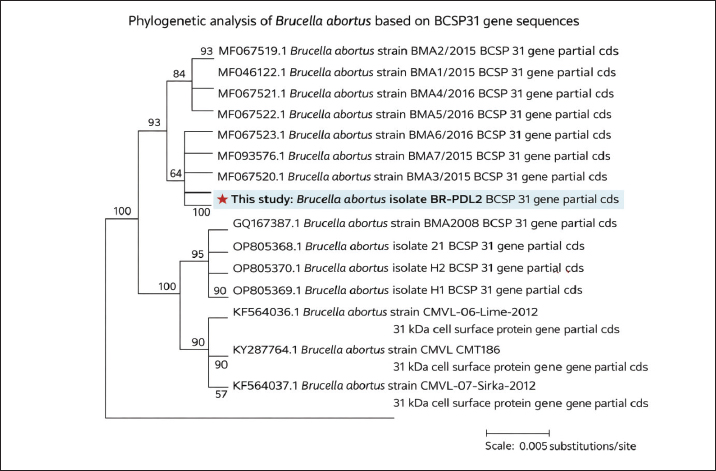
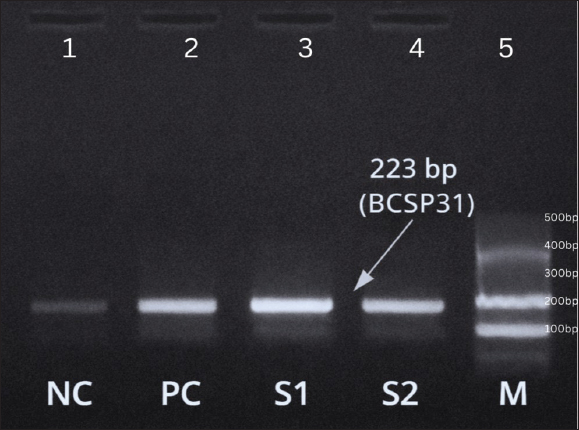
Partial gene sequencing and nucleotide BLAST analysisPCR-positive amplicons targeting the bcsp31 gene (n=2) were purified and subjected to Sanger sequencing using the same primers as those used for PCR amplification. Sequencing was performed commercially (Celemics® BTSeq™). The obtained nucleotide sequences were analyzed using the basic local alignment search tool available at the National Center for Biotechnology Information to determine sequence similarity with reference Brucella strains deposited in GenBank. The phylogenetic relationships between the obtained sequences and global reference strains were inferred using distance-based methods in MEGA 11 software. Ethical approvalThe Institutional Review Committee for Biomedical Research of the University of Veterinary and Animal Sciences, Lahore, approved the study (No. 065/IRC/BMR dated: 08.10.2019). ResultsPolymerase chain reactionThe detection rate of B. abortus in vaginal swabs was 40% (2/5), whereas all whole blood samples were negative (0/16). Statistical comparison was not performed due to the limited sample size. All vaginal swab and blood samples were negative for B. melitensis. Both the PCR-positive specimens originated from goats belonging to different flocks in Jhang district, Punjab. Representative agarose gel electrophoresis results are provided in the Supplementary Data (Fig. S1). Partial gene sequencing and BLAST analysisPartial sequencing of the bcsp31 (31-kDa) gene was performed for both field samples, and the NCBI BLAST tool was used to analyze the nucleotide sequences. Both sequences exhibited 99% nucleotide identity with reference sequences of B. abortus deposited in GenBank. The phylogenetic tree was constructed using genetic-distance-based methods, as shown in Figure 1. The field isolates showed a high degree of genetic similarity to previously reported B. abortus strains, confirming their species-level identification.
Fig. 1. Phylogenetic analysis of B. abortus based on partial bcsp31 gene sequences. DiscussionIn this study, a conventional PCR assay targeting the bcsp31 gene was employed as a safer and faster molecular alternative to bacterial culture for detecting B. abortus DNA in small ruminants. The key finding was the detection of B. abortus DNA in 40% (2/5) of vaginal swabs from aborted goats, whereas all whole-blood samples (0/16) tested negative for both B. abortus and B. melitensis. These results provided not only the preliminary molecular evidence of B. abortus infection in small ruminants in Punjab, Pakistan, but also raised important questions about the pathogen tropism and cross-species transmission of B. abortus. The complete absence of Brucella DNA in whole-blood samples is consistent with earlier reports (Leal-Klevezas et al., 1995; Zerva et al., 2001) and can be explained by several biological and technical factors. First, brucellosis in small ruminants is often intermittent and of low magnitude, particularly during the chronic or post-abortion phase. Second, whole blood contains PCR inhibitors, such as Haemoglobin and Lactoferrin, and high concentrations of host genomic DNA, which reduce amplification efficiency. Third, the small sample size (n=16) limits the probability of capturing transient bacteremia. Therefore, the negative blood PCR results do not rule out brucellosis but rather underscore that vaginal swab is a preferable specimen in field settings when animals are sampled after abortion. This finding is methodologically important for future surveillance studies, which should prioritize molecular detection of reproductive samples over blood. The detection of B. abortus DNA in 40% of vaginal swabs from aborted goats aligns with the known pathobiology of Brucella species, where the organism localizes in the pregnant uterus and is shed in high numbers in placental tissues and vaginal discharges. Similar findings have been reported in Egyptian and Nigerian goats and sheep (Ocholi et al., 2005; Wareth et al., 2015). The moderate detection rate (2/5), despite a history of abortion, may be explained by the timing of swab collection relative to abortion, partial clearance of bacteria, or low bacterial load in some animals. Nevertheless, vaginal swabs were more informative than blood, supporting their use as a preferred field samples for molecular confirmation of brucellosis in small ruminants. The absence of B. melitensis DNA and the presence of B. abortus DNA in goats were notable findings. Because B. melitensis is traditionally considered the primary cause of brucellosis in small ruminants worldwide, this result requires careful interpretation. Several hypotheses may explain this observation: (i) cross-species spillover from co-grazing cattle or buffalo infected with B. abortus, a plausible scenario in Punjab’s mixed livestock farming systems; (ii) possible misclassification of traditional host specificity, as B. abortus has been increasingly reported in small ruminants in Africa and Asia (Ocholi et al., 2005; Wareth et al., 2015); (iii) or, less likely, primer-related limitations, although the IS711 primer set used has been well validated. These molecular findings are strongly corroborated by our previously published cross-sectional study conducted in the same three districts of Punjab (Chakwal, Dera Ghazi Khan, and Jhang) (Khaliq et al., 2025b). Seropositivity was detected in 2.0% of animals and 9.8% of humans in that large-scale study involving 1,783 small ruminants and 122 livestock workers, and, notably, real-time PCR confirmed B. abortus DNA in seropositive small ruminants. The concordance between the two diagnostic approaches supports the consistency of the findings: both identified B. abortus, not B. melitensis, as the circulating species in small ruminants in this region. Furthermore, the previous study identified mixed farming with large ruminants as a significant risk factor (OR: 4.0), providing an epidemiological mechanism for the observed spillover of B. abortus from cattle/buffalo to sheep and goats. Thus, the current molecular results added direct evidence from post-abortion vaginal swabs to the serological and real-time PCR evidence already published, creating a coherent and mutually reinforcing body of evidence. Partial sequencing of the bcsp31 gene from both positive samples showed 99% nucleotide identity with reference B. abortus strains in GenBank, confirming species-level identification. The high sequence conservation observed is consistent with multiple international studies (El-Diasty et al., 2020; Mirzaei et al., 2021) and supports the utility of bcsp31 as a stable and reliable genetic marker for Brucella detection across different hosts and geographic regions. However, the bcsp31 gene is highly conserved among Brucella species and is unsuitable for strain typing or epidemiological trace-back. Therefore, while sequencing successfully confirmed B. abortus, it could not distinguish vaccine strains from field strains or identify specific lineages. To better understand transmission networks, future studies should employ higher resolution typing methods, such as Multiple-Locus Variable-Number Tandem Repeat Analysis or whole-genome sequencing. The present findings are broadly consistent with earlier reports from Punjab (Aslam et al., 2017; Khan et al., 2019), where B. abortus was detected in cattle and buffalo, and occasional spillover into small ruminants was suspected. The results also mirror observations from sub-Saharan Africa and the Middle East, where mixed farming facilitates interspecies transmission (Whatmore et al., 2016; Godfroid et al., 2011). Nevertheless, unlike studies from endemic regions where B. melitensis dominates (e.g., Mediterranean countries), our finding of B. abortus in goats suggests that the local epidemiology may be driven more by large and small ruminants contact than by independent maintenance of B. melitensis in small ruminant flocks. This has important implications for control: vaccination programs targeting cattle with B. abortus S19 or RB51 may indirectly benefit small ruminants. However, such cross-protection may be incomplete and should not replace species-specific surveillance. ConclusionIn summary, this study provides preliminary but scientifically valid molecular evidence of B. abortus infection in aborted goats in Punjab, Pakistan, using a safer PCR-based approach on vaginal swabs. The findings highlight the unsuitability of blood for molecular diagnosis in field settings, the utility of reproductive samples, and the occurrence of cross-species transmission in mixed farming systems. When combined with our previously published sero-molecular study from the same districts, the combined evidence consistently points to B. abortus as an important pathogen in small ruminants and a zoonotic risk to livestock workers in Punjab. Future research must employ larger sample sizes, culture isolation, and high-resolution genotyping to establish the true prevalence, transmission routes, and public health risks associated with B. abortus in small ruminants. LimitationThe most significant limitation affecting scientific interpretation is the very small sample size (n=5 vaginal swabs; n=16 blood samples), which precludes statistical generalization and risks both false-negative and false-positive inflation. In addition, no bacterial culture was performed to confirm the viability of bacteria, and no quantitative PCR was performed to estimate the bacterial load. The absence of B. melitensis detection could also reflect sampling bias rather than true absence. Therefore, while the results are molecularly convincing for the tested animals, they cannot be extrapolated to the wider small-ruminant population of Punjab without caution. However, when viewed alongside the larger sero-molecular study (Khaliq et al., 2025b), the evidence for B. abortus circulation in this region becomes substantially more robust. AcknowledgmentsNone. Conflict of interestThe authors have no financial or other conflicts of interest with any person or institution related to the conduct and publication of this research work. They are also responsible for data integrity and analysis. FundingThis study was not funded through a special grant; however, the Livestock and Dairy Development Department, Punjab, provided support for laboratory diagnosis and logistics. Authors’ contributionsMuhammad Shakeel Khaliq conceived the idea for this study. The study methodology was designed by Muhammad Shakeel Khaliq and monitored by Muhammad Hassan Mushtaq and Abdul Rehman. Muhammad Shakeel Khaliq and Farhat Nazir Awan performed the field sampling and laboratory diagnosis. Data were analyzed, and the manuscript draft was prepared by Muhammad Shakeel Khaliq. Data availabilityThe data supporting this study’s findings are available from the corresponding author upon request through the editor. ReferencesAli, S., Ali, Q., Melzer, F., Khan, I., Akhter, S., Neubauer, H. and Jamal, S.M. 2014. Isolation and identification of bovine Brucella isolates from Pakistan by biochemical tests and PCR. Trop. Anim. Health Prod. 46, 73–78. Aslam, M., Yaqub, T., Rahman, S.U., Hanif, K. and Sajjad-ur-Rahman Younus. 2017. Molecular detection of Brucella abortus in bovine populations of Punjab, Pakistan. Pak. J. Agric. Sci. 54, 459–464. Bricker, B.J. and Halling, S.M. 1995. Enhancement of the Brucella AMOS PCR assay for differentiation of Brucella abortus vaccine strains S19 and RB51. J. Clin. Microbiol. 33, 1640–1642. El-Diasty, M.M., Wareth, G., Melzer, F., Mustafa, S., Sprague, L.D. and Neubauer, H. 2020. Isolation and molecular characterization of Brucella spp. in Egypt. Vet. Microbiol. 243, 108636. Fekete, A., Bantle, J.A., Halling, S.M. and Sanborn, M.R. 1990. Preliminary development of a diagnostic test for Brucella using polymerase chain reaction. J. Appl. Microbiol. 69, 216–227. Godfroid, J., Scholz, H.C., Barbier, T., Nicolas, C., Wattiau, P., Fretin, D., Whatmore, A.M., Cloeckaert, A., Blasco, J.M., Moriyon, I., Saegerman, C., Muma, J.B., Al Dahouk, S., Neubauer, H. and Letesson, J.J. 2011. Brucellosis at the animal/ecosystem/human interface at the beginning of the 21st century. Prev. Vet. Med. 102, 118–131. Khaliq, M.S., Mushtaq, M.H. and Rehman, A. 2025a. A systematic review and meta-analysis study to evaluate the accuracy of various PCR methods for diagnosing brucellosis in animals and humans. Heliyon 11, e42728. Khaliq, M.S., Mushtaq, M.H., Rehman, A., Awan, F.N. and Avais, M. 2025b. Brucellosis seropositivity and risk factors in small ruminants and livestock workers: a cross-sectional study in Punjab, Pakistan. Vet. Microbiol. 297, 110311. Khan, I., Riaz, M., Zahoor, A.B. and Saqib, M. 2019. Detection and molecular characterization of Brucella species in livestock of Khyber Pakhtunkhwa, Pakistan. Trop. Anim. Health Prod. 51, 1707–1713. Leal-Klevezas, D.S., Martínez-Vázquez, I.O., López-Merino, A. and Martínez-Soriano, J.P. 1995. Single-step PCR for detection of Brucella spp. from blood and milk of infected animals. J. Clin. Microbiol. 33, 3087–3090. Mirzaei, H., Shakerian, A. and Dezfouli, M.R.M. 2021. Molecular detection of Brucella spp. in small ruminants using PCR targeting the bcsp31 gene. Small Ruminant Res. 199, 106356. Morata, P., Queipo-Ortuño, M.I., Reguera, J.M., Miralles, F., Lopez-Gonzalez, J.J. and Colmenero, J.D. 2001. Diagnostic yield of a PCR assay in focal complications of brucellosis. J. Clin. Microbiol. 39, 3743–3746. Ocholi, R.A., Kwaga, J.K., Ajogi, I. and Bale, J.O. 2005. Abortion due to Brucella abortus in sheep in Nigeria. Rev. Sci. Tech. 24, 973–980. Sreevatsan, S., Bookout, J.B., Ringpis, F., Perumaalla, V.S., Ficht, T.A., Adams, L.G., Hagius, S.D., Elzer, P.H., Bricker, B.J., Kumar, G.K., Rajasekhar, M., Isloor, S. and Barathur, R.R. 2000. A multiplex approach to molecular detection of Brucella abortus and/or Mycobacterium bovis infection in cattle. J. Clin. Microbiol. 38, 2602–2610. Wareth, G., Melzer, F., Tomaso, H., Roesler, U. and Neubauer, H. 2015. Detection of Brucella abortus DNA in aborted goats and sheep in Egypt by real-time PCR. BMC Res. Notes 8, 171. Whatmore, A.M., Foster, J.T. and Perrett, L.L. 2016. Brucella genomics and the evolution of zoonotic pathogens. Curr. Opin. Microbiol. 30, 1–7. Zerva, L., Bourantas, K., Mitka, S., Kansouzidou, A. and Legakis, N.J. 2001. Serum is the preferred clinical specimen for diagnosis of human brucellosis by PCR. J. Clin. Microbiol. 39, 1661–1664. Supplementary Figure
Fig. S1. Agarose gel electrophoresis of PCR amplification targeting the Brucella abortus bcsp31 gene (223 bp). Lane 1: Negative control (NC); Lane 2: Positive control (PC); Lanes 3–4: Positive samples (S1 and S2); Lane 5: 100 bp DNA ladder (M). | ||

| How to Cite this Article |
| Pubmed Style Khaliq MS, Mushtaq MH, Rehman A, Awan FN, Avais M. PCR-based molecular detection and bcsp31 gene characterization of Brucella abortus in small ruminants from Punjab, Pakistan. Open Vet. J.. 2026; 16(7): 4141-4146. doi:10.5455/OVJ.2026.v16.i7.5 Web Style Khaliq MS, Mushtaq MH, Rehman A, Awan FN, Avais M. PCR-based molecular detection and bcsp31 gene characterization of Brucella abortus in small ruminants from Punjab, Pakistan. https://www.openveterinaryjournal.com/?mno=313112 [Access: June 30, 2026]. doi:10.5455/OVJ.2026.v16.i7.5 AMA (American Medical Association) Style Khaliq MS, Mushtaq MH, Rehman A, Awan FN, Avais M. PCR-based molecular detection and bcsp31 gene characterization of Brucella abortus in small ruminants from Punjab, Pakistan. Open Vet. J.. 2026; 16(7): 4141-4146. doi:10.5455/OVJ.2026.v16.i7.5 Vancouver/ICMJE Style Khaliq MS, Mushtaq MH, Rehman A, Awan FN, Avais M. PCR-based molecular detection and bcsp31 gene characterization of Brucella abortus in small ruminants from Punjab, Pakistan. Open Vet. J.. (2026), [cited June 30, 2026]; 16(7): 4141-4146. doi:10.5455/OVJ.2026.v16.i7.5 Harvard Style Khaliq, M. S., Mushtaq, . M. H., Rehman, . A., Awan, . F. N. & Avais, . M. (2026) PCR-based molecular detection and bcsp31 gene characterization of Brucella abortus in small ruminants from Punjab, Pakistan. Open Vet. J., 16 (7), 4141-4146. doi:10.5455/OVJ.2026.v16.i7.5 Turabian Style Khaliq, Muhammad Shakeel, Muhammad Hassan Mushtaq, Abdul Rehman, Farhat Nazir Awan, and Muhammad Avais. 2026. PCR-based molecular detection and bcsp31 gene characterization of Brucella abortus in small ruminants from Punjab, Pakistan. Open Veterinary Journal, 16 (7), 4141-4146. doi:10.5455/OVJ.2026.v16.i7.5 Chicago Style Khaliq, Muhammad Shakeel, Muhammad Hassan Mushtaq, Abdul Rehman, Farhat Nazir Awan, and Muhammad Avais. "PCR-based molecular detection and bcsp31 gene characterization of Brucella abortus in small ruminants from Punjab, Pakistan." Open Veterinary Journal 16 (2026), 4141-4146. doi:10.5455/OVJ.2026.v16.i7.5 MLA (The Modern Language Association) Style Khaliq, Muhammad Shakeel, Muhammad Hassan Mushtaq, Abdul Rehman, Farhat Nazir Awan, and Muhammad Avais. "PCR-based molecular detection and bcsp31 gene characterization of Brucella abortus in small ruminants from Punjab, Pakistan." Open Veterinary Journal 16.7 (2026), 4141-4146. Print. doi:10.5455/OVJ.2026.v16.i7.5 APA (American Psychological Association) Style Khaliq, M. S., Mushtaq, . M. H., Rehman, . A., Awan, . F. N. & Avais, . M. (2026) PCR-based molecular detection and bcsp31 gene characterization of Brucella abortus in small ruminants from Punjab, Pakistan. Open Veterinary Journal, 16 (7), 4141-4146. doi:10.5455/OVJ.2026.v16.i7.5 |


