




| Research Article | ||
Open Vet. J.. 2026; 16(7): 4351-4357 Open Veterinary Journal, (2026), Vol. 16(7): 4351-4357 Research Article Clinical and ultrasonographic findings in dogs with biliary sludge or gallbladder mucocele receiving Alpinia zerumbet supplement: A retrospective case seriesYusuke Sasaki1*, Emiko Sasaki1, Hiroko Kondo1, Misa Yamauchi1 and Masao Sasaki2,31Sakura Pet Clinic, Hiroshima, Japan 2Sasaki Animal Hospital, Nagano, Japan 3INSIVO Inc., Nagano, Japan *Corresponding Author: Yusuke Sasaki. Sakura Pet Clinic, Hiroshima, Japan. Submitted: 12/03/2026 Revised: 30/05/2026 Accepted: 11/06/2026 Published: 11/07/2026 © 2026 Open Veterinary Journal
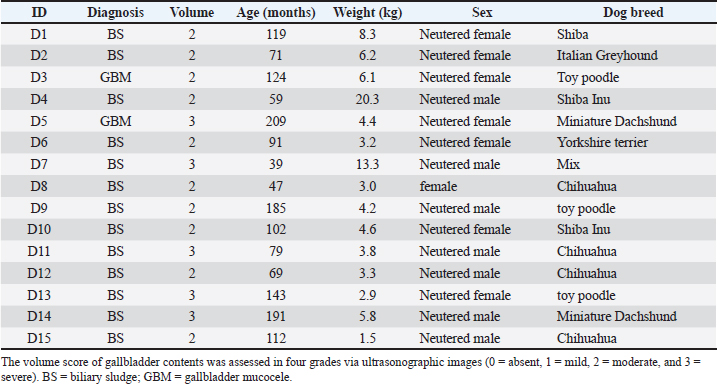
AbstractBackground: Biliary sludge and gallbladder mucocele are hepatobiliary disorders commonly identified in dogs. Although various medical management strategies have been used in clinical practice, there is limited evidence supporting their effectiveness. Alpinia zerumbet, a plant used in traditional medicine, has been reported to possess antioxidant and anti-inflammatory properties, but its role in canine hepatobiliary disease remains poorly described. Aim: This study aimed to describe the clinical and ultrasonographic findings in dogs with biliary sludge or gallbladder mucocele receiving a supplement containing A. zerumbet. Methods: The medical records of dogs diagnosed with biliary sludge or gallbladder mucocele and receiving a supplement containing A. zerumbet were retrospectively reviewed. Serial ultrasonographic was examined to assess temporal changes in gallbladder contents during follow-up. No other medications targeting gallbladder disease were administered during the study period. Results: Fifteen dogs met the inclusion criteria. The median duration of supplement administration was 5 months (range: 3–11 months). During follow-up examinations, a reduction in gallbladder contents was observed in 14 of 15 dogs (93.3%), with a median time to first observation of 6 months (range: 3–11 months). Conclusion: This retrospective case series describes serial ultrasonographic observations in dogs with biliary sludge or gallbladder mucocele who received A. zerumbet supplement. Because of the retrospective design and absence of a control group, these findings should be interpreted as descriptive clinical observations rather than evidence of therapeutic efficacy. Prospective controlled studies are warranted to evaluate this supplement’s potential role in canine gallbladder disease. Keywords: Alpinia zerumbet, Biliary sludge, Gallbladder mucocele, Dog, Ultrasonography. IntroductionBiliary sludge is a relatively common finding during abdominal ultrasonography in dogs and is often considered a precursor or risk factor for the development of gallbladder disease, including gallbladder mucocele (Smalle et al., 2015; Thomas Butler et al., 2015; Shinya Mizutani et al., 2016). Although biliary sludge may remain clinically silent in some cases, progressive accumulation of biliary material and impaired gallbladder motility may contribute to further hepatobiliary disorders (Thomas Butler et al., 2015; DeMonaco et al., 2016; Shinya Mizutani et al., 2016). Gallbladder mucocele is a well-recognized condition in dogs characterized by abnormal accumulation of mucus and inspissated bile within the gallbladder (Smalle et al., 2015; Shinya Mizutani et al., 2016). In severe cases, this condition may lead to gallbladder distension, biliary obstruction, or even rupture (Jaffey et al., 2017; Monty Galley et al., 2022). Therefore, early detection and appropriate management are important in clinical practice. Various medical and dietary approaches have been used to manage biliary sludge and early gallbladder disease in dogs. However, evidence supporting the effectiveness of many medical interventions remains limited, and treatment strategies are often based on empirical clinical experience (Max Parkanzky et al., 2019). Consequently, additional nonsurgical therapeutic options that may help reduce gallbladder contents or slow disease progression in affected dogs are needed. Alpinia zerumbet, a plant widely used in traditional medicine (Teschke and Xuan, 2018), has been reported to possess antioxidant (Abdelnaser et al., 2007; Pham Thi Be Tu et al., 2015), anti-inflammatory (Yuto Nishidono et al., 2020; Tao Xiong et al., 2024), and antimicrobial properties (Grasiela Merícia Costa et al., 2015; Tavichakorntrakool Ratree et al., 2019) in experimental studies. These biological effects suggest that compounds derived from A. zerumbet may influence hepatobiliary physiology, although clinical evidence in veterinary medicine remains scarce. To the best of our knowledge, the clinical effects of long-term administration of an A. zerumbet-containing supplement on canine gallbladder disease have not been previously described. This study aimed to describe the clinical and ultrasonographic findings in dogs with biliary sludge or gallbladder mucocele receiving a supplement containing A. zerumbet. Using a retrospective case series design, we evaluated long-term serial ultrasonographic observations to control the supplement in a clinical setting. This case series was designed to describe clinical outcomes and generate hypotheses. Materials and MethodsStudy designThis was a retrospective case series of client-owned dogs treated at a single veterinary clinic during routine clinical practice between July 2022 and May 2023. Inclusion criteria and diagnosisDogs were eligible if they met the following criteria: Diagnosis of BS or GBM confirmed by abdominal ultrasonography (Smalle et al., 2015; Thomas Butler et al., 2015; Shinya Mizutani et al., 2016). Clinical signs requiring emergency surgical intervention (e.g., jaundice, severe lethargy, and acute abdominal pain) were not observed. General health status was suitable for nonsurgical management. BS was defined as echogenic bile without acoustic shadowing (Smalle et al., 2015; Thomas Butler et al., 2015; Shinya Mizutani et al., 2016). GBM was defined by gallbladder wall thickening and accumulation of immobile mucus consistent with previously described ultrasonographic features (Smalle et al., 2015; Shinya Mizutani et al., 2016). Treatment protocolAll dogs received an oral liquid supplement (Alpinia for Veterinary Clinics®, Medinex Co., Ltd., Nagano, Japan) containing A. zerumbet extract, loofah extract, and natural hot spring water. The supplement was administered at a dosage of 0.4 ml/kg body weight twice daily, in accordance with the manufacturer’s recommended guidelines. The minimum administration period was 3 months, with continuation based on clinical progress and owner consent. During the study period, dogs diagnosed with biliary sludge or gallbladder mucocele received a nutritional supplement containing A. zerumbet. Ursodeoxycholic acid or other medications targeting gallbladder disease were not administered during the observation period. In addition, no intentional dietary modifications or nutritional interventions were implemented, and all dogs were maintained on their owners’ usual diets. Ultrasonographic evaluationBaseline ultrasonography was performed before initiating supplementation, followed by re-evaluation at intervals of approximately 1–3 months. Gallbladder contents (sludge or mucus) were graded on a 4-point volume scale (Smalle et al., 2015; Thomas Butler et al., 2015; Shinya Mizutani et al., 2016): 0=absent, 1=mild, 2=moderate, and 3=severe. Changes compared with the previous examination were recorded using a 5-point change score: −II=marked decrease, −I=decrease, 0=no change, I=increase, and II=marked increase. All scans were performed and interpreted by the same veterinarian, and images were archived for potential re-evaluation or third-party review. Outcome definitionImprovement was defined as the first observation of a change score ≤ −1 on ultrasonography, indicating a reduction in gallbladder contents. A change score of ≤ −1 was consistently defined as an event across all cases. Reductions were further categorized as −I (mild reduction, −1) and −II (marked reduction, ≤ −2), and these categories were distinguished in the longitudinal analysis. The time to improvement was measured in months from the start of supplementation. Statistical analysisDescriptive statistics were calculated for demographic and clinical data. The continuous variables are presented as mean ± SD and range. Time-to-event analysis for improvement was performed using the Kaplan–Meier method (EZR version 1.61, Saitama Medical Center, Jichi Medical University). Dogs without improvement were censored at the last follow-up. Ethical approvalAll diagnostic and therapeutic procedures were part of the standard veterinary care, and no experimental interventions were performed. Verbal informed consent was obtained from all patients before treatment. Dogs were withdrawn from observation if they required emergency surgery or experienced severe adverse effects. According to institutional policy for retrospective studies based on clinical records, formal ethical committee approval was not required. ResultsBaseline characteristicsFifteen dogs were included in this study. The median age was 102 months (range: 39–209 months), and the median body weight was 4.4 kg (range: 1.45–20.3 kg). The sex distribution included 7 neutered males (46.7%), 7 spayed females (46.7%), and one intact female (6.7%). The breeds included four Chihuahuas, three Shiba Inus, three Toy Poodles, two Miniature Dachshunds, one Italian Greyhound, one Yorkshire Terrier, and one mixed breed. Based on ultrasonographic findings, 13 dogs were diagnosed with BS and 2 with GBM. The baseline characteristics of the dogs are summarized in Table 1. Table 1. Patient background at the first visit.
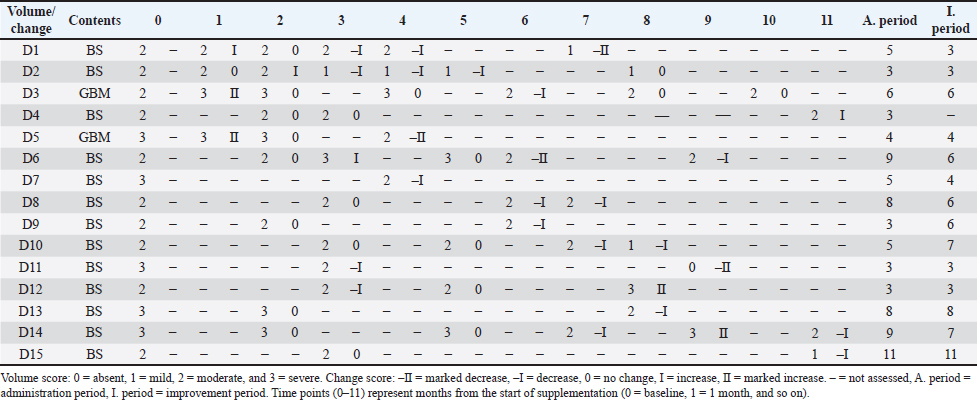
Changes in gallbladder contents over timeFollowing twice-daily administration of Alpinia for Veterinary Clinics® for at least 3 months, the median treatment duration was 5 months (range: 3–11 months). A reduction in gallbladder contents was observed in 93.3% (14/15) of dogs, with a median improvement time of 6 months (range: 3–11 months). In one patient in whom no improvement was observed, the duration of treatment was only 3 months. No severe adverse effects or emergency surgery cases were reported during the observation period (Table 2). Table 2. Changes in the gallbladder contents over time.
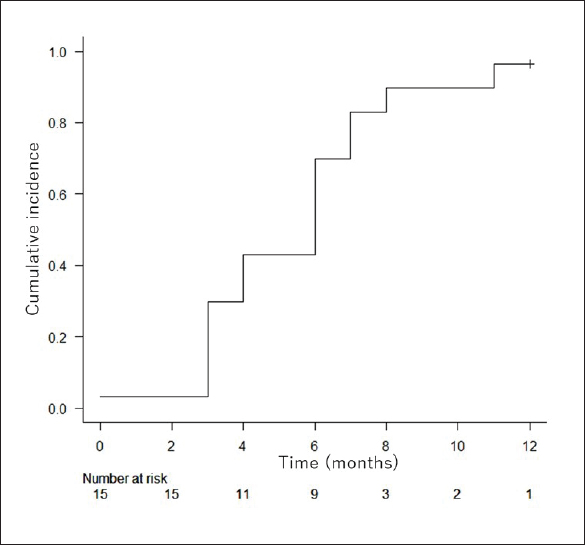
A Kaplan–Meier cumulative incidence curve was generated to depict the time to improvement (Fig. 1). An event was defined as the first ultrasonographic observation of a change score ≤ −1. Dogs without improvement were censored at the last follow-up. Most dogs showed improvement within 6 months of initiating supplementation.
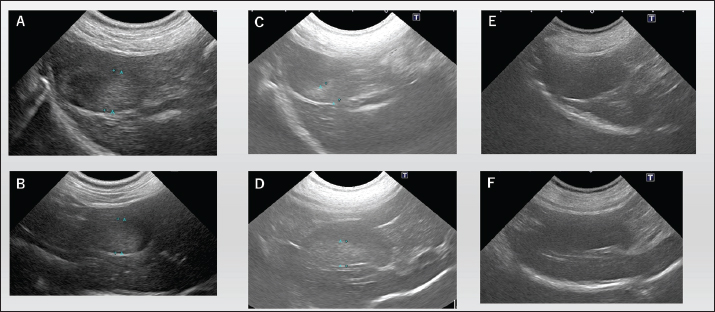
Fig. 1. Kaplan–Meier curve showing the time to improvement in GB content. The Kaplan–Meier method was used to illustrate the cumulative incidence of improvement in gallbladder contents over time. An event was defined as the first ultrasonographic confirmation of a reduction in gallbladder contents (i.e., a change score of −1 or lower). Patients who did not show improvement during the observation period were treated as censored at the end of the study. The mean time to improvement was 6.1 ± 2.4 months. Figure 2 shows the representative ultrasonographic changes before and after supplementation.
Fig. 2. Representative example of gallbladder content scores based on ultrasound images. Ultrasound images of a representative patient at the initial visit (A, B), at 3 months (C, D), and at 7 months (E, F). The volume score was 3 (severe) at the initial visit, improved to 2 (moderate) after 3 months, and further improved to 0 (none) after 7 months. DiscussionIn the present case series, long-term administration of a supplement containing A. zerumbet was associated with temporal changes in gallbladder contents observed on serial ultrasonography in dogs diagnosed with BS or GBM. In many cases, the echogenic material within the gallbladder appeared to decrease or become less conspicuous during the observation period. Preliminary clinical observations in our practice suggested possible changes in gallbladder contents following this supplement’s administration. These findings may indicate that this supplement is associated with improvement of gallbladder contents in some dogs. BS is a relatively common ultrasonographic finding in dogs and is often considered a dynamic condition that may change over time (Smalle et al., 2015; Thomas Butler et al., 2015; Shinya Mizutani et al., 2016). Although BS may remain clinically silent in some cases, previous studies have suggested that it can progress to GBM, a condition characterized by excessive mucus accumulation and gallbladder distension that may lead to biliary obstruction, gallbladder rupture, bile peritonitis, and death (Smalle et al., 2015; Thomas Butler et al., 2015; Shinya Mizutani et al., 2016; Jaffey et al., 2017; Monty Galley et al., 2022). Therefore, medical strategies that could reduce gallbladder contents or slow disease progression may have clinical value. The natural course of BS has been previously investigated. In a longitudinal study evaluating dogs with ultrasonographically detected BS, spontaneous resolution occurred in only 2% of dogs and a reduction in 19% during a 12-month observation period (DeMonaco et al., 2016). Although a direct comparison between studies is difficult due to differences in study design and population characteristics, the proportion of dogs showing improvement in the present case series appeared to be higher than that reported in the natural history study. However, because this study lacked a control group and was conducted as a retrospective case series, whether the observed changes were directly attributable to the supplement could not be determined. The potential biological mechanisms by which A. zerumbet might influence biliary conditions remain uncertain. Experimental studies have demonstrated that compounds derived from A. zerumbet possess antioxidant (Abdelnaser et al., 2007; Pham Thi Be Tu et al., 2015), anti-inflammatory (Yuto Nishidono et al., 2020; Tao Xiong et al., 2024), and antimicrobial properties (Grasiela Merícia Costa et al., 2015; Tavichakorntrakool Ratree et al., 2019). These biological activities could theoretically influence hepatobiliary physiology by reducing oxidative stress, inflammation, or microbial activity in the biliary system. However, whether oral supplementation could significantly alter bile composition, gallbladder motility, or mucin accumulation in dogs remains unclear, and the potential involvement of choleretic or cholagogue effects warrants further investigation. The supplement was initially developed as a dermatological spray, and its application in hepatobiliary disease was prompted by a serendipitous clinical observation. One dog that habitually ingested small amounts of the spray during topical application exhibited complete BS resolution on follow-up ultrasonography. This finding led to targeted oral administration in other affected dogs, with encouraging results. The multifactorial nature of BS and early GBM development is another important consideration. Alterations in bile composition, impaired gallbladder contraction, mucin hypersecretion, and systemic conditions have all been implicated in the pathogenesis of gallbladder disease in dogs (Smalle et al., 2015; Thomas Butler et al., 2015; Shinya Mizutani et al., 2016). In clinical practice, management strategies include dietary modification, hepatobiliary-supportive medications, and longitudinal monitoring (Max Parkanzky et al., 2019). Because detailed control of these factors was not possible in this retrospective analysis, potential confounding influences cannot be excluded. Interestingly, improvement was observed not only in dogs with BS but also in some dogs with mild to moderate GBM. Although advanced GBM typically requires surgical management (Max Parkanzky et al., 2019), these observations raise the possibility that certain early-stage cases might respond to medical management if they are identified before disease progression. This study has several limitations. First, the retrospective design, absence of a control group, and potential selection bias limit the ability to establish a causal relationship between supplement administration and ultrasonographic changes. Second, the relatively small sample size and single-center setting may limit the generalizability of the findings. Third, ultrasonographic evaluations were performed at variable intervals by a single observer, which may introduce measurement or observer bias. Fourth, dietary intake was not strictly standardized or objectively monitored, and owner reported information may have introduced variability; therefore, the potential influence of unrecognized dietary factors cannot be excluded. Fifth, screening for concurrent endocrinopathies such as hyperadrenocorticism or hypothyroidism was not systematically performed, and their potential effects cannot be excluded. Sixth, we did not assess long-term outcomes such as recurrence, survival, or the need for surgical intervention. In addition, the supplement used in this study contained multiple components, including A. zerumbet, loofah extract, and hot spring-derived minerals; therefore, the contribution of each component could not be determined. Furthermore, studies using single-component formulations are warranted to clarify their individual effects. Despite these limitations, the present case series provides longitudinal ultrasonographic observations in dogs in a clinical setting receiving a supplement containing A. zerumbet. These descriptive findings may contribute to the generation of hypotheses regarding potential nonsurgical management strategies for BS and early gallbladder disease in dogs. Future prospective studies with appropriate control groups will be necessary to determine whether A. zerumbet supplementation plays a clinically meaningful role in the management of canine gallbladder disease. ConclusionIn this retrospective case series, serial ultrasonographic changes in gallbladder contents were observed in dogs with biliary sludge or gallbladder mucocele during long-term supplementation with A. zerumbet. Because of the retrospective design and absence of a control group, these findings should be interpreted as descriptive clinical observations rather than evidence of therapeutic efficacy. Prospective, controlled studies are warranted to further evaluate the potential role of this supplement in the management of gallbladder disease in dogs. AcknowledgmentsWe thank the staff at Sakura Pet Clinic and the participating dog owners for their cooperation. FundingThis study received no specific grant. Authors' contributionsConceptualization: Y.S., M.S. Methodology: Y.S. Investigation: Y.S., E.S., H.K., M.Y. Data curation: Y.S., E.S., H.K., M.Y. Formal analysis: Y.S. Validation: Y.S. Resources: M.S. Writing – original draft: Y.S. Writing – review and editing: Y.S. Project administration: Y.S. Conflict of interestMasao Sasaki is the president and CEO of INSIVO Inc., which supplied the supplement used in this study. The company played no role in the study design, data collection, analysis, or manuscript preparation. All other authors have no conflicts of interest to declare. Data availabilityThe datasets generated and analyzed during the current study are available in the Figshare repository at https://doi.org/10.6084/m9.figshare.29000159. ReferencesAbdelnaser, A.E., Tran D Xuan., Shinkichi, H.K. and Tawata. 2007. Antioxidant activity and contents of essential oil and phenolic compounds in flowers and seeds of Alpinia zerumbet (Pers.) B.L. Burtt. & R.M. Sm. Food. Chem. 104(4), 1648–1653. Butler, T., Bexfield, N., Dor, C., Fantaconi, N., Heinsoo, I., Kelly, D., Kent, A., Pack, M., Spence, S.J., Ward, P.M., Watson, P. and Mccallum, K.E. 2015. A multicenter retrospective study assessing progression of biliary sludge in dogs using ultrasonography. J. Vet. Intern. Med. 36(3), 976–985. Costa, G.M., Suga, R., Oliveira, P., Silva, F.C., Magalhães, P., Duarte, L. and Farias, L.M. 2015. Bioactivity of extracts from Alpinia zerumbet against sinusitis-causing bacterial pathogens. Revista Fitos 9(3). Demonaco, S.M., Grant, D.C., Larson, M.M., Panciera, D.L. and Leib, M.S. 2016. Spontaneous course of biliary sludge over 12 months in dogs with ultrasonographically identified biliary sludge. J. Vet. Intern. Med. 30(3), 771–778. Galley, M., Lang, J., Mitchell, M. and Fletcher, J. 2022. Factors affecting survival in 516 dogs that underwent cholecystectomy for the treatment of gallbladder mucocele. Can. Vet. J. 63(1), 63–66. Jaffey, J.A., Graham, A., Vaneerde, E., Hostnik, E., Alvarez, W., Arango, J., Jacobs, C. and Declue, A.E. 2017. Gallbladder mucocele: variables associated with outcome and the utility of ultrasonography to identify gallbladder rupture in 219 dogs (2007–2016). J. Vet. Intern. Med. 32(1), 195–200. Mizutani, S., Torisu, S., Kaneko, Y., Yamamoto, S., Fujimoto, S., Ong, B.H.E. and Naganobu, K. 2016. Retrospective analysis of canine gallbladder contents in biliary sludge and gallbladder mucoceles. J. Vet. Med. Sci. 79(2), 366–374. Nishidono, Y., Okada, R., Iwama, Y., Okuyama, T., Nishizawa, M. and Tanaka, K. 2020. Anti-inflammatory kavalactones from Alpinia zerumbet. Fitoterapia 140, 104444. Parkanzky, M., Grimes, J., Schmiedt, C., Secrest, S. and Bugbee, A. 2019. Long‐term survival of dogs treated for gallbladder mucocele by cholecystectomy, medical management, or both. J. Vet. Intern. Med. 33(5), 2057–2066. Ratree, T., Aroonlug, L., Arunnee, S., Seksit, S. and Natthida, W. 2019. Antibacterial activity and bioactive compounds of 50% hydroethanolic extract of Alpinia zerumbet (Pers.) B.L. Burtt & R.M. Sm. Asian Pacific J. Trop. Biomed. 9(5), 204–208. Teschke, R. and Xuan, T.D. 2018. A contributory role of shell ginger (Alpinia zerumbet (Pers.) B.L. Burtt & R.M. Sm) for Human Longevity in Okinawa, Japan?. Nutrients 10(2), 166. Tesh M Smalle., Alane K Cahalane. and Liza S Köster. 2015. Gallbladder mucocoele: a review. J. S. Afr. Vet. Assoc. 86(1), 1318. Tu, P. and Tawata, S. 2015. Anti-oxidant, anti-aging, and anti-melanogenic properties of the essential oils from two varieties of Alpinia zerumbet. Molecules 20(9), 16723–11740. Xiong, T., Zeng, J., Chen, L., Wang, L., Gao, J., Huang, L., Xu, J., Wang, Y. and He, X. 2024. Anti-inflammatory terpenoids from the rhizomes of shell ginger. J. Agric. Food. Chem. 72(1), 424–436. | ||
| How to Cite this Article |
| Pubmed Style Sasaki Y, Sasaki E, Kondo H, Yamauchi M, Sasaki M. Clinical and ultrasonographic findings in dogs with biliary sludge or gallbladder mucocele receiving Alpinia zerumbet supplement: A retrospective case series. Open Vet. J.. 2026; 16(7): 4351-4357. doi:10.5455/OVJ.2026.v16.i7.22 Web Style Sasaki Y, Sasaki E, Kondo H, Yamauchi M, Sasaki M. Clinical and ultrasonographic findings in dogs with biliary sludge or gallbladder mucocele receiving Alpinia zerumbet supplement: A retrospective case series. https://www.openveterinaryjournal.com/?mno=313699 [Access: July 10, 2026]. doi:10.5455/OVJ.2026.v16.i7.22 AMA (American Medical Association) Style Sasaki Y, Sasaki E, Kondo H, Yamauchi M, Sasaki M. Clinical and ultrasonographic findings in dogs with biliary sludge or gallbladder mucocele receiving Alpinia zerumbet supplement: A retrospective case series. Open Vet. J.. 2026; 16(7): 4351-4357. doi:10.5455/OVJ.2026.v16.i7.22 Vancouver/ICMJE Style Sasaki Y, Sasaki E, Kondo H, Yamauchi M, Sasaki M. Clinical and ultrasonographic findings in dogs with biliary sludge or gallbladder mucocele receiving Alpinia zerumbet supplement: A retrospective case series. Open Vet. J.. (2026), [cited July 10, 2026]; 16(7): 4351-4357. doi:10.5455/OVJ.2026.v16.i7.22 Harvard Style Sasaki, Y., Sasaki, . E., Kondo, . H., Yamauchi, . M. & Sasaki, . M. (2026) Clinical and ultrasonographic findings in dogs with biliary sludge or gallbladder mucocele receiving Alpinia zerumbet supplement: A retrospective case series. Open Vet. J., 16 (7), 4351-4357. doi:10.5455/OVJ.2026.v16.i7.22 Turabian Style Sasaki, Yusuke, Emiko Sasaki, Hiroko Kondo, Misa Yamauchi, and Masao Sasaki. 2026. Clinical and ultrasonographic findings in dogs with biliary sludge or gallbladder mucocele receiving Alpinia zerumbet supplement: A retrospective case series. Open Veterinary Journal, 16 (7), 4351-4357. doi:10.5455/OVJ.2026.v16.i7.22 Chicago Style Sasaki, Yusuke, Emiko Sasaki, Hiroko Kondo, Misa Yamauchi, and Masao Sasaki. "Clinical and ultrasonographic findings in dogs with biliary sludge or gallbladder mucocele receiving Alpinia zerumbet supplement: A retrospective case series." Open Veterinary Journal 16 (2026), 4351-4357. doi:10.5455/OVJ.2026.v16.i7.22 MLA (The Modern Language Association) Style Sasaki, Yusuke, Emiko Sasaki, Hiroko Kondo, Misa Yamauchi, and Masao Sasaki. "Clinical and ultrasonographic findings in dogs with biliary sludge or gallbladder mucocele receiving Alpinia zerumbet supplement: A retrospective case series." Open Veterinary Journal 16.7 (2026), 4351-4357. Print. doi:10.5455/OVJ.2026.v16.i7.22 APA (American Psychological Association) Style Sasaki, Y., Sasaki, . E., Kondo, . H., Yamauchi, . M. & Sasaki, . M. (2026) Clinical and ultrasonographic findings in dogs with biliary sludge or gallbladder mucocele receiving Alpinia zerumbet supplement: A retrospective case series. Open Veterinary Journal, 16 (7), 4351-4357. doi:10.5455/OVJ.2026.v16.i7.22 |


