




| Research Article | ||
Open Vet. J.. 2026; 16(7): 4330-4339 Open Veterinary Journal, (2026), Vol. 16(7): 4330-4339 Research Article Quail egg yolk enhances the protective effect of dimethylformamide-glycerol extenders during Angus bull semen cryopreservationAhmed Haikal1, Najmi Mariol2, Husein Amer1, Diya A. El-Badry3, Abeer M. Anwer4, Maha M. Elgebaly1 and Ayman Mesalam1*1Department of Theriogenology, Faculty of Veterinary Medicine, Zagazig University, Zagazig, Egypt 2Department of Surgery and Theriogenology, Faculty of Veterinary Medicine, University of Tripoli, Tripoli, Libya 3Department of Artificial Insemination and Embryo Transfer, Animal Reproduction Research Institute, Agriculture Research Center, Giza, Egypt 4Immunopharmacology Unit, Animal Reproduction Research Institute, Agriculture Research Center, Giza, Egypt *Corresponding Author: Ayman Mesalam. Department of Theriogenology, Faculty of Veterinary Medicine, Zagazig University, Zagazig, Egypt. Email: aymanmesalam [at] gmail.com Submitted: 11/04/2026 Revised: 03/06/2026 Accepted: 11/06/2026 Published: 11/07/2026 © 2026 Open Veterinary Journal
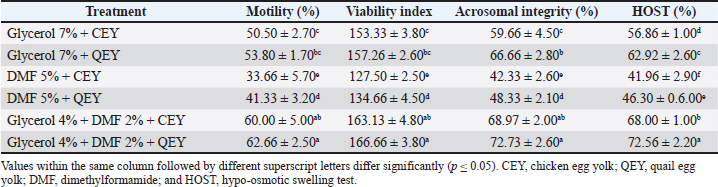
AbstractBackground: The cryopreservation of bovine semen is associated with several challenges, including cellular stress, cold shock, and the potential toxicity of cryoprotective agents. These limitations highlight the need for improved cryopreservation strategies that enhance sperm survival after thawing. Aim: The present study investigated the effect of different combinations of glycerol and dimethylformamide (DMF), supplemented with either chicken egg yolk (CEY), or quail egg yolk (QEY) on the post-thaw quality of bull spermatozoa. Methods: Semen samples were diluted in a Tris-based extender containing either CEY or QEY combined with different cryoprotectant treatments: 7% glycerol, 5% DMF, or a combination of 4% glycerol and 2% DMF. After gradual cooling to 5°C and equilibration for 2 hours, the semen was packaged into mini-straws and cryopreserved in liquid nitrogen. Post-thaw sperm quality was assessed by evaluating progressive motility, viability, acrosomal integrity, plasma membrane functionality using the hypo-osmotic swelling test, mitochondrial activity, and DNA fragmentation. Results: The results demonstrated that the extender containing a combination of 4% glycerol and 2% DMF, supplemented with QEY, significantly improved the freezability of bull spermatozoa compared with other treatments. Furthermore, the combination of glycerol 4% and DMF 2% with either QEY or CEY increased the proportion of spermatozoa with intact DNA following thawing. Conclusion: The combined use of DMF and glycerol, particularly when supplemented with QEY, provides enhanced protection to bovine spermatozoa during cryopreservation and may represent a promising alternative strategy for improving post-thaw semen quality. Keywords: Cryopreservation, Dimethylformamide, Extenders, Glycerol, Quail egg yolk. IntroductionSemen cryopreservation and artificial insemination are essential reproductive biotechnologies for livestock genetic improvement (Araujo Silva et al., 2022). However, the freeze–thaw process imposes severe osmotic and thermal stresses that compromise sperm structures such as the plasma membrane, mitochondria, acrosome, and nuclear DNA (Gürler et al., 2016), thereby impairing motility, viability, and fertilization capacity (Celeghini et al., 2008; Medeiros et al., 2002). The cryopreservation efficiency is strongly influenced by the extender composition, cryoprotectant type and concentration, and cooling–thawing protocols (Shah et al., 2016). Cryoprotective agents, which are broadly classified as permeable or non-permeable, are central to mitigating cryodamage by reducing ice crystal formation, osmotic imbalance, and membrane destabilization (Sieme et al., 2016). Permeable agents penetrate the sperm cell, increasing intracellular viscosity and lowering electrolyte concentration to facilitate controlled dehydration and limit intracellular ice formation (Macias Garcia et al., 2012; Sieme et al., 2016). Glycerol remains the most widely used cryoprotectant in bovine semen extenders and is typically incorporated at concentrations ranging from 6% to 7% in Tris-citric acid-based diluents (Almeida et al., 2017). Nevertheless, the use of glycerol is associated with certain limitations, particularly its cytotoxic effects on spermatozoa (Fahy, 2010; Macias Garcia et al., 2012). High glycerol concentrations may disrupt sperm plasma membrane organization, negatively affecting motility and fertilizing capacity (Seifi-Jamadi et al., 2017). Excessive glycerol exposure has been associated with the induction of apoptotic pathways and increased proportions of necrotic spermatozoa (Rasul et al., 2007). These adverse effects are partly attributed to the slow permeability of glycerol through sperm membranes, which can induce osmotic stress during cryopreservation (Olaciregui et al., 2014). Consequently, considerable research efforts have been directed toward identifying alternative cryoprotectants capable of providing effective protection with reduced cytotoxicity. Amide-based cryoprotectants have emerged as promising alternatives to glycerol because of their lower molecular weight and higher membrane permeability, which may reduce osmotic stress during freezing (Alvarenga et al., 2005; Vásquez et al., 2013). Dimethylformamide (DMF) has attracted increasing attention for its cryoprotective potential in several species. The presence of hydrophilic and lipophilic functional groups enables DMF to interact with both water molecules and membrane lipids, thereby reducing the formation of ice crystals (Ball and Vo, 2001; Araujo Silva et al., 2022). DMF can improve post-thaw sperm quality in stallions (Olaciregui et al., 2014; Pukazhenthi et al., 2014; Frasson et al., 2025), buck (Araujo Silva et al., 2022), and buffalo (Herbowo et al., 2020). However, in bovine semen cryopreservation, research evaluating DMF remains limited, although existing studies have reported encouraging outcomes (Forero-Gonzalez et al., 2012; Matilla et al., 2017). Therefore, further investigation is required to determine the optimal DMF concentrations and to comprehensively evaluate its effects on multiple post-thaw sperm quality parameters. Moreover, the potential synergistic interaction between glycerol and DMF in semen extenders has not been sufficiently explored in bovine species and may offer a strategy to balance cryoprotective efficiency with reduced toxicity. In addition to permeable cryoprotectants, non-permeable components such as egg yolk are widely incorporated into semen extenders due to their protective effects against cold shock (Moussa et al., 2002; Perumal et al., 2016). Egg yolk contributes to sperm plasma membrane stabilization and limits extracellular ice crystal formation during freezing, thereby preserving sperm functionality after thawing (Moussa et al., 2002; Swelum et al., 2023). Traditionally, chicken egg yolk (CEY) has been the most commonly used source in bovine semen extenders, typically at concentrations around 20%, largely due to its widespread availability and established effectiveness (Bathgate et al., 2006; Perumal et al., 2016). Nevertheless, several studies have indicated that egg yolks obtained from other avian species may provide superior protection during cryopreservation. Improvements in post-thaw sperm quality have been reported when egg yolks from species such as duck, goose, and quail were used in extenders for bulls (Su et al., 2008), ram (Kulaksız et al., 2010; Ali et al., 2013), buffalo (; Andrabi et al., 2008; Waheed et al., 2012; Akhter et al., 2017), and equine species (Clulow et al., 2007; Burris and Webb, 2009; Webb et al., 2011). These differences may be related to variations in lipid composition, phospholipid content, and fatty acid profiles among egg yolks from different avian species, which may influence their ability to stabilize sperm membranes during freezing (Bathgate et al., 2006; Swelum et al., 2023). Quail egg yolk (QEY) has been reported to enhance the post-thaw quality of frozen semen in several species, including Nili-Ravi buffalo bulls, Poitou jackasses, and dogs (Trimeche et al., 1997; Akhter et al., 2017; Strzeżek and Reksa, 2022). Considering the limitations associated with conventional cryoprotectants and the potential protective properties of alternative egg yolk sources, this study aimed to identify extender formulations capable of enhancing sperm cryosurvival and improving the overall efficiency of bovine semen cryopreservation. By exploring the combined effects of permeable cryoprotectants (glycerol and DMF) and egg yolk sources (CEY and QEY) on the post-thaw quality of cryopreserved Angus bull spermatozoa. The assessment of multiple functional and structural sperm parameters, including motility, viability, membrane integrity, mitochondrial activity, and DNA fragmentation, was particularly important. Materials and MethodsExperimental designThis study aimed to evaluate the effects of different permeable cryoprotectant systems and egg yolk sources on the post-thaw quality of cryopreserved Angus bull semen. Semen samples were collected from four fertile Angus bulls, and two consecutive ejaculates obtained from each bull on the same collection day were pooled after the initial quality assessment to minimize individual bull variation. Collections were repeated once weekly for 5 consecutive weeks, resulting in five biological replicates. The pooled semen samples from each replicate were divided equally into six experimental treatment groups according to the type of permeable cryoprotectant and egg yolk source used in the extender: glycerol 7% with CEY, glycerol 7% with QEY, DMF 5% with CEY, DMF 5% with QEY, glycerol 4% combined with DMF 2% and CEY, and glycerol 4% combined with DMF 2% and QEY. Following cryopreservation and thawing, sperm quality was evaluated by assessing post-thaw motility (PTM), viability index, acrosomal integrity, plasma membrane integrity using the hypo-osmotic swelling test (HOST), mitochondrial activity, and DNA integrity. Chemicals used and extender preparationAll chemicals were purchased from Sigma-Aldrich (St. Louis, MO, USA) unless otherwise stated. Egg yolks were obtained from commercially available local sources. The base extender consisted of Tris (33.2 g/l), citric acid (18.3 g/l), dextrose (7.8 g/l), and trehalose (100 mM), according to the formulation described by Shiva Shankar Reddy et al. (2010). The extender was supplemented with antibiotics, including spectinomycin HCl (600 µg/ml), tylosin tartrate (100 µg/ml), gentamicin sulfate (500 µg/ml), and lincomycin HCl (300 µg/ml), following the protocol described by Akhter et al. (2011). The prepared extender was divided into three aliquots supplemented with different permeable cryoprotectant treatments: glycerol 7%, DMF 5%, or a combination of glycerol 4% and DMF 2%. The combination of glycerol and DMF at lower concentrations was intended to utilize the advantages of both cryoprotectants while minimizing their individual cytotoxic effects (de Menezes et al., 2021; Pugh et al., 2000). Subsequently, each aliquot was divided into two equal portions and supplemented with either 20% CEY or 20% QEY. The pH and osmolarity of all extenders were adjusted to 6.9 and 300–320 mOsm/l, respectively, before filtration using double-ring filter paper (Hangzhou Special Paper Industry Co., China). The extenders were then stored frozen and used within 2 weeks. Semen collection and processingSemen samples were collected from four fertile Angus bulls aged 2–4 years at the Animal Reproduction Research Institute, Egypt. The animals weighed approximately 450–600 kg and were maintained under standard management and feeding conditions. Semen collection was performed early in the morning using an artificial vagina maintained at 40°C–42°C. Two consecutive ejaculates were collected from each bull on the same day once weekly for 5 consecutive weeks, resulting in a total of 40 ejaculates (4 bulls × 2 ejaculates × 5 weeks). Semen samples were maintained at 37°C immediately after collection and transported to the laboratory for further evaluation and processing. Following initial evaluation, semen samples meeting the minimum quality criteria (≥ 70% progressive motility and sperm concentration ≥ 1.5 × 10⁹ sperm/ml) were selected for further processing. The two ejaculates collected from each bull on the same collection day were pooled to minimize ejaculate variation and then diluted at 37°C with the respective extenders to obtain a final concentration of 120 × 10⁶ spermatozoa/ml. The diluted semen samples were gradually cooled to 4°C over 2 hours, loaded into 0.25 ml mini-straws, sealed, and equilibrated at the same temperature for an additional 2 hours. After equilibration, the filled straws were exposed to liquid nitrogen vapor inside a foam box for 15 minutes before being plunged into liquid nitrogen and stored at −196°C (Ba-Awadh et al., 2023). One straw from each treatment group was thawed in a water bath at 37°C for 30 seconds during each biological replicate for post-thaw evaluation. Four biological replicates were included in the statistical analysis. Evaluation of motility and viability indexPTM was evaluated immediately after thawing using a phase-contrast microscope (400× magnification) equipped with a heated stage maintained at 37°C. Sperm motility was expressed as the percentage of spermatozoa exhibiting forward progressive movement (Bianchi et al., 2008). The viability index was determined by incubating semen samples at 37°C for 3 hours and recording sperm motility at 1-hour intervals. The index was calculated according to Ezz et al. (2017) using the following formula: Viability index=(0.5 × PTM) + (motility at 1 h + 2 h + 3 h) Assessment of acrosomal integrityAcrosomal integrity was evaluated using a dual-staining technique described by Didion et al. (1989). Semen samples were mixed with 0.2% trypan blue in a 1:1 ratio and incubated at 37°C for 10 minutes. The mixture was then centrifuged twice with physiological saline (700 × g for 6 minutes). Smears were prepared on glass slides, air dried, and stained for 40 minutes with 10% Giemsa solution. After rinsing with distilled water and air drying, the slides were examined using oil immersion microscopy. Spermatozoa with intact acrosomes appeared light purple to dark pink, whereas damaged acrosomes were stained blue or unstained. Assessment of plasma membrane integritySperm plasma membrane integrity was assessed using the HOST. Briefly, 100 µl of semen was mixed with 1 ml of pre-warmed hypo-osmotic solution containing 0.735 g of sodium citrate dihydrate and 1.351 g of fructose dissolved in 100 ml of sterile deionized water. The mixture was incubated at 37°C for 1 hour. A drop of the incubated sample was then placed on a glass slide, covered with a coverslip, and examined under phase-contrast microscopy at 400× magnification. At least 100 spermatozoa were evaluated across multiple microscopic fields. Spermatozoa with swollen or coiled tails were considered HOST-positive (intact membranes), whereas sperm with no tail changes were classified as HOST-negative (Jeyendran et al., 1984). Evaluation of mitochondrial functionThe mitochondrial activity of spermatozoa was determined using the 3-(4,5-dimethylthiazol-2-yl)-2,5-diphenyltetrazolium bromide (MTT) reduction assay, which is based on the conversion of MTT into insoluble formazan crystals by metabolically active mitochondria. Briefly, 100 µl of semen was incubated with 10 µl of MTT stock solution (5 mg/ml in PBS) in a microtiter plate. Optical density (OD) was measured at 550 nm using an enzyme-linked immunosorbent assay microplate reader immediately and again after 1 hour of incubation at 37°C. Mitochondrial activity was expressed as the difference between the final and initial OD values (Tvrdá et al., 2015). The alkaline comet assayThe alkaline comet assay was used to assess DNA integrity following the method described by Ribas-Maynou et al. (2024). Sperm cells were embedded in agarose on microscope slides and subjected to proteinase K digestion. DNA was then denatured under alkaline conditions and subjected to electrophoresis. After neutralization, the slides were stained with ethidium bromide and examined under a fluorescence microscope. A total of 200 spermatozoa were analyzed per sample. DNA damage was quantified using specialized image analysis software by evaluating comet parameters, including tail length, percentage of DNA in the tail, and tail moment. Spermatozoa with fragmented DNA displayed characteristic comet-like tails, whereas intact nuclei appeared compact without tail formation. Statistical analysisStatistical analysis was performed using the Statistical Package for the Social Sciences (SPSS, version 27.0). Four biological replicates were included in the analysis, and the data are presented as mean ± SD. Differences among treatment groups were evaluated using one-way analysis of variance, followed by Duncan’s multiple range test for post hoc comparisons. Statistical significance was considered at p ≤ 0.05. Ethical approvalThe experimental protocol and all animal-related procedures were evaluated and approved by the Research Ethics Committee of Zagazig University (approval number: ZU-IACUC/2/F/329/2026). ResultsEffects of different cryoprotectant combinations and egg yolk sources on functional parameters of post-thaw spermThe results demonstrated that the extender containing a combination of 4% glycerol and 2% DMF supplemented with QEY produced the highest values (p ≤ 0.05) for PTM, viability index, acrosomal integrity, and plasma membrane integrity (62.66% ± 2.5%, 166.66% ± 3.8, 72.73% ± 2.6%, and 72.56% ± 2.2%, respectively) compared with the other treatments (Table 1). Replacing 7% glycerol with 5% DMF resulted in a significant decline in all evaluated sperm quality parameters following thawing. This reduction was evident in motility, viability index, acrosomal integrity, and plasma membrane integrity values in both egg yolk groups (Table 1). Regarding the egg yolk source, extenders supplemented with QEY generally showed higher post-thaw sperm quality than those containing CEY, although not all differences reached statistical significance (Table 1). Table 1. Effect of different cryoprotectant combinations and egg yolk sources on PTM, viability index, acrosomal integrity, and plasma membrane integrity of Angus bull spermatozoa.
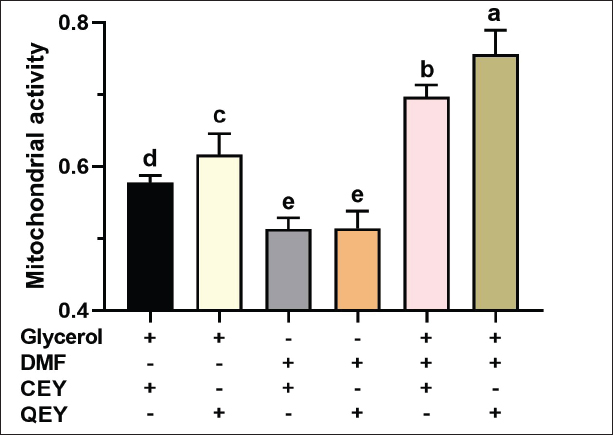
Mitochondrial activitySperm samples cryopreserved in extenders containing a combination of 4% glycerol and 2% DMF exhibited significantly higher mitochondrial activity than the other treatment groups. The highest mitochondrial activity was observed when this combination was supplemented with QEY (Fig. 1). In contrast, extenders containing DMF as the only permeable cryoprotectant (5% DMF) were associated with markedly (p ≤ 0.05) reduced mitochondrial activity after thawing. Furthermore, the use of QEY generally resulted in better preservation of mitochondrial function than CEY (Fig. 1).
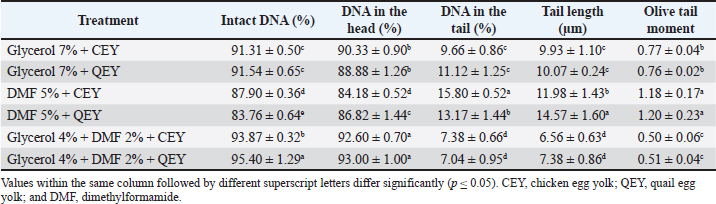
Fig. 1. Effect of different cryoprotectant combinations and egg yolk sources on the mitochondrial activity of frozen–thawed Angus bull spermatozoa measured using the MTT reduction assay. Columns with different superscript letters indicate significant differences among treatments (p ≤ 0.05). CEY, chicken egg yolk; QEY, quail egg yolk; and DMF, dimethylformamide. DNA integrity of post-thaw spermatozoaThe combination treatment of 4% glycerol and 2% DMF supplemented with either QEY or CEY resulted in higher (p ≤ 0.05) percentages of intact DNA and lower values of DNA fragmentation parameters than the other treatments (Table 2). Conversely, the use of DMF alone (5% DMF) was associated with increased DNA damage, as reflected by lower percentages of intact DNA and higher values of DNA in the tail, tail length, and olive tail moment (Table 2). Among the tested treatments, the QEY-containing extender supplemented with 4% glycerol and 2% DMF showed the most favorable DNA integrity profile following cryopreservation, exhibiting the highest percentage of intact DNA (95.40% ± 1.29%), which was significantly higher than the values observed in the other treatment groups (Table 2). Table 2. Effect of different cryoprotectant combinations and egg yolk sources on DNA integrity parameters of cryopreserved Angus bull spermatozoa evaluated by the alkaline comet assay.
DiscussionAlthough semen cryopreservation has greatly contributed to the global expansion of assisted reproductive technologies, the process still represents a major challenge for sperm survival, with only ~50% of spermatozoa maintaining their viability following cryopreservation (Sharafi et al., 2022). Spermatozoa are exposed to osmotic stress, temperature fluctuations, and oxidative damage during freezing and thawing, which may compromise membrane integrity, mitochondrial activity, and DNA stability (Kumar et al., 2019). To mitigate these detrimental effects, semen extenders are supplemented with cryoprotective agents that act as protective barriers against structural and functional damage occurring during the freeze–thaw cycle (AbdelHafez et al., 2008). Subsequently, considerable research efforts have focused on identifying optimal cryoprotectant systems capable of improving the quality of post-thaw semen in bulls. The results of the current study demonstrated that glycerol at 7% preserved bull spermatozoa more efficiently than DMF at 5% when used as a single permeable cryoprotectant. This was evident in the higher post-thaw values of motility, viability, acrosomal integrity, plasma membrane integrity, and DNA stability observed in glycerol-based extenders. These findings are consistent with the results reported for Korean Jeju black bulls, where glycerol at 7% showed superior post-thaw semen quality compared with DMF at 5% (Oh ShinAe et al., 2012). Similarly, Forero-Gonzalez et al. (2012) reported that glycerol at 7% provided better preservation of motility, membrane integrity, and mitochondrial activity than DMF at 3% in bovine spermatozoa. Comparable observations have also been reported in stallions, where glycerol at 5% resulted in higher PTM, viability, and acrosomal integrity than DMF at the same concentration (Wu et al., 2015). The lower post-thaw values observed in the current study when 5% DMF was used as a single permeable cryoprotectant may be attributed to its rapid penetration and intracellular accumulation, which is consistent with previous studies suggesting that DMF may exert cytotoxic effects at relatively high concentrations, particularly above 2% (Moustacas et al., 2011; Silva et al., 2012). However, the effectiveness of DMF as a cryoprotectant appears to vary among species. For instance, Herbowo et al. (2020) demonstrated that DMF at 5% could serve as an effective alternative to glycerol for the cryopreservation of swamp buffalo semen. In addition, Bianchi et al. (2008) reported successful cryopreservation of boar spermatozoa using DMF at 5% compared with glycerol at 3%. These contrasting outcomes across species may be attributed to differences in extender composition, cryopreservation protocols, and specific-species membrane characteristics. Variations in phospholipid composition and membrane fluidity among species are believed to influence the interaction between sperm membranes and cryoprotective agents during freezing (Bittencourt et al., 2018). Consequently, combining glycerol and DMF at lower concentrations may represent a practical strategy to exploit the advantages of both cryoprotectants while minimizing their individual limitations (Pugh et al., 2000). This study demonstrated that QEY provided superior preservation of sperm quality following thawing. The improved protective effect of QEY may be attributed to its unique biochemical composition. Previous studies have reported that QEY contains higher concentrations of phospholipids than CEY, which may enhance membrane stabilization by integrating into the sperm plasma membrane and compensating for phospholipids lost during cryopreservation (Bergeron and Manjunath, 2006; Zhang et al., 2026). Furthermore, higher levels of cholesterol and saturated fatty acids have been reported in QEY, which contribute to membrane rigidity and reduce lipid peroxidation during cryopreservation (Arthur and Bejaei, 2017; Naz et al., 2019; Czerwonka et al., 2024). The high proportion of palmitic acid in QEY has also been associated with improved post-thaw sperm quality in bovine species (Gürler et al., 2015; Kiernan et al., 2013). In addition, QEY is rich in phosphatidylcholine and phosphatidylethanolamine, two phospholipids that play essential roles in maintaining mitochondrial membrane stability (Bathgate et al., 2006; Zhang et al., 2026). These molecules may also serve as substrates for mitochondrial β-oxidation, thereby supporting the energy requirements of spermatozoa during the recovery phase following thawing (Li et al., 2022; Ngo et al., 2023). The superior results obtained with the combined cryoprotectant system, glycerol and DMF, supplemented with QEY, reflected by improved PTM, viability index, plasma membrane integrity, mitochondrial function, and DNA integrity, reported in the present study, may therefore be explained by the synergistic interaction between permeable and non-permeable protective components. Maintaining the integrity of the plasma membrane during freezing is crucial because it protects intracellular organelles, such as mitochondria and the nucleus, from cryo-induced damage (Hoffmann et al., 2011). Araujo Silva et al. (2022) reported a positive relationship between plasma membrane integrity and mitochondrial activity in frozen–thawed buck semen. The combined use of glycerol and DMF may reduce osmotic stress and mechanical damage associated with dehydration and ice crystal formation during cryopreservation. As oxidative stress and lipid peroxidation are known to contribute to DNA fragmentation in spermatozoa (Kumar et al., 2011; Chao et al., 2012), the improved DNA integrity observed with the combined treatment may also reflect the enhanced stabilization of sperm membranes and reduced susceptibility to oxidative damage during freezing and thawing. This study was limited by the small number of experimental animals included in the design. Moreover, neither in vitro nor in vivo fertilization trials were conducted, which restricts the extrapolation of the findings to reproductive outcomes. ConclusionThe findings of this study indicate that both the type of permeable cryoprotectant and egg yolk source influence the in vitro post-thaw quality of cryopreserved bull semen. The combination of 4% glycerol and 2% DMF supplemented with QEY showed the most favorable post-thaw sperm characteristics, including improved motility, membrane integrity, mitochondrial activity, and DNA stability. Combining glycerol and DMF with QEY may improve the freezability of bovine semen compared with conventional extenders containing glycerol and CEY. However, further studies evaluating fertilizing capacity and in vivo fertility outcomes are required before practical application in artificial insemination programs can be recommended. AcknowledgmentsThe authors would like to thank all staff members of the Department of Theriogenology, Faculty of Veterinary Medicine, Zagazig University, for their support and assistance throughout this study. Conflict of interestThe authors declare no conflicts of interest. FundingThis research did not receive any specific grant from public, commercial, or not-for-profit funding agencies. Authors' contributionsHusein Amer, Ayman Mesalam, and Diya A. El-Badry designed the experiments. Ahmed Haikal performed the experiments and wrote the first draft of the manuscript. Abeer M. Anwer, Maha M. Elgebaly, and Najmi Mariol analyzed the data and provided assistance. Ayman Mesalam revised and edited the manuscript. Data availabilityThe data supporting the findings of this study are available upon reasonable request from the corresponding author. ReferencesAbdelhafez, F., Bedaiwy, M., El-Nashar, S.A., Sabanegh, E. and Desai, N. 2008. Techniques for cryopreservation of individual or small numbers of human spermatozoa: a systematic review. Hum. Reprod. Update. 15, 153–164. Akhter, S., Ansari, M.S., Rakha, B.A., Andrabi, S.M.H., Khalid, M. and Ullah, N. 2011. Effect of low density lipoproteins in extender on freezability and fertility of buffalo (Bubalus bubalis) bull semen. Theriogenology 76, 759–764. Akhter, S., Rakha, B.A., Ansari, M.S., Husna, A.U., Iqbal, S. and Khalid, M. 2017. Evaluation of quail and turkey egg yolk for cryopreservation of Nili-Ravi buffalo bull semen. Theriogenology 87, 259–265. Ali, A.B.T., Bomboi, G. and Floris, B. 2013. Replacing chicken yolk with yolks from other sources in ram semen diluents and their effects on fertility in vitro. Small Ruminant Res. 113, 405–410. Almeida, F.C., Silva, S.V., Souza, H.M., Gomes, W.A., Lima Filho, J.A.C., Wicke, A.A., Batista, A.M. and Guerra, M.M.P. 2017. Effects of glycerol, equilibration time and antioxidants on post-thaw functional integrity of bovine spermatozoa directly obtained from epididymis. Andrologia 49, e12623. Alvarenga, M.A., Papa, F.O., Landim-Alvarenga, F.C. and Medeiros, A.S.L. 2005. Amides as cryoprotectants for freezing stallion semen: a review. Anim. Reprod. Sci. 89, 105–113. Andrabi, S.M.H., Ansari, M.S., Ullah, N., Anwar, M., Mehmood, A. and Akhter, S. 2008. Duck egg yolk in extender improves the freezability of buffalo bull spermatozoa. Anim. Reprod. Sci. 104, 427–433. Araujo Silva, R.A.J., Monteiro, M.M., Costa, J.A.S., Mergulhao, F.C.C., Monteiro, P.L.J., Silva, D.M.F., Santos Filho, A.S., Souza, A.F., Batista, A.M. and Guerra, M.M.P. 2022. Dimethylformamide preserves the integrity of cryopreserved goat semen in a soybean lecithin-based extender. Biopreservation. Biobanking. 20, 502–508. Arthur, J. and Bejaei, M. 2017. Quail eggs. In Egg Innovations and Strategies for Improvements. Ed., Hester, P.Y. San Diego, CA: Academic Press, pp: 13–21. Ba-Awadh, H.A., Olarinre, I.O., Alowaimer, A.N., Saadeldin, I.M. and Swelum, A.A. 2023. Comparison between rapid and slow cryopreservation protocols for ram semen. Slov. Vet. Res. 60, 249–257. Ball, B.A. and Vo, A. 2001. Osmotic tolerance of equine spermatozoa and the effects of soluble cryoprotectants on equine sperm motility, viability, and mitochondrial membrane potential. J. Androl. 22, 1061–1069. Bathgate, R., Maxwell, W. and Evans, G. 2006. Studies on the effect of supplementing boar semen cryopreservation media with different avian egg yolk types on in vitro post-thaw sperm quality. Reprod. Domest. Anim. 41, 68–73. Bergeron, A. and Manjunath, P. 2006. New insights towards understanding the mechanisms of sperm protection by egg yolk and milk. Mol. Reprod. Dev. 73, 1338–1344. Bianchi, I., Calderam, K., Maschio, E.F., Madeira, E.M., Da Rosa Ulguim, R., Corcini, C.D., Bongalhardo, D.C., Corrêa, E.K., Lucia, T., Deschamps, J.C. and Corrêa, M.N. 2008. Evaluation of amides and centrifugation temperature in boar semen cryopreservation. Theriogenology 69, 632–638. Bittencourt, R.F., Oba, E., De Almeida Biscarde, C.E., Azevedo, H.C., Bittencourt, M.V., De Menezes, G.F.O., Da Silva Lima, A., Da Mata Fuchs, K. and De Lisboa Ribeiro Filho, A. 2018. Dimethylacetamide and trehalose for ram semen cryopreservation. Cryobiology 85, 1–6. Burris, C. and Webb, G. 2009. Effects of egg yolk source on the cryopreservation of stallion semen. J. Equine Vet. Sci. 29, 336–337. Celeghini, E.C., De Arruda, R.P., De Andrade, A.F., Nascimento, J., Raphael, C.F. and Rodrigues, P.H. 2008. Effects that bovine sperm cryopreservation using two different extenders has on sperm membranes and chromatin. Anim. Reprod. Sci. 104, 119–131. Chao, S., Li, J., Jin, X., Tang, H., Wang, G. and Gao, G. 2012. Epigenetic reprogramming of embryos derived from sperm frozen at −20°C. Sci. China. Life Sci. 55, 349–357. Clulow, J., Maxwell, W., Evans, G. and Morris, L. 2007. A comparison of duck and chicken egg yolk for cryopreservation of stallion sperm. Aust. Vet. J. 85, 232–235. Czerwonka, M., Białek, A., Skrajnowska, D. and Bobrowska-Korczak, B. 2024. Evaluation and discrimination of lipid components and iron and zinc levels in chicken and quail eggs available on the Polish market. Foods 13, 1571. Didion, B.A., Dobrinsky, J.R., Giles, J.R. and Graves, C.N. 1989. Staining procedure to detect viability and the true acrosome reaction in spermatozoa of various species. Gamete Res. 22, 51–57. Ezz, M.A., Montasser, A.E., Hussein, M., Eldesouky, A., Badr, M., Hegab, A.E., Balboula, A. and Zaabel, S.M. 2017. The effect of cholesterol loaded cyclodextrins on post-thawing quality of buffalo semen in relation to sperm DNA damage and ultrastructure. Reprod. Biol. 17, 42–50. Fahy, G.M. 2010. Cryoprotectant toxicity neutralization. Cryobiology 60, S45–S53. Forero-Gonzalez, R.A., Celeghini, E.C.C., Raphael, C.F., Andrade, A.F.C., Bressan, F.F. and Arruda, R.P. 2012. Effects of bovine sperm cryopreservation using different freezing techniques and cryoprotective agents on plasma, acrosomal and mitochondrial membranes. Andrologia 44, 154–159. Frasson, M.S., Oliveira, S.N., Dell'Aqua, J.A., Rodrigues, L.T., Cavaleiro, T.M.S., Freitas-Dell'Aqua, C.P., Crespilho, A.M., De Mello Papa, P., Segabinazzi, L. and Papa, F.O. 2025. Unraveling the effect of glycerol and amides and different cooling rates on post-thawed sperm parameters of equine frozen semen. J. Equine Vet. Sci. 145, 105286. Gürler, H., Calisici, O., Calisici, D. and Bollwein, H. 2015. Effects of feeding omega-3-fatty acids on fatty acid composition and quality of bovine sperm and on antioxidative capacity of bovine seminal plasma. Anim. Reprod. Sci. 160, 97–104. Gürler, H., Malama, E., Heppelmann, M., Calisici, O., Leiding, C., Kastelic, J.P. and Bollwein, H. 2016. Effects of cryopreservation on sperm viability, synthesis of reactive oxygen species, and DNA damage of bovine sperm. Theriogenology 86, 562–571. Herbowo, M.T., Arifiantini, R.I., Karja, N.W.K. and Sianturi, R.G. 2020. Comparison of different cryoprotective agents on swamp buffalo semen cryopreservation. J. Indones. Trop. Anim. Agric. 45, 268–276. Hoffmann, N., Oldenhof, H., Morandini, C., Rohn, K. and Sieme, H. 2011. Optimal concentrations of cryoprotective agents for semen from stallions that are classified 'good' or 'poor' for freezing. Anim. Reprod. Sci. 125, 112–118. Jeyendran, R.S., Van Der Ven, H.H., Perez-Pelaez, M., Crabo, B.G. and Zaneveld, L.J.D. 1984. Development of an assay to assess the functional integrity of the human sperm membrane and its relationship to other semen characteristics. Reproduction 70, 219–228. Kiernan, M., Fahey, A.G. and Fair, S. 2013. The effect of the in vitro supplementation of exogenous long-chain fatty acids on bovine sperm cell function. Reprod. Fertil. Dev. 25, 947–954. Kulaksız, R., Çebi, C., Akçay, E. and Daşkın, A. 2010. The protective effect of egg yolk from different avian species during the cryopreservation of Karayaka ram semen. Small Ruminant Res. 88, 12–15. Kumar, A., Prasad, J.K., Srivastava, N. and Ghosh, S.K. 2019. Strategies to minimize various stress-related freeze-thaw damages during conventional cryopreservation of mammalian spermatozoa. Biopreserv. Biobank. 17, 603–612. Kumar, R., Jagan Mohanarao, G., Arvind. and Atreja, S.K. 2011. Freeze–thaw induced genotoxicity in buffalo (Bubalus bubalis) spermatozoa in relation to total antioxidant status. Mol. Biol. Rep. 38, 1499–1506. Li, Y., Huang, X., Yang, G., Xu, K., Yin, Y., Brecchia, G. and Yin, J. 2022. CD36 favours fat sensing and transport to govern lipid metabolism. Prog. Lipid. Res. 88, 101193. Macías García, B., Ortega Ferrusola, C., Aparicio, I.M., Miró-Morán, A., Morillo Rodriguez, A., Gallardo Bolaños, J.M., González Fernández, L., Balao Da Silva, C.M., Rodríguez Martínez, H., Tapia, J.A. and Peña, F.J. 2012. Toxicity of glycerol for the stallion spermatozoa: effects on membrane integrity and cytoskeleton, lipid peroxidation and mitochondrial membrane potential. Theriogenology 77, 1280–1289. Matilla, E., González-Fernández, L., Martínez-Pastor, F., Hernández, N., Tobajas, C., Calle-Guisado, V., Mijares, J., Sánchez-Margallo, F.M., Álvarez, I.S. and Macías-García, B. 2017. Outlining adequate protocols for Lidia bull epididymal storage and sperm cryopreservation: use of glycerol, dimethylformamide and N-acetylcysteine. Span. J. Agric. Res. 15, 405. Medeiros, C.M.O., Forell, F., Oliveira, A.T.D. and Rodrigues, J.L. 2002. Current status of sperm cryopreservation: why isn't it better?. Theriogenology 57, 327–344. de Menezes, G.F.O., Bittencourt, R.F., Cardoso, F.D.L., Lents, M.P., Santos, E.S.D., Barreto, R.O., Jesus, E.O.D., Valverde, M.M. and Ribeiro Filho, A.D.L. 2021. Dimethylacetamide alone or in combination with glycerol can be used for cryopreservation of ovine semen. Anim. Reprod. 17, e20200036. Moussa, M., Martinet, V., Trimeche, A., Tainturier, D. and Anton, M. 2002. Low density lipoproteins extracted from hen egg yolk by an easy method: cryoprotective effect on frozen–thawed bull semen. Theriogenology 57, 1695–1706. Moustacas, V., Cruz, B., Varago, F., Miranda, D., Lage, P. and Henry, M. 2011. Extenders containing dimethylformamide associated or not with glycerol are ineffective for ovine sperm cryopreservation. Reprod. Domest. Anim. 46, 924–925. Naz, S., Umair, M. and Iqbal, S. 2019. Ostrich egg yolk improves post thaw quality and in vivo fertility of Nili Ravi buffalo (Bubalus bubalis) bull spermatozoa. Theriogenology 126, 140–144. Ngo, J., Choi, D.W., Stanley, I.A., Stiles, L., Molina, A.J.A., Chen, P.H., Lako, A., Sung, I.C.H., Goswami, R., Kim, M.Y., Miller, N., Baghdasarian, S., Kim-Vasquez, D., Jones, A.E., Roach, B., Gutierrez, V., Erion, K., Divakaruni, A.S., Liesa, M., Danial, N.N. and Shirihai, O.S. 2023. Mitochondrial morphology controls fatty acid utilization by changing CPT1 sensitivity to malonyl-CoA. EMBO. J. 42, e111901. Oh Shinae, O.S., Choi Sunho, C.S., Ko Minhee, K.M., Kang Taeyoung, K.T., Cho Sangrae, C.S., Ko Moonsuck, K.M., Oh Youngmi, O.Y. and Cho Wonmo, C.W. 2012. Effect of amides as a cryoprotectant on quality of frozen-thawed sperm in Korean Jeju Black Bull. J. Anim. Sci. Technol. 54, 95–101. Olaciregui, M., Gil, L., Montón, A., Luño, V., Jerez, R.A. and Martí, J.I. 2014. Cryopreservation of epididymal stallion sperm. Cryobiology 68, 91–95. Perumal, P., Srivastava, S., Ghosh, S., Baruah, K., Bag, S., Rajoria, J., Kumar, K., Rajkhowa, C., Pande, M. and Srivastava, N. 2016. Effects of low-density lipoproteins as additive on quality parameters and oxidative stress following cryopreservation of mithun (Bos frontalis) spermatozoa. Reprod. Domest. Anim. 51, 708–716. Pugh, P.A., Tervit, H.R. and Niemann, H. 2000. Effects of vitrification medium composition on the survival of bovine in vitro produced embryos, following in straw-dilution, in vitro and in vivo following transfer. Anim. Reprod. Sci. 58, 9–22. Pukazhenthi, B.S., Johnson, A., Guthrie, H.D., Songsasen, N., Padilla, L.R., Wolfe, B.A., Coutinho Da Silva, M., Alvarenga, M.A. and Wildt, D.E. 2014. Improved sperm cryosurvival in diluents containing amides versus glycerol in the Przewalski's horse (Equus ferus przewalskii). Cryobiology 68, 205–214. Rasul, Z., Ahmed, N. and Anzar, M. 2007. Antagonist effect of DMSO on the cryoprotection ability of glycerol during cryopreservation of buffalo sperm. Theriogenology 68, 813–819. Ribas-Maynou, J., Muiño, R., Tamargo, C. and Yeste, M. 2024. Cryopreservation of bovine sperm causes single-strand DNA breaks that are localized in the toroidal regions of chromatin. J. Anim. Sci. Biotechnol. 15, 140. Seifi-Jamadi, A., Ahmad, E., Ansari, M. and Kohram, H. 2017. Antioxidant effect of quercetin in an extender containing DMA or glycerol on freezing capacity of goat semen. Cryobiology 75, 15–20. Shah, S.A.H., Andrabi, S.M.H., Ahmed, H. and Qureshi, I.Z. 2016. Cryoprotection synergism between glycerol and dimethyl sulfoxide improves the mitochondrial transmembrane potential, plasmalemma, acrosomal and DNA integrities, and in vivo fertility of water buffalo (Bubalus bubalis) spermatozoa. Cytotechnology 68, 2335–2344. Sharafi, M., Borghei-Rad, S.M., Hezavehei, M., Shahverdi, A. and Benson, J.D. 2022. Cryopreservation of semen in domestic animals: a review of current challenges, applications, and prospective strategies. Animals (Basel). 12(23), 3271. Shiva Shankar Reddy, N., Jagan Mohanarao, G. and Atreja, S.K. 2010. Effects of adding taurine and trehalose to a tris-based egg yolk extender on buffalo (Bubalus bubalis) sperm quality following cryopreservation. Anim. Reprod. Sci. 119, 183–190. Sieme, H., Oldenhof, H. and Wolkers, W.F. 2016. Mode of action of cryoprotectants for sperm preservation. Anim. Reprod. Sci. 169, 2–5. Silva, E.C.B., Cajueiro, J.F.P., Silva, S.V., Vidal, A.H., Soares, P.C. and Guerra, M.M.P. 2012. In vitro evaluation of ram sperm frozen with glycerol, ethylene glycol or acetamide. Anim. Reprod. Sci. 132, 155–158. Strzeżek, R. and Reksa, A. 2022. Effect of different egg yolk sources on dog semen quality following cryopreservation. Pol. J. Vet. Sci. 25, 187–189. Su, L., Li, X., Quan, J., Yang, S., Li, Y., He, X. and Tang, X. 2008. A comparison of the protective action of added egg yolks from five avian species to the cryopreservation of bull sperm. Anim. Reprod. Sci. 104, 212–219. Swelum, A.A., Ba‐Awadh, H.A., Olarinre, I.O., Saadeldin, I.M. and Alowaimer, A.N. 2023. Correlation between fatty acids levels in chicken, duck, goose, pigeon, quail and turkey egg yolks and post-thawed quality of ram semen. Reprod. Domest. Anim. 58, 1298–1310. Trimeche, A., Anton, M., Renard, P., Gandemer, G. and Tainturier, D. 1997. Quail egg yolk: a novel cryoprotectant for the freeze preservation of Poitou jackass sperm. Cryobiology 34, 385–393. Tvrdá, E., Lukáč, N., Lukáčová, J., Jambor, T. and Massányi, P. 2015. Dose- and time-dependent in vitro effects of divalent and trivalent iron on the activity of bovine spermatozoa. Biol. Trace. Elem. Res. 167, 36–47. Vásquez, J.H., Núñez, V.H., Florentini, E.A., Gonzales, J.M., Camargo, L.A. and Valdivia, M.E. 2013. Effects of five cryoprotective agents on quality of sheep epididymal spermatozoa during pre-freezing. Livest. Sci. 152, 94–99. Waheed, S., Ahmad, N., Najib-Ur-Rahman., Jamil-Ur-Rahman, H., Younis, M. and Iqbal, S. 2012. Evaluation of duck egg yolk for the cryopreservation of Nili-Ravi buffalo bull semen. Anim. Reprod. Sci. 131, 95–99. Webb, G.W., Burris, C.L., Harmon, S.E. and Baker, R.H. 2011. Effects of egg yolk source on the cryopreservation of stallion spermatozoa. J. Equine. Vet. Sci. 31, 166–173. Wu, Z., Zheng, X., Luo, Y., Huo, F., Dong, H., Zhang, G., Yu, W., Tian, F., He, L. and Chen, J. 2015. Cryopreservation of stallion spermatozoa using different cryoprotectants and combinations of cryoprotectants. Anim. Reprod. Sci. 163, 75–81. Zhang, Y., Xie, Y., Qiu, M., He, H., Liao, D., Zhao, H., Hu, G. and Geng, F. 2026. Insight into the difference in nutritional yolk granules of different poultry eggs from the perspective of quantitative lipidomics combined with nutrient analysis. Food Sci. Hum. Wellness 15, 9250532. | ||
| How to Cite this Article |
| Pubmed Style Haikal A, Mariol N, Amer H, El-badry DA, Anwer AM, Elgebaly MM, Mesalam A. Quail egg yolk enhances the protective effect of dimethylformamideglycerol extenders during Angus bull semen cryopreservation. Open Vet. J.. 2026; 16(7): 4330-4339. doi:10.5455/OVJ.2026.v16.i7.20 Web Style Haikal A, Mariol N, Amer H, El-badry DA, Anwer AM, Elgebaly MM, Mesalam A. Quail egg yolk enhances the protective effect of dimethylformamideglycerol extenders during Angus bull semen cryopreservation. https://www.openveterinaryjournal.com/?mno=317086 [Access: July 10, 2026]. doi:10.5455/OVJ.2026.v16.i7.20 AMA (American Medical Association) Style Haikal A, Mariol N, Amer H, El-badry DA, Anwer AM, Elgebaly MM, Mesalam A. Quail egg yolk enhances the protective effect of dimethylformamideglycerol extenders during Angus bull semen cryopreservation. Open Vet. J.. 2026; 16(7): 4330-4339. doi:10.5455/OVJ.2026.v16.i7.20 Vancouver/ICMJE Style Haikal A, Mariol N, Amer H, El-badry DA, Anwer AM, Elgebaly MM, Mesalam A. Quail egg yolk enhances the protective effect of dimethylformamideglycerol extenders during Angus bull semen cryopreservation. Open Vet. J.. (2026), [cited July 10, 2026]; 16(7): 4330-4339. doi:10.5455/OVJ.2026.v16.i7.20 Harvard Style Haikal, A., Mariol, . N., Amer, . H., El-badry, . D. A., Anwer, . A. M., Elgebaly, . M. M. & Mesalam, . A. (2026) Quail egg yolk enhances the protective effect of dimethylformamideglycerol extenders during Angus bull semen cryopreservation. Open Vet. J., 16 (7), 4330-4339. doi:10.5455/OVJ.2026.v16.i7.20 Turabian Style Haikal, Ahmed, Najmi Mariol, Husein Amer, Diya A. El-badry, Abeer M. Anwer, Maha M. Elgebaly, and Ayman Mesalam. 2026. Quail egg yolk enhances the protective effect of dimethylformamideglycerol extenders during Angus bull semen cryopreservation. Open Veterinary Journal, 16 (7), 4330-4339. doi:10.5455/OVJ.2026.v16.i7.20 Chicago Style Haikal, Ahmed, Najmi Mariol, Husein Amer, Diya A. El-badry, Abeer M. Anwer, Maha M. Elgebaly, and Ayman Mesalam. "Quail egg yolk enhances the protective effect of dimethylformamideglycerol extenders during Angus bull semen cryopreservation." Open Veterinary Journal 16 (2026), 4330-4339. doi:10.5455/OVJ.2026.v16.i7.20 MLA (The Modern Language Association) Style Haikal, Ahmed, Najmi Mariol, Husein Amer, Diya A. El-badry, Abeer M. Anwer, Maha M. Elgebaly, and Ayman Mesalam. "Quail egg yolk enhances the protective effect of dimethylformamideglycerol extenders during Angus bull semen cryopreservation." Open Veterinary Journal 16.7 (2026), 4330-4339. Print. doi:10.5455/OVJ.2026.v16.i7.20 APA (American Psychological Association) Style Haikal, A., Mariol, . N., Amer, . H., El-badry, . D. A., Anwer, . A. M., Elgebaly, . M. M. & Mesalam, . A. (2026) Quail egg yolk enhances the protective effect of dimethylformamideglycerol extenders during Angus bull semen cryopreservation. Open Veterinary Journal, 16 (7), 4330-4339. doi:10.5455/OVJ.2026.v16.i7.20 |


